Periodicity
The Periodic Table of Elements
Chemical Properties
First of all….
Many forms of periodic table…
Examples:
•  International Union of Pure and Applied
Chemistry
•  Chemistry Data Booklet (FE 2009)
We are going to use the
Chemistry Data Booklet (FE 2009) for
uniformity
The Periodic Table of Elements
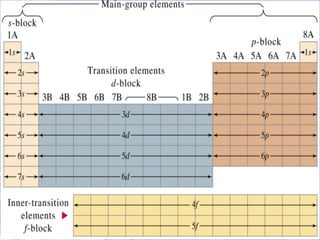
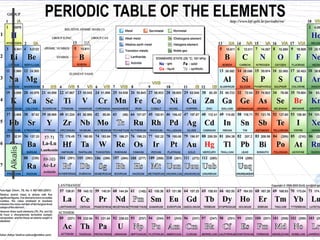
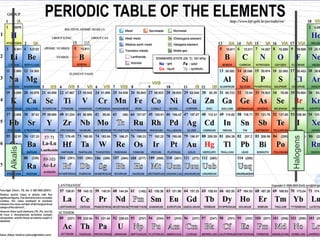
•  4 blocks (S, P, D and F)
•  Position -> determines the energy level of
element
•  8 Groups (1-7,0) (IB CHE DB FE 2009)
•  Vertical
•  Same Group, Same Chemical Properties
•  Periods (1-7)
•  Horizontal
•  Same Period, Same Outer Shell
The Periodic Table of Elements
•  4th to 7th Period
•  Filled with Transitions Metals
•  4th and 5th Period – 10 Trans. Metals
•  6th Period – 9 Trans. Metals
•  7th Period – 6 Trans. Metals (IB CHE DB

FE 2009) F Block
•  6th Period -> Lanthanides
•  7th Period -> Actinides
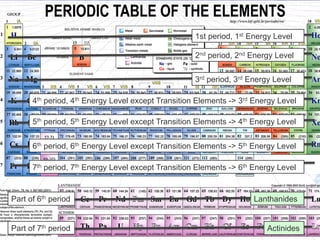
1st period, 1st Energy Level
2nd period, 2nd Energy Level
3rd period, 3rd Energy Level
4th period, 4th Energy Level except Transition Elements -> 3rd Energy Level
5th period, 5th Energy Level except Transition Elements -> 4th Energy Level
6th period, 6th Energy Level except Transition Elements -> 5th Energy Level
7th period, 7th Energy Level except Transition Elements -> 6th Energy Level

Part of 6th period

Lanthanides

Part of 7th period

Actinides
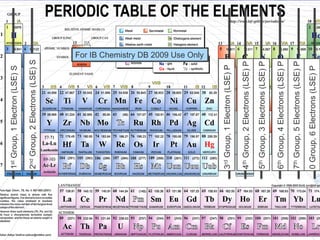
0 Group, 6 Electrons (LSE) P

7th Group, 5 Electrons (LSE) P

6th Group, 4 Electrons (LSE) P

5th Group, 3 Electrons (LSE) P

4th Group, 2 Electrons (LSE) P

3rd Group, 1 Electron (LSE) P

2nd Group, 2 Electrons (LSE) S

1st Group, 1 Electron (LSE) S

For IB Chemistry DB 2009 Use Only
The Periodic Table of Elements
•  Valence Electrons -> outermost electrons
•  Ionisation Energies
•  Increase when group or period ascends
•  Group 1 as the lowest value on each
period
•  Electronegativity
•  Group 0 -> no electronegativity
•  Relative value increase when group or
period ascends
The Periodic Table of Elements
•  Other Properties (Determine Location)
•  Atomic Radii
•  Ionic Radii
•  Negative Ions
•  Melting Point
Electron Configuration
•  Valence Electrons
•  outermost energy level
•  take part in a chemical reaction
•  Determines the physical and chemical
properties of the element
•  Position of the element -> related to its
electron structure
Electron Configuration
•  Period Matters with ECN
•  1st period -> 1st energy level
•  2nd Period -> 2nd energy level
•  3rd Period -> 3rd energy level
•  (except for transition metals -> 21-30 ->
3rd energy level, 39-48 -> 4th energy
level, etc)
Electron Configuration
•  Group Matters with ECN (IB DB 2009 use
only)
•  1st Group -> 1 electron in the valence
shell
•  2nd Group -> 2 electrons in the valence
shell
•  3rd Group -> 3 electrons in the valence
shell
•  So on and so forth
Chemical Properties: Alkali
•  Metals
•  Group 1
•  3Li, 11Na, 19K, 37Rb, 55Cs and 87Fr*
•  Left most part of periodic table
•  Same chemical property
•  1 electron in outermost shell
•  Fr – Alkali or not?
•  Scarcity
•  nuclear instability
Chemical Properties: Alkali
•  Metals
•  Malleable
• Sharpened
• Altered by hammering or pressure
•  Ductile
• Easily molded
• Sharpened into wires
Chemical Properties: Alkali
•  Conductors
•  Heat
•  Electricity
•  Difference from other metals
•  Softer
•  Lower density
•  Lower melting point
Chemical Properties: Alkali
•  Very Reactive
•  Only one electron
• active in losing that extra electron with
ion bonding
•  With halogens
•  When exposed on open air
• Effect: Tarnish rapidly
•  Trivia: Alkali elements mixed with water will
explode.
Alkalis
Chemical Properties: Halogens
• 
• 
• 
• 
• 
• 

Non-Metals
Group 7 (IB DB 2009 use only)
9F, 17Cl, 35Br, 53I and 85At (IB DB 2009 use only)
2nd to the right of periodic table
Same chemical property
Only elements that have all states of
matter as their original state in normal
room temperature.
Chemical Properties: Halogens
•  Always diatomic (2 atoms/molecule)
•  Anions
•  Strongest type of bond -> Ionic bond
•  Strong Bond
•  Very Reactive
•  High electron affinity
• Lack only 1 electron to complete shell
• React to most element they come
across to
Chemical Properties: Halogens
•  Low Dissociation Energy
•  Reacting with other elements
• Halogens separate themselves
• Easier bonding
•  Hydrogen Halides
•  Halogens reacting with hydrogen
•  Very acidic
•  When converted to liquid -> hydrohalic
acid
Halogens

Alkalis
Special Groups: Noble Gases
•  Non-Metals
•  Group 0 (IB DB 2009 use only)
•  2He, 10Ne, 18Ar, 36Kr, 54Xe and 86Rn
2009 use only)
•  Right most part of periodic table
•  Same chemical property
•  Complete electron valence shell
•  Rarely react with other elements
•  Stable

(IB DB
Special Groups: Noble Gases
•  Complete electron valence shell
•  Less Reactive
•  Gaseous state -> room temperature
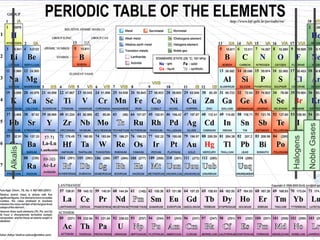
Noble Gases

Halogens

Alkalis
TOK: Risk-taking and science
Statement: The predictive power of Mendeleev’s periodic
table can be seen as an example of a “scientist” as a “risk
taker”.
© IBO 2007
Read the article and maybe, you can post your own insight in
your wordpress! J
Source: Green and Damji
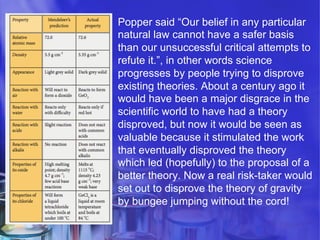
There is no doubt at all that when he proposed his periodic
table Mendeleev put his neck on the line. Not only did he
predict that there were some elements still to be found, he also
made many detailed predictions about their properties, for
example his predictions with regard to Germanium (which
Mendeleev referred to as eka-silicon) are given below, along
with the properties it was found to have after its discovery in
1886, about 15 years after it had been predicted by Mendeleev.
Whether being a risk-taker is a good thing or not is also worth
some thought, and probably evolution, through survival of the
fittest, is the final arbiter. Having a long tail is obviously a risk
for a male peacock when trying to escape from a fox, so do the
extra peahens he attracts compensate for this risk? Will he
survive long enough to mate with them? In scientific terms it
could be argued there is now less risk attached to proposing a
new theory than there once was as a result of Karl Popper, a
20th Century Austrian philosopher.
Popper said “Our belief in any particular
natural law cannot have a safer basis
than our unsuccessful critical attempts to
refute it.”, in other words science
progresses by people trying to disprove
existing theories. About a century ago it
would have been a major disgrace in the
scientific world to have had a theory
disproved, but now it would be seen as
valuable because it stimulated the work
that eventually disproved the theory
which led (hopefully) to the proposal of a
better theory. Now a real risk-taker would
set out to disprove the theory of gravity
by bungee jumping without the cord!
Sources :
Internet Sources:
Malleable | Define Malleable at Dictionary.com . (n.d.).Dictionary.com | Find the Meanings and Definitions of Words at Dictionary.com . Retrieved
August 4, 2011, from http://dictionary.reference.com/browse/malleable
Chem4Kids.com: Elements & Periodic Table: Alkali Metals. (n.d.). Rader's CHEM4KIDS.COM. Retrieved August 4, 2011, from http://
www.chem4kids.com/files/elem_alkalimetal.html
Chemical Elements.com - Alkali Metals. (n.d.). Chemical Elements.com - An Interactive Periodic Table of the Elements. Retrieved August 4, 2011,
from http://www.chemicalelements.com/groups/alkali.html
Chemistry Resources: The Elements: Alkali Metals. (n.d.).Chemistry Resources. Retrieved August 4, 2011, from http://www.chemtopics.com/
elements/alkali/alkali.htm
Dynamic Periodic Table. (n.d.).Dynamic Periodic Table. Retrieved August 4, 2011, from http://www.ptable.com/
Helmenstine, �. M., & Ph.D.. (n.d.). Halogens - Properties of Element Groups. Chemistry - Periodic Table, Chemistry Projects, and Chemistry
Homework Help. Retrieved August 4, 2011, from http://chemistry.about.com/od/elementgroups/a/halogens.htm
Helmenstine, �. M., & Ph.D.. (n.d.). Alkali Metals - Properties of Element Groups.Chemistry - Periodic Table, Chemistry Projects, and Chemistry
Homework Help. Retrieved August 4, 2011, from http://chemistry.about.com/od/elementgroups/a/alkalimetals.htm
Helmenstine, �. M., & Ph.D.. (n.d.). Noble Gases - Properties of Element Groups.Chemistry - Periodic Table, Chemistry Projects, and Chemistry
Homework Help. Retrieved August 4, 2011, from http://chemistry.about.com/od/elementgroups/a/noblegases.htm
Periodic Table. (n.d.). Model Science Software. Retrieved August 4, 2011, from modelscience.com/PeriodicTable.html
Thadani, R. (n.d.). Halogens: Properties of Halogens. Buzzle Web Portal: Intelligent Life on the Web. Retrieved August 4, 2011, from http://
www.buzzle.com/articles/halogens-properties-of-halogens.html
bbawor. (n.d.). ‪‫‏‬Chlorine - Periodic Table of Videos‬ - YouTube . YouTube - Broadcast Yourself. . Retrieved August 4, 2011, from http://
www.youtube.com/watch?v=BXCfBl4rmh0
ductile - definition of ductile by the Free Online Dictionary, Thesaurus and Encyclopedia.. (n.d.). Dictionary, Encyclopedia and Thesaurus - The
Free Dictionary. Retrieved August 4, 2011, from http://www.thefreedictionary.com/ductile
"Periodic Table." Periodic Table. N.p., n.d. Web. 5 Aug. 2011. <2.bp.blogspot.com/-siucfd55FWc/TgVCP6o1DtI/AAAAAAAAAGs/1pwv92teTfI/
s1600/periodic_table.gif>.

Print Sources:
Green, J., & Damji, S. (2008).Chemistry: for use with International Baccalaureate. Victoria, Australia: IBID Press. (Original work published 2007)
Neuss, G. (2010). Chemistry: course companion. Oxford: Oxford University Press.
Lumsden, C. (2002). Chemistry standard level international baccalaureate revision guide . S.l.: Oxford Study Courses.

Periodic table and chemical properties

  • 1.
    Periodicity The Periodic Tableof Elements Chemical Properties
  • 2.
    First of all…. Manyforms of periodic table… Examples: •  International Union of Pure and Applied Chemistry •  Chemistry Data Booklet (FE 2009) We are going to use the Chemistry Data Booklet (FE 2009) for uniformity
  • 3.
    The Periodic Tableof Elements •  4 blocks (S, P, D and F) •  Position -> determines the energy level of element •  8 Groups (1-7,0) (IB CHE DB FE 2009) •  Vertical •  Same Group, Same Chemical Properties •  Periods (1-7) •  Horizontal •  Same Period, Same Outer Shell
  • 4.
    The Periodic Tableof Elements •  4th to 7th Period •  Filled with Transitions Metals •  4th and 5th Period – 10 Trans. Metals •  6th Period – 9 Trans. Metals •  7th Period – 6 Trans. Metals (IB CHE DB FE 2009) F Block •  6th Period -> Lanthanides •  7th Period -> Actinides
  • 6.
    1st period, 1stEnergy Level 2nd period, 2nd Energy Level 3rd period, 3rd Energy Level 4th period, 4th Energy Level except Transition Elements -> 3rd Energy Level 5th period, 5th Energy Level except Transition Elements -> 4th Energy Level 6th period, 6th Energy Level except Transition Elements -> 5th Energy Level 7th period, 7th Energy Level except Transition Elements -> 6th Energy Level Part of 6th period Lanthanides Part of 7th period Actinides
  • 7.
    0 Group, 6Electrons (LSE) P 7th Group, 5 Electrons (LSE) P 6th Group, 4 Electrons (LSE) P 5th Group, 3 Electrons (LSE) P 4th Group, 2 Electrons (LSE) P 3rd Group, 1 Electron (LSE) P 2nd Group, 2 Electrons (LSE) S 1st Group, 1 Electron (LSE) S For IB Chemistry DB 2009 Use Only
  • 8.
    The Periodic Tableof Elements •  Valence Electrons -> outermost electrons •  Ionisation Energies •  Increase when group or period ascends •  Group 1 as the lowest value on each period •  Electronegativity •  Group 0 -> no electronegativity •  Relative value increase when group or period ascends
  • 9.
    The Periodic Tableof Elements •  Other Properties (Determine Location) •  Atomic Radii •  Ionic Radii •  Negative Ions •  Melting Point
  • 10.
    Electron Configuration •  ValenceElectrons •  outermost energy level •  take part in a chemical reaction •  Determines the physical and chemical properties of the element •  Position of the element -> related to its electron structure
  • 11.
    Electron Configuration •  PeriodMatters with ECN •  1st period -> 1st energy level •  2nd Period -> 2nd energy level •  3rd Period -> 3rd energy level •  (except for transition metals -> 21-30 -> 3rd energy level, 39-48 -> 4th energy level, etc)
  • 12.
    Electron Configuration •  GroupMatters with ECN (IB DB 2009 use only) •  1st Group -> 1 electron in the valence shell •  2nd Group -> 2 electrons in the valence shell •  3rd Group -> 3 electrons in the valence shell •  So on and so forth
  • 13.
    Chemical Properties: Alkali • Metals •  Group 1 •  3Li, 11Na, 19K, 37Rb, 55Cs and 87Fr* •  Left most part of periodic table •  Same chemical property •  1 electron in outermost shell •  Fr – Alkali or not? •  Scarcity •  nuclear instability
  • 14.
    Chemical Properties: Alkali • Metals •  Malleable • Sharpened • Altered by hammering or pressure •  Ductile • Easily molded • Sharpened into wires
  • 15.
    Chemical Properties: Alkali • Conductors •  Heat •  Electricity •  Difference from other metals •  Softer •  Lower density •  Lower melting point
  • 16.
    Chemical Properties: Alkali • Very Reactive •  Only one electron • active in losing that extra electron with ion bonding •  With halogens •  When exposed on open air • Effect: Tarnish rapidly •  Trivia: Alkali elements mixed with water will explode.
  • 17.
  • 18.
    Chemical Properties: Halogens •  •  •  •  •  •  Non-Metals Group7 (IB DB 2009 use only) 9F, 17Cl, 35Br, 53I and 85At (IB DB 2009 use only) 2nd to the right of periodic table Same chemical property Only elements that have all states of matter as their original state in normal room temperature.
  • 19.
    Chemical Properties: Halogens • Always diatomic (2 atoms/molecule) •  Anions •  Strongest type of bond -> Ionic bond •  Strong Bond •  Very Reactive •  High electron affinity • Lack only 1 electron to complete shell • React to most element they come across to
  • 20.
    Chemical Properties: Halogens • Low Dissociation Energy •  Reacting with other elements • Halogens separate themselves • Easier bonding •  Hydrogen Halides •  Halogens reacting with hydrogen •  Very acidic •  When converted to liquid -> hydrohalic acid
  • 21.
  • 22.
    Special Groups: NobleGases •  Non-Metals •  Group 0 (IB DB 2009 use only) •  2He, 10Ne, 18Ar, 36Kr, 54Xe and 86Rn 2009 use only) •  Right most part of periodic table •  Same chemical property •  Complete electron valence shell •  Rarely react with other elements •  Stable (IB DB
  • 23.
    Special Groups: NobleGases •  Complete electron valence shell •  Less Reactive •  Gaseous state -> room temperature
  • 24.
  • 25.
    TOK: Risk-taking andscience Statement: The predictive power of Mendeleev’s periodic table can be seen as an example of a “scientist” as a “risk taker”. © IBO 2007 Read the article and maybe, you can post your own insight in your wordpress! J Source: Green and Damji
  • 26.
    There is nodoubt at all that when he proposed his periodic table Mendeleev put his neck on the line. Not only did he predict that there were some elements still to be found, he also made many detailed predictions about their properties, for example his predictions with regard to Germanium (which Mendeleev referred to as eka-silicon) are given below, along with the properties it was found to have after its discovery in 1886, about 15 years after it had been predicted by Mendeleev.
  • 27.
    Whether being arisk-taker is a good thing or not is also worth some thought, and probably evolution, through survival of the fittest, is the final arbiter. Having a long tail is obviously a risk for a male peacock when trying to escape from a fox, so do the extra peahens he attracts compensate for this risk? Will he survive long enough to mate with them? In scientific terms it could be argued there is now less risk attached to proposing a new theory than there once was as a result of Karl Popper, a 20th Century Austrian philosopher.
  • 28.
    Popper said “Ourbelief in any particular natural law cannot have a safer basis than our unsuccessful critical attempts to refute it.”, in other words science progresses by people trying to disprove existing theories. About a century ago it would have been a major disgrace in the scientific world to have had a theory disproved, but now it would be seen as valuable because it stimulated the work that eventually disproved the theory which led (hopefully) to the proposal of a better theory. Now a real risk-taker would set out to disprove the theory of gravity by bungee jumping without the cord!
  • 29.
    Sources : Internet Sources: Malleable| Define Malleable at Dictionary.com . (n.d.).Dictionary.com | Find the Meanings and Definitions of Words at Dictionary.com . Retrieved August 4, 2011, from http://dictionary.reference.com/browse/malleable Chem4Kids.com: Elements & Periodic Table: Alkali Metals. (n.d.). Rader's CHEM4KIDS.COM. Retrieved August 4, 2011, from http:// www.chem4kids.com/files/elem_alkalimetal.html Chemical Elements.com - Alkali Metals. (n.d.). Chemical Elements.com - An Interactive Periodic Table of the Elements. Retrieved August 4, 2011, from http://www.chemicalelements.com/groups/alkali.html Chemistry Resources: The Elements: Alkali Metals. (n.d.).Chemistry Resources. Retrieved August 4, 2011, from http://www.chemtopics.com/ elements/alkali/alkali.htm Dynamic Periodic Table. (n.d.).Dynamic Periodic Table. Retrieved August 4, 2011, from http://www.ptable.com/ Helmenstine, �. M., & Ph.D.. (n.d.). Halogens - Properties of Element Groups. Chemistry - Periodic Table, Chemistry Projects, and Chemistry Homework Help. Retrieved August 4, 2011, from http://chemistry.about.com/od/elementgroups/a/halogens.htm Helmenstine, �. M., & Ph.D.. (n.d.). Alkali Metals - Properties of Element Groups.Chemistry - Periodic Table, Chemistry Projects, and Chemistry Homework Help. Retrieved August 4, 2011, from http://chemistry.about.com/od/elementgroups/a/alkalimetals.htm Helmenstine, �. M., & Ph.D.. (n.d.). Noble Gases - Properties of Element Groups.Chemistry - Periodic Table, Chemistry Projects, and Chemistry Homework Help. Retrieved August 4, 2011, from http://chemistry.about.com/od/elementgroups/a/noblegases.htm Periodic Table. (n.d.). Model Science Software. Retrieved August 4, 2011, from modelscience.com/PeriodicTable.html Thadani, R. (n.d.). Halogens: Properties of Halogens. Buzzle Web Portal: Intelligent Life on the Web. Retrieved August 4, 2011, from http:// www.buzzle.com/articles/halogens-properties-of-halogens.html bbawor. (n.d.). ‪‫‏‬Chlorine - Periodic Table of Videos‬ - YouTube . YouTube - Broadcast Yourself. . Retrieved August 4, 2011, from http:// www.youtube.com/watch?v=BXCfBl4rmh0 ductile - definition of ductile by the Free Online Dictionary, Thesaurus and Encyclopedia.. (n.d.). Dictionary, Encyclopedia and Thesaurus - The Free Dictionary. Retrieved August 4, 2011, from http://www.thefreedictionary.com/ductile "Periodic Table." Periodic Table. N.p., n.d. Web. 5 Aug. 2011. <2.bp.blogspot.com/-siucfd55FWc/TgVCP6o1DtI/AAAAAAAAAGs/1pwv92teTfI/ s1600/periodic_table.gif>. Print Sources: Green, J., & Damji, S. (2008).Chemistry: for use with International Baccalaureate. Victoria, Australia: IBID Press. (Original work published 2007) Neuss, G. (2010). Chemistry: course companion. Oxford: Oxford University Press. Lumsden, C. (2002). Chemistry standard level international baccalaureate revision guide . S.l.: Oxford Study Courses.