SCIENCE, TECHNOLOGY and
SOCIETY
1. Historical antecedents in which social
considerations changed the course of science
and technology (Wk 1-3)
2. Intellectual revolutions that defined society (Wk
4)
3. Science and technology and nation building (Wk
5-6)
STS AND THE HUMAN CONDITION
4. The Human Person flourishing in terms of
science and technology (Wk 7-8)
5. The Good Life (Wk 9)
6. When technology and humanity cross (Wk
10)
7. Why the future does not need us (Wk 11-12)
SPECIFIC ISSUES IN STS
8. The Information Age (Wk 13)
9. Biodiversity and the healthy society (Wk 14-
15)
10. The nano world (Wk 16)
11. Gene therapy, Culminating Activity (Wk 17-
18)
• “If I have seen further
than others, it is by
standing on the
shoulders of giants.”
Sir Isaac Newton
“If I have seen further than others, it is by
standing on the shoulders of giants.”
1. What do you think Newton has seen?
2. Who do you think Newton refers to as “giants”?
3. What do you think this quote tells you about
Newton’s character?
• Science is as old as the world itself.
• Science as an idea
• Science as an intellectual activity
• Science as a body of knowledge
• Science as a personal and social activity
vbc
• SCIENCE
• Latin “scientia” – knowledge
• Human have persistently observed and studied
the natural and physical world in order to find
meanings and seek answers to many questions.
• Listen to:
“Stephen Colbert Interviews Neil deGrasse Tyson at
Montclair Kimberley Academy” 01/29/10
• Is it better to know or not to know?
• Our identity is based on how we see the
world.
• Should scientists be allowed to do anything
that they can?
SOCRATES
Socrates
• Greek philosopher and the main source of
Western thought
• His "Socratic method," laid the groundwork
for Western systems of logic and philosophy.
• Socrates always emphasized the importance
of the mind over the relative unimportance of
the human body.
• he claimed to be ignorant because he had no
ideas, but wise because he recognized his own
ignorance.
• The more I know, the more I do not know.
• An unexamined life is not worth living.
PLATO
Plato
• was a student of Socrates and a teacher of
Aristotle
• founded the Academy in Athens
• Idealist
• His work on the use of reason to develop a
more fair and just society that is focused on
the equality of individuals established the
foundation for modern democracy.
• Plato claimed that knowledge gained through the
senses is no more than opinion and that, in order
to have real knowledge, we must gain it through
philosophical reasoning.
• Know yourself
• Constant struggle for humans is discovering the
reality of the world while balancing what you
know to be true, and what the physical world is
showing you to be true
ARISTOTLE
Aristotle
• Focus on systematic concept of logic
• objective was to come up with a universal
process of reasoning that would allow man to
learn every conceivable thing about reality.
• Realist
• The golden mean: Living a moral life is the
ultimate goal.
Medieval Philosophy
• Christian era
• For most medieval scholars, who believed that
God created the universe according to geometric
and harmonic principles, science –
particularly geometry and astronomy – was
linked directly to the divine.
• To seek these principles, therefore, would be to
seek God.
• Origen of Alexandria
• Origen firmly believed
that the knowledge of
the good (God) is
itself enough to
remove all taint of sin
and ignorance from
souls.
• St. Anselm –
defended the
existence of God thru
reason
• Such a being, he
argued, must really
exist, for the very idea
of such a being
implies its existence.
• St. Augustine
– Such a being, he
argued, must really
exist, for the very
idea of such a being
implies its existence.
– De Trinitate
Assignment:
• Intellectuals and their contributions to the
development of science
- Nicolaus Copernicus
- Charles Darwin
- Sigmund Freud
• Tools discovered during the Ancient, Middle
and Modern Ages
Scientific Revolution
• The period of enlightenment
• The Scientific Revolution was a
series of events that marked
the emergence of modern
science during the early
modern period, when
developments in mathematics,
physics, astronomy, biology
and chemistry transformed the
views of society about nature
Nicolaus Copernicus
• mathematician and astronomer who
formulated a model of the universe that
placed the Sun rather than the Earth at the
center of the universe.
• Polyglot and polymath
• Dē revolutionibus orbium coelestium (On the
Revolutions of the Celestial Spheres)
Charles Darwin
• English naturalist, geologist and biologist,[6]
best known for his contributions to the
science of evolution
• All species of organisms arise and develop
through the natural selection of small,
inherited variations that increase the
individual's ability to compete, survive, and
reproduce.
Darwin's theory consisted of two main points:
1) diverse groups of animals evolve from
one or a few common ancestors;
2) the mechanism by which this evolution
takes place is natural selection.
Sigmund Freud
• Austrian neurologist and the founder of
psychoanalysis.
• Development of an observational method
• Focused on human sexuality and the evil
nature of man.
Filipino Scientists
Filipino Scientists
• Adelina Adato Barrion (September
9, 1951 – July 10, 2010) was a
Filipino entomologist and geneticist
whose extensive contribution to the
study of Philippine spiders earned
her the moniker "Asia's Spider
Woman,” although she also
contributed significantly to the
study of other species, and to the
study of genetics in general.
• Filipino botanist, Eduardo
Quisumbing was a noted
expert in the medicinal plants
of the Philippines. He was
author of more than 129
scientific articles. many on
orchids.
• served as the Director of the
National Museum of the
Philippines, where he rebuilt
the Herbarium.
• The plant "saccolabium
quisumbingii" is named in
honor of Eduardo
Quisumbing.
• Angel C. Alcala is a Filipino biologist who was
named a National Scientist of the Philippines
in 2014. He had created the artificial coral
reefs that help a lot to the Philippines' aquatic
ecosystem.
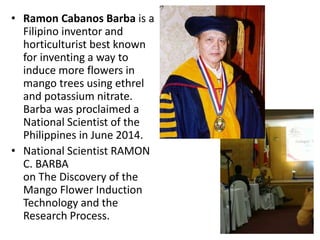
• Ramon Cabanos Barba is a
Filipino inventor and
horticulturist best known
for inventing a way to
induce more flowers in
mango trees using ethrel
and potassium nitrate.
Barba was proclaimed a
National Scientist of the
Philippines in June 2014.
• National Scientist RAMON
C. BARBA
on The Discovery of the
Mango Flower Induction
Technology and the
Research Process.
• Dr. Lilian F. Patena
develops tissue culture
for garlic.
• Fe Villanueva del Mundo, was a Filipino
pediatrician. The first woman admitted as a
student of the Harvard Medical School, she
founded the first pediatric hospital in the
Philippines.
– credited with studies that lead to the invention of an
improved incubator and a jaundice-relieving device

bsp-sts pt1

  • 1.
  • 2.
    1. Historical antecedentsin which social considerations changed the course of science and technology (Wk 1-3) 2. Intellectual revolutions that defined society (Wk 4) 3. Science and technology and nation building (Wk 5-6) STS AND THE HUMAN CONDITION 4. The Human Person flourishing in terms of science and technology (Wk 7-8) 5. The Good Life (Wk 9)
  • 3.
    6. When technologyand humanity cross (Wk 10) 7. Why the future does not need us (Wk 11-12) SPECIFIC ISSUES IN STS 8. The Information Age (Wk 13) 9. Biodiversity and the healthy society (Wk 14- 15) 10. The nano world (Wk 16) 11. Gene therapy, Culminating Activity (Wk 17- 18)
  • 4.
    • “If Ihave seen further than others, it is by standing on the shoulders of giants.” Sir Isaac Newton
  • 5.
    “If I haveseen further than others, it is by standing on the shoulders of giants.” 1. What do you think Newton has seen? 2. Who do you think Newton refers to as “giants”? 3. What do you think this quote tells you about Newton’s character?
  • 6.
    • Science isas old as the world itself. • Science as an idea • Science as an intellectual activity • Science as a body of knowledge • Science as a personal and social activity
  • 7.
  • 10.
    • SCIENCE • Latin“scientia” – knowledge • Human have persistently observed and studied the natural and physical world in order to find meanings and seek answers to many questions.
  • 11.
    • Listen to: “StephenColbert Interviews Neil deGrasse Tyson at Montclair Kimberley Academy” 01/29/10
  • 12.
    • Is itbetter to know or not to know? • Our identity is based on how we see the world. • Should scientists be allowed to do anything that they can?
  • 15.
  • 16.
    Socrates • Greek philosopherand the main source of Western thought • His "Socratic method," laid the groundwork for Western systems of logic and philosophy. • Socrates always emphasized the importance of the mind over the relative unimportance of the human body. • he claimed to be ignorant because he had no ideas, but wise because he recognized his own ignorance.
  • 17.
    • The moreI know, the more I do not know. • An unexamined life is not worth living.
  • 18.
  • 19.
    Plato • was astudent of Socrates and a teacher of Aristotle • founded the Academy in Athens • Idealist • His work on the use of reason to develop a more fair and just society that is focused on the equality of individuals established the foundation for modern democracy.
  • 21.
    • Plato claimedthat knowledge gained through the senses is no more than opinion and that, in order to have real knowledge, we must gain it through philosophical reasoning. • Know yourself • Constant struggle for humans is discovering the reality of the world while balancing what you know to be true, and what the physical world is showing you to be true
  • 22.
  • 23.
    Aristotle • Focus onsystematic concept of logic • objective was to come up with a universal process of reasoning that would allow man to learn every conceivable thing about reality. • Realist • The golden mean: Living a moral life is the ultimate goal.
  • 24.
    Medieval Philosophy • Christianera • For most medieval scholars, who believed that God created the universe according to geometric and harmonic principles, science – particularly geometry and astronomy – was linked directly to the divine. • To seek these principles, therefore, would be to seek God.
  • 25.
    • Origen ofAlexandria • Origen firmly believed that the knowledge of the good (God) is itself enough to remove all taint of sin and ignorance from souls.
  • 26.
    • St. Anselm– defended the existence of God thru reason • Such a being, he argued, must really exist, for the very idea of such a being implies its existence.
  • 27.
    • St. Augustine –Such a being, he argued, must really exist, for the very idea of such a being implies its existence. – De Trinitate
  • 28.
    Assignment: • Intellectuals andtheir contributions to the development of science - Nicolaus Copernicus - Charles Darwin - Sigmund Freud • Tools discovered during the Ancient, Middle and Modern Ages
  • 29.
    Scientific Revolution • Theperiod of enlightenment • The Scientific Revolution was a series of events that marked the emergence of modern science during the early modern period, when developments in mathematics, physics, astronomy, biology and chemistry transformed the views of society about nature
  • 31.
    Nicolaus Copernicus • mathematicianand astronomer who formulated a model of the universe that placed the Sun rather than the Earth at the center of the universe. • Polyglot and polymath • Dē revolutionibus orbium coelestium (On the Revolutions of the Celestial Spheres)
  • 32.
    Charles Darwin • Englishnaturalist, geologist and biologist,[6] best known for his contributions to the science of evolution • All species of organisms arise and develop through the natural selection of small, inherited variations that increase the individual's ability to compete, survive, and reproduce.
  • 33.
    Darwin's theory consistedof two main points: 1) diverse groups of animals evolve from one or a few common ancestors; 2) the mechanism by which this evolution takes place is natural selection.
  • 34.
    Sigmund Freud • Austrianneurologist and the founder of psychoanalysis. • Development of an observational method • Focused on human sexuality and the evil nature of man.
  • 35.
  • 36.
    Filipino Scientists • AdelinaAdato Barrion (September 9, 1951 – July 10, 2010) was a Filipino entomologist and geneticist whose extensive contribution to the study of Philippine spiders earned her the moniker "Asia's Spider Woman,” although she also contributed significantly to the study of other species, and to the study of genetics in general.
  • 37.
    • Filipino botanist,Eduardo Quisumbing was a noted expert in the medicinal plants of the Philippines. He was author of more than 129 scientific articles. many on orchids. • served as the Director of the National Museum of the Philippines, where he rebuilt the Herbarium. • The plant "saccolabium quisumbingii" is named in honor of Eduardo Quisumbing.
  • 38.
    • Angel C.Alcala is a Filipino biologist who was named a National Scientist of the Philippines in 2014. He had created the artificial coral reefs that help a lot to the Philippines' aquatic ecosystem.
  • 39.
    • Ramon CabanosBarba is a Filipino inventor and horticulturist best known for inventing a way to induce more flowers in mango trees using ethrel and potassium nitrate. Barba was proclaimed a National Scientist of the Philippines in June 2014. • National Scientist RAMON C. BARBA on The Discovery of the Mango Flower Induction Technology and the Research Process.
  • 41.
    • Dr. LilianF. Patena develops tissue culture for garlic.
  • 42.
    • Fe Villanuevadel Mundo, was a Filipino pediatrician. The first woman admitted as a student of the Harvard Medical School, she founded the first pediatric hospital in the Philippines. – credited with studies that lead to the invention of an improved incubator and a jaundice-relieving device