WHAT IS HISTORY
E. Kent Rogers
IN PAIRS, DISCUSS THESE TOPICS:
WHAT IS HISTORY?
OFFER A DEFINITION FOR THE SUBJECT WE CALL
“HISTORY”.
WHAT DO OTHERS SAY?
• a branch of knowledge that records
and explains past events –Merriam-
Webster
• the study of or a record of past
events considered together,
especially events of a particular
period, country, or subject –
Cambridge Dictionaries Online
WHY DO WE STUDY HISTORY?
• To know more about the roots of our current culture.
Why is this important?
• To learn about the mistakes of those who have gone
before us.
Why is this important?
• To learn about human nature in general by looking at
trends that repeat through history.
Why is this important?
• To learn historical facts.
Why is this important?
• To learn about how different factors shape society e.g.
religion, greed, the intersection of different cultures,
technology, etc.
Why is this important?
WHY IS HISTORY IMPORTANT?
In sum, we study history
to learn about who we
are—both our past and
our present.
WHO INVESTIGATES HISTORY
Archaeologists
WHO INVESTIGATES HISTORY?
Anthropologists
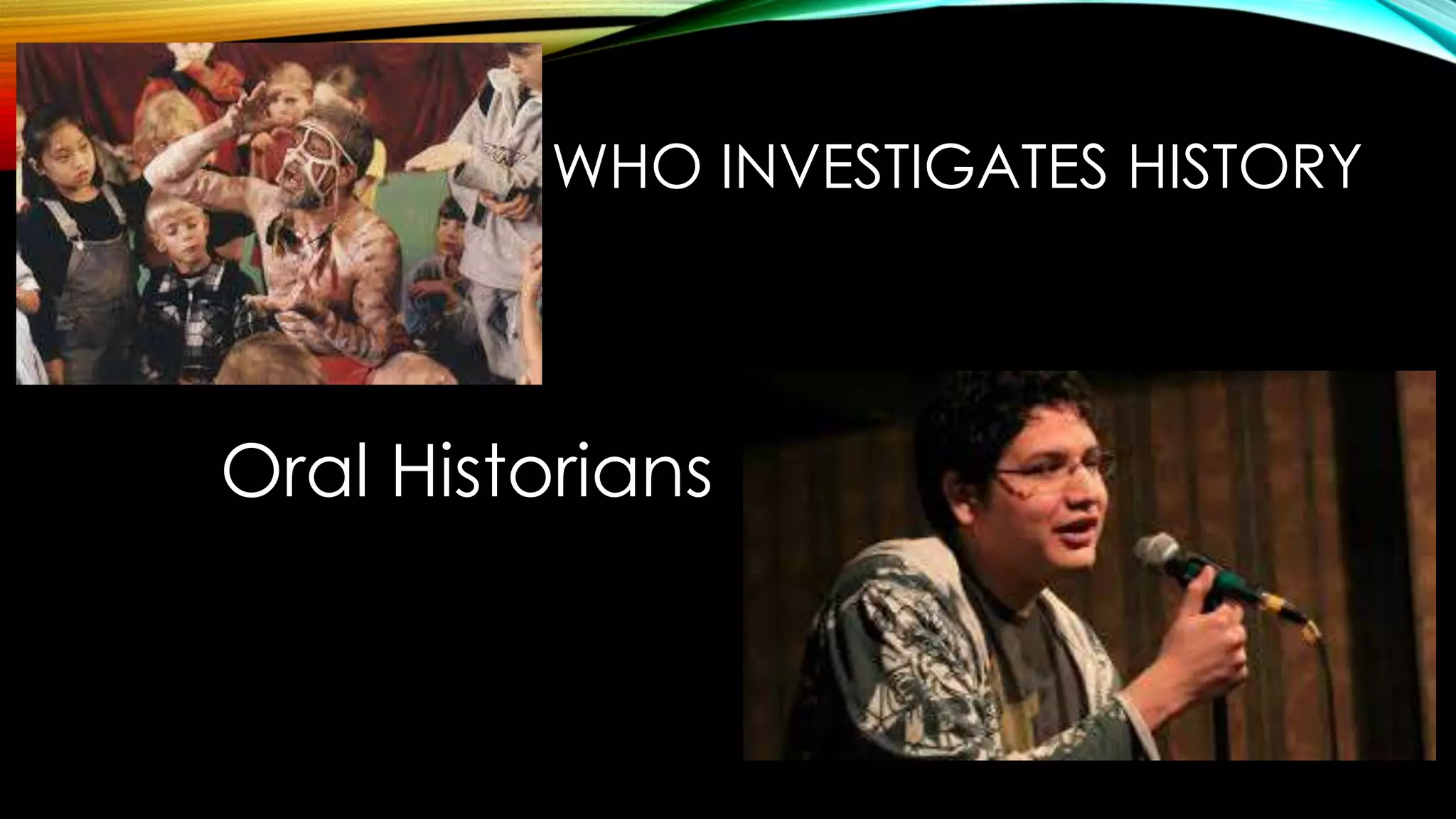
WHO INVESTIGATES HISTORY
Oral Historians
WHO INVESTIGATES HISTORY?
Chemists
WHO INVESTIGATES HISTORY?
Linguists
HISTORY IS A MYSTERY TO BE
SOLVED
• Finding out about history is a lot like
trying to solve a mystery…
• You must look for clues.
• You must interpret those clues
• You must bring all the clues together to
shed light on each other.
• You must reinterpret each clue every time
you find a new clue.
• You must then try fill in the gaps and
come to an educated conclusion.
SOURCES
•Scholars call anything that gives us a clue about
history “Sources.”
•Sources fall into two major categories
•Primary Sources, and, you guessed it,
•Secondary Sources.
•Can you guess what is meant by
primary source?
PRIMARY SOURCES
A primary source is a document or
physical object which was written or
created during the time under study.
These sources were present during an
experience or time period and offer an
inside view of a particular event.
PRIMARY SOURCES
What are some examples of primary
sources?
PRIMARY SOURCES
•First-hand accounts of events
PRIMARY SOURCES
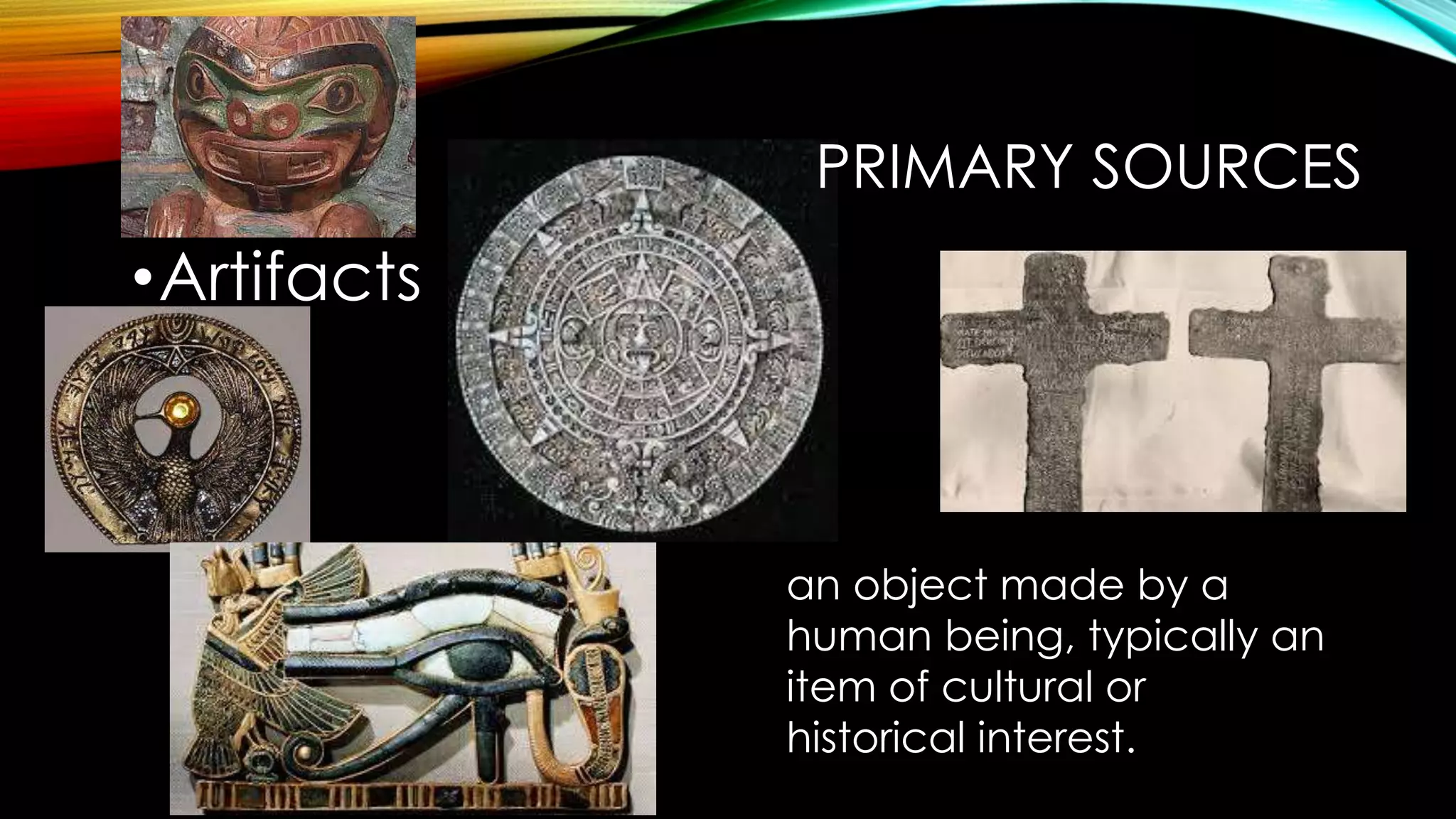
•Artifacts
an object made by a
human being, typically an
item of cultural or
historical interest.
PRIMARY SOURCES
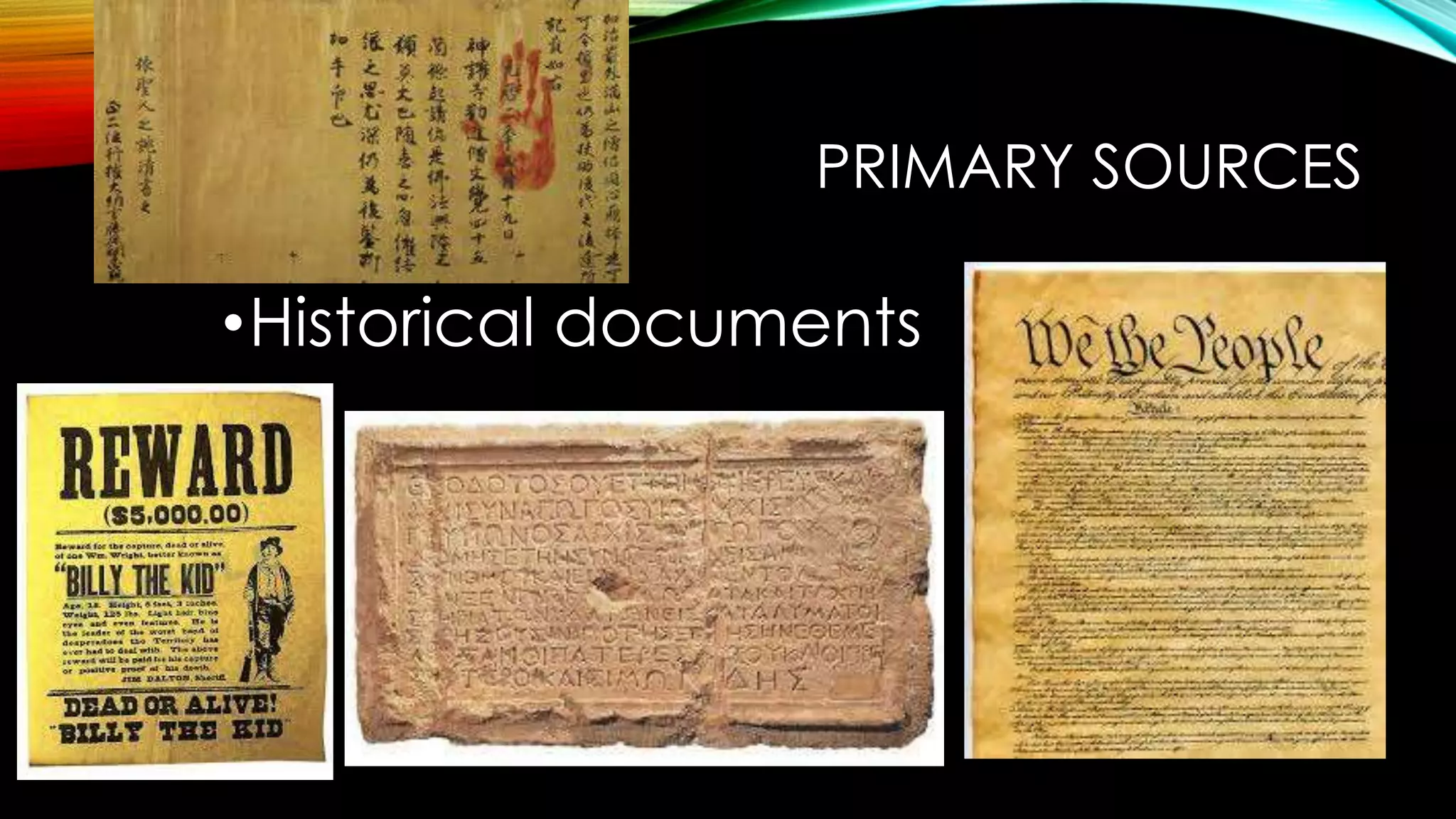
•Historical documents
PRIMARY SOURCES
•Memoirs
PRIMARY SOURCES
•Oral histories
PRIMARY SOURCES
•Newsprint
MORE EXAMPLES OF PRIMARY
SOURCES
•Diaries
•Poetry
•Personal Interviews
•Government Documents
•Autobiographies
•Peer-reviewed journal
articles of new findings
•Photographs
•Video
•Etc.
SECONDARY SOURCES
What do you think is meant by
Secondary Source?
A secondary source interprets and
analyzes primary sources. These
sources are one or more steps
removed from the event.
WHAT ARE INCLUDED AS
SECONDARY SOURCES?
• Textbooks
• Encyclopedias
• Magazine or
news articles
dealing with
issues from the
past
WHICH KIND OF SOURCE DO YOU
THINK WE’LL BE LOOKING AT?
Secondary!

Defining History and Its Importance.