MOVEMENT
EDUCATION
RACQUEL REYES 17435619
Movement Education
Children have the innate need to move as a form of rhythmic expression.
They love to run, jump, skip, dance, clap, pick things up and climb.
Integrating movement in learning provides children the opportunity to explore
their bodies, move in different ways and expand their physical capabilities.
(Currie, 2013).
Movement education is an approach to teaching motor skills.
This includes basic movement skills, games, dance and other activities that
utilizes the process of discovery learning and incorporates movement factors.
Movement education targets the individual in three learning domains:
 Cognitive – mental processes, perception, judgment and reason
 Psychomotor – organisation of movement in mental activity
 Affective – emotions, feelings and attitudes
Movement Framework
Basic or foundational movements is framed into the four concepts of:
1. Body – What do we move?
2. Space – Where do we move?
3. Effort – How do we move?
4. Relationships – What are the connections with whom or what we move with?
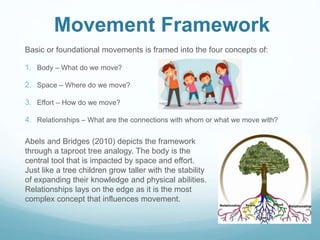
Abels and Bridges (2010) depicts the framework
through a taproot tree analogy. The body is the
central tool that is impacted by space and effort.
Just like a tree children grow taller with the stability
of expanding their knowledge and physical abilities.
Relationships lays on the edge as it is the most
complex concept that influences movement.
Fundamental Movement Skills (FMS)
Fundamental movement skills is a branch of movement education that
includes locomotor, manipulative or object control and stability skills.
FMS are considered as building block that lead to specialized movement
sequences for participation in organized and non-organized physical
activities.
Movement skill development is experienced in three stages:
1. Initial – first goal oriented attempt to perform a movement task
2. Formative – transitional period characterised by better control and
rhythmic coordination in movement performance
3. Mature – the skill is generalised with well-organised, controlled and can
be applied to a variety of situations
Proficiency in FMS is achievable with appropriate practice, encouragement
and feedback. Children who do not receive adequate practice and quality skill
instruction are at risk of demonstrating developmental delays in gross motor
ability (Lubans, Morgan, Cliff, Barnett and Okely, 2010).
Rationale
Movement education introduces and consolidates children’s motor skills. It
sets up children to lead physically active lifestyles that lays a foundation for
life long participation (Peters and Quay, 2013; Board of Studies, 2007).
As a physical educator I possess a social responsibility to develop
children’s knowledge, skills, values and attitudes by providing opportunities
for students to practice and improve their motor skills.
To achieve students building motor competence I must address a
movement skill with clear instructions and a correct demonstration whilst
emphasising on the process instead of the outcome.
Incorporating modified games, exploring tactics within a game situation
moves beyond isolates skill drills to provide an authentic learning
experience that involves problem solving and discovery. (Currie, 2013).
Addressing students as safe, respectful learners establishes a safe
learning environment through social interaction and physically active
learning.
Is your child at risk?
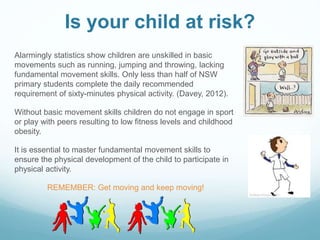
Alarmingly statistics show children are unskilled in basic
movements such as running, jumping and throwing, lacking
fundamental movement skills. Only less than half of NSW
primary students complete the daily recommended
requirement of sixty-minutes physical activity. (Davey, 2012).
Without basic movement skills children do not engage in sport
or play with peers resulting to low fitness levels and childhood
obesity.
It is essential to master fundamental movement skills to
ensure the physical development of the child to participate in
physical activity.
REMEMBER: Get moving and keep moving!
Benefits of Movement Education
 Contributes to the physical, cognitive, social and
emotional development of children.
 Engaging in a socially active learning environment fosters
teamwork and cooperation.
 Positive learning experiences in physical education can
contribute to exploring leisure and recreational activities,
eg bowling, rock climbing, ice-skating.
 Encouraging students to progress promotes self-esteem
and maintains motivation.
 Competency in FMS builds strength, endurance and
flexibility
 Foundation for leading a physically active lifestyle that
reduces the health risks of obesity, diabetes and heart
disease.
References
Abels, K.W., & Bridges, J.M. (2010). Teaching movement education: foundation for active lifestyles. Champaign, IL:
Human Kinetics.
Board of Studies, NSW. (2007). Personal development, health and physical education K-6 syllabus. Sydney: Board of Studies.
Retrieved from http://k6.boardofstudies.nsw.edu.au/wps/portal/go/personal-development-health-and-physical-
education-pdhpe
Currie, J.L. (2013). Teaching physical education in primary school. Australia: ACER Press.
Davey, M. (2012, July 24). Can’t run, can’t thow: Motor skills wide of mark. The Daily Advisor. Retrieved from http://
www.dailyadvertiser.com.au/story/142373/cant-run-cant-throw-motor-skills-wide-of-the-mark/
Lubans, D.R., Morgan, P.J, Cliff, D.P, Barnett, L.M., & Okely, A.D. (2010). Fundamental movement skills in children and
adolescents: Review of associated health benefits. Sports Medicine, 40(12), 1019-1035.
Meldrum, K., & Peters, J. (2012). Moving and learning through physical education. In Learning to teach health and
physical education: The student, the teacher and the curriculum. Frenchs Forest, Australia: Pearson.
Peters, J., & Quay., J. (2013). Health and physical education: Students, teachers and the curriculum ( In P.Hudson (Ed.).,
Learning to teach in the primary school (pp. 170-187). Port Melbourne, Australia: Cambridge.

Movement Education

  • 1.
  • 2.
    Movement Education Children havethe innate need to move as a form of rhythmic expression. They love to run, jump, skip, dance, clap, pick things up and climb. Integrating movement in learning provides children the opportunity to explore their bodies, move in different ways and expand their physical capabilities. (Currie, 2013). Movement education is an approach to teaching motor skills. This includes basic movement skills, games, dance and other activities that utilizes the process of discovery learning and incorporates movement factors. Movement education targets the individual in three learning domains:  Cognitive – mental processes, perception, judgment and reason  Psychomotor – organisation of movement in mental activity  Affective – emotions, feelings and attitudes
  • 3.
    Movement Framework Basic orfoundational movements is framed into the four concepts of: 1. Body – What do we move? 2. Space – Where do we move? 3. Effort – How do we move? 4. Relationships – What are the connections with whom or what we move with? Abels and Bridges (2010) depicts the framework through a taproot tree analogy. The body is the central tool that is impacted by space and effort. Just like a tree children grow taller with the stability of expanding their knowledge and physical abilities. Relationships lays on the edge as it is the most complex concept that influences movement.
  • 4.
    Fundamental Movement Skills(FMS) Fundamental movement skills is a branch of movement education that includes locomotor, manipulative or object control and stability skills. FMS are considered as building block that lead to specialized movement sequences for participation in organized and non-organized physical activities. Movement skill development is experienced in three stages: 1. Initial – first goal oriented attempt to perform a movement task 2. Formative – transitional period characterised by better control and rhythmic coordination in movement performance 3. Mature – the skill is generalised with well-organised, controlled and can be applied to a variety of situations Proficiency in FMS is achievable with appropriate practice, encouragement and feedback. Children who do not receive adequate practice and quality skill instruction are at risk of demonstrating developmental delays in gross motor ability (Lubans, Morgan, Cliff, Barnett and Okely, 2010).
  • 5.
    Rationale Movement education introducesand consolidates children’s motor skills. It sets up children to lead physically active lifestyles that lays a foundation for life long participation (Peters and Quay, 2013; Board of Studies, 2007). As a physical educator I possess a social responsibility to develop children’s knowledge, skills, values and attitudes by providing opportunities for students to practice and improve their motor skills. To achieve students building motor competence I must address a movement skill with clear instructions and a correct demonstration whilst emphasising on the process instead of the outcome. Incorporating modified games, exploring tactics within a game situation moves beyond isolates skill drills to provide an authentic learning experience that involves problem solving and discovery. (Currie, 2013). Addressing students as safe, respectful learners establishes a safe learning environment through social interaction and physically active learning.
  • 6.
    Is your childat risk? Alarmingly statistics show children are unskilled in basic movements such as running, jumping and throwing, lacking fundamental movement skills. Only less than half of NSW primary students complete the daily recommended requirement of sixty-minutes physical activity. (Davey, 2012). Without basic movement skills children do not engage in sport or play with peers resulting to low fitness levels and childhood obesity. It is essential to master fundamental movement skills to ensure the physical development of the child to participate in physical activity. REMEMBER: Get moving and keep moving!
  • 7.
    Benefits of MovementEducation  Contributes to the physical, cognitive, social and emotional development of children.  Engaging in a socially active learning environment fosters teamwork and cooperation.  Positive learning experiences in physical education can contribute to exploring leisure and recreational activities, eg bowling, rock climbing, ice-skating.  Encouraging students to progress promotes self-esteem and maintains motivation.  Competency in FMS builds strength, endurance and flexibility  Foundation for leading a physically active lifestyle that reduces the health risks of obesity, diabetes and heart disease.
  • 8.
    References Abels, K.W., &Bridges, J.M. (2010). Teaching movement education: foundation for active lifestyles. Champaign, IL: Human Kinetics. Board of Studies, NSW. (2007). Personal development, health and physical education K-6 syllabus. Sydney: Board of Studies. Retrieved from http://k6.boardofstudies.nsw.edu.au/wps/portal/go/personal-development-health-and-physical- education-pdhpe Currie, J.L. (2013). Teaching physical education in primary school. Australia: ACER Press. Davey, M. (2012, July 24). Can’t run, can’t thow: Motor skills wide of mark. The Daily Advisor. Retrieved from http:// www.dailyadvertiser.com.au/story/142373/cant-run-cant-throw-motor-skills-wide-of-the-mark/ Lubans, D.R., Morgan, P.J, Cliff, D.P, Barnett, L.M., & Okely, A.D. (2010). Fundamental movement skills in children and adolescents: Review of associated health benefits. Sports Medicine, 40(12), 1019-1035. Meldrum, K., & Peters, J. (2012). Moving and learning through physical education. In Learning to teach health and physical education: The student, the teacher and the curriculum. Frenchs Forest, Australia: Pearson. Peters, J., & Quay., J. (2013). Health and physical education: Students, teachers and the curriculum ( In P.Hudson (Ed.)., Learning to teach in the primary school (pp. 170-187). Port Melbourne, Australia: Cambridge.