History of physical
education

By: Ramadimetja Jerida Malebana
201206747
History physical education


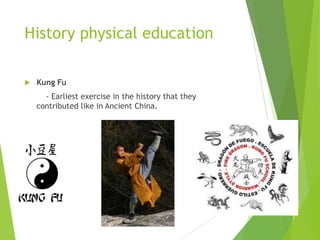
Kung Fu
- Earliest exercise in the history that they
contributed like in Ancient China.
Primitive Man


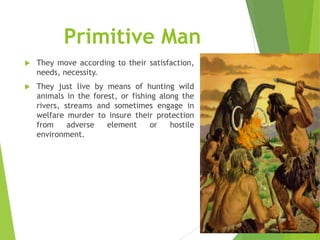
They move according to their satisfaction,
needs, necessity.



They just live by means of hunting wild
animals in the forest, or fishing along the
rivers, streams and sometimes engage in
welfare murder to insure their protection
from
adverse
element
or
hostile
environment.
Ancient Oriental Countries
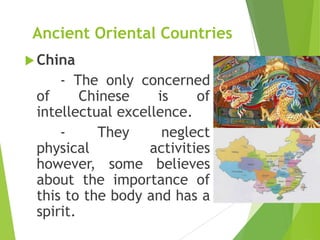
 China

- The only concerned
of
Chinese
is
of
intellectual excellence.
They
neglect
physical
activities
however, some believes
about the importance of
this to the body and has a
spirit.
Medical Gymnastics




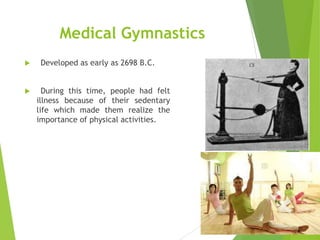
Developed as early as 2698 B.C.
During this time, people had felt
illness because of their sedentary
life which made them realize the
importance of physical activities.
Yoga
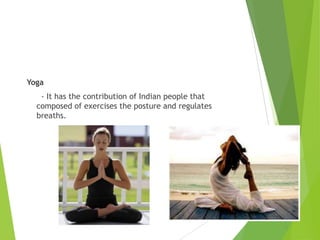
- It has the contribution of Indian people that
composed of exercises the posture and regulates
breaths.
Greek Philosophers


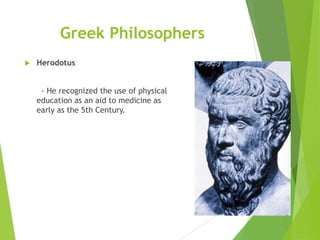
Herodotus
- He recognized the use of physical
education as an aid to medicine as
early as the 5th Century.


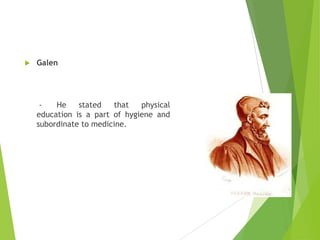
Galen

He
stated
that
physical
education is a part of hygiene and
subordinate to medicine.


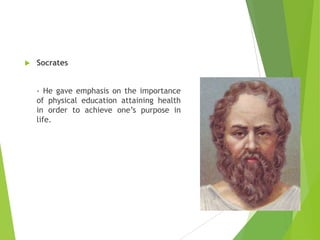
Socrates
- He gave emphasis on the importance
of physical education attaining health
in order to achieve one’s purpose in
life.


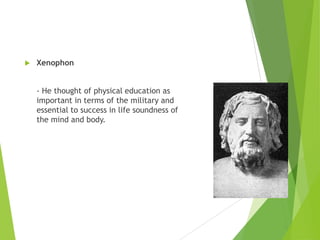
Xenophon
- He thought of physical education as
important in terms of the military and
essential to success in life soundness of
the mind and body.
Word Origins
Do you ever wonder
where some of the
words we use in
physical education
come from?







Exercise – From the
Latin words “ex” &
“arcere,” to restrain.

Gymnasium – From the
Greek word
“gumnasion” or
“gumnazein” meaning
to exercise naked.

 Kinesiology – From the Greek
words “kinesis” movement .
 Physical Education – From the
Latin words “physica,”
physics and “educatio.”

 Physiology – From the Greek
words “phusio,” nature and
ology for branch of learning.
 Flexibility – From the Latin
word “flexus”, to bend.
Physical fitness is not only one of the most
important keys to a healthy
body, it is the basis of dynamic and creative
intellectual activity. The
relationship between the soundness of the
body and the activities of the
mind is subtle and complex. Much is not yet
understood. But we do know what
the Greeks knew: that intelligence and skill
can only function at the peak
of their capacity when the body is healthy and
strong."





- President John Fitzgerald Kennedy
Special
Physical

Classes

Education
Objectives

●

Create empathy in children.

●

Include all children.

●

Learn what each disorder is.

●

Children know how to help their partner with special educational needs.
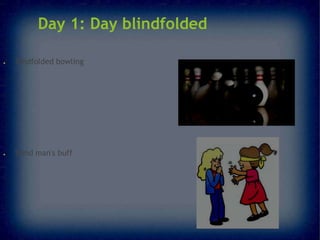
Day 1: Day blindfolded
●

Bindfolded bowling

●

Blind man's buff
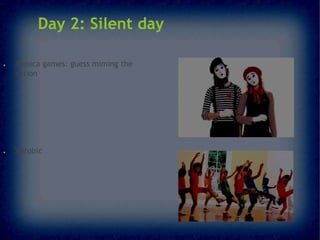
Day 2: Silent day
●

●

Mimica games: guess miming the
action

Aerobic
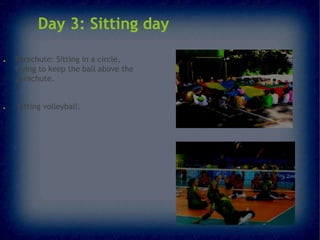
Day 3: Sitting day
●

●

Parachute: Sitting in a circle,
trying to keep the ball above the
parachute.
Sitting volleyball.
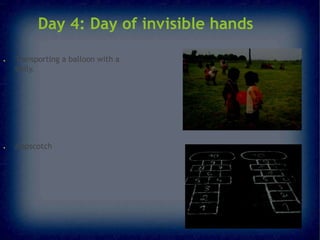
Day 4: Day of invisible hands
●

●

Transporting a balloon with a
belly.

Hopscotch
●

●

Day blindfolded: These games
are dedicated to childrenwith
vision problems or blindness.

Sitting day: These games are
dedicated to children in
wheelchairs or with mobility
problems in the legs.

●

●

Silent day: These games are
dedicated to deaf children.

Day of invisible hands: These
games are dedicated to children
with motor problems in hands.
Vocabulary
●

Hand, leg, mime, deafness,
blindfolded, belly, special
educational needs, etc.

●

Balloon, blind man's buff,
parachute, bowling, hopscotch,
etc.
Evaluation

●

Help partner

●

Accept the rules

●

Empathy

●

Comprehension
Exercise is
fun!
What does it do for me?
Find out!

Click HERE
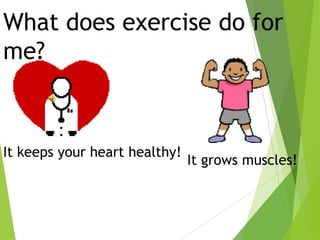
What does exercise do for
me?

It keeps your heart healthy!

It grows muscles!
Click here to see a video of kids doing
fun easy exercises!
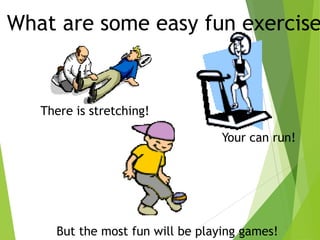
What are some easy fun exercise

There is stretching!

Your can run!

But the most fun will be playing games!
Always follow instructions!
For exercises
And
For games you play
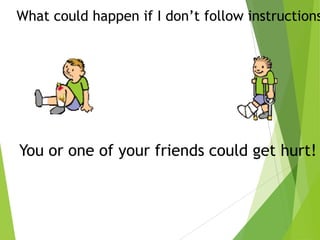
What could happen if I don’t follow instructions

You or one of your friends could get hurt!
Most important thing to remember!!

Make sure
you drink
plenty of
WATER!
Reference



The presentation is a mashup of 3 different sources:

Ainhoa, B.F. (2013). Special Classes: Physical Education.

http://www.slideshare.net/AinhoaBF/fe-29389967?qid=0bb4dad9-2bd6-475093d4-1614198d5a96&v=default&b=&from_search
Accessed: 07 March 2014
Bendiola, I. (2013). History of Physical Education.
http://www.slideshare.net/IvanBendiola/history-of-physical-educationreport?qid=a9cc7c14-6967-46bc-a8f3-874e0aa152b9&v=default&b=&from_search
Accessed: 07 March 2014
Case, D. (2009). Physical Education: lets get healthy.
http://www.slideshare.net/casedaniel88/physical-education-10521948?qid=3860ddd8c513-49e2-8596-d01aacd92078&v=default&b=&from_search
Accessed: 07 March 2014

Physical education

  • 1.
    History of physical education By:Ramadimetja Jerida Malebana 201206747
  • 2.
    History physical education  KungFu - Earliest exercise in the history that they contributed like in Ancient China.
  • 3.
    Primitive Man  They moveaccording to their satisfaction, needs, necessity.  They just live by means of hunting wild animals in the forest, or fishing along the rivers, streams and sometimes engage in welfare murder to insure their protection from adverse element or hostile environment.
  • 4.
    Ancient Oriental Countries China - The only concerned of Chinese is of intellectual excellence. They neglect physical activities however, some believes about the importance of this to the body and has a spirit.
  • 5.
    Medical Gymnastics   Developed asearly as 2698 B.C. During this time, people had felt illness because of their sedentary life which made them realize the importance of physical activities.
  • 6.
    Yoga - It hasthe contribution of Indian people that composed of exercises the posture and regulates breaths.
  • 7.
    Greek Philosophers  Herodotus - Herecognized the use of physical education as an aid to medicine as early as the 5th Century.
  • 8.
     Galen He stated that physical education is apart of hygiene and subordinate to medicine.
  • 9.
     Socrates - He gaveemphasis on the importance of physical education attaining health in order to achieve one’s purpose in life.
  • 10.
     Xenophon - He thoughtof physical education as important in terms of the military and essential to success in life soundness of the mind and body.
  • 11.
    Word Origins Do youever wonder where some of the words we use in physical education come from?    Exercise – From the Latin words “ex” & “arcere,” to restrain. Gymnasium – From the Greek word “gumnasion” or “gumnazein” meaning to exercise naked.  Kinesiology – From the Greek words “kinesis” movement .  Physical Education – From the Latin words “physica,” physics and “educatio.”  Physiology – From the Greek words “phusio,” nature and ology for branch of learning.  Flexibility – From the Latin word “flexus”, to bend.
  • 12.
    Physical fitness isnot only one of the most important keys to a healthy body, it is the basis of dynamic and creative intellectual activity. The relationship between the soundness of the body and the activities of the mind is subtle and complex. Much is not yet understood. But we do know what the Greeks knew: that intelligence and skill can only function at the peak of their capacity when the body is healthy and strong."   - President John Fitzgerald Kennedy
  • 13.
  • 14.
    Objectives ● Create empathy inchildren. ● Include all children. ● Learn what each disorder is. ● Children know how to help their partner with special educational needs.
  • 15.
    Day 1: Dayblindfolded ● Bindfolded bowling ● Blind man's buff
  • 16.
    Day 2: Silentday ● ● Mimica games: guess miming the action Aerobic
  • 17.
    Day 3: Sittingday ● ● Parachute: Sitting in a circle, trying to keep the ball above the parachute. Sitting volleyball.
  • 18.
    Day 4: Dayof invisible hands ● ● Transporting a balloon with a belly. Hopscotch
  • 19.
    ● ● Day blindfolded: Thesegames are dedicated to childrenwith vision problems or blindness. Sitting day: These games are dedicated to children in wheelchairs or with mobility problems in the legs. ● ● Silent day: These games are dedicated to deaf children. Day of invisible hands: These games are dedicated to children with motor problems in hands.
  • 20.
    Vocabulary ● Hand, leg, mime,deafness, blindfolded, belly, special educational needs, etc. ● Balloon, blind man's buff, parachute, bowling, hopscotch, etc.
  • 21.
    Evaluation ● Help partner ● Accept therules ● Empathy ● Comprehension
  • 23.
    Exercise is fun! What doesit do for me? Find out! Click HERE
  • 24.
    What does exercisedo for me? It keeps your heart healthy! It grows muscles!
  • 25.
    Click here tosee a video of kids doing fun easy exercises!
  • 26.
    What are someeasy fun exercise There is stretching! Your can run! But the most fun will be playing games!
  • 27.
    Always follow instructions! Forexercises And For games you play
  • 28.
    What could happenif I don’t follow instructions You or one of your friends could get hurt!
  • 29.
    Most important thingto remember!! Make sure you drink plenty of WATER!
  • 30.
    Reference  The presentation isa mashup of 3 different sources: Ainhoa, B.F. (2013). Special Classes: Physical Education. http://www.slideshare.net/AinhoaBF/fe-29389967?qid=0bb4dad9-2bd6-475093d4-1614198d5a96&v=default&b=&from_search Accessed: 07 March 2014 Bendiola, I. (2013). History of Physical Education. http://www.slideshare.net/IvanBendiola/history-of-physical-educationreport?qid=a9cc7c14-6967-46bc-a8f3-874e0aa152b9&v=default&b=&from_search Accessed: 07 March 2014 Case, D. (2009). Physical Education: lets get healthy. http://www.slideshare.net/casedaniel88/physical-education-10521948?qid=3860ddd8c513-49e2-8596-d01aacd92078&v=default&b=&from_search Accessed: 07 March 2014