Fundamentals of Astronomy Lecture #2:The Science of Astronomy
In this lecture…The Nature of ScienceWhat is science?What is it not?How does the process of science work?What is “pseudoscience”?Astronomy as a ScienceChallenges of observational scienceSurveys and population studiesCoordinate systems and mapping
What is Science?Take a moment to consider and write down your own definitions or ideas of what science is.
What is Science?Science is…The study of the workings of the physical universeA process for acquiring knowledgeA collection of facts built up from observationsA collection of organizing principles and lawsA community based on shared knowledgeAn important part of our culture, studied by philosophers and sociologistsA cultural symbol of credibility and authority			Adapted from “The Process of Science”, released 			by the American Astronomical Society
Scientific FoundationsScience is our way of better understanding the natural world.Answers questions of how the universe worksExpands upon observation, leads to predictionExplains processes in terms of tested physical mechanisms
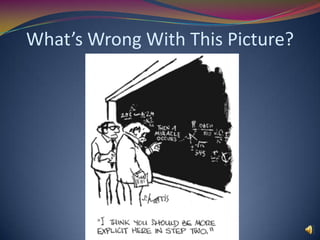
What’s Wrong With This Picture?
Key Components of ScienceThe scientific methodObservation and question-askingSearch for explanationsProve or disprove possible explanations through testing and comparison with known dataScientific goalsExplain, predict aspects of the natural worldMust be testable, falsifiableThe scientific communityMultiple evaluationsCritique and retesting
Science Does Not…Answer “why” questions that deal with purpose and meaning.Directly include any reference to, support for or against anything super-natural.Scientists sometimes make statements based on what science finds, but these statements are not science themselves.This is a limit from principle (such things are not observable) and practice (doesn’t work, not “fruitful” for science)Exist in a vacuumAffected by society, biases and assumptions of scientists.  The scientific method is designed to eliminate the influence of these the best it can.
The Method of ScienceCareful observation of natural phenomenaMake a hypothesis/modelTest that hypothesisPrimarily, we check to see if it is wrong (we try to falsify the hypothesis)If the hypothesis agrees well with experiment and observation, incorporate it into your modelIf not, set it aside and try to come up with something better!
Features of Scientific IdeasObservabilityNatural explanationPredictabilityTestabilityFalsifiabilityRepeatabilityConsistency
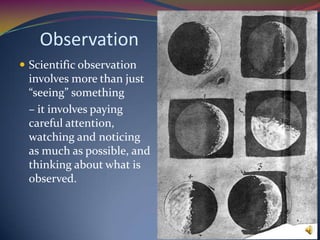
ObservationScientific observation involves more than just “seeing” something	– it involves paying careful attention, watching and noticing as much as possible, and thinking about what is observed.
Testing a HypothesisTesting a hypothesis does not always mean doing an experiment in a lab!  Other possibilities:Prove something mathematicallyMake additional observations that match with expectationsRun a computer simulation and see whether behaves as expected
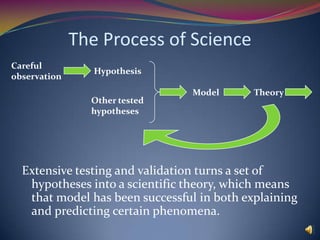
The Process of ScienceCareful observationHypothesisModelTheoryOther tested hypothesesExtensive testing and validation turns a set of hypotheses into a scientific theory, which means that model has been successful in both explaining and predicting certain phenomena.
ModelA scientific model is a collection of tested hypotheses that explain how some aspect of nature appears or operates.  Note: a hypothesis can rarely be tested entirely on its own – usually depends upon other hypotheses that have already been tested.  Suppose a scientist uses a particular model to come up with a new hypothesis – but that hypothesis turns out to be wrong.  Does this mean the model is wrong?
Know Your Limits! Understanding the boundaries and limitations of a model is a crucial aspect of science!
A model does not have to explain everything in order to be valid.
May have a limited, but important, range in which it applies
May contain an important concept that is useful for prediction even though the actual system is more complicated.
The world is a complex place, but to understand it we often have to break it into simpler pieces.TheoryWhen a model’s hypotheses agree well with many observations over time, we “promote” it to the level of theory.This is a special word in science, meaning a well verified model or hypothesis.Lots of evidenceConsistent internally and externallyTested in many ways by many people over timeContaining the fewest possible untested assumptionsIn science, a theory is not simply a guess.
Theory and FactA fact is a simple, direct piece of informationUsually something directly measured or observed.A theory is an organizing frameworkWe use a theory to bring facts together, to explain them and how they relate.In science, the theory is more important, because it:Explains the factsHelps us predict new facts
Theory and Fact"Science is built up of facts, as a house is with stones. But a collection of facts is no more a science than a heap of stones is a house.”Henri Poincaré (1854–1912)
The Process of ScienceOur knowledge changes and grows over time.Not perfect or staticAll science has levels of certainty, based on strength of evidence.Hypotheses and even theories are constantly tested and new ones developed.New ideas modify the old ones, sometimes replacing them, but usually making them more accurate.
The Scientific CommunityCritique, evaluation, and exploration by multiple people is ESSENTIAL to the process of science.  As consequence, new ideas (even if right) take time to be validated and accepted by the community at large. Keep in mind that not everything a scientist says is necessarily true, valid, or even scientific.
PseudoscienceTries to look like science, but does not follow the rulesRecall… these rules are not arbitrary, they come from experience and necessity.May make claims based on science which are beyond the natural world (without saying so) This may come out of very legitimate areas of study and might in the end even be true, but it’s not science.Usually is not reliable when trying to figure out how the natural world works.
Breaking RulesCommon ways the rules are ignored or broken…Not making predictions, or making ones that aren’t testable or falsifiableInvoking super-natural explanations (which aren’t testable or falsifiable)Using appeals to emotion and fear instead of evidenceIgnoring contradictory evidence, not working to falsify their hypotheses, only admitting favorable evidenceFocusing on a few small items (good or bad) and ignoring the larger body of knowledge (oversimplifying)
Criteria for Scientific IdeasCan this idea be used to make predictions about what will happen under particular circumstances or at a specific time in the future?Are the predictions testable? Have the predictions been tested? What evidence would it take to prove the idea wrong? Do conclusions in this area undergo peer review in a mainstream scientific journal?				from The Process of Science, AAS
Questions to ConsiderScientific method involves each of these exceptA) systematic search for informationB) reformulating observations to agree with theoriesC) forming and testing possible explanationsD) observation and experimentation
Questions to ConsiderWhich of these statements is correct?A) A theory is a hypothesis that has been proven to be true.B) A hypothesis which cannot be tested is a good candidate for becoming a theory.C) If a well-tested hypothesis explains the available data and has not yet been falsified, then it can be called a theory.D) Once a hypothesis has been published it becomes a theory.
Questions to ConsiderThe nature of science is such that:A) all scientific models become theoriesB) nature always obeys scientific modelsC) scientific models describe relationships observed in natureD) scientific theories are statements of absolute truth
Questions to ConsiderWhen a scientist develops an explanation for patterns or relationships observed among a number of factsA) a new theory has been developed.B) the pattern and explanation should be included in the next edition of a relevant text book.C) the pattern and explanation should be submitted for publication, then verified by others.
Questions for DiscussionWalter Alvarez proposed in 1980 that the extinction of the dinosaurs was due to a large meteorite hitting the earth.  After extensive experimental work by many people which show this to be a likely explanation, this is A) a hypothesisB) a theoryC) conjectureD)  a scientific law
Questions for DiscussionWhich is most correct?A) Science is always rightB) Nonscientific study has little valueC) Science has all the answersD) Science seeks to understand nature
Questions for DiscussionWhich of these could be a valid scientific statement (regardless of its truth)?A) Nuclear power is good for society.B) Theory and observations indicate that our Sun formed about 5 billion years ago.C) The fact that we can explain much of how the world works proves that there is no God or other supernatural beings.D) The fact that humans are very small in a very big universe means that we are insignificant.
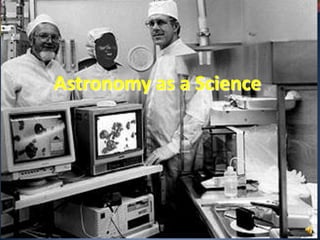
Astronomy as a Science
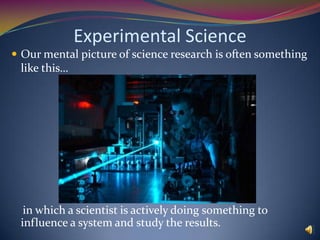
Experimental ScienceOur mental picture of science research is often something like this…    in which a scientist is actively doing something to influence a system and study the results.
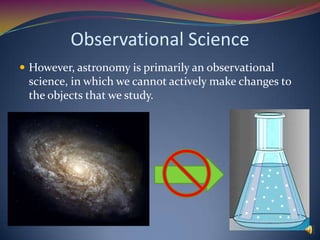
Observational ScienceHowever, astronomy is primarily an observational science, in which we cannot actively make changes to the objects that we study.
Activity: Astro-AutosSuppose you were raised by wild scientists in a remote region of Western Kansas and have never encountered a car or any type of motor vehicle before.  Knowing nothing about a car, what it is, what it is used for, and how it works, you are suddenly given one to study and figure out.  	How might you start trying to learn about the car?
Activity: Astro-AutosNow suppose you were raised by wild scientists who live on the moon, where you have never seen a car or any motor vehicle.   From the moon, using only your powerful telescopes and your trusty camera, you are again told to find out all about cars, what they are, what they are used for, and how they work.  How would you start your study of cars now?
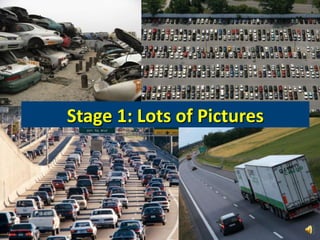
Stage 1: Lots of Pictures
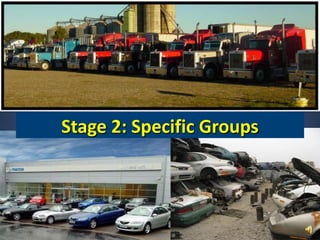
Stage 2: Specific Groups
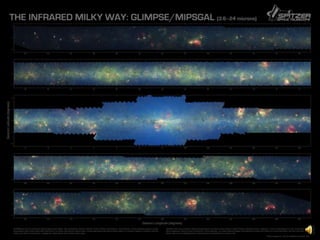
SurveysLarge efforts to collect data about many different stars or other astrophysical objects are called “surveys”.  These may involve many telescopes doing observations, or one telescope working for a really long time.  The goal is to get information on as many objects as possible – you’re looking for the total variation as well as the rare individual objects.
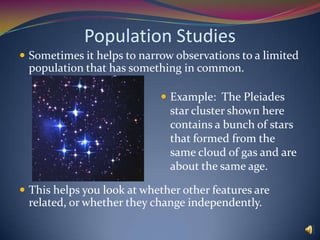
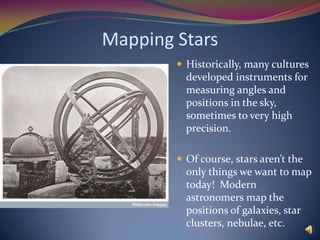
Population StudiesSometimes it helps to narrow observations to a limited population that has something in common.  This helps you look at whether other features are related, or whether they change independently.  Example:  The Pleiades star cluster shown here contains a bunch of stars that formed from the same cloud of gas and are about the same age.   Mapping StarsHistorically, many cultures developed instruments for measuring angles and positions in the sky, sometimes to very high precision.
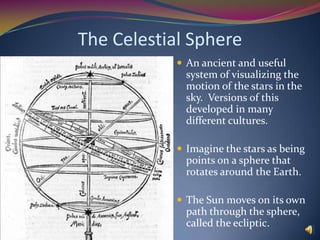
Of course, stars aren’t the only things we want to map today!  Modern astronomers map the positions of galaxies, star clusters, nebulae, etc.The Celestial SphereAn ancient and useful system of visualizing the motion of the stars in the sky.  Versions of this developed in many different cultures.
Imagine the stars as being points on a sphere that rotates around the Earth.
The Sun moves on its own path through the sphere, called the ecliptic.   The Celestial SphereTo think about:How would you see the axis of the sphere in the night sky?  (How would the stars near the axis move?) What if you are at the equator?  What if you are at the North Pole?How does the position of the Sun on the sphere affect what stars you see on a particular night?
Coordinate SystemsStars’ positions in the sky are specified using two major astronomical coordinate systemsThe altitude-azimuth systemAltitude is the object’s angle above the horizon0 degrees is on the horizon, 90 degrees is straight overhead.Azimuth is the object’s angle along the horizon 0 degrees = North, 90 degrees = East, 180 degrees = South, 270 degrees = West.

AstroLecture2

  • 1.
    Fundamentals of AstronomyLecture #2:The Science of Astronomy
  • 2.
    In this lecture…TheNature of ScienceWhat is science?What is it not?How does the process of science work?What is “pseudoscience”?Astronomy as a ScienceChallenges of observational scienceSurveys and population studiesCoordinate systems and mapping
  • 3.
    What is Science?Takea moment to consider and write down your own definitions or ideas of what science is.
  • 4.
    What is Science?Scienceis…The study of the workings of the physical universeA process for acquiring knowledgeA collection of facts built up from observationsA collection of organizing principles and lawsA community based on shared knowledgeAn important part of our culture, studied by philosophers and sociologistsA cultural symbol of credibility and authority Adapted from “The Process of Science”, released by the American Astronomical Society
  • 5.
    Scientific FoundationsScience isour way of better understanding the natural world.Answers questions of how the universe worksExpands upon observation, leads to predictionExplains processes in terms of tested physical mechanisms
  • 6.
    What’s Wrong WithThis Picture?
  • 7.
    Key Components ofScienceThe scientific methodObservation and question-askingSearch for explanationsProve or disprove possible explanations through testing and comparison with known dataScientific goalsExplain, predict aspects of the natural worldMust be testable, falsifiableThe scientific communityMultiple evaluationsCritique and retesting
  • 8.
    Science Does Not…Answer“why” questions that deal with purpose and meaning.Directly include any reference to, support for or against anything super-natural.Scientists sometimes make statements based on what science finds, but these statements are not science themselves.This is a limit from principle (such things are not observable) and practice (doesn’t work, not “fruitful” for science)Exist in a vacuumAffected by society, biases and assumptions of scientists. The scientific method is designed to eliminate the influence of these the best it can.
  • 9.
    The Method ofScienceCareful observation of natural phenomenaMake a hypothesis/modelTest that hypothesisPrimarily, we check to see if it is wrong (we try to falsify the hypothesis)If the hypothesis agrees well with experiment and observation, incorporate it into your modelIf not, set it aside and try to come up with something better!
  • 10.
    Features of ScientificIdeasObservabilityNatural explanationPredictabilityTestabilityFalsifiabilityRepeatabilityConsistency
  • 11.
    ObservationScientific observation involvesmore than just “seeing” something – it involves paying careful attention, watching and noticing as much as possible, and thinking about what is observed.
  • 12.
    Testing a HypothesisTestinga hypothesis does not always mean doing an experiment in a lab! Other possibilities:Prove something mathematicallyMake additional observations that match with expectationsRun a computer simulation and see whether behaves as expected
  • 13.
    The Process ofScienceCareful observationHypothesisModelTheoryOther tested hypothesesExtensive testing and validation turns a set of hypotheses into a scientific theory, which means that model has been successful in both explaining and predicting certain phenomena.
  • 14.
    ModelA scientific modelis a collection of tested hypotheses that explain how some aspect of nature appears or operates. Note: a hypothesis can rarely be tested entirely on its own – usually depends upon other hypotheses that have already been tested. Suppose a scientist uses a particular model to come up with a new hypothesis – but that hypothesis turns out to be wrong. Does this mean the model is wrong?
  • 15.
    Know Your Limits!Understanding the boundaries and limitations of a model is a crucial aspect of science!
  • 16.
    A model doesnot have to explain everything in order to be valid.
  • 17.
    May have alimited, but important, range in which it applies
  • 18.
    May contain animportant concept that is useful for prediction even though the actual system is more complicated.
  • 19.
    The world isa complex place, but to understand it we often have to break it into simpler pieces.TheoryWhen a model’s hypotheses agree well with many observations over time, we “promote” it to the level of theory.This is a special word in science, meaning a well verified model or hypothesis.Lots of evidenceConsistent internally and externallyTested in many ways by many people over timeContaining the fewest possible untested assumptionsIn science, a theory is not simply a guess.
  • 20.
    Theory and FactAfact is a simple, direct piece of informationUsually something directly measured or observed.A theory is an organizing frameworkWe use a theory to bring facts together, to explain them and how they relate.In science, the theory is more important, because it:Explains the factsHelps us predict new facts
  • 21.
    Theory and Fact"Scienceis built up of facts, as a house is with stones. But a collection of facts is no more a science than a heap of stones is a house.”Henri Poincaré (1854–1912)
  • 22.
    The Process ofScienceOur knowledge changes and grows over time.Not perfect or staticAll science has levels of certainty, based on strength of evidence.Hypotheses and even theories are constantly tested and new ones developed.New ideas modify the old ones, sometimes replacing them, but usually making them more accurate.
  • 23.
    The Scientific CommunityCritique,evaluation, and exploration by multiple people is ESSENTIAL to the process of science. As consequence, new ideas (even if right) take time to be validated and accepted by the community at large. Keep in mind that not everything a scientist says is necessarily true, valid, or even scientific.
  • 24.
    PseudoscienceTries to looklike science, but does not follow the rulesRecall… these rules are not arbitrary, they come from experience and necessity.May make claims based on science which are beyond the natural world (without saying so) This may come out of very legitimate areas of study and might in the end even be true, but it’s not science.Usually is not reliable when trying to figure out how the natural world works.
  • 25.
    Breaking RulesCommon waysthe rules are ignored or broken…Not making predictions, or making ones that aren’t testable or falsifiableInvoking super-natural explanations (which aren’t testable or falsifiable)Using appeals to emotion and fear instead of evidenceIgnoring contradictory evidence, not working to falsify their hypotheses, only admitting favorable evidenceFocusing on a few small items (good or bad) and ignoring the larger body of knowledge (oversimplifying)
  • 26.
    Criteria for ScientificIdeasCan this idea be used to make predictions about what will happen under particular circumstances or at a specific time in the future?Are the predictions testable? Have the predictions been tested? What evidence would it take to prove the idea wrong? Do conclusions in this area undergo peer review in a mainstream scientific journal? from The Process of Science, AAS
  • 27.
    Questions to ConsiderScientificmethod involves each of these exceptA) systematic search for informationB) reformulating observations to agree with theoriesC) forming and testing possible explanationsD) observation and experimentation
  • 28.
    Questions to ConsiderWhichof these statements is correct?A) A theory is a hypothesis that has been proven to be true.B) A hypothesis which cannot be tested is a good candidate for becoming a theory.C) If a well-tested hypothesis explains the available data and has not yet been falsified, then it can be called a theory.D) Once a hypothesis has been published it becomes a theory.
  • 29.
    Questions to ConsiderThenature of science is such that:A) all scientific models become theoriesB) nature always obeys scientific modelsC) scientific models describe relationships observed in natureD) scientific theories are statements of absolute truth
  • 30.
    Questions to ConsiderWhena scientist develops an explanation for patterns or relationships observed among a number of factsA) a new theory has been developed.B) the pattern and explanation should be included in the next edition of a relevant text book.C) the pattern and explanation should be submitted for publication, then verified by others.
  • 31.
    Questions for DiscussionWalterAlvarez proposed in 1980 that the extinction of the dinosaurs was due to a large meteorite hitting the earth. After extensive experimental work by many people which show this to be a likely explanation, this is A) a hypothesisB) a theoryC) conjectureD) a scientific law
  • 32.
    Questions for DiscussionWhichis most correct?A) Science is always rightB) Nonscientific study has little valueC) Science has all the answersD) Science seeks to understand nature
  • 33.
    Questions for DiscussionWhichof these could be a valid scientific statement (regardless of its truth)?A) Nuclear power is good for society.B) Theory and observations indicate that our Sun formed about 5 billion years ago.C) The fact that we can explain much of how the world works proves that there is no God or other supernatural beings.D) The fact that humans are very small in a very big universe means that we are insignificant.
  • 34.
  • 35.
    Experimental ScienceOur mentalpicture of science research is often something like this… in which a scientist is actively doing something to influence a system and study the results.
  • 36.
    Observational ScienceHowever, astronomyis primarily an observational science, in which we cannot actively make changes to the objects that we study.
  • 37.
    Activity: Astro-AutosSuppose youwere raised by wild scientists in a remote region of Western Kansas and have never encountered a car or any type of motor vehicle before. Knowing nothing about a car, what it is, what it is used for, and how it works, you are suddenly given one to study and figure out. How might you start trying to learn about the car?
  • 38.
    Activity: Astro-AutosNow supposeyou were raised by wild scientists who live on the moon, where you have never seen a car or any motor vehicle. From the moon, using only your powerful telescopes and your trusty camera, you are again told to find out all about cars, what they are, what they are used for, and how they work. How would you start your study of cars now?
  • 39.
    Stage 1: Lotsof Pictures
  • 40.
  • 41.
    SurveysLarge efforts tocollect data about many different stars or other astrophysical objects are called “surveys”. These may involve many telescopes doing observations, or one telescope working for a really long time. The goal is to get information on as many objects as possible – you’re looking for the total variation as well as the rare individual objects.
  • 43.
    Population StudiesSometimes ithelps to narrow observations to a limited population that has something in common. This helps you look at whether other features are related, or whether they change independently. Example: The Pleiades star cluster shown here contains a bunch of stars that formed from the same cloud of gas and are about the same age. Mapping StarsHistorically, many cultures developed instruments for measuring angles and positions in the sky, sometimes to very high precision.
  • 44.
    Of course, starsaren’t the only things we want to map today! Modern astronomers map the positions of galaxies, star clusters, nebulae, etc.The Celestial SphereAn ancient and useful system of visualizing the motion of the stars in the sky. Versions of this developed in many different cultures.
  • 45.
    Imagine the starsas being points on a sphere that rotates around the Earth.
  • 46.
    The Sun moveson its own path through the sphere, called the ecliptic. The Celestial SphereTo think about:How would you see the axis of the sphere in the night sky? (How would the stars near the axis move?) What if you are at the equator? What if you are at the North Pole?How does the position of the Sun on the sphere affect what stars you see on a particular night?
  • 47.
    Coordinate SystemsStars’ positionsin the sky are specified using two major astronomical coordinate systemsThe altitude-azimuth systemAltitude is the object’s angle above the horizon0 degrees is on the horizon, 90 degrees is straight overhead.Azimuth is the object’s angle along the horizon 0 degrees = North, 90 degrees = East, 180 degrees = South, 270 degrees = West.

Editor's Notes