What Is & Isn’t Science?


           Ref: Dr. Bruce Railsback
    Department of Geology, University of Georgia   jschmied©2012
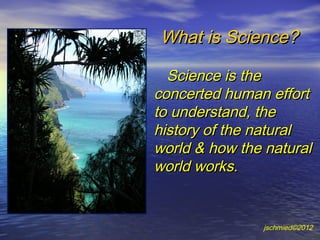
What is Science?

  Science is the
concerted human effort
to understand, the
history of the natural
world & how the natural
world works.


               jschmied©2012
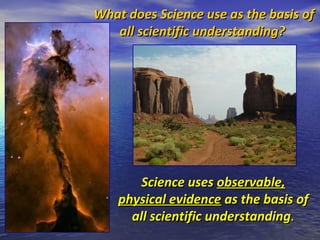
What does Science use as the basis of
   all scientific understanding?


        Science uses observable,
    physical evidence as the basis of
      all scientific understanding.
How is Science
                                                        http://www.physorg.com/news84027776.html


Done?
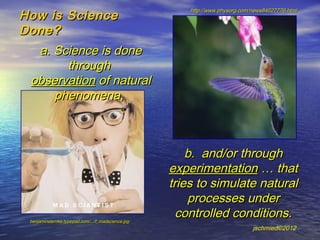
  a. Science is done
       through
 observation of natural
     phenomena,


                                                        b. and/or through
                                                    experimentation … that
                                                    tries to simulate natural
                                                        processes under
 benjaminsternke.typepad.com/.../f_madscience.jpg
                                                      controlled conditions.
                                                                               jschmied©2012
2 Types of Science:
                             Type 1:
                             Observational
                                Science
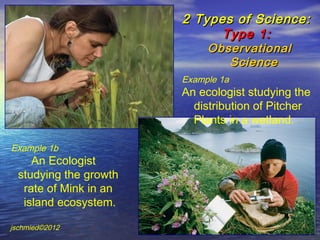
                        Example 1a
                        An ecologist studying the
                          distribution of Pitcher
                          Plants in a wetland.

Example 1b
     An Ecologist
  studying the growth
   rate of Mink in an
   island ecosystem.

jschmied©2012
Observational
                               Science


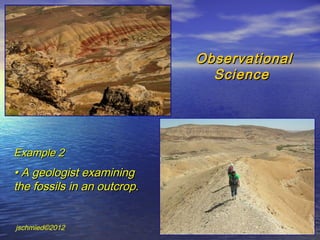
Example 2
• A geologist examining
the fossils in an outcrop.


jschmied©2012
Observational Science
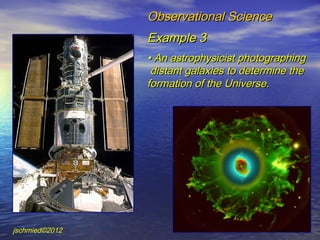
                Example 3
                • An astrophysicist photographing
                 distant galaxies to determine the
                formation of the Universe.


jschmied©2012
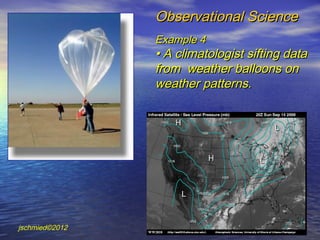
Observational Science
                Example 4
                • A climatologist sifting data
                from weather balloons on
                weather patterns.


jschmied©2012
http://www.cdc.gov/niosh/mining/images%5CChemistryLabSRL.jpg


                                                                              2 Types of Science
                                                                                                Type 2:
                                                                                         Experimental
                                                                                           Science


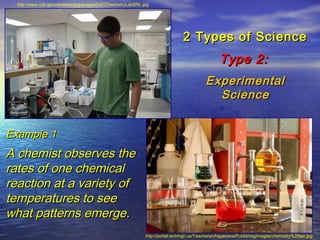
Example 1
A chemist observes the
rates of one chemical
reaction at a variety of
temperatures to see
what patterns emerge.
                                                            http://portal.techhigh.us/Teachers/chapariana/PublishingImages/chemistry%20lab.jpg
http://www.nytimes.com/2007/05/15/science/15cern.html?fta=y


                                                                                                      Type 2:
                                                                                              Experimental
                                                                                                Science


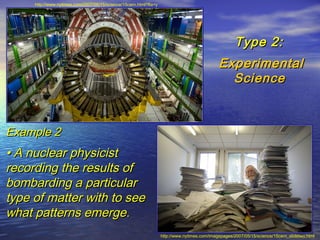
Example 2
• A nuclear physicist
recording the results of
bombarding a particular
type of matter with to see
what patterns emerge.
                                                                   http://www.nytimes.com/imagepages/2007/05/15/science/15cern_slidetwo.html
http://www.contractlaboratory.com/www/images/people/scientist_crystal.gif


                                                                                         Type 2:

                                                                              Experimental
                                                                                Science


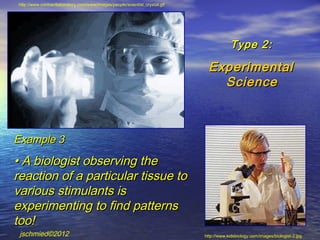
Example 3
• A biologist observing the
reaction of a particular tissue to
various stimulants is
experimenting to find patterns
too!
 jschmied©2012                                                              http://www.kidsbiology.com/images/biologist-2.jpg
http://www.gbrmpa.gov.au/__data/assets/image/0008/17648/biologist.jpg


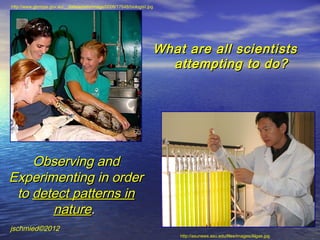
                                                                        What are all scientists
                                                                          attempting to do?


    Observing and
Experimenting in order
 to detect patterns in
       nature.
jschmied©2012
                                                                            http://asunews.asu.edu/files/images/Algae.jpg
www.puzzlehouse.com/astronomer.htm

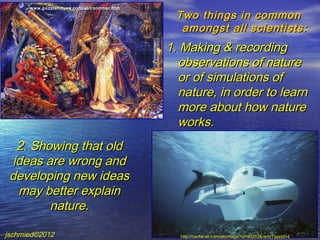
                                            Two things in common
                                             amongst all scientists:
                                           1. Making & recording
                                             observations of nature
                                             or of simulations of
                                             nature, in order to learn
                                             more about how nature
                                             works.
   2. Showing that old
  ideas are wrong and
 developing new ideas
   may better explain
         nature.

jschmied©2012                                http://cache.eb.com/eb/image?id=93353&rendTypeId=4
What Isn’t Science?

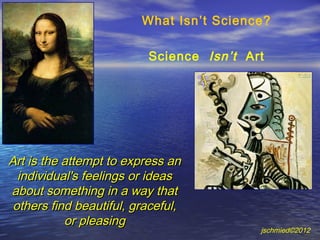
                          Science Isn’t Art


Art is the attempt to express an
  individual's feelings or ideas
about something in a way that
 others find beautiful, graceful,
           or pleasing
                                          jschmied©2012
http://www.punaridge.org/doc/teacher/method/Default.htm


                                                            What Isn’t Science?

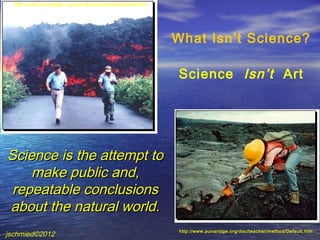
                                                            Science Isn’t Art


Science is the attempt to
    make public and,
 repeatable conclusions
about the natural world.
                                                             http://www.punaridge.org/doc/teacher/method/Default.htm
jschmied©2012
What Isn’t Science?
                               Science Isn’t
                                Technology
madassgamers.com


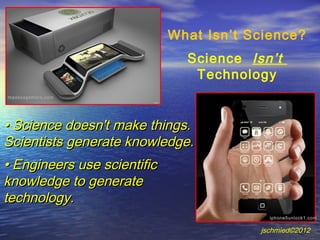
• Science doesn't make things.
Scientists generate knowledge.
• Engineers use scientific
knowledge to generate
technology.
                                           iphone5unlock1.com

                                         jschmied©2012
What Isn ’t Science?

                                                                         Science is often
                                                                       confused with Truth
                                                                        and Certainty. It ’s
                                                                           just not so…

                                                                      Science Isn ’t Truth


                                        • Most scientists seek Truth; they
                                        don't know or generate Truth .

Ref: Dr. Bruce Railsback, Department of Geology, University of Georgia                      jschmied©2012
Sheldon F. Gottlieb, Ph.D. Department of Biological Sciences, University of South Alabama
What Isn ’t Science?

                                                                            Science Isn ’t
                                                                              Certainty


                                    • Scientists use evidence to
                         propose and test theories, knowing
                          that future evidence may change,
                            revise, or even reject today's
                                       theories.
Ref: Dr. Bruce Railsback, Department of Geology, University of Georgia                      jschmied©2012
Sheldon F. Gottlieb, Ph.D. Department of Biological Sciences, University of South Alabama
http://academics.hamilton.edu/asian_studies/home/TempleCulture.html


                                                                        What Isn’t Science?
                                                                                Science Isn’t
                                                                                   Religion


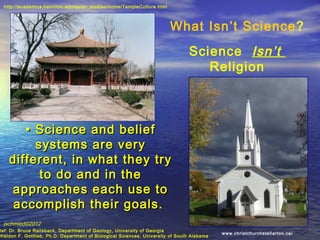
       • Science and belief
         systems are very
    different, in what they try
          to do and in the
    approaches each use to
     accomplish their goals.
  jschmied©2012
Ref: Dr. Bruce Railsback, Department of Geology, University of Georgia
                                                                                            www.christchurchstellarton.ca/
Sheldon F. Gottlieb, Ph.D. Department of Biological Sciences, University of South Alabama
http://commons.wikimedia.org/wiki/Main_Page

                                                                 What Isn’t Science?
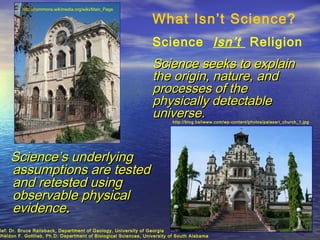
                                                                 Science Isn’t Religion
                                                                 Science seeks to explain
                                                                 the origin, nature, and
                                                                 processes of the
                                                                 physically detectable
                                                                 universe.
                                                                         http://blog.baliwww.com/wp-content/photos/palasari_church_1.jpg


     Science’s underlying
     assumptions are tested
     and retested using
     observable physical
     evidence.
Ref: Dr. Bruce Railsback, Department of Geology, University of Georgia
Sheldon F. Gottlieb, Ph.D. Department of Biological Sciences, University of South Alabama
The Three Basic Questions Science
  Asks….
                      http://evolution.berkeley.edu/evosite/nature/I3basicquestions.shtml

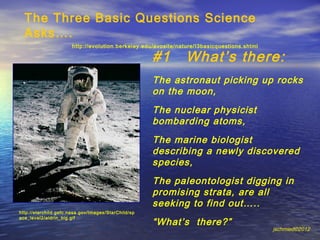
                                                     #1        What’s there:
                                                     The astronaut picking up rocks
                                                     on the moon,
                                                     The nuclear physicist
                                                     bombarding atoms,
                                                     The marine biologist
                                                     describing a newly discovered
                                                     species,
                                                     The paleontologist digging in
                                                     promising strata, are all
                                                     seeking to find out…..
http://starchild.gsfc.nasa.gov/Images/StarChild/sp

                                                     “What’s there?”
ace_level2/aldrin_big.gif

                                                                                            jschmied©2012
The Three Basic Questions Science
Asks….
      http://evolution.berkeley.edu/evosite/nature/I3basicquestions.shtml

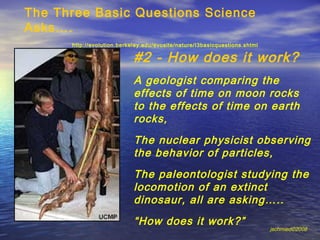
                            #2 - How does it work?
                            A geologist comparing the
                            effects of time on moon rocks
                            to the effects of time on earth
                            rocks,
                            The nuclear physicist observing
                            the behavior of particles,
                            The paleontologist studying the
                            locomotion of an extinct
                            dinosaur, all are asking…..
                            “How does it work?”
                                                                            jschmied©2008
The Three Basic Questions Science
    Asks….
                http://evolution.berkeley.edu/evosite/nature/I3basicquestions.shtml
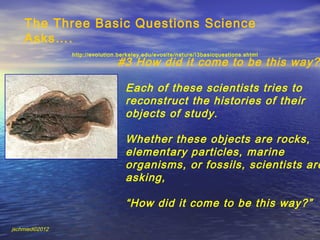
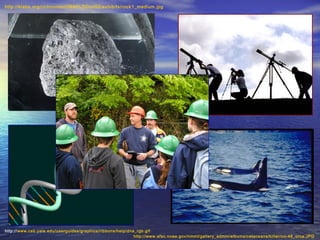
                                #3 How did it come to be this way?

                                   Each of these scientists tries to
                                   reconstruct the histories of their
                                   objects of study.

                                   Whether these objects are rocks,
                                   elementary particles, marine
                                   organisms, or fossils, scientists are
                                   asking,

                                   “How did it come to be this way?”

jschmied©2012
http://klabs.org/richcontent/MAPLDCon02/exhibits/rock1_medium.jpg


http://www.csb.yale.edu/userguides/graphics/ribbons/help/dna_rgb.gif
                                                            http://www.afsc.noaa.gov/nmml/gallery_admin/albums/cetaceans/killer/oo-48_orca.JPG

What is & isn’t science

  • 1.
    What Is &Isn’t Science? Ref: Dr. Bruce Railsback Department of Geology, University of Georgia jschmied©2012
  • 2.
    What is Science? Science is the concerted human effort to understand, the history of the natural world & how the natural world works. jschmied©2012
  • 3.
    What does Scienceuse as the basis of all scientific understanding? Science uses observable, physical evidence as the basis of all scientific understanding.
  • 4.
    How is Science http://www.physorg.com/news84027776.html Done? a. Science is done through observation of natural phenomena, b. and/or through experimentation … that tries to simulate natural processes under benjaminsternke.typepad.com/.../f_madscience.jpg controlled conditions. jschmied©2012
  • 5.
    2 Types ofScience: Type 1: Observational Science Example 1a An ecologist studying the distribution of Pitcher Plants in a wetland. Example 1b An Ecologist studying the growth rate of Mink in an island ecosystem. jschmied©2012
  • 6.
    Observational Science Example 2 • A geologist examining the fossils in an outcrop. jschmied©2012
  • 7.
    Observational Science Example 3 • An astrophysicist photographing distant galaxies to determine the formation of the Universe. jschmied©2012
  • 8.
    Observational Science Example 4 • A climatologist sifting data from weather balloons on weather patterns. jschmied©2012
  • 9.
    http://www.cdc.gov/niosh/mining/images%5CChemistryLabSRL.jpg 2 Types of Science Type 2: Experimental Science Example 1 A chemist observes the rates of one chemical reaction at a variety of temperatures to see what patterns emerge. http://portal.techhigh.us/Teachers/chapariana/PublishingImages/chemistry%20lab.jpg
  • 10.
    http://www.nytimes.com/2007/05/15/science/15cern.html?fta=y Type 2: Experimental Science Example 2 • A nuclear physicist recording the results of bombarding a particular type of matter with to see what patterns emerge. http://www.nytimes.com/imagepages/2007/05/15/science/15cern_slidetwo.html
  • 11.
    http://www.contractlaboratory.com/www/images/people/scientist_crystal.gif Type 2: Experimental Science Example 3 • A biologist observing the reaction of a particular tissue to various stimulants is experimenting to find patterns too! jschmied©2012 http://www.kidsbiology.com/images/biologist-2.jpg
  • 12.
    http://www.gbrmpa.gov.au/__data/assets/image/0008/17648/biologist.jpg What are all scientists attempting to do? Observing and Experimenting in order to detect patterns in nature. jschmied©2012 http://asunews.asu.edu/files/images/Algae.jpg
  • 13.
    www.puzzlehouse.com/astronomer.htm Two things in common amongst all scientists: 1. Making & recording observations of nature or of simulations of nature, in order to learn more about how nature works. 2. Showing that old ideas are wrong and developing new ideas may better explain nature. jschmied©2012 http://cache.eb.com/eb/image?id=93353&rendTypeId=4
  • 14.
    What Isn’t Science? Science Isn’t Art Art is the attempt to express an individual's feelings or ideas about something in a way that others find beautiful, graceful, or pleasing jschmied©2012
  • 15.
    http://www.punaridge.org/doc/teacher/method/Default.htm What Isn’t Science? Science Isn’t Art Science is the attempt to make public and, repeatable conclusions about the natural world. http://www.punaridge.org/doc/teacher/method/Default.htm jschmied©2012
  • 16.
    What Isn’t Science? Science Isn’t Technology madassgamers.com • Science doesn't make things. Scientists generate knowledge. • Engineers use scientific knowledge to generate technology. iphone5unlock1.com jschmied©2012
  • 17.
    What Isn ’tScience? Science is often confused with Truth and Certainty. It ’s just not so… Science Isn ’t Truth • Most scientists seek Truth; they don't know or generate Truth . Ref: Dr. Bruce Railsback, Department of Geology, University of Georgia jschmied©2012 Sheldon F. Gottlieb, Ph.D. Department of Biological Sciences, University of South Alabama
  • 18.
    What Isn ’tScience? Science Isn ’t Certainty • Scientists use evidence to propose and test theories, knowing that future evidence may change, revise, or even reject today's theories. Ref: Dr. Bruce Railsback, Department of Geology, University of Georgia jschmied©2012 Sheldon F. Gottlieb, Ph.D. Department of Biological Sciences, University of South Alabama
  • 19.
    http://academics.hamilton.edu/asian_studies/home/TempleCulture.html What Isn’t Science? Science Isn’t Religion • Science and belief systems are very different, in what they try to do and in the approaches each use to accomplish their goals. jschmied©2012 Ref: Dr. Bruce Railsback, Department of Geology, University of Georgia www.christchurchstellarton.ca/ Sheldon F. Gottlieb, Ph.D. Department of Biological Sciences, University of South Alabama
  • 20.
    http://commons.wikimedia.org/wiki/Main_Page What Isn’t Science? Science Isn’t Religion Science seeks to explain the origin, nature, and processes of the physically detectable universe. http://blog.baliwww.com/wp-content/photos/palasari_church_1.jpg Science’s underlying assumptions are tested and retested using observable physical evidence. Ref: Dr. Bruce Railsback, Department of Geology, University of Georgia Sheldon F. Gottlieb, Ph.D. Department of Biological Sciences, University of South Alabama
  • 21.
    The Three BasicQuestions Science Asks…. http://evolution.berkeley.edu/evosite/nature/I3basicquestions.shtml #1 What’s there: The astronaut picking up rocks on the moon, The nuclear physicist bombarding atoms, The marine biologist describing a newly discovered species, The paleontologist digging in promising strata, are all seeking to find out….. http://starchild.gsfc.nasa.gov/Images/StarChild/sp “What’s there?” ace_level2/aldrin_big.gif jschmied©2012
  • 22.
    The Three BasicQuestions Science Asks…. http://evolution.berkeley.edu/evosite/nature/I3basicquestions.shtml #2 - How does it work? A geologist comparing the effects of time on moon rocks to the effects of time on earth rocks, The nuclear physicist observing the behavior of particles, The paleontologist studying the locomotion of an extinct dinosaur, all are asking….. “How does it work?” jschmied©2008
  • 23.
    The Three BasicQuestions Science Asks…. http://evolution.berkeley.edu/evosite/nature/I3basicquestions.shtml #3 How did it come to be this way? Each of these scientists tries to reconstruct the histories of their objects of study. Whether these objects are rocks, elementary particles, marine organisms, or fossils, scientists are asking, “How did it come to be this way?” jschmied©2012
  • 24.