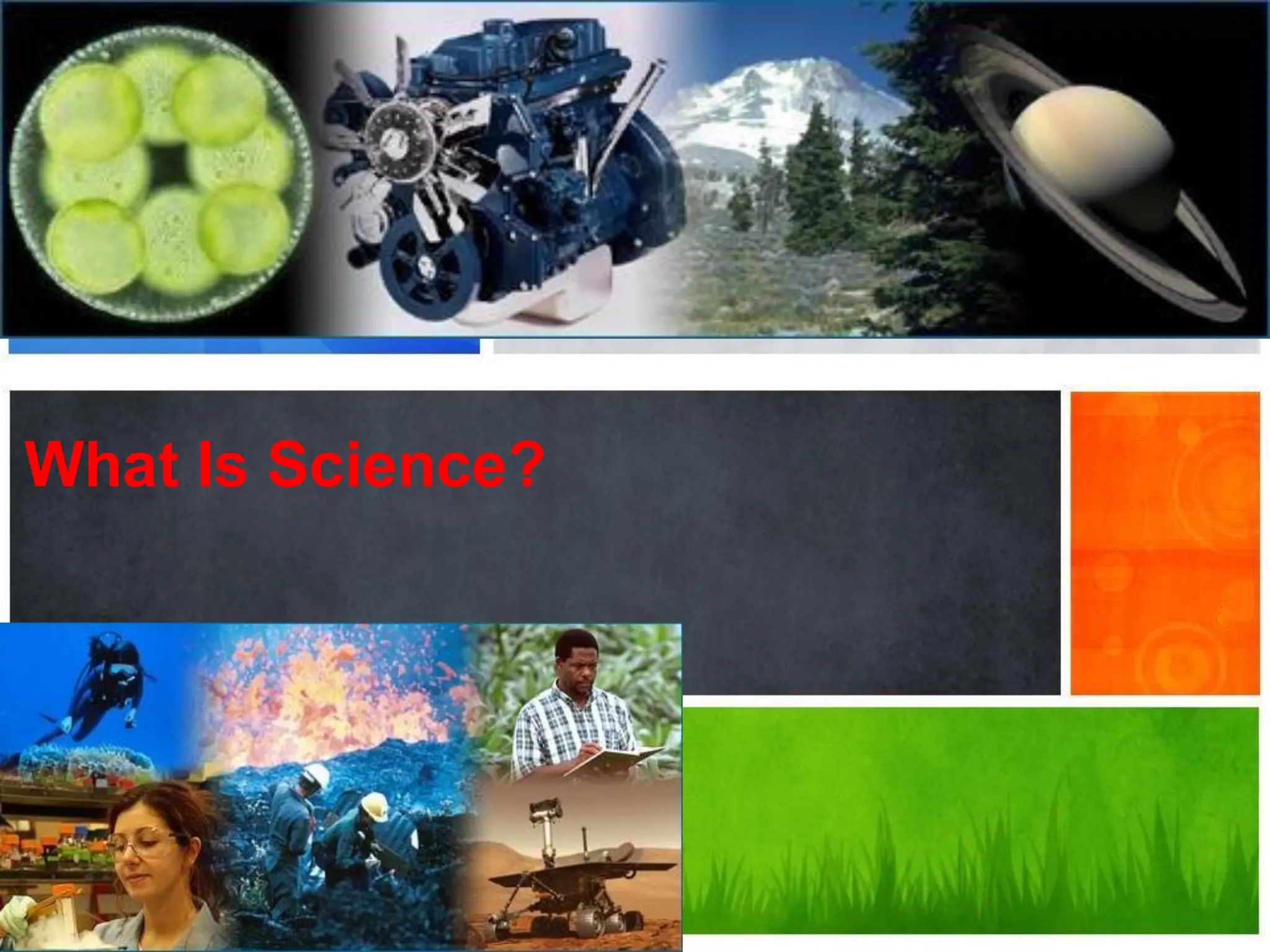
What Is Science?
What is Science?
The word ā€œscienceā€ probably brings to mind
many different pictures:
• A fat textbook
• White lab coats and microscopes
• An astronomer peering through a telescope
• A naturalist in the rainforest
• Einstein’s equations scribbled on a
chalkboard
• The launch of the space shuttle
• Bubbling beakers ….
All of those images reflect some aspect
of science, but none of them provides a
full picture because science has so many
facets:
What is Science?
Science is both a body of knowledge and a process
āž¢ In school, science may sometimes seem like a
collection of isolated and static facts listed in a
textbook
but that’s only a small part of the story.
āž¢ Just as importantly, science is also a process of
discovery that allows us to link isolated facts
into coherent and comprehensive
understandings of the natural world.
Science is exciting
Science is a way of discovering
āž¢ what’s in the universe
āž¢ how those things work today
āž¢ how they worked in the past
āž¢ how they are likely to work in the future.
Scientists are motivated by the thrill of seeing or figuring out
something that no one has before.
Science is useful
āž¢ The knowledge generated by science is
powerful and reliable.
It can be used to
āž¢ develop new technologies,
āž¢ treat diseases
āž¢ deal with many other sorts of problems.
Science is ongoing
āž¢ Science is continually refining and expanding our
knowledge of the universe, and as it does
āž¢ it leads to new questions for future investigation
āž¢ Science will never be ā€œfinished.ā€
Science is a global human endeavor
āž¢ People all over the world participate in the
process of science.
āž¢ And you can too!
Discovery: The spark for science
āž¢ ā€œaha!ā€ moments may not happen frequently, but
they are often experiences that drive science and
scientists.
āž¢ For a scientist, every day holds the possibility of
discovery
āž¢ coming up with a brand new idea or of observing
something that no one has ever seen before. Vast
bodies of knowledge have yet to be built and
many of the most basic questions about the
universe have yet to be answered:
Discovery: The spark for science
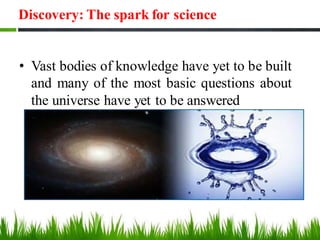
• Vast bodies of knowledge have yet to be built
and many of the most basic questions about
the universe have yet to be answered
Discovery: The spark for science
•What causes gravity?
•How do tectonic plates move around on Earth’s
surface?
•How do our brains store memories?
•How do water molecules interact with each other?
We don’t know the complete answers to these and
an overwhelming number of other questions, but
the prospect of answering them beckons science
forward.
āž¢ Scientific questions can seem complex (e.g., what
chemical reactions allow cells to break the bonds
in sugar molecules), but they don’t have to be.
āž¢ You’ve probably posed many perfectly valid
scientific questions yourself: like
• how can airplanes fly,
• why do cakes rise in the oven,
• why do apples turn brown once they’re cut?
EVERYDAY SCIENCE QUESTIONS
āž¢ You can discover the answers to many of these
ā€œeverydayā€ science questions in your local
library
āž¢ but for others, science may not have the answers
yet
āž¢ answering such questions can lead to astonishing
new discoveries.
EVERYDAY SCIENCE QUESTIONS
For example, we still don’t know much about
āž¢ how your brain remembers to buy milk at
the grocery store.
āž¢ Just as we’re motivated to answer
questions about our everyday experiences,
scientists confront such questions at all
scales, including questions about the very
nature of the universe.
āž¢ The process of scientific discovery is not limited to
professional scientists working in labs.
The everyday experience of deducing that
āž¢ your car won’t start because of a bad fuel pump
āž¢ figuring out that the centipedes in your backyard
prefer shady rocks shares
fundamental similarities with classically scientific
discoveries like
āž¢ working out DNA’s double helix.
āž¢ These activities all involve making observations
and analyzing evidence
āž¢ they all provide the satisfaction of finding an
answer that makes sense of all the facts.
āž¢ In fact, some psychologists argue that the way
individual humans learn (especially as children)
bears a lot of similarity to the progress of science
āž¢ both involve making observations, considering
evidence, testing ideas, and holding on to those
that work.

01-What-is-Science Lecture 1 Background.pdf

  • 1.
  • 2.
    What is Science? Theword ā€œscienceā€ probably brings to mind many different pictures: • A fat textbook • White lab coats and microscopes • An astronomer peering through a telescope • A naturalist in the rainforest
  • 3.
    • Einstein’s equationsscribbled on a chalkboard • The launch of the space shuttle • Bubbling beakers …. All of those images reflect some aspect of science, but none of them provides a full picture because science has so many facets: What is Science?
  • 4.
    Science is botha body of knowledge and a process āž¢ In school, science may sometimes seem like a collection of isolated and static facts listed in a textbook but that’s only a small part of the story. āž¢ Just as importantly, science is also a process of discovery that allows us to link isolated facts into coherent and comprehensive understandings of the natural world.
  • 5.
    Science is exciting Scienceis a way of discovering āž¢ what’s in the universe āž¢ how those things work today āž¢ how they worked in the past āž¢ how they are likely to work in the future. Scientists are motivated by the thrill of seeing or figuring out something that no one has before.
  • 6.
    Science is useful āž¢The knowledge generated by science is powerful and reliable. It can be used to āž¢ develop new technologies, āž¢ treat diseases āž¢ deal with many other sorts of problems.
  • 7.
    Science is ongoing āž¢Science is continually refining and expanding our knowledge of the universe, and as it does āž¢ it leads to new questions for future investigation āž¢ Science will never be ā€œfinished.ā€
  • 8.
    Science is aglobal human endeavor āž¢ People all over the world participate in the process of science. āž¢ And you can too!
  • 9.
    Discovery: The sparkfor science āž¢ ā€œaha!ā€ moments may not happen frequently, but they are often experiences that drive science and scientists. āž¢ For a scientist, every day holds the possibility of discovery āž¢ coming up with a brand new idea or of observing something that no one has ever seen before. Vast bodies of knowledge have yet to be built and many of the most basic questions about the universe have yet to be answered:
  • 10.
    Discovery: The sparkfor science • Vast bodies of knowledge have yet to be built and many of the most basic questions about the universe have yet to be answered
  • 11.
    Discovery: The sparkfor science •What causes gravity? •How do tectonic plates move around on Earth’s surface? •How do our brains store memories? •How do water molecules interact with each other? We don’t know the complete answers to these and an overwhelming number of other questions, but the prospect of answering them beckons science forward.
  • 12.
    āž¢ Scientific questionscan seem complex (e.g., what chemical reactions allow cells to break the bonds in sugar molecules), but they don’t have to be. āž¢ You’ve probably posed many perfectly valid scientific questions yourself: like • how can airplanes fly, • why do cakes rise in the oven, • why do apples turn brown once they’re cut? EVERYDAY SCIENCE QUESTIONS
  • 13.
    EVERYDAY SCIENCE QUESTIONS āž¢You can discover the answers to many of these ā€œeverydayā€ science questions in your local library āž¢ but for others, science may not have the answers yet āž¢ answering such questions can lead to astonishing new discoveries.
  • 14.
    EVERYDAY SCIENCE QUESTIONS Forexample, we still don’t know much about āž¢ how your brain remembers to buy milk at the grocery store. āž¢ Just as we’re motivated to answer questions about our everyday experiences, scientists confront such questions at all scales, including questions about the very nature of the universe.
  • 15.
    āž¢ The processof scientific discovery is not limited to professional scientists working in labs. The everyday experience of deducing that āž¢ your car won’t start because of a bad fuel pump āž¢ figuring out that the centipedes in your backyard prefer shady rocks shares fundamental similarities with classically scientific discoveries like āž¢ working out DNA’s double helix.
  • 16.
    āž¢ These activitiesall involve making observations and analyzing evidence āž¢ they all provide the satisfaction of finding an answer that makes sense of all the facts. āž¢ In fact, some psychologists argue that the way individual humans learn (especially as children) bears a lot of similarity to the progress of science āž¢ both involve making observations, considering evidence, testing ideas, and holding on to those that work.