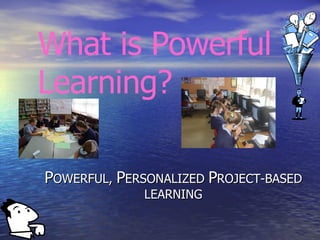
P OWERFUL,  P ERSONALIZED  P ROJECT-BASED LEARNING What is Powerful Learning?
 
Can you Zooley? Note how this makes you feel…..
Facts Mathematical Physical Historical Disciplines Mathematics Physics History Subjects Mathematics Science History Curriculum designers World Scientific knowledge Educational  Knowledge teachers Lesson plans Student’s Mind Old knowledge New knowledge scientists gluing
Why focus on learning? What is Powerful Learning?  What is the Aim of Schooling? What is Project Based Learning? What does PBL look like in schools? At the end of the day….. What do we want our KIDS (students) to be?
Powerful Learning What is powerful learning: From a student perspective From a teacher perspective What Kind of environment do you think is required to promote such powerful learning? Watch Movie complete grid
What do we know about Powerful Learning? Finish the following statement. People learn well when . . .
People learn well when . . . What they learn is Personally meaningful. Challenging and they accept the challenge. Developmentally appropriate.
People learn well when . . . How they learn involves  Controlling their own learning and having choices. Using what they already know as they construct new knowledge. Opportunities for social interaction. Getting feedback. Acquiring and using strategies.
People learn well when . . . Where they learn is A positive emotional climate. A supportive environment. What else?
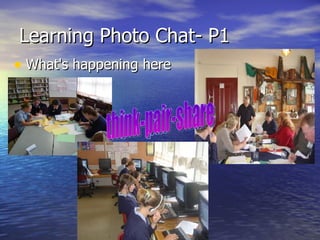
Learning Photo Chat- P1 What's happening here think-pair-share
What is the aim of schooling?
The aim of schooling is not to do well in school, but to do well in life. Elliot Eisner, 2001
What do we know about schools today?  (Eisner, 2001) Virtual absence of intellectual conversation Implies listening and interacting Celebrate achievement over inquiry The real game is in the journey and learning where the resources are. Lack intellectual dispositions This involves an appetite to be engaged We don’t have enough “romance” in our schools! Students learn how to “do school” in order to get through it. We should be about getting kids “into it!” is this true????
What does it mean that a school is doing well? What kinds of activities are the students doing? What kinds of questions are kids asking? What kinds of intellectual things are kids learning? Are students exposed to multiple perspectives? Are students given “bones they can chew on for the rest of their lives?” What connections are students making between what they are learning and the outside world? Are their opportunities for students to work cooperatively with other students? Does the school make it possible for students to engage in community projects? Can students pursue some field in depth? Are their variations in student performance products?
Place Mat / BUMS UP What do we know about Project Based Learning?
What is Project-Based Learning? The Final Word
What is Project-Based Learning? An innovative model for teaching and learning Focuses on central concepts and principles of a discipline Involves students in problem-solving investigations and other meaningful tasks Allows students to work autonomously to construct their own knowledge realistic projects
What is Problem-based learning? An instructional method that encourages learners to apply critical thinking and problem-solving skills, and content knowledge to real-world problems and issues.
PBL fosters growth in many areas Ability to be critical thinkers Skills to analyze and solve complex, real world problems Expertise in finding, evaluating, and using information resources Ability to work cooperatively in groups Skills to communicate orally and in written form Interest in being lifelong learners and role models for other students
The PBL VISION  Project-based learning emerges from a vision of education in which  students take greater responsibility  for their own learning, and graduate from school prepared to use the skills and knowledge they have attained to lead successful lives.
The Power of PBL PBL provides learning that has  deep meaning , processed into long-term memory, because the learner has a chance to  do something they want to do , something  real , something  exciting . Classroom walls expand to the community at large and self-esteem soars as students work harder than ever before on relevant, real-world challenges.
Key Elements of PBL 10/4 task What are the most important elements of Project Based Learning?
What are the benefits? More coaching and modeling Less telling More finding out along with students More cross-disciplinary thinking Less specialization More teamwork Less privacy and isolation
How do students benefit from Project Based Learning?  PBL . .  Evokes active, deep, generative processing that keeps kids interested Allows students to construct their own knowledge thereby improving learning (better transfer, retention) Helps students become better problem solvers. Offers multiple ways for students to participate Accommodates different intelligences
More use of multiple and primary resources  Fewer texts More multi-dimensional assessment Less paper-pencil testing More performance based assessment/less knowledge-based assessment More varied materials and media Expands students capabilities to display and manipulate information Shifts students away from what they normally do giving students a richer, more “authentic” learning experience. Widens students interests and career options Multiplies the ways students can contribute to project work.
Allows for a variety of learning styles  "Real" world oriented - learning has value beyond the demonstrated competence of the learner  Risk-free environment - provides positive feedback and allow choice  Encourages the use of higher order thinking skills and learning concepts as well as basic facts  Utilizes hands-on approaches  Provides for in-depth understanding  Accessible for all learners  Utilizes various modes of communication  Assessment is congruent with instruction, i.e. performance-based  Students are responsible for their own learning  Students have ownership of their learning within the curriculum  Projects promote meaningful learning, connecting new learning to students' past performances  Learning utilizes real time data - investigating data and drawing conclusions  The learning process is valued as well as the learning project  Learning cuts across curricular areas - multidisciplinary in nature  Teacher is a facilitator of learning  Student self-assessment of learning is encouraged  Other benefits
Defining Features of PBL CONTENT Compelling Ideas, Deep Knowledge Questions, Guiding Questions ACTIVITIES Investigative and Engaging, skill specific CONDITIONS Support, Deep Understanding and assessment for, of and as learning RESULTS Real-world products, presentation of ideas and deep understanding
Planning and Assessing for Project Based Learning Lets have a go! In Groups… See EXAMPLES- Discuss and make meaning of them - PMI!!! What’s good - What’s not When should we plan and assess? HOW?
Generating Project Questions with students input Low level – High Level (Bloom’s) Knowledge Comprehension Application Analysis Synthesis Evaluation "if it's worth doing it's worth doing...??"
Essential Questions   (This section is reprinted from a series of articles first published in  Technology Connection  in 1995.)  We are fighting a long school history of topical research. For decades students have been sent to the library to "find out about" some topic. This tradition has led to information gathering but little analysis or thought.
Essential questions set students and staff free from this tedious and wasteful ritual. Research becomes motivating and meaningful. An essential question has the following attributes: Essential questions reside at the top of Bloom's Taxonomy (Bloom, 1954). They require students to EVALUATE (make a thoughtful choice between options, with the choice based upon clearly stated criteria), to SYNTHESIZE (invent a new or different version) or to ANALYZE (develop a thorough and complex understanding through skilful questioning).
Getting Started Begin simply and slowly. Choose elements of PBL that makes sense for your content area. Do what’s comfortable. Set rules and guidelines for behavior. Take risks. Be patient. PBL doesn’t have to be yet another thing to fit into your program. Use it to integrate and pull together other aspects of learning. discuss learning styles with students
Deep Knowledge Question Guiding Questions Guiding Questions Guiding Questions Deep Understanding Performance Research/Inquiry Research/Inquiry Research/Inquiry Deep Understanding Performance Deep Understanding Performance Reflections/Assessment
Deep Knowledge Questions Who needs a rainforest anyway? What should we wear? Is life getting better or worse? Does competition make up better? Who is a friend? How does my environment affect me?
Who needs a rainforest anyway? How can you save a  rainforest? What does the rainforest give the world? What and who is Killing the rainforest? Deep Understanding Performance Research/Inquiry Research/Inquiry Research/Inquiry Deep Understanding Performance Deep Understanding Performance Reflections/Assessment
So What? What now?
Websites http://www.edutopia.org/index.php  excellent Google - project base learning
 
PBL PROJECT ORGANIZER <http://gsh.lightspan.com/weblib/autoes/DOCS/project.html>
Also . . . Brain research is helping us understand that PBL also works by helping students move  beyond surface learning , beyond learning held in short-term memory, learned for the test and then forgotten.
TIME FOR A BRAIN ACTIVITY
Mirror, Mirror Activity Write your name while looking only in a mirror.  Do not look at your pencil directly.  Write it so that you can read it in the mirror. Copy each figure in the boxes beside them.  Try it three times.  No erasing.
Reflecting –  Talk to your neighbor How did you feel while trying to complete the exercise? What do you think your brain was doing? Imagine what it is like for your students to learn a new concept or skill? How does this activity demonstrate a similar process?
How do we learn? What the human brain does best is learn. Learning changes the brain because it can rewire itself with each new stimulation, experience, and behavior. Learning begins with a stimulus. The stimulus is sorted and processed at a variety of levels. Then there is a formation of memory potential Pieces are in place so that the memory can be easily activated.
What percent of your physical brain do you use? On a given day, most areas are used because functions are well-distributed throughout it. Mathematically, however, it is estimated that we use  less than 1 percent of 1 percent  of our brain’s projected processing capacity. (Each of your 100 billion neurons ordinarily connects with 1,000-10,000 other neurons.  Your brain is capable of processing as much as  10 to the 100 trillionth power .  That number exceeds the number of known particles in the universe.
FYI The brain is energy inefficient. It is about 2% of the body’s adult weight. Primary source of energy is blood which supplies nutrients like glucose, protein, trace elements and oxygen. Water provides the electrolytic balance for proper functioning. The brain needs 8 to 12 glasses of water a day for optimal function.  Dehydration is a common problem in school classrooms, leading to lethargy and impaired learning. (Hannaford, 1995)
How Brain-Based Learning Impacts Education http://www.funderstanding.com/brain_based_learning.cfm Curriculum --Teachers must design learning around student interests and make learning contextual.  Instruction --Educators let students learn in teams and use peripheral learning. Teachers structure learning around real problems, encouraging students to also learn in settings outside the classroom and the school building.  Assessment --Since all students are learning, their assessment should allow them to understand their own learning styles and preferences. This way, students monitor and enhance their own learning process.
Think It- Team It- Present It Brainstorm more ideas about the power of the brain…maybe research using WEB…list already know aspects. What else can I find? Who might help us find out more? Present the group findings….5 min presentation to whole group.
Action Learning FIND IT OBSERVE IT IMPROVE IT PROMOTE IT  MANAGE IT
Remodelling the School of the Future Transforming Learning in Year 7 to create a Personalised Learning Culture David Carter-Principal of John Cabot CTC, Bristol www.cabot.ac.uk
The Learning Challenge for the next ten years To Personalise the School based learning experience  To support every child with a learning coach who has co-ownership for a child’s individual learning plan To develop the skill of learning to unlock the content conundrum Take Learning outside of the classroom and beyond the school boundaries To build an e-learning strategy that provides the impetus for new learning To create a vision for learning that recognises that 80% of the jobs current 11 year olds will do in the future have not yet been created
How Will Learning Have Changed by 2008? Personalisation will be in place and all Pupils will have an IEP that they will own with their mentor Class Sizes will be more variable and adapted to the style of delivery that is most appropriate Curriculum Pathways from 10-14 and 14-19 Will provide a core learning programme with a negotiated set of options, some in school, some on-line, some vocational
How Will Learning Have Changed by 2008? Homework will be a thing of the past. Assignments and Extension activities will develop school based learning rather than replicate it. Students doing a 25-30 hour week from home and school Learning Skill Development will be as important as Knowledge Acquisition
The Transformational Starting Point in 2005-6 Learning & Teaching Free teachers to teach National Agreement ICT for  Learning Managing change Focus on teaching and learning Work/life balance Every Child Matters Support staff Non-Teaching Workload Partnerships & collaboration
The Dual Debate-Learning and Culture The Learning Argument -Motivation of pupils & engagement with lifelong learning -Customised Learning Plans for Pupils -E-Learning and the Virtual Curriculum The Cultural Argument -Managing school change and improvement -Engaging the school workforce -The Widely Shared Moral Purpose to sustain distributed effort & commitment
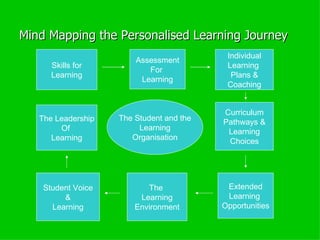
Mind Mapping the Personalised Learning Journey The Student and the Learning Organisation Skills for Learning Individual Learning  Plans & Coaching Curriculum Pathways & Learning Choices The Leadership Of  Learning Extended Learning  Opportunities Student Voice & Learning Assessment For  Learning The  Learning Environment
Personalising Learning at John Cabot CTC Personalising  Learning Curriculum Diversity- KS4 pathways Learning to Learn-Year 7 CCC New  Technologies VLE Mentoring & Welfare  CPD-Teacher Partnerships Student Voice-Cabot  Promise School Organisation- Lead Practitioners Workforce Remodelling- Cover Sups Re-Organise Tutor Groups
The Cabot Competency Curriculum in Year 7 Competencies Learning to Learn Citizenship Relating to people Managing situations Managing information Themes for the Five Terms Theme 1 – Learning to Learn  (An introduction to the competencies) Theme 2 – Community and Environment Theme 3 - Communication Theme 4 – Life styles and Health Theme 5 – Finance and Enterprise
A Week in the Life of CCC The 45 period week Project 1-9 Lessons Project 2-9 Lessons Innovation Day-9 Lessons Literacy-4 Lessons Numeracy-4 Lessons Euro Time-2 Lessons Arts Time-2 Lessons E-Citizenship-2 Lessons PE-4 Lessons
COMMUNITY AND ENVIRONMENT Aims: to give students an appreciation of their city in terms of time and space CELEBRATION CITY INNOVATIVE CITY
CELEBRATION CITY Research festivals Make sparklers! Produce 10 min ‘Newsround’ report in groups Make balloons & have JC balloon fiesta Look at twin towns Look at JC environment South Africa link How and why does the community of Bristol celebrate?
INNOVATIVE CITY Read Treasure Island Draw maps of Bristol & link up Create and ‘bury’Time capsule Visit to Kingsdown/Cabot Tower/Docks Time line for Bristol  future Construct house for the future Compare city with other Bristols How do we fit into our city – and how does Bristol fit into the world?
The CCC Competence Passport Learning to Learn Learning Styles Thinking Methods Creativity Managing Information Finding and Using Information Reflecting and Improving Managing People Team Work Communication Conflict Stress
The CCC Competence Passport Managing Situations Time and Resource Management Flexibility and Risk Taking Initiative Gold and Silver Credits Targets End of Term Assessment (WWW/EBI)
The Learning Vision for a Personalised Experience Year 7 Entry Year-Learning to Learn Year 8-Intermediate Year-1 Full GCSE-Humanities, Expressive Arts or Single Science Year 9 to Year 11 English, Maths, Science, Technology, ICT (DIDA) PE, PSE and Citizenship Fast-track AS Modules In Y11  3 Year GCSE  Programmes Y9 and 10 Y10 and 11 Vocational 2 days off Site 3 days-Core Year 12 and 13 Core Experience +Vocational and  Enrichment AS and A2 IB OU Foundation Degree Modules AS and A2 & IB BTEC/A2 Shape  & Balance Core Learning-70% Negotiated Learning Pathways-30% Arts, Languages, Humanities, Sport, Media & Business, General Specialist Pathways

What Is Powerful Learning Pbl

  • 1.
    P OWERFUL, P ERSONALIZED P ROJECT-BASED LEARNING What is Powerful Learning?
  • 2.
  • 3.
    Can you Zooley?Note how this makes you feel…..
  • 4.
    Facts Mathematical PhysicalHistorical Disciplines Mathematics Physics History Subjects Mathematics Science History Curriculum designers World Scientific knowledge Educational Knowledge teachers Lesson plans Student’s Mind Old knowledge New knowledge scientists gluing
  • 5.
    Why focus onlearning? What is Powerful Learning? What is the Aim of Schooling? What is Project Based Learning? What does PBL look like in schools? At the end of the day….. What do we want our KIDS (students) to be?
  • 6.
    Powerful Learning Whatis powerful learning: From a student perspective From a teacher perspective What Kind of environment do you think is required to promote such powerful learning? Watch Movie complete grid
  • 7.
    What do weknow about Powerful Learning? Finish the following statement. People learn well when . . .
  • 8.
    People learn wellwhen . . . What they learn is Personally meaningful. Challenging and they accept the challenge. Developmentally appropriate.
  • 9.
    People learn wellwhen . . . How they learn involves Controlling their own learning and having choices. Using what they already know as they construct new knowledge. Opportunities for social interaction. Getting feedback. Acquiring and using strategies.
  • 10.
    People learn wellwhen . . . Where they learn is A positive emotional climate. A supportive environment. What else?
  • 11.
    Learning Photo Chat-P1 What's happening here think-pair-share
  • 12.
    What is theaim of schooling?
  • 13.
    The aim ofschooling is not to do well in school, but to do well in life. Elliot Eisner, 2001
  • 14.
    What do weknow about schools today? (Eisner, 2001) Virtual absence of intellectual conversation Implies listening and interacting Celebrate achievement over inquiry The real game is in the journey and learning where the resources are. Lack intellectual dispositions This involves an appetite to be engaged We don’t have enough “romance” in our schools! Students learn how to “do school” in order to get through it. We should be about getting kids “into it!” is this true????
  • 15.
    What does itmean that a school is doing well? What kinds of activities are the students doing? What kinds of questions are kids asking? What kinds of intellectual things are kids learning? Are students exposed to multiple perspectives? Are students given “bones they can chew on for the rest of their lives?” What connections are students making between what they are learning and the outside world? Are their opportunities for students to work cooperatively with other students? Does the school make it possible for students to engage in community projects? Can students pursue some field in depth? Are their variations in student performance products?
  • 16.
    Place Mat /BUMS UP What do we know about Project Based Learning?
  • 17.
    What is Project-BasedLearning? The Final Word
  • 18.
    What is Project-BasedLearning? An innovative model for teaching and learning Focuses on central concepts and principles of a discipline Involves students in problem-solving investigations and other meaningful tasks Allows students to work autonomously to construct their own knowledge realistic projects
  • 19.
    What is Problem-basedlearning? An instructional method that encourages learners to apply critical thinking and problem-solving skills, and content knowledge to real-world problems and issues.
  • 20.
    PBL fosters growthin many areas Ability to be critical thinkers Skills to analyze and solve complex, real world problems Expertise in finding, evaluating, and using information resources Ability to work cooperatively in groups Skills to communicate orally and in written form Interest in being lifelong learners and role models for other students
  • 21.
    The PBL VISION Project-based learning emerges from a vision of education in which students take greater responsibility for their own learning, and graduate from school prepared to use the skills and knowledge they have attained to lead successful lives.
  • 22.
    The Power ofPBL PBL provides learning that has deep meaning , processed into long-term memory, because the learner has a chance to do something they want to do , something real , something exciting . Classroom walls expand to the community at large and self-esteem soars as students work harder than ever before on relevant, real-world challenges.
  • 23.
    Key Elements ofPBL 10/4 task What are the most important elements of Project Based Learning?
  • 24.
    What are thebenefits? More coaching and modeling Less telling More finding out along with students More cross-disciplinary thinking Less specialization More teamwork Less privacy and isolation
  • 25.
    How do studentsbenefit from Project Based Learning? PBL . . Evokes active, deep, generative processing that keeps kids interested Allows students to construct their own knowledge thereby improving learning (better transfer, retention) Helps students become better problem solvers. Offers multiple ways for students to participate Accommodates different intelligences
  • 26.
    More use ofmultiple and primary resources Fewer texts More multi-dimensional assessment Less paper-pencil testing More performance based assessment/less knowledge-based assessment More varied materials and media Expands students capabilities to display and manipulate information Shifts students away from what they normally do giving students a richer, more “authentic” learning experience. Widens students interests and career options Multiplies the ways students can contribute to project work.
  • 27.
    Allows for avariety of learning styles &quot;Real&quot; world oriented - learning has value beyond the demonstrated competence of the learner Risk-free environment - provides positive feedback and allow choice Encourages the use of higher order thinking skills and learning concepts as well as basic facts Utilizes hands-on approaches Provides for in-depth understanding Accessible for all learners Utilizes various modes of communication Assessment is congruent with instruction, i.e. performance-based Students are responsible for their own learning Students have ownership of their learning within the curriculum Projects promote meaningful learning, connecting new learning to students' past performances Learning utilizes real time data - investigating data and drawing conclusions The learning process is valued as well as the learning project Learning cuts across curricular areas - multidisciplinary in nature Teacher is a facilitator of learning Student self-assessment of learning is encouraged Other benefits
  • 28.
    Defining Features ofPBL CONTENT Compelling Ideas, Deep Knowledge Questions, Guiding Questions ACTIVITIES Investigative and Engaging, skill specific CONDITIONS Support, Deep Understanding and assessment for, of and as learning RESULTS Real-world products, presentation of ideas and deep understanding
  • 29.
    Planning and Assessingfor Project Based Learning Lets have a go! In Groups… See EXAMPLES- Discuss and make meaning of them - PMI!!! What’s good - What’s not When should we plan and assess? HOW?
  • 30.
    Generating Project Questionswith students input Low level – High Level (Bloom’s) Knowledge Comprehension Application Analysis Synthesis Evaluation &quot;if it's worth doing it's worth doing...??&quot;
  • 31.
    Essential Questions (This section is reprinted from a series of articles first published in Technology Connection in 1995.) We are fighting a long school history of topical research. For decades students have been sent to the library to &quot;find out about&quot; some topic. This tradition has led to information gathering but little analysis or thought.
  • 32.
    Essential questions setstudents and staff free from this tedious and wasteful ritual. Research becomes motivating and meaningful. An essential question has the following attributes: Essential questions reside at the top of Bloom's Taxonomy (Bloom, 1954). They require students to EVALUATE (make a thoughtful choice between options, with the choice based upon clearly stated criteria), to SYNTHESIZE (invent a new or different version) or to ANALYZE (develop a thorough and complex understanding through skilful questioning).
  • 33.
    Getting Started Beginsimply and slowly. Choose elements of PBL that makes sense for your content area. Do what’s comfortable. Set rules and guidelines for behavior. Take risks. Be patient. PBL doesn’t have to be yet another thing to fit into your program. Use it to integrate and pull together other aspects of learning. discuss learning styles with students
  • 34.
    Deep Knowledge QuestionGuiding Questions Guiding Questions Guiding Questions Deep Understanding Performance Research/Inquiry Research/Inquiry Research/Inquiry Deep Understanding Performance Deep Understanding Performance Reflections/Assessment
  • 35.
    Deep Knowledge QuestionsWho needs a rainforest anyway? What should we wear? Is life getting better or worse? Does competition make up better? Who is a friend? How does my environment affect me?
  • 36.
    Who needs arainforest anyway? How can you save a rainforest? What does the rainforest give the world? What and who is Killing the rainforest? Deep Understanding Performance Research/Inquiry Research/Inquiry Research/Inquiry Deep Understanding Performance Deep Understanding Performance Reflections/Assessment
  • 37.
  • 38.
    Websites http://www.edutopia.org/index.php excellent Google - project base learning
  • 39.
  • 40.
    PBL PROJECT ORGANIZER<http://gsh.lightspan.com/weblib/autoes/DOCS/project.html>
  • 41.
    Also . .. Brain research is helping us understand that PBL also works by helping students move beyond surface learning , beyond learning held in short-term memory, learned for the test and then forgotten.
  • 42.
    TIME FOR ABRAIN ACTIVITY
  • 43.
    Mirror, Mirror ActivityWrite your name while looking only in a mirror. Do not look at your pencil directly. Write it so that you can read it in the mirror. Copy each figure in the boxes beside them. Try it three times. No erasing.
  • 44.
    Reflecting – Talk to your neighbor How did you feel while trying to complete the exercise? What do you think your brain was doing? Imagine what it is like for your students to learn a new concept or skill? How does this activity demonstrate a similar process?
  • 45.
    How do welearn? What the human brain does best is learn. Learning changes the brain because it can rewire itself with each new stimulation, experience, and behavior. Learning begins with a stimulus. The stimulus is sorted and processed at a variety of levels. Then there is a formation of memory potential Pieces are in place so that the memory can be easily activated.
  • 46.
    What percent ofyour physical brain do you use? On a given day, most areas are used because functions are well-distributed throughout it. Mathematically, however, it is estimated that we use less than 1 percent of 1 percent of our brain’s projected processing capacity. (Each of your 100 billion neurons ordinarily connects with 1,000-10,000 other neurons. Your brain is capable of processing as much as 10 to the 100 trillionth power . That number exceeds the number of known particles in the universe.
  • 47.
    FYI The brainis energy inefficient. It is about 2% of the body’s adult weight. Primary source of energy is blood which supplies nutrients like glucose, protein, trace elements and oxygen. Water provides the electrolytic balance for proper functioning. The brain needs 8 to 12 glasses of water a day for optimal function. Dehydration is a common problem in school classrooms, leading to lethargy and impaired learning. (Hannaford, 1995)
  • 48.
    How Brain-Based LearningImpacts Education http://www.funderstanding.com/brain_based_learning.cfm Curriculum --Teachers must design learning around student interests and make learning contextual. Instruction --Educators let students learn in teams and use peripheral learning. Teachers structure learning around real problems, encouraging students to also learn in settings outside the classroom and the school building. Assessment --Since all students are learning, their assessment should allow them to understand their own learning styles and preferences. This way, students monitor and enhance their own learning process.
  • 49.
    Think It- TeamIt- Present It Brainstorm more ideas about the power of the brain…maybe research using WEB…list already know aspects. What else can I find? Who might help us find out more? Present the group findings….5 min presentation to whole group.
  • 50.
    Action Learning FINDIT OBSERVE IT IMPROVE IT PROMOTE IT MANAGE IT
  • 51.
    Remodelling the Schoolof the Future Transforming Learning in Year 7 to create a Personalised Learning Culture David Carter-Principal of John Cabot CTC, Bristol www.cabot.ac.uk
  • 52.
    The Learning Challengefor the next ten years To Personalise the School based learning experience To support every child with a learning coach who has co-ownership for a child’s individual learning plan To develop the skill of learning to unlock the content conundrum Take Learning outside of the classroom and beyond the school boundaries To build an e-learning strategy that provides the impetus for new learning To create a vision for learning that recognises that 80% of the jobs current 11 year olds will do in the future have not yet been created
  • 53.
    How Will LearningHave Changed by 2008? Personalisation will be in place and all Pupils will have an IEP that they will own with their mentor Class Sizes will be more variable and adapted to the style of delivery that is most appropriate Curriculum Pathways from 10-14 and 14-19 Will provide a core learning programme with a negotiated set of options, some in school, some on-line, some vocational
  • 54.
    How Will LearningHave Changed by 2008? Homework will be a thing of the past. Assignments and Extension activities will develop school based learning rather than replicate it. Students doing a 25-30 hour week from home and school Learning Skill Development will be as important as Knowledge Acquisition
  • 55.
    The Transformational StartingPoint in 2005-6 Learning & Teaching Free teachers to teach National Agreement ICT for Learning Managing change Focus on teaching and learning Work/life balance Every Child Matters Support staff Non-Teaching Workload Partnerships & collaboration
  • 56.
    The Dual Debate-Learningand Culture The Learning Argument -Motivation of pupils & engagement with lifelong learning -Customised Learning Plans for Pupils -E-Learning and the Virtual Curriculum The Cultural Argument -Managing school change and improvement -Engaging the school workforce -The Widely Shared Moral Purpose to sustain distributed effort & commitment
  • 57.
    Mind Mapping thePersonalised Learning Journey The Student and the Learning Organisation Skills for Learning Individual Learning Plans & Coaching Curriculum Pathways & Learning Choices The Leadership Of Learning Extended Learning Opportunities Student Voice & Learning Assessment For Learning The Learning Environment
  • 58.
    Personalising Learning atJohn Cabot CTC Personalising Learning Curriculum Diversity- KS4 pathways Learning to Learn-Year 7 CCC New Technologies VLE Mentoring & Welfare CPD-Teacher Partnerships Student Voice-Cabot Promise School Organisation- Lead Practitioners Workforce Remodelling- Cover Sups Re-Organise Tutor Groups
  • 59.
    The Cabot CompetencyCurriculum in Year 7 Competencies Learning to Learn Citizenship Relating to people Managing situations Managing information Themes for the Five Terms Theme 1 – Learning to Learn (An introduction to the competencies) Theme 2 – Community and Environment Theme 3 - Communication Theme 4 – Life styles and Health Theme 5 – Finance and Enterprise
  • 60.
    A Week inthe Life of CCC The 45 period week Project 1-9 Lessons Project 2-9 Lessons Innovation Day-9 Lessons Literacy-4 Lessons Numeracy-4 Lessons Euro Time-2 Lessons Arts Time-2 Lessons E-Citizenship-2 Lessons PE-4 Lessons
  • 61.
    COMMUNITY AND ENVIRONMENTAims: to give students an appreciation of their city in terms of time and space CELEBRATION CITY INNOVATIVE CITY
  • 62.
    CELEBRATION CITY Researchfestivals Make sparklers! Produce 10 min ‘Newsround’ report in groups Make balloons & have JC balloon fiesta Look at twin towns Look at JC environment South Africa link How and why does the community of Bristol celebrate?
  • 63.
    INNOVATIVE CITY ReadTreasure Island Draw maps of Bristol & link up Create and ‘bury’Time capsule Visit to Kingsdown/Cabot Tower/Docks Time line for Bristol future Construct house for the future Compare city with other Bristols How do we fit into our city – and how does Bristol fit into the world?
  • 64.
    The CCC CompetencePassport Learning to Learn Learning Styles Thinking Methods Creativity Managing Information Finding and Using Information Reflecting and Improving Managing People Team Work Communication Conflict Stress
  • 65.
    The CCC CompetencePassport Managing Situations Time and Resource Management Flexibility and Risk Taking Initiative Gold and Silver Credits Targets End of Term Assessment (WWW/EBI)
  • 66.
    The Learning Visionfor a Personalised Experience Year 7 Entry Year-Learning to Learn Year 8-Intermediate Year-1 Full GCSE-Humanities, Expressive Arts or Single Science Year 9 to Year 11 English, Maths, Science, Technology, ICT (DIDA) PE, PSE and Citizenship Fast-track AS Modules In Y11 3 Year GCSE Programmes Y9 and 10 Y10 and 11 Vocational 2 days off Site 3 days-Core Year 12 and 13 Core Experience +Vocational and Enrichment AS and A2 IB OU Foundation Degree Modules AS and A2 & IB BTEC/A2 Shape & Balance Core Learning-70% Negotiated Learning Pathways-30% Arts, Languages, Humanities, Sport, Media & Business, General Specialist Pathways