PBL:  A Menu of Ideas A Menu of Ideas Jennifer L. Brinson Instructional Coach -- Salisbury High School Allentown, PA
Who and Where? Who am I? Where to find resources: http://shsinstructionaltools.stsd.wikispaces.net / Look for pages on “Project/Challenge Based Learning” & “The Flipped Classroom”
Debunk the Myths! Sporadic projects are PBL..... My kids won’t learn what I need them to.... I have a standardized test to be accountable for.... I don’t have time.... It’s too difficult....
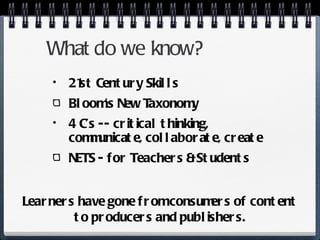
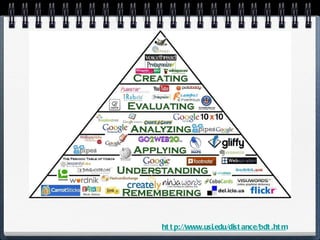
What do we know? 21st Century Skills Bloom’s New Taxonomy 4 C’s -- critical thinking, communicate, collaborate, create NETS - for Teachers & Students Learners have gone from consumers of content to producers and publishers.
http://www.usi.edu/distance/bdt.htm
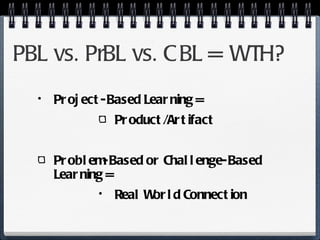
PBL vs. PrBL vs. CBL = WTH? Project-Based Learning =  Product/Artifact Problem-Based or Challenge-Based Learning =  Real World Connection
Challenge-Based Learning http://www.youtube.com/watch?v=9tjxdTbtUvA
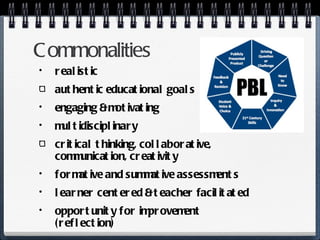
Commonalities realistic authentic educational goals engaging & motivating multidisciplinary critical thinking, collaborative, communication, creativity formative and summative assessments learner centered & teacher facilitated opportunity for improvement (reflection)
Project-Based Learning Explained http://www.youtube.com/watch?v=LMCZvGesRz8
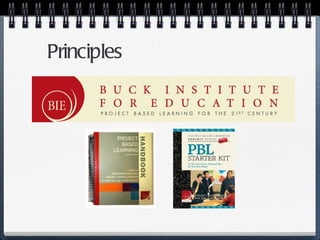
Principles
Backwards Design “ Begin with the end in mind”   Wiggins & McTighe Six A’s Authenticity Academic Rigor Applied Learning Active Exploration Adult Connections Assessment Practices
Driving Question Provocative Open-Ended Goes to the heart of a discipline Challenging Can be tied to the real world
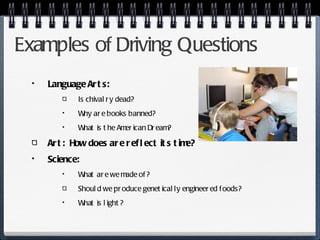
Examples of Driving Questions Language Arts: Is chivalry dead? Why are books banned? What is the American Dream? Art:  How does are reflect its time? Science:  What are we made of? Should we produce genetically engineered foods? What is light?
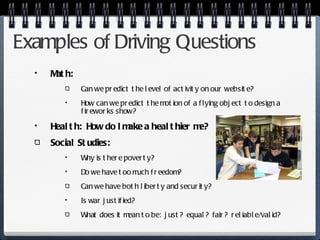
Examples of Driving Questions Math: Can we predict the level of activity on our website? How can we predict the motion of a flying object to design a fireworks show? Health:  How do I make a healthier me? Social Studies:  Why is there poverty? Do we have too much freedom? Can we have both liberty and security? Is war justified? What does it mean to be:  just?  equal?  fair?  reliable/valid?
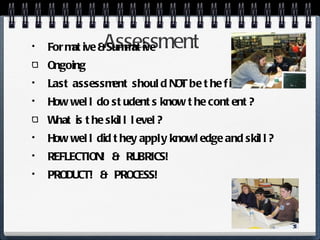
Assessment Formative & Summative Ongoing Last assessment should NOT be the first! How well do students know the content? What is the skill level? How well did they apply knowledge and skill? REFLECTION!  &  RUBRICS! PRODUCT!  &  PROCESS!
Map the Project Organize the tasks  -- Scaffold Gather Resources Storyboard/Timeline  (be flexible)
Manage Share Goals Checkpoints/Milestones/Benchmarks Evaluation/Reflection Debrief Fishbowl/Socratic Seminar Survey Self-Evaluation (use your rubrics)
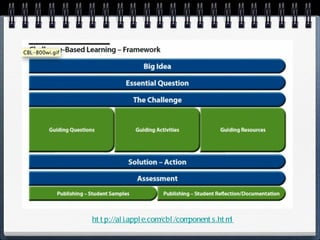
http://ali.apple.com/cbl/components.html
What holds teachers back? Personal Confidence Professional Repetoire Temperament (different, new, unpredictable)
Realities of PBL Engaging, Authentic, Challenging, Significant Depth over Breadth Process is: messy, involves student choice, follows multiple paths, scaffolds learning Collaborative Takes Time -- be flexible Requires Reflection - by student, teacher, and group Achieve multiple standards/objectives Rigorous & Relevant
Research from New Media Consortium Challenge-Based Learning:  An Approach for Our Time  (2009)  (2009)  Both teachers and students overwhelmingly found CBL both effective and engaging. 100% of teachers reported that student work exceeded their expectations. 97% of teachers felt students learned more than expected and in some cases much more. Students self reported learning skills that aligned remarkably with the 21st Century Skills Projects which the students felt highly relevant were most likely to have high quality final products.  The two least relevant challenges were not completed by the students.
to the Rescue! United Streaming: Download, Access,  Editable! Assignment Builder: Build the intro. to  form background knowledge Discovery Health:Health and Biology  Classes - great for resources
to the Rescue! Discovery Atlas:  incredible wealth  of resources for World Language,  Social Studies, Environmental Science STEM:  Math & Science --  Build a better roller coaster..... Design the school 2050.....
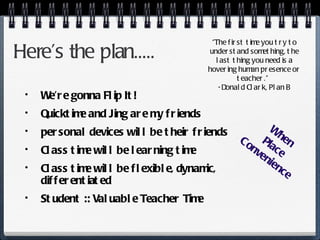
Here’s the plan..... We’re gonna Flip It! Quicktime and Jing are my friends personal devices will be their friends Class time will be learning time Class time will be flexible, dynamic, differentiated Student :: Valuable Teacher Time “ The first time you try to understand something, the last thing you need is a hovering human presence or teacher.”  -Donald Clark, Plan B When Place Convenience
The Flipped Classroom http://www.youtube.com/watch?v=2H4RkudFzlc


Questions http://shsinstructionaltools.stsd.wikispaces.net /
WWII Veterans - A Call to Action
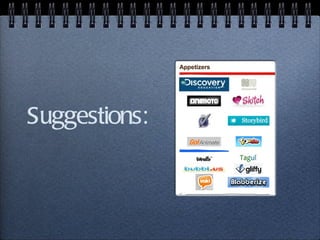
Suggestions:
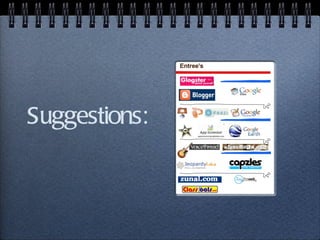
Suggestions:
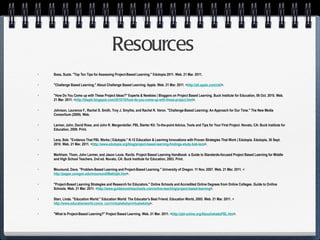
Resources Boss, Suzie. &quot;Top Ten Tips for Assessing Project-Based Learning.&quot; Edutopia 2011. Web. 21 Mar. 2011. &quot;Challenge Based Learning.&quot; About Challenge Based Learning. Apple. Web. 21 Mar. 2011. < http://ali.apple.com/cbl/ >. &quot;How Do You Come up with These Project Ideas?&quot; Experts & Newbies | Bloggers on Project Based Learning. Buck Institute for Education, 06 Oct. 2010. Web. 21 Mar. 2011. < http://biepbl.blogspot.com/2010/10/how-do-you-come-up-with-these-project.html >. Johnson, Laurence F., Rachel S. Smith, Troy J. Smythe, and Rachel K. Varon. &quot;Challenge-Based Learning: An Approach for Our Time.&quot; The New Media Consortium (2009). Web. Larmer, John, David Ross, and John R. Mergendoller. PBL Starter Kit: To-the-point Advice, Tools and Tips for Your First Project. Novato, CA: Buck Institute for Education, 2009. Print. Lenz, Bob. &quot;Evidence That PBL Works | Edutopia.&quot; K-12 Education & Learning Innovations with Proven Strategies That Work | Edutopia. Edutopia, 30 Sept. 2010. Web. 21 Mar. 2011. < http://www.edutopia.org/blog/project-based-learning-findings-study-bob-lenz >. Markham, Thom, John Larmer, and Jason Louis. Ravitz. Project Based Learning Handbook: a Guide to Standards-focused Project Based Learning for Middle and High School Teachers. 2nd ed. Novato, CA: Buck Institute for Education, 2003. Print. Moursund, Dave. &quot;Problem-Based Learning and Project-Based Learning.&quot; University of Oregon. 11 Nov. 2007. Web. 21 Mar. 2011. < http://pages.uoregon.edu/moursund/Math/pbl.htm >. &quot;Project-Based Learning Strategies and Research for Educators.&quot; Online Schools and Accredited Online Degrees from Online Colleges. Guide to Oniline Schools. Web. 21 Mar. 2011. < http://www.guidetoonlineschools.com/online-teaching/project-based-learning >. Starr, Linda. &quot;Education World.&quot; Education World: The Educator's Best Friend. Education World, 2005. Web. 21 Mar. 2011. < http://www.educationworld.com/a_curr/virtualwkshp/virtualwkshp >. &quot;What Is Project-Based Learning?&quot; Project Based Learning. Web. 21 Mar. 2011. < http://pbl-online.org/About/whatisPBL.htm >.

Pbl a menu of ideas

  • 1.
    PBL: AMenu of Ideas A Menu of Ideas Jennifer L. Brinson Instructional Coach -- Salisbury High School Allentown, PA
  • 2.
    Who and Where?Who am I? Where to find resources: http://shsinstructionaltools.stsd.wikispaces.net / Look for pages on “Project/Challenge Based Learning” & “The Flipped Classroom”
  • 3.
    Debunk the Myths!Sporadic projects are PBL..... My kids won’t learn what I need them to.... I have a standardized test to be accountable for.... I don’t have time.... It’s too difficult....
  • 4.
    What do weknow? 21st Century Skills Bloom’s New Taxonomy 4 C’s -- critical thinking, communicate, collaborate, create NETS - for Teachers & Students Learners have gone from consumers of content to producers and publishers.
  • 5.
  • 6.
    PBL vs. PrBLvs. CBL = WTH? Project-Based Learning = Product/Artifact Problem-Based or Challenge-Based Learning = Real World Connection
  • 7.
  • 8.
    Commonalities realistic authenticeducational goals engaging & motivating multidisciplinary critical thinking, collaborative, communication, creativity formative and summative assessments learner centered & teacher facilitated opportunity for improvement (reflection)
  • 9.
    Project-Based Learning Explainedhttp://www.youtube.com/watch?v=LMCZvGesRz8
  • 10.
  • 11.
    Backwards Design “Begin with the end in mind” Wiggins & McTighe Six A’s Authenticity Academic Rigor Applied Learning Active Exploration Adult Connections Assessment Practices
  • 12.
    Driving Question ProvocativeOpen-Ended Goes to the heart of a discipline Challenging Can be tied to the real world
  • 13.
    Examples of DrivingQuestions Language Arts: Is chivalry dead? Why are books banned? What is the American Dream? Art: How does are reflect its time? Science: What are we made of? Should we produce genetically engineered foods? What is light?
  • 14.
    Examples of DrivingQuestions Math: Can we predict the level of activity on our website? How can we predict the motion of a flying object to design a fireworks show? Health: How do I make a healthier me? Social Studies: Why is there poverty? Do we have too much freedom? Can we have both liberty and security? Is war justified? What does it mean to be: just? equal? fair? reliable/valid?
  • 15.
    Assessment Formative &Summative Ongoing Last assessment should NOT be the first! How well do students know the content? What is the skill level? How well did they apply knowledge and skill? REFLECTION! & RUBRICS! PRODUCT! & PROCESS!
  • 16.
    Map the ProjectOrganize the tasks -- Scaffold Gather Resources Storyboard/Timeline (be flexible)
  • 17.
    Manage Share GoalsCheckpoints/Milestones/Benchmarks Evaluation/Reflection Debrief Fishbowl/Socratic Seminar Survey Self-Evaluation (use your rubrics)
  • 18.
  • 19.
    What holds teachersback? Personal Confidence Professional Repetoire Temperament (different, new, unpredictable)
  • 20.
    Realities of PBLEngaging, Authentic, Challenging, Significant Depth over Breadth Process is: messy, involves student choice, follows multiple paths, scaffolds learning Collaborative Takes Time -- be flexible Requires Reflection - by student, teacher, and group Achieve multiple standards/objectives Rigorous & Relevant
  • 21.
    Research from NewMedia Consortium Challenge-Based Learning: An Approach for Our Time (2009) (2009) Both teachers and students overwhelmingly found CBL both effective and engaging. 100% of teachers reported that student work exceeded their expectations. 97% of teachers felt students learned more than expected and in some cases much more. Students self reported learning skills that aligned remarkably with the 21st Century Skills Projects which the students felt highly relevant were most likely to have high quality final products. The two least relevant challenges were not completed by the students.
  • 22.
    to the Rescue!United Streaming: Download, Access, Editable! Assignment Builder: Build the intro. to form background knowledge Discovery Health:Health and Biology Classes - great for resources
  • 23.
    to the Rescue!Discovery Atlas: incredible wealth of resources for World Language, Social Studies, Environmental Science STEM: Math & Science -- Build a better roller coaster..... Design the school 2050.....
  • 24.
    Here’s the plan.....We’re gonna Flip It! Quicktime and Jing are my friends personal devices will be their friends Class time will be learning time Class time will be flexible, dynamic, differentiated Student :: Valuable Teacher Time “ The first time you try to understand something, the last thing you need is a hovering human presence or teacher.” -Donald Clark, Plan B When Place Convenience
  • 25.
    The Flipped Classroomhttp://www.youtube.com/watch?v=2H4RkudFzlc
  • 26.
  • 27.
  • 28.
  • 29.
  • 30.
  • 31.
    WWII Veterans -A Call to Action
  • 32.
  • 33.
  • 34.
    Resources Boss, Suzie.&quot;Top Ten Tips for Assessing Project-Based Learning.&quot; Edutopia 2011. Web. 21 Mar. 2011. &quot;Challenge Based Learning.&quot; About Challenge Based Learning. Apple. Web. 21 Mar. 2011. < http://ali.apple.com/cbl/ >. &quot;How Do You Come up with These Project Ideas?&quot; Experts & Newbies | Bloggers on Project Based Learning. Buck Institute for Education, 06 Oct. 2010. Web. 21 Mar. 2011. < http://biepbl.blogspot.com/2010/10/how-do-you-come-up-with-these-project.html >. Johnson, Laurence F., Rachel S. Smith, Troy J. Smythe, and Rachel K. Varon. &quot;Challenge-Based Learning: An Approach for Our Time.&quot; The New Media Consortium (2009). Web. Larmer, John, David Ross, and John R. Mergendoller. PBL Starter Kit: To-the-point Advice, Tools and Tips for Your First Project. Novato, CA: Buck Institute for Education, 2009. Print. Lenz, Bob. &quot;Evidence That PBL Works | Edutopia.&quot; K-12 Education & Learning Innovations with Proven Strategies That Work | Edutopia. Edutopia, 30 Sept. 2010. Web. 21 Mar. 2011. < http://www.edutopia.org/blog/project-based-learning-findings-study-bob-lenz >. Markham, Thom, John Larmer, and Jason Louis. Ravitz. Project Based Learning Handbook: a Guide to Standards-focused Project Based Learning for Middle and High School Teachers. 2nd ed. Novato, CA: Buck Institute for Education, 2003. Print. Moursund, Dave. &quot;Problem-Based Learning and Project-Based Learning.&quot; University of Oregon. 11 Nov. 2007. Web. 21 Mar. 2011. < http://pages.uoregon.edu/moursund/Math/pbl.htm >. &quot;Project-Based Learning Strategies and Research for Educators.&quot; Online Schools and Accredited Online Degrees from Online Colleges. Guide to Oniline Schools. Web. 21 Mar. 2011. < http://www.guidetoonlineschools.com/online-teaching/project-based-learning >. Starr, Linda. &quot;Education World.&quot; Education World: The Educator's Best Friend. Education World, 2005. Web. 21 Mar. 2011. < http://www.educationworld.com/a_curr/virtualwkshp/virtualwkshp >. &quot;What Is Project-Based Learning?&quot; Project Based Learning. Web. 21 Mar. 2011. < http://pbl-online.org/About/whatisPBL.htm >.