An overview
Understanding by Design (UbD)
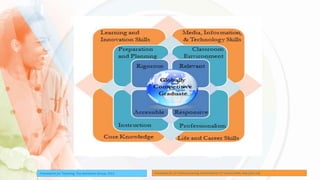
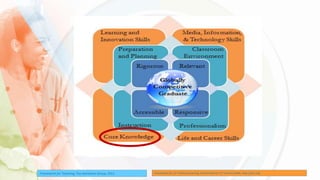
Framework for Teaching, The Danielson Group, 2011 Framework for 21st Century Learning, Partnership for 21st Century Skills, http://p21.org
Today’s Outcomes
Our Essential Question:
• What does it mean to understand?
Today’s Outcomes:
• We will develop an understanding of the core principles
of Understanding by Design
NAEP 8th-grade test item,
constructed response
How many buses does the
army need to transport 1,128
soldiers if each bus holds 36
soldiers?
Answer from 30% :
“31, remainder 12”
What is“understanding”?
• Explaining or showing why and how (e.g. show your work,
say why it works, defend your view, make connections on
your own, etc.)
• Insightful use of knowledge and skill, observable in
performance
• Drawing key inferences and constructing meaning
independently.
• Essential for recall and transfer of “content” to new
situations
What is“understanding”?
Applying what you have learned to a new situation
(e.g. use it, adapt it, teach it, solve new problems,
etc.). Transfer is key.
• The teacher’s role is to make transfer likely through good
design, facilitation, and feedback.
You’ve got to go
below the surface...
to uncover the
really ‘big ideas.’
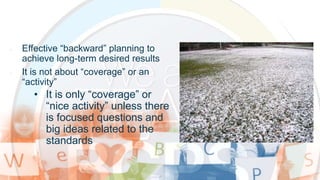
• Effective “backward” planning to
achieve long-term desired results
• It is not about “coverage” or an
“activity”
• It is only “coverage” or
“nice activity” unless there
is focused questions and
big ideas related to the
standards
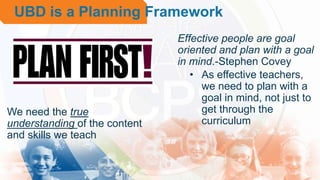
UbD is a Planning Framework
 Way to purposefully think about planning
• Develops deep understanding and makes meaning of “Big
Ideas”
• Effective people are goal
oriented and plan with a goal
in mind.-Stephen Covey
• As effective teachers,
we need to plan with a
goal in mind, not just to
get through the
curriculum
We need the true
understanding of the content
and skills we teach
UBD is a Planning Framework
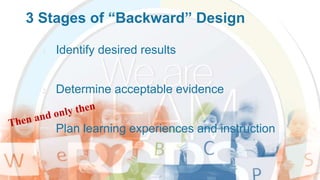
3 Stages of “Backward” Design
1. Identify desired results
2. Determine acceptable evidence
3. Plan learning experiences and instruction
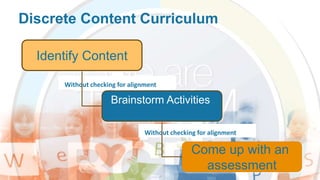
Discrete Content Curriculum
Without checking for alignment
Identify Content
Brainstorm Activities
& Methods
Come up with an
assessment
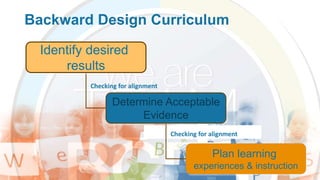
Backward Design Curriculum
Checking for alignment
Identify desired
results
Determine Acceptable
Evidence
Plan learning
experiences & instruction
UbD Addresses:
Student lack of transfer ability
Lessons that lack long-term purpose (and alignment
to the standards)
Aimless activities and worksheets
Needlessly low-level and unengaging work
Over-reliance on textbook: the textbook is a
resource, not the syllabus
goehler@bcps.org

Understanding by design an overview

  • 1.
  • 2.
    Framework for Teaching,The Danielson Group, 2011 Framework for 21st Century Learning, Partnership for 21st Century Skills, http://p21.org
  • 3.
    Framework for Teaching,The Danielson Group, 2011 Framework for 21st Century Learning, Partnership for 21st Century Skills, http://p21.org
  • 4.
    Today’s Outcomes Our EssentialQuestion: • What does it mean to understand? Today’s Outcomes: • We will develop an understanding of the core principles of Understanding by Design
  • 5.
    NAEP 8th-grade testitem, constructed response How many buses does the army need to transport 1,128 soldiers if each bus holds 36 soldiers?
  • 6.
    Answer from 30%: “31, remainder 12”
  • 7.
    What is“understanding”? • Explainingor showing why and how (e.g. show your work, say why it works, defend your view, make connections on your own, etc.) • Insightful use of knowledge and skill, observable in performance • Drawing key inferences and constructing meaning independently. • Essential for recall and transfer of “content” to new situations
  • 8.
    What is“understanding”? Applying whatyou have learned to a new situation (e.g. use it, adapt it, teach it, solve new problems, etc.). Transfer is key. • The teacher’s role is to make transfer likely through good design, facilitation, and feedback.
  • 9.
    You’ve got togo below the surface...
  • 10.
    to uncover the really‘big ideas.’
  • 11.
    • Effective “backward”planning to achieve long-term desired results • It is not about “coverage” or an “activity” • It is only “coverage” or “nice activity” unless there is focused questions and big ideas related to the standards
  • 12.
    UbD is aPlanning Framework  Way to purposefully think about planning • Develops deep understanding and makes meaning of “Big Ideas”
  • 13.
    • Effective peopleare goal oriented and plan with a goal in mind.-Stephen Covey • As effective teachers, we need to plan with a goal in mind, not just to get through the curriculum We need the true understanding of the content and skills we teach UBD is a Planning Framework
  • 14.
    3 Stages of“Backward” Design 1. Identify desired results 2. Determine acceptable evidence 3. Plan learning experiences and instruction
  • 15.
    Discrete Content Curriculum Withoutchecking for alignment Without checking for alignment Identify Content Brainstorm Activities & Methods Come up with an assessment
  • 16.
    Backward Design Curriculum Checkingfor alignment Checking for alignment Identify desired results Determine Acceptable Evidence Plan learning experiences & instruction
  • 17.
    UbD Addresses: Student lackof transfer ability Lessons that lack long-term purpose (and alignment to the standards) Aimless activities and worksheets Needlessly low-level and unengaging work Over-reliance on textbook: the textbook is a resource, not the syllabus
  • 18.