Fostering Critical Thinking with Project Based Learning Jennifer Dorman jdorman.wikispaces.com/pbl
WHY PBL?
Project Based Learning Provides A multiple entry point strategy and varied and multiple possible solutions A focus on universal challenges with local solutions An authentic connection with multiple disciplines An opportunity to develop 21st century skills The purposeful use of Web 2.0 tools for organizing, collaborating, and publishing Challenge-Based Learning: An Approach for Our Time –  A Research Report from The New Media Consortium  http://ali.apple.com/cbl/index.html
Project Based Learning Provides The opportunity for students to do something rather than just learn about something The documentation of the learning experience from challenge to solution 24/7 access to up-to-date technology tools and resources so students can do their work  Challenge-Based Learning: An Approach for Our Time –  A Research Report from The New Media Consortium  http://ali.apple.com/cbl/index.html
Five Minds for the Future Gardner, Howard. (2007).  Five minds for the future.  Boston: Harvard Business School Press.  Disciplined mastery of key subjects Creating beyond existing knowledge and syntheses to pose new questions Respectful seeking to understand differences Ethical striving toward good work and good citizenship Synthesizing arraying information to make sense to self and others
21 st  Century Skills http://www.21stcenturyskills.org
http://nets-implementation.iste.wikispaces.net/
http://ali.apple.com/acot2/principles/ ACOT2 has identified six design principles for the 21st century high school
WHERE CAN I LEARN ABOUT PBL?
http://ali.apple.com/cbl/index.html
http://www.bie.org/
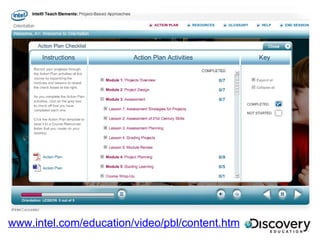
http://www.intel.com/education/video/pbl/content.htm
http://www.edutopia.org/project-learning
DISSECTING THE PBL PROCESS
Design Structure http://ali.apple.com/cbl/
Big Idea a broad concept that can be explored in multiple ways, is engaging, and has importance to high school students and the larger society Examples –  Diversity Sustainability
Essential Question identify what is important to know about the big idea and refine and contextualize that idea Examples –  What is cultural identity and how does it define you? How does my water consumption impact my world?
Challenge a challenge is articulated that asks students to create a specific answer or solution that can result in concrete, meaningful action Example –  Create cross-cultural connections at your school Improve your home, school, or community use of water.
Guiding Questions generated by the students, these questions represent the knowledge students need to discover to successfully meet the challenge Examples –  How do we use water?  How much do we use?  How is water wasted? How can water be conserved?
Guiding Activities lessons, simulations, games, and other types of activities to help students answer the guiding questions and set the foundation for them to develop innovative, insightful, and realistic solutions Example –  Calculate Your Individual Water Footprint
Guiding Resources focused set of resources can include podcasts, websites, videos, databases, experts, and so on that support the activities and assist students with developing a solution Example  - WaterSense Quiz from the Environmental Protection Agency’ www.epa.gov/watersense/water/text.htm
Solution(s) each solution should be thoughtful, concrete,  actionable , clearly articulated, and presented in a publishable multimedia format
Assessment solution can be assessed for its connection to the challenge, accuracy of the content, clarity of communication, applicability for implementation, and efficacy of the idea the process that the individuals as well as teams went through in getting to a solution can also be assessed, capturing the development of 21st century skills
Publishing students are encouraged to publish their results online, soliciting feedback
Exemplar – Energy  Big Idea  = Energy Essential Question  = What is the impact of my fossil fuel consumption? Challenge  = Reduce your family’s fossil fuel consumption. http://ali.apple.com/cbl/challenges/sustainability/energy.html
Energy  Guiding Questions =  What is a fossil fuel? Where does my family use fossil fuels? What is made from fossil fuels? How much gas does my family use in one week? What are the alternatives to fossil fuels? http://ali.apple.com/cbl/challenges/sustainability/energy.html
Energy  Guiding Activities =  Learn About Fossil Fuels Students research and develop a clear definition of fossil fuels. How Much Fossil Fuel Do You Own? Students create a list of products that have fossil fuels in them. They do an inventory of all the items in their homes that contain fossil fuel and investigate alternatives to these items. http://ali.apple.com/cbl/challenges/sustainability/energy.html
Energy  Guiding Resources = Energy Story: Fossil Fuels—Coal, Oil and Natural Gas The California Energy Commission provides an overview of fossil fuels. www.energyquest.ca.gov/story/chapter08.html Energy Efficiency The Energy Information Administration provides information for students about energy consumption and efficiency. www.eia.doe.gov/kids/energyfacts/saving/efficiency/savingenergy_secondary.html http://ali.apple.com/cbl/challenges/sustainability/energy.html
Global to Local . . .  PBL in Action
wecanchangetheworldchallenge.com Elementary, Middle, and High School Challenges
www.epals.com
 
iearn.org
 
 
globe.gov
www.globalschoolnet.org
www.globalschoolnet.org/gsnprojects/google/index.cfm
www.tigweb.org
 
www.thefutureismine.com
 
Vicki Davis Julie Lindsay 123elearning.blogspot.com Beijing International School, China coolcatteacher.blogspot.com Westwood Schools, Camilla, GA
www.flatclassroomproject.net www.digiteen.org www.eracismproject.org www.netgened.org http://www.flatclassroomproject.net/all-projects.html
www.flatclassroomproject.net The  Flat Classroom™ Project  is a global collaborative project that joins together middle and senior high school students.  This project is part of the emerging tend in internationally-aware schools to embrace a holistic and constructivist educational approach to work collaboratively with others around the world in order to create students who are competitive and globally-minded. One of the main goals of the project is to 'flatten' or lower the classroom walls so that instead of each class working isolated and alone, 2 or more classes are joined virtually to become one large classroom.
www.digiteen.org In some ways, Digiteen™ is 21st Century Character Education!   Students (typically Grade 7-9, 12-16 year old) are introduced to information through a series of videos selected by their school, research current digital citizenship trends and news and compile a collaborative report with other students around the world, and make fact based recommendations in their offline action project at their local school to promote safe, appropriate online behaviors.
www.eracismproject.org This project bridges the divide between culture, schools, countries, and even bandwidth by providing low-bandwidth methods for participants.   This is a middle school debate project promoting cultural understanding.
www.netgened.org Students will study the current research and create wiki-reports with their student partners around the world analyzing current trends and projecting future happenings based upon this collaborative analysis.  After compiling their wiki reports based upon current research, and encouraged by "expert advisors" (subject matter experts in the industry), students will then create a video in one of two strands.  Video strand I competition will be the NetGenEd Challenge where students are asked to envision the future of education based upon current global technological trends.  Video Strand II Competition is the Macrowikinomics Challenge where students envision the future of global social action based upon their research in current global technological trends.
How will the  process  be assessed? How will the  solution  be assessed?
Process Collaboration (in-person & virtual) Organization (ideas & materials) Time Management (planning) Adequate Distribution of Tasks
Solution Product (presentation, implementation, reflection) Checkpoints (drafts, proposals, checklists) Multimedia (design, performance) Content (research, documentation, presentation, citation)
Impact of the Performance (Solution) The success of the performance, given the purposes, goals and desired results Adapted from the work of Grant Wiggins
Work Quality and Craftsmanship The overall polish, organization, and rigor of the work Adapted from the work of Grant Wiggins
Adequacy of Methods and Behaviors The quality of the procedures and manner of presentation, prior to an during performance Adapted from the work of Grant Wiggins
Validity of Content The correctness of the ideas, skills, and materials used Adapted from the work of Grant Wiggins
Sophistication of Knowledge Employed The complexity or maturity of the knowledge displayed Adapted from the work of Grant Wiggins
pbl-online.org/pathway2.html
 
www.bie.org
www.bie.org/tools/useful
ali.apple.com/cbl/process.html
www.intel.com/education/video/pbl/content.htm
educate.intel.com/en/AssessingProjects/AssessmentStrategies/
sn.im/mswordpblrubric
rubistar.4teachers.org
pblchecklist.4teachers.org
www.projectfoundry.org
jdorman.wikispaces.com/pbl

Fostering critical thinking_pbl

  • 1.
    Fostering Critical Thinkingwith Project Based Learning Jennifer Dorman jdorman.wikispaces.com/pbl
  • 2.
  • 3.
    Project Based LearningProvides A multiple entry point strategy and varied and multiple possible solutions A focus on universal challenges with local solutions An authentic connection with multiple disciplines An opportunity to develop 21st century skills The purposeful use of Web 2.0 tools for organizing, collaborating, and publishing Challenge-Based Learning: An Approach for Our Time – A Research Report from The New Media Consortium http://ali.apple.com/cbl/index.html
  • 4.
    Project Based LearningProvides The opportunity for students to do something rather than just learn about something The documentation of the learning experience from challenge to solution 24/7 access to up-to-date technology tools and resources so students can do their work Challenge-Based Learning: An Approach for Our Time – A Research Report from The New Media Consortium http://ali.apple.com/cbl/index.html
  • 5.
    Five Minds forthe Future Gardner, Howard. (2007). Five minds for the future. Boston: Harvard Business School Press. Disciplined mastery of key subjects Creating beyond existing knowledge and syntheses to pose new questions Respectful seeking to understand differences Ethical striving toward good work and good citizenship Synthesizing arraying information to make sense to self and others
  • 6.
    21 st Century Skills http://www.21stcenturyskills.org
  • 7.
  • 8.
    http://ali.apple.com/acot2/principles/ ACOT2 hasidentified six design principles for the 21st century high school
  • 9.
    WHERE CAN ILEARN ABOUT PBL?
  • 10.
  • 11.
  • 12.
  • 13.
  • 14.
  • 15.
  • 16.
  • 17.
    Big Idea abroad concept that can be explored in multiple ways, is engaging, and has importance to high school students and the larger society Examples – Diversity Sustainability
  • 18.
    Essential Question identifywhat is important to know about the big idea and refine and contextualize that idea Examples – What is cultural identity and how does it define you? How does my water consumption impact my world?
  • 19.
    Challenge a challengeis articulated that asks students to create a specific answer or solution that can result in concrete, meaningful action Example – Create cross-cultural connections at your school Improve your home, school, or community use of water.
  • 20.
    Guiding Questions generatedby the students, these questions represent the knowledge students need to discover to successfully meet the challenge Examples – How do we use water? How much do we use? How is water wasted? How can water be conserved?
  • 21.
    Guiding Activities lessons,simulations, games, and other types of activities to help students answer the guiding questions and set the foundation for them to develop innovative, insightful, and realistic solutions Example – Calculate Your Individual Water Footprint
  • 22.
    Guiding Resources focusedset of resources can include podcasts, websites, videos, databases, experts, and so on that support the activities and assist students with developing a solution Example - WaterSense Quiz from the Environmental Protection Agency’ www.epa.gov/watersense/water/text.htm
  • 23.
    Solution(s) each solutionshould be thoughtful, concrete, actionable , clearly articulated, and presented in a publishable multimedia format
  • 24.
    Assessment solution canbe assessed for its connection to the challenge, accuracy of the content, clarity of communication, applicability for implementation, and efficacy of the idea the process that the individuals as well as teams went through in getting to a solution can also be assessed, capturing the development of 21st century skills
  • 25.
    Publishing students areencouraged to publish their results online, soliciting feedback
  • 26.
    Exemplar – Energy Big Idea = Energy Essential Question = What is the impact of my fossil fuel consumption? Challenge = Reduce your family’s fossil fuel consumption. http://ali.apple.com/cbl/challenges/sustainability/energy.html
  • 27.
    Energy GuidingQuestions = What is a fossil fuel? Where does my family use fossil fuels? What is made from fossil fuels? How much gas does my family use in one week? What are the alternatives to fossil fuels? http://ali.apple.com/cbl/challenges/sustainability/energy.html
  • 28.
    Energy GuidingActivities = Learn About Fossil Fuels Students research and develop a clear definition of fossil fuels. How Much Fossil Fuel Do You Own? Students create a list of products that have fossil fuels in them. They do an inventory of all the items in their homes that contain fossil fuel and investigate alternatives to these items. http://ali.apple.com/cbl/challenges/sustainability/energy.html
  • 29.
    Energy GuidingResources = Energy Story: Fossil Fuels—Coal, Oil and Natural Gas The California Energy Commission provides an overview of fossil fuels. www.energyquest.ca.gov/story/chapter08.html Energy Efficiency The Energy Information Administration provides information for students about energy consumption and efficiency. www.eia.doe.gov/kids/energyfacts/saving/efficiency/savingenergy_secondary.html http://ali.apple.com/cbl/challenges/sustainability/energy.html
  • 30.
    Global to Local. . . PBL in Action
  • 31.
  • 32.
  • 33.
  • 34.
  • 35.
  • 36.
  • 37.
  • 38.
  • 39.
  • 40.
  • 41.
  • 42.
  • 43.
  • 44.
    Vicki Davis JulieLindsay 123elearning.blogspot.com Beijing International School, China coolcatteacher.blogspot.com Westwood Schools, Camilla, GA
  • 45.
    www.flatclassroomproject.net www.digiteen.org www.eracismproject.orgwww.netgened.org http://www.flatclassroomproject.net/all-projects.html
  • 46.
    www.flatclassroomproject.net The Flat Classroom™ Project is a global collaborative project that joins together middle and senior high school students. This project is part of the emerging tend in internationally-aware schools to embrace a holistic and constructivist educational approach to work collaboratively with others around the world in order to create students who are competitive and globally-minded. One of the main goals of the project is to 'flatten' or lower the classroom walls so that instead of each class working isolated and alone, 2 or more classes are joined virtually to become one large classroom.
  • 47.
    www.digiteen.org In someways, Digiteen™ is 21st Century Character Education!  Students (typically Grade 7-9, 12-16 year old) are introduced to information through a series of videos selected by their school, research current digital citizenship trends and news and compile a collaborative report with other students around the world, and make fact based recommendations in their offline action project at their local school to promote safe, appropriate online behaviors.
  • 48.
    www.eracismproject.org This projectbridges the divide between culture, schools, countries, and even bandwidth by providing low-bandwidth methods for participants.  This is a middle school debate project promoting cultural understanding.
  • 49.
    www.netgened.org Students willstudy the current research and create wiki-reports with their student partners around the world analyzing current trends and projecting future happenings based upon this collaborative analysis. After compiling their wiki reports based upon current research, and encouraged by "expert advisors" (subject matter experts in the industry), students will then create a video in one of two strands. Video strand I competition will be the NetGenEd Challenge where students are asked to envision the future of education based upon current global technological trends. Video Strand II Competition is the Macrowikinomics Challenge where students envision the future of global social action based upon their research in current global technological trends.
  • 50.
    How will the process be assessed? How will the solution be assessed?
  • 51.
    Process Collaboration (in-person& virtual) Organization (ideas & materials) Time Management (planning) Adequate Distribution of Tasks
  • 52.
    Solution Product (presentation,implementation, reflection) Checkpoints (drafts, proposals, checklists) Multimedia (design, performance) Content (research, documentation, presentation, citation)
  • 53.
    Impact of thePerformance (Solution) The success of the performance, given the purposes, goals and desired results Adapted from the work of Grant Wiggins
  • 54.
    Work Quality andCraftsmanship The overall polish, organization, and rigor of the work Adapted from the work of Grant Wiggins
  • 55.
    Adequacy of Methodsand Behaviors The quality of the procedures and manner of presentation, prior to an during performance Adapted from the work of Grant Wiggins
  • 56.
    Validity of ContentThe correctness of the ideas, skills, and materials used Adapted from the work of Grant Wiggins
  • 57.
    Sophistication of KnowledgeEmployed The complexity or maturity of the knowledge displayed Adapted from the work of Grant Wiggins
  • 58.
  • 59.
  • 60.
  • 61.
  • 62.
  • 63.
  • 64.
  • 65.
  • 66.
  • 67.
  • 68.
  • 69.
  • 70.
  • 71.
  • 72.
  • 73.
  • 74.
  • 75.
  • 76.