Project-Based Learning, Constructivism,  and Technology Prepared by Carla Piper, Ed. D.
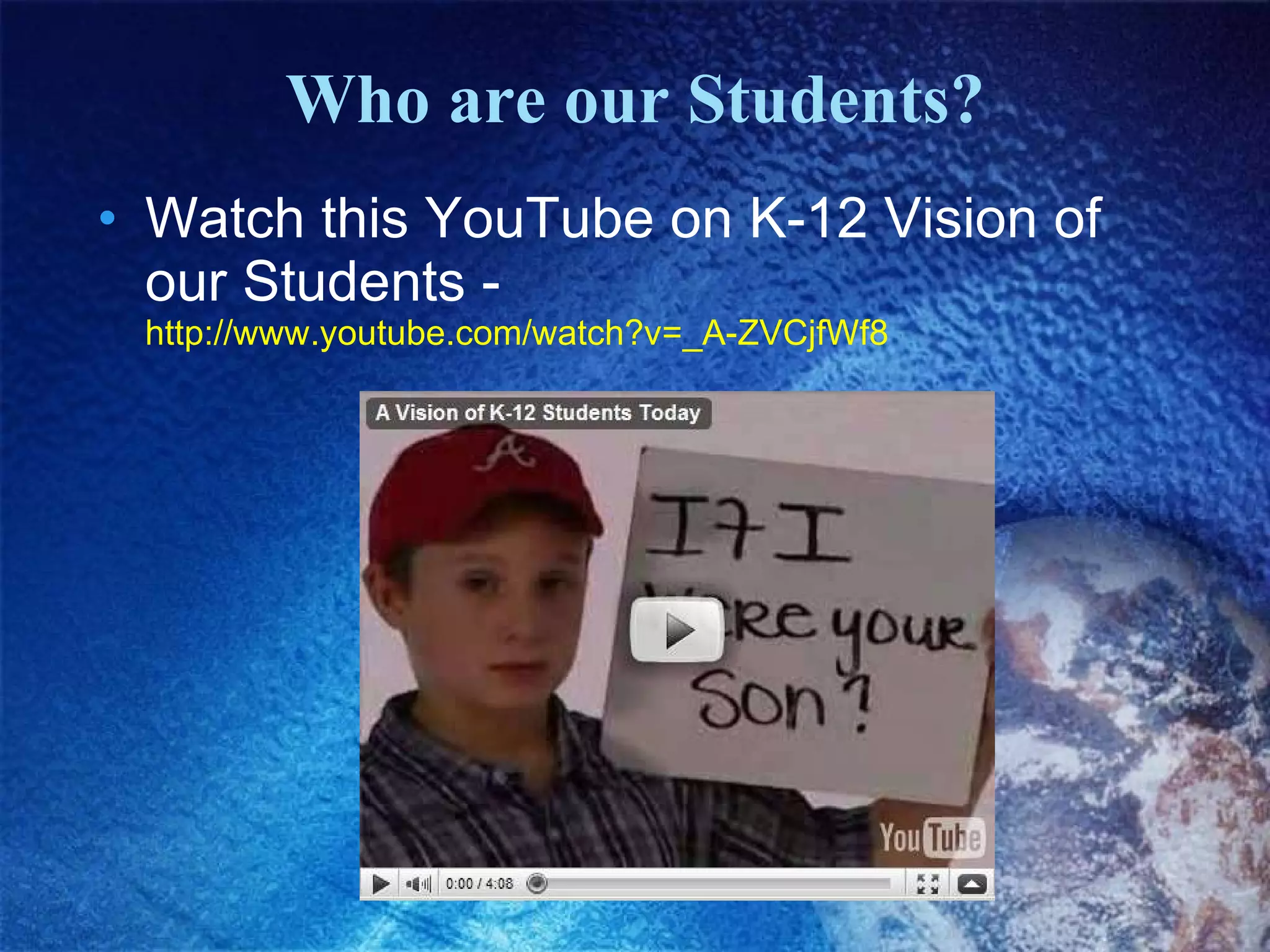
Who are our Students? Watch this YouTube on K-12 Vision of our Students -  http://www.youtube.com/watch?v=_A-ZVCjfWf8
How do we teach our students? How do children learn? Constructivism   Students learn best by being “active” learners. Students learn by constructing their own Bloom’s Taxonomy  Levels of Learning - Taxonomy Develop Higher Level Critical Thinking meaning Diverse Learning Styles Multiple Intelligences Students learn in different ways. What does the research say?
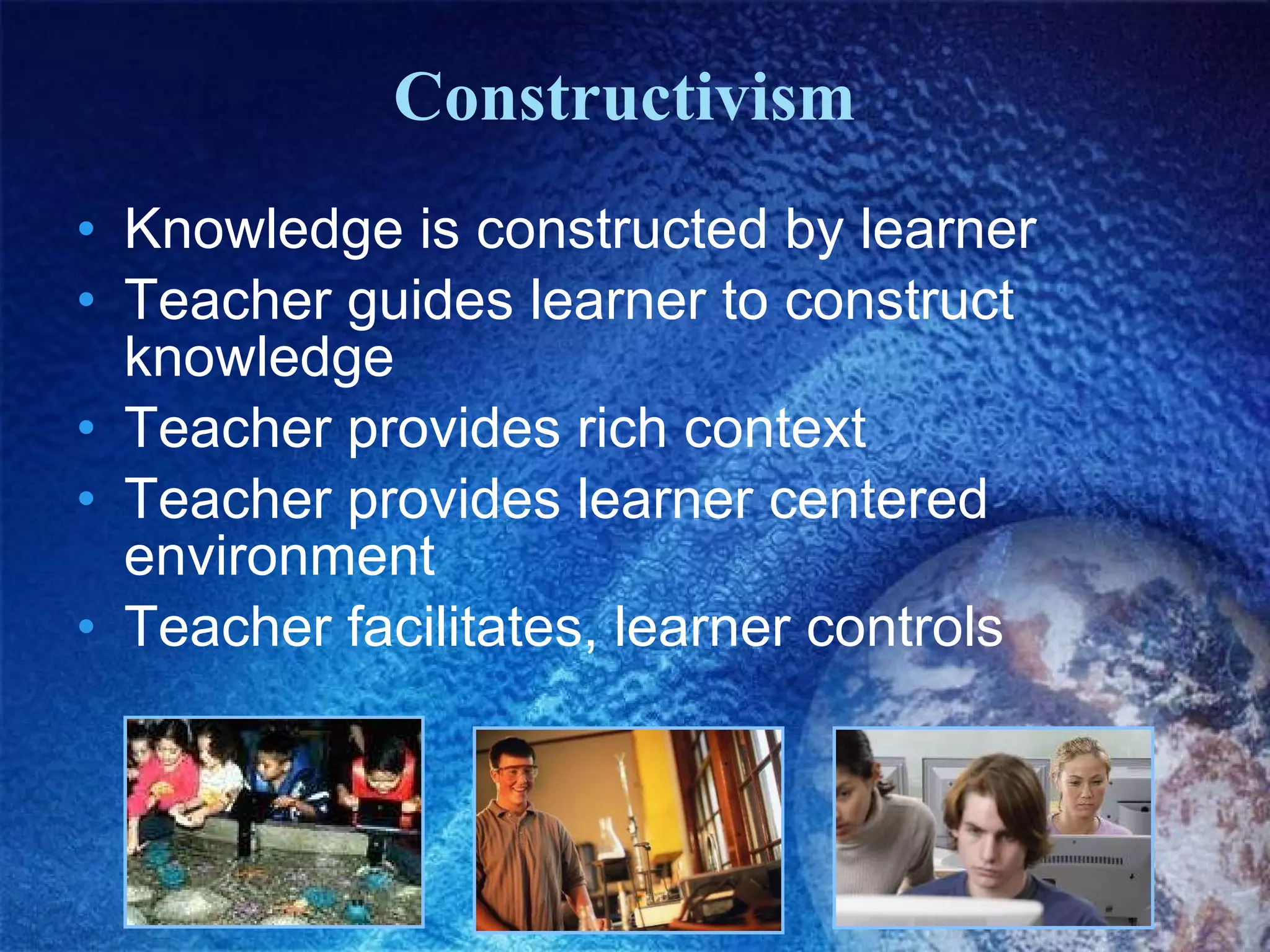
Constructivism Knowledge is constructed by learner Teacher guides learner to construct knowledge Teacher provides rich context Teacher provides learner centered environment Teacher facilitates, learner controls
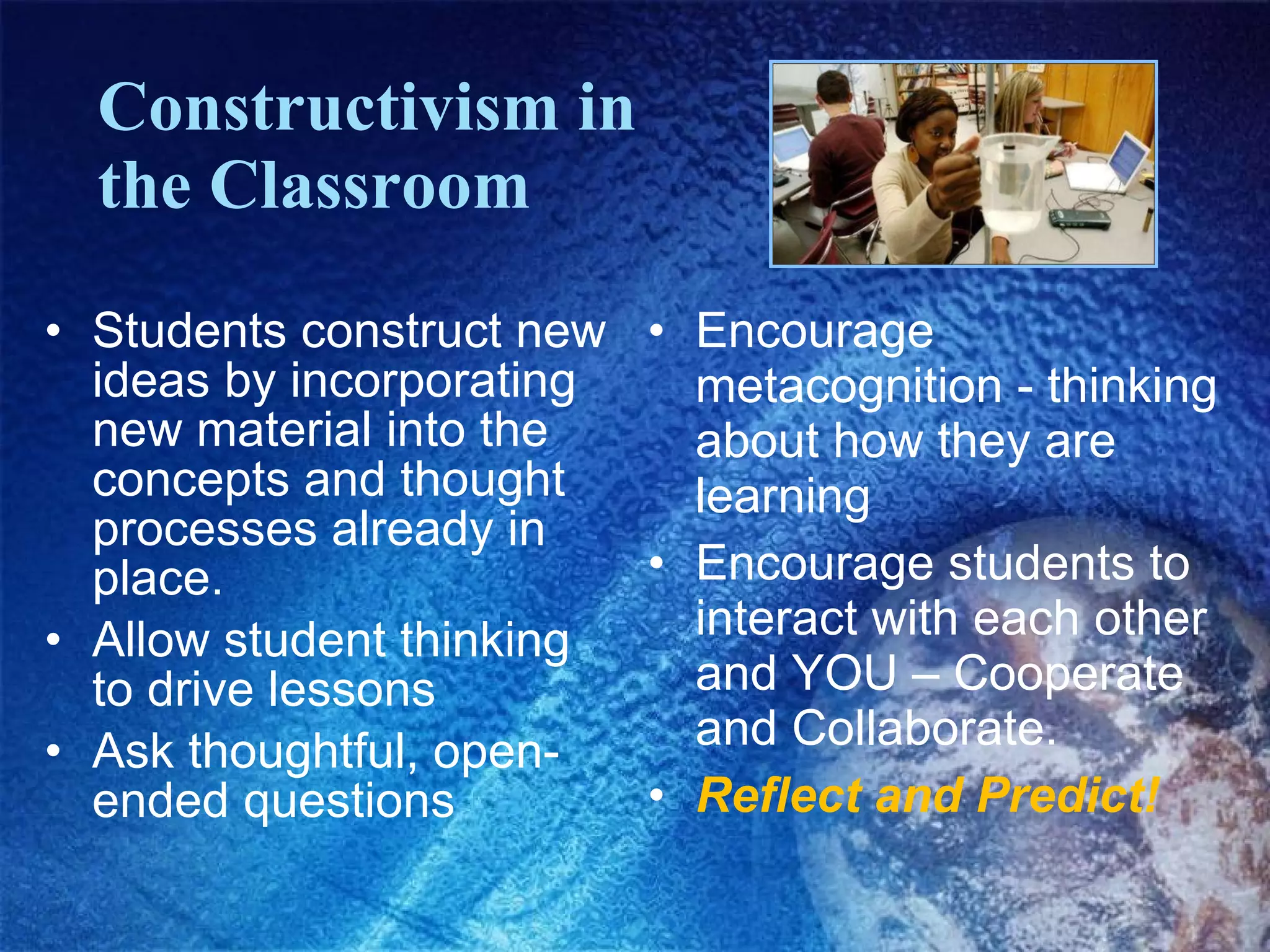
Constructivism in  the Classroom Students construct new ideas by incorporating new material into the concepts and thought processes already in place. Allow student thinking to drive lessons Ask thoughtful, open-ended questions Encourage metacognition - thinking about how they are learning Encourage students to interact with each other and YOU – Cooperate and Collaborate. Reflect and Predict!
Goals for Students Develop higher level critical thinking Understand causes or effects of ideas or actions Become engaged in their own learning Become active and not passive learners Student initiative accepted Student ideas respected and encouraged Independent thinking encouraged Students engage in dialogue Students apply knowledge in authentic problem-solving tasks Brahler & Johnson
Goals for Teachers Ask open-ended questions and allow wait time for responses Encourage student autonomy, initiative, and collaboration Uses raw data and primary material sources  Provides authentic learning experiences Guide and facilitate learning Brahler & Johnson
Constructivist Classroom: Teachers May Experience Difficulties Teacher loses some control over what learners will learn May take longer to cover certain topics Testing is more difficult because learning is less structured Standardized testing relies on factual recall and lower level thinking
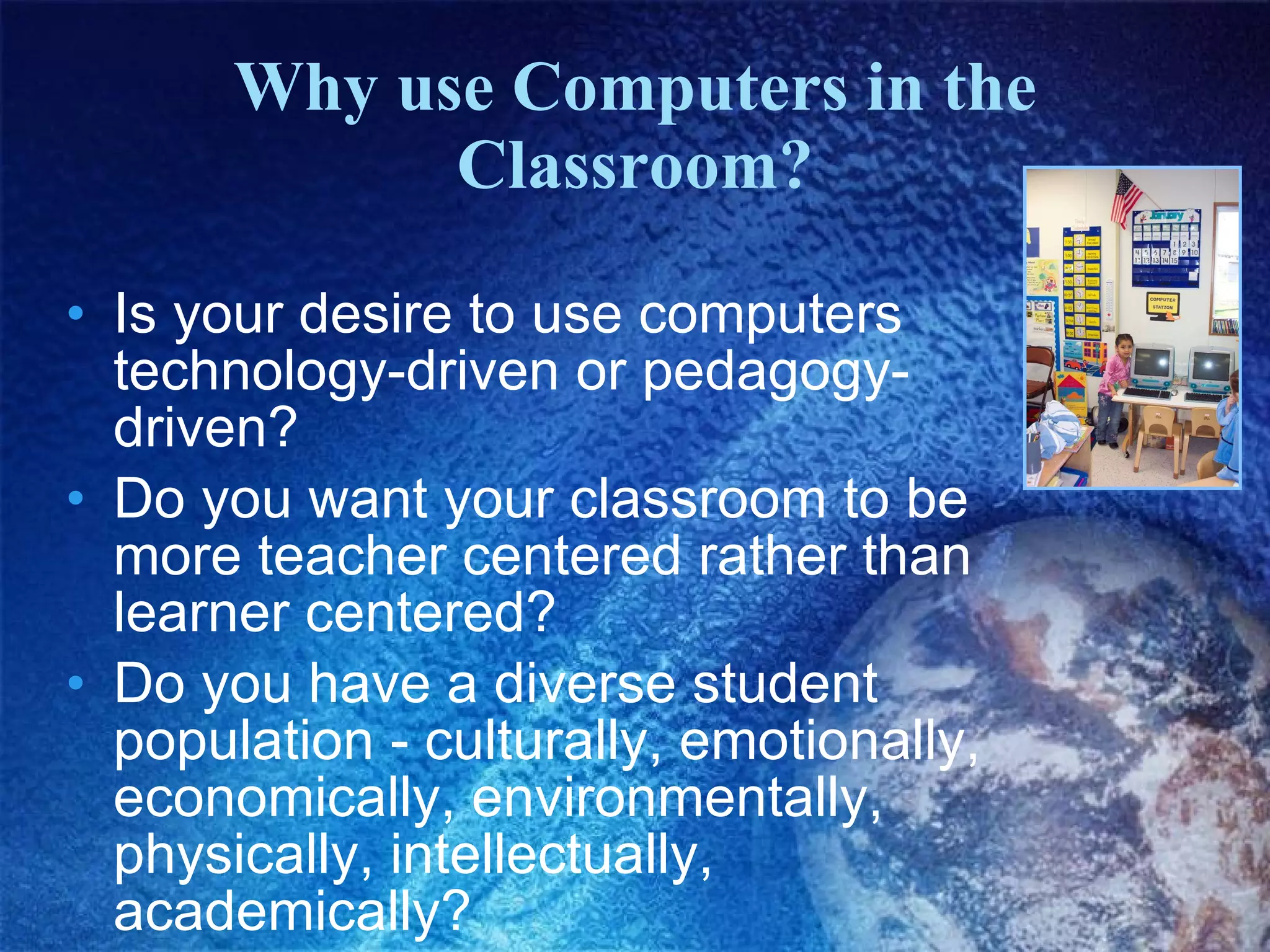
Why use Computers in the Classroom? Is your desire to use computers technology-driven or pedagogy-driven? Do you want your classroom to be more teacher centered rather than learner centered? Do you have a diverse student population - culturally, emotionally, economically, environmentally, physically, intellectually, academically?
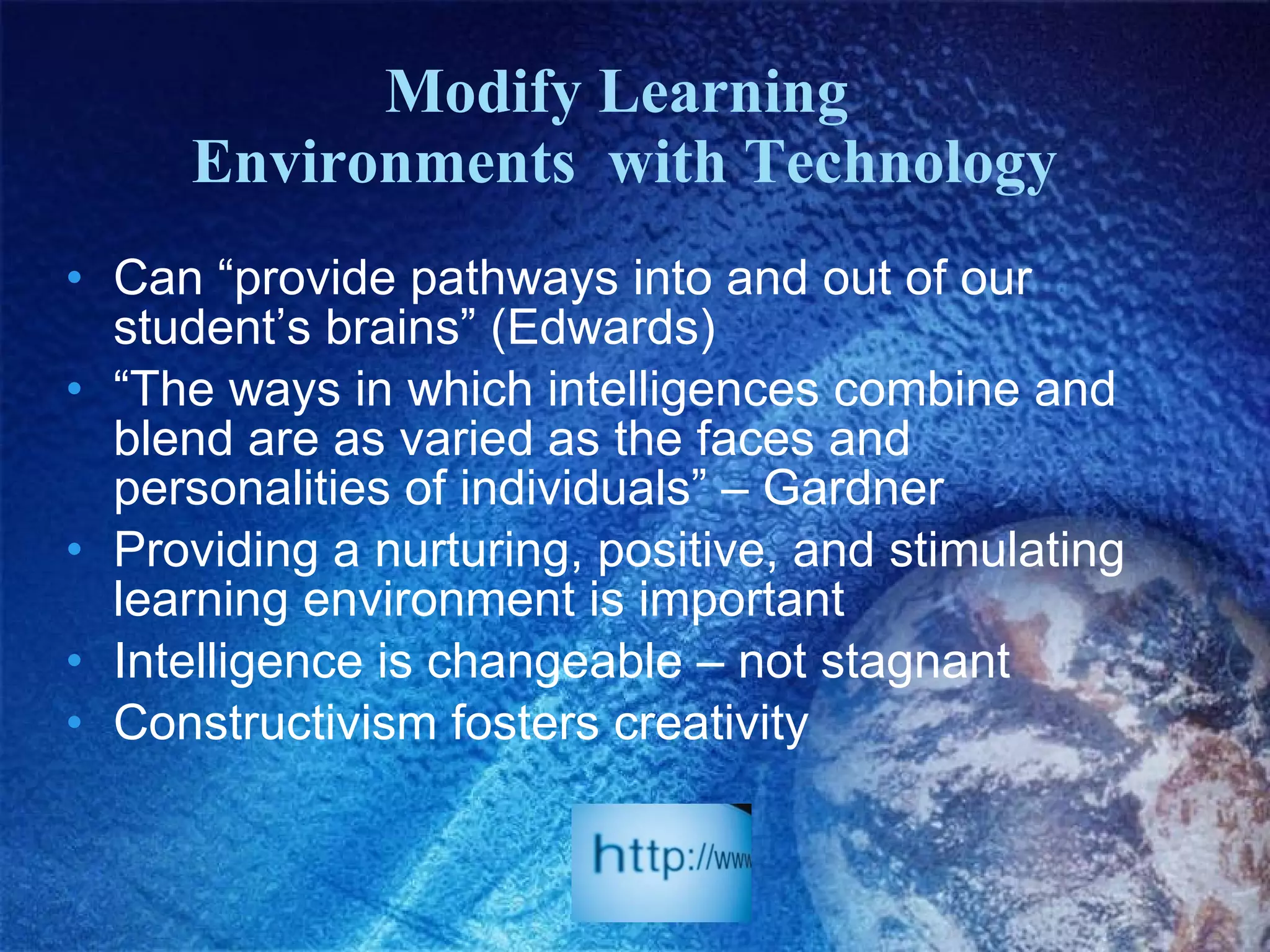
Modify Learning  Environments  with Technology Can “provide pathways into and out of our student’s brains” (Edwards) “ The ways in which intelligences combine and blend are as varied as the faces and personalities of individuals” – Gardner Providing a nurturing, positive, and stimulating learning environment is important Intelligence is changeable – not stagnant Constructivism fosters creativity
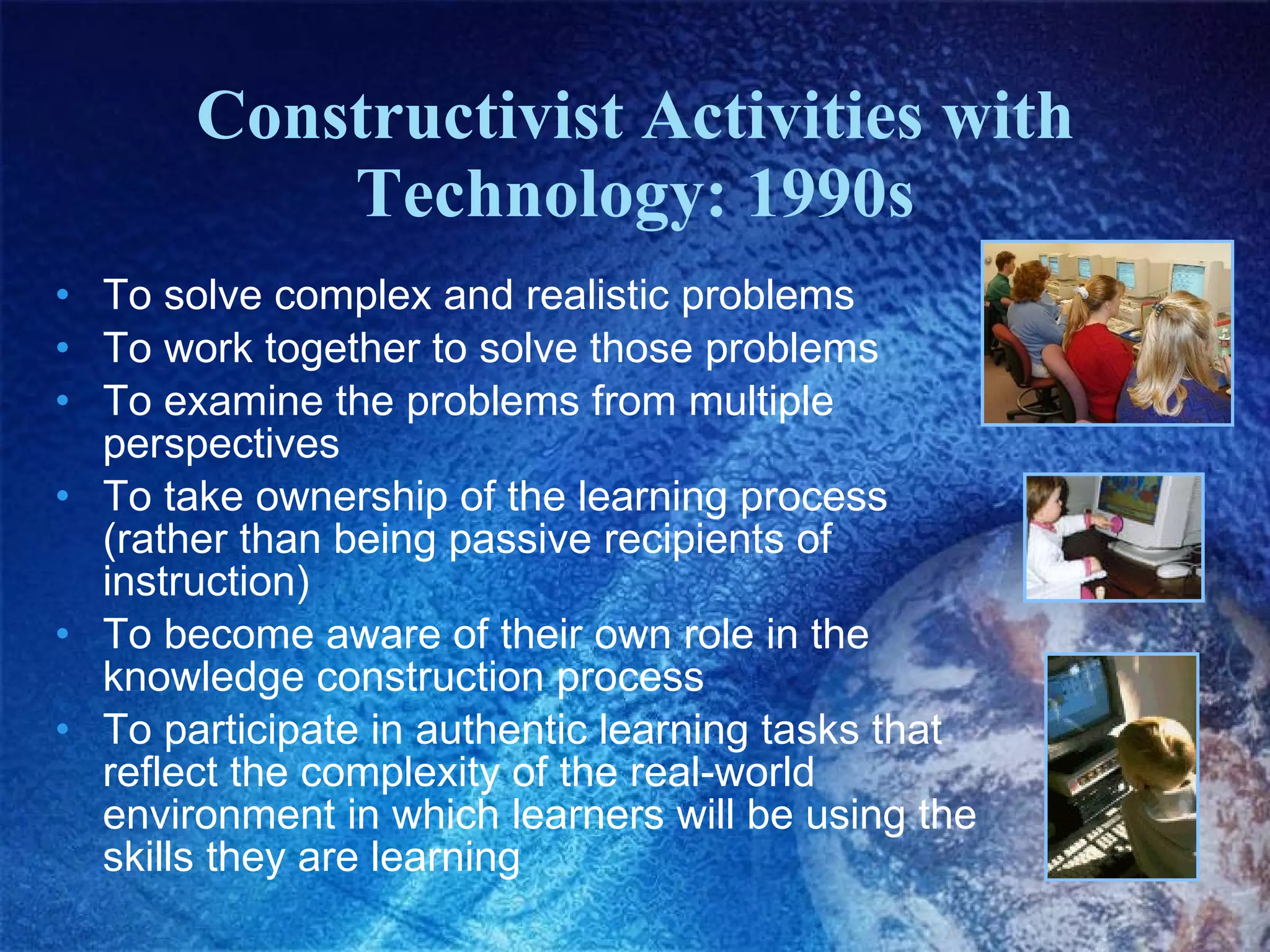
Constructivist Activities with Technology: 1990s To solve complex and realistic problems To work together to solve those problems To examine the problems from multiple perspectives To take ownership of the learning process (rather than being passive recipients of instruction) To become aware of their own role in the knowledge construction process To participate in authentic learning tasks that reflect the complexity of the real-world environment in which learners will be using the skills they are learning
How can we use computers in the classroom to promote student learning and still maintain control of behavior?
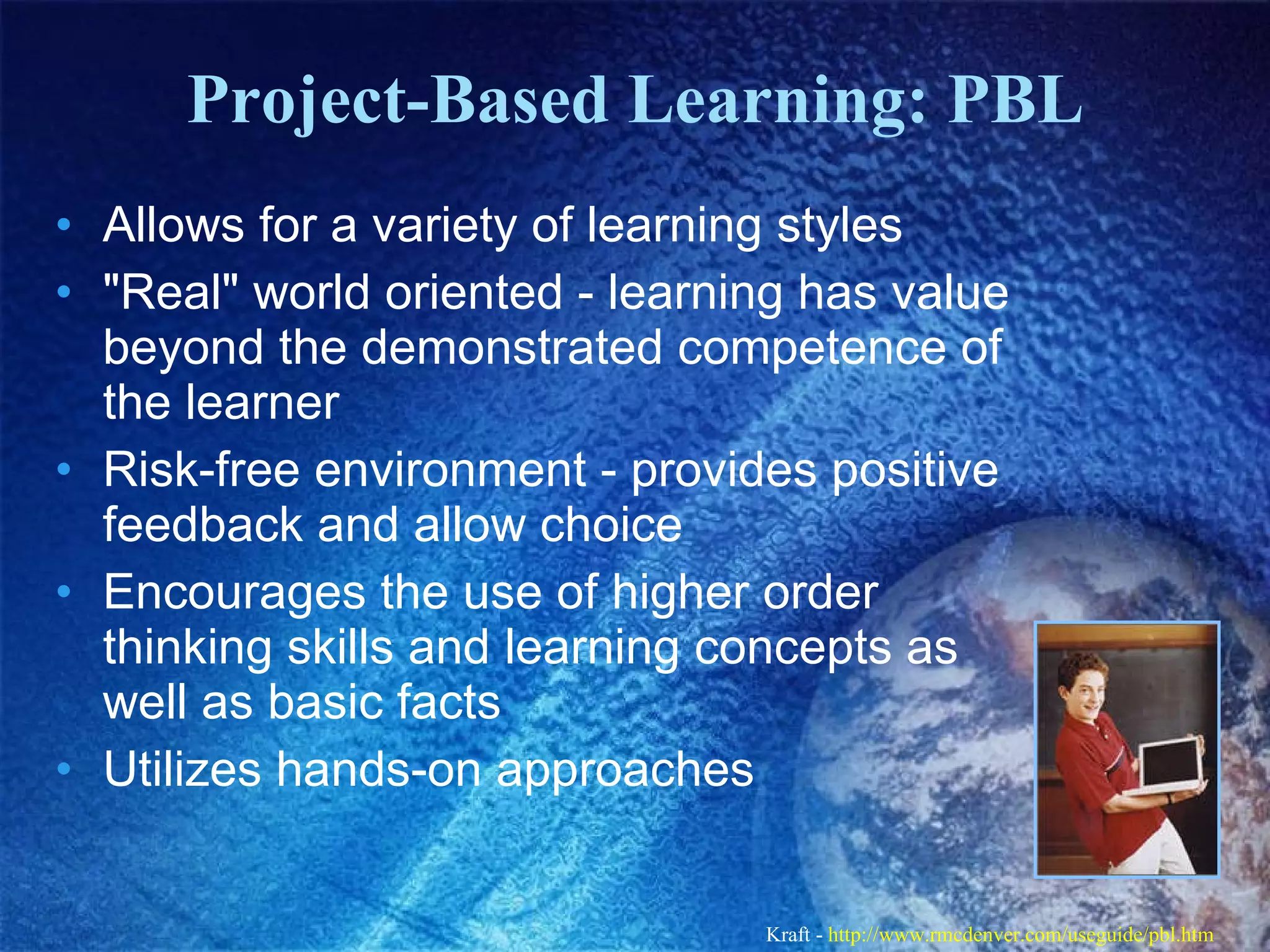
Project-Based Learning: PBL Allows for a variety of learning styles  "Real" world oriented - learning has value beyond the demonstrated competence of the learner  Risk-free environment - provides positive feedback and allow choice  Encourages the use of higher order thinking skills and learning concepts as well as basic facts  Utilizes hands-on approaches  Kraft -  http://www.rmcdenver.com/useguide/pbl.htm
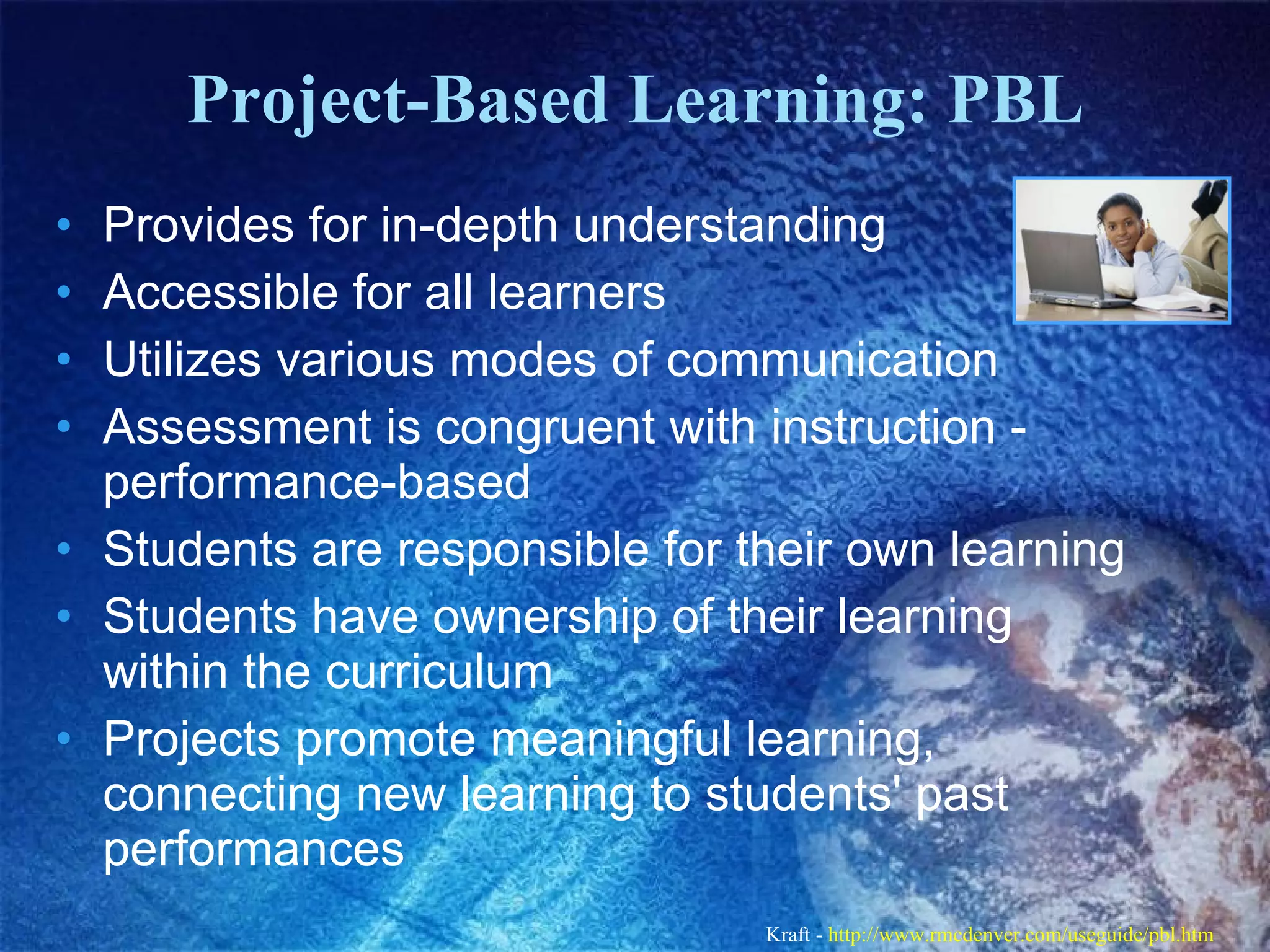
Project-Based Learning: PBL Provides for in-depth understanding  Accessible for all learners  Utilizes various modes of communication  Assessment is congruent with instruction - performance-based  Students are responsible for their own learning  Students have ownership of their learning within the curriculum  Projects promote meaningful learning, connecting new learning to students' past performances  Kraft -  http://www.rmcdenver.com/useguide/pbl.htm
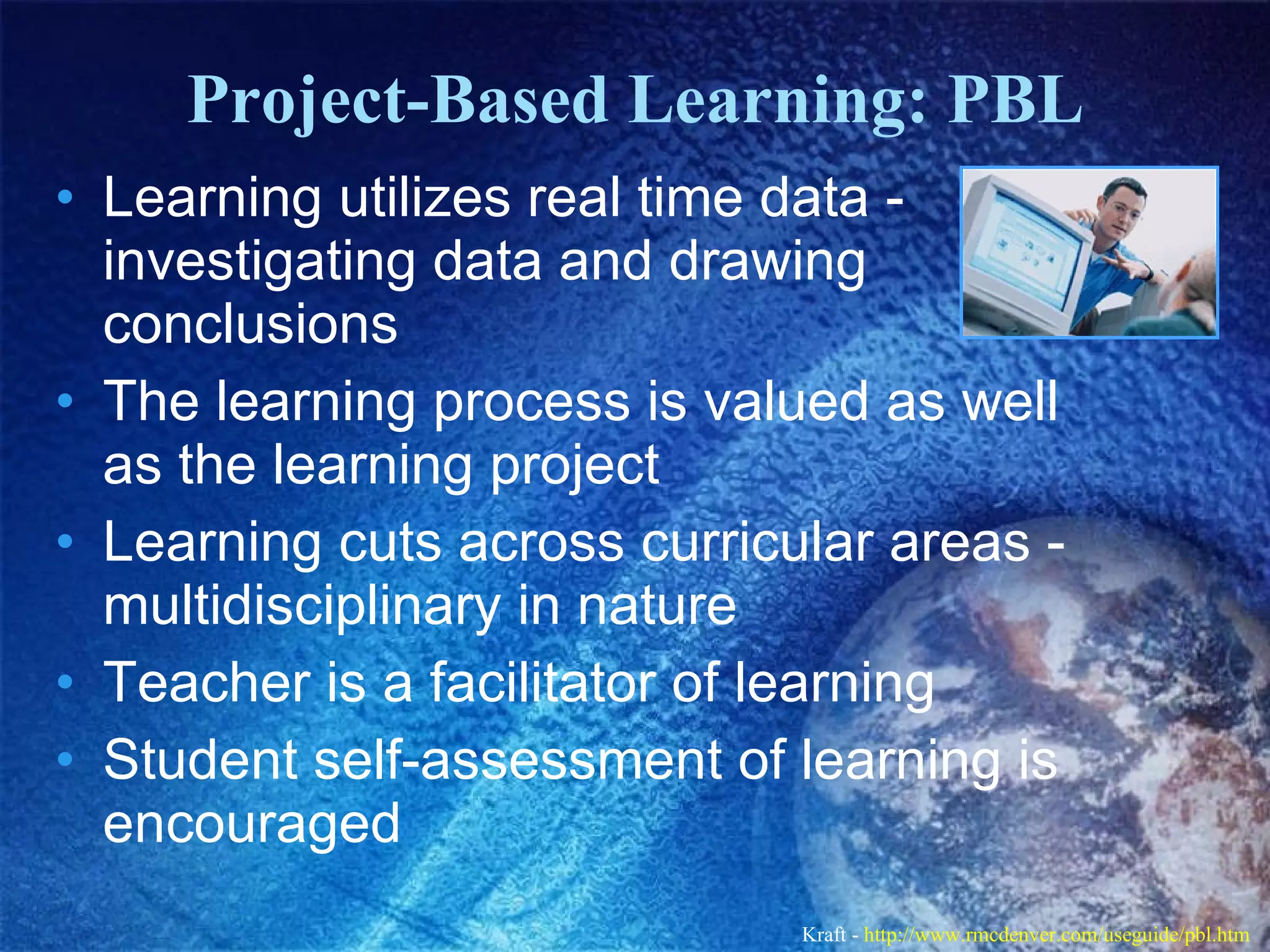
Project-Based Learning: PBL Learning utilizes real time data - investigating data and drawing conclusions  The learning process is valued as well as the learning project  Learning cuts across curricular areas - multidisciplinary in nature  Teacher is a facilitator of learning  Student self-assessment of learning is encouraged  Kraft -  http://www.rmcdenver.com/useguide/pbl.htm
Project Learning: Edutopia According to research:  A dynamic approach to teaching Explore real-world problems and challenges Develop cross-curriculum skills  Work in small collaborative groups.  Fosters active and engaged learning  Inspires students to obtain a deeper knowledge of the subjects they're studying.   View Video at:  http://www.edutopia.org/project-based-learning-overview
Project Learning: Edutopia Develop confidence and self-direction through both team-based and independent work. More likely to retain the knowledge gained through this approach far more readily than through traditional textbook-centered learning. Read Intro at:  http://www.edutopia.org/project-learning-introduction Read World Issues Motivate Students -  http://www.edutopia.org/start-pyramid
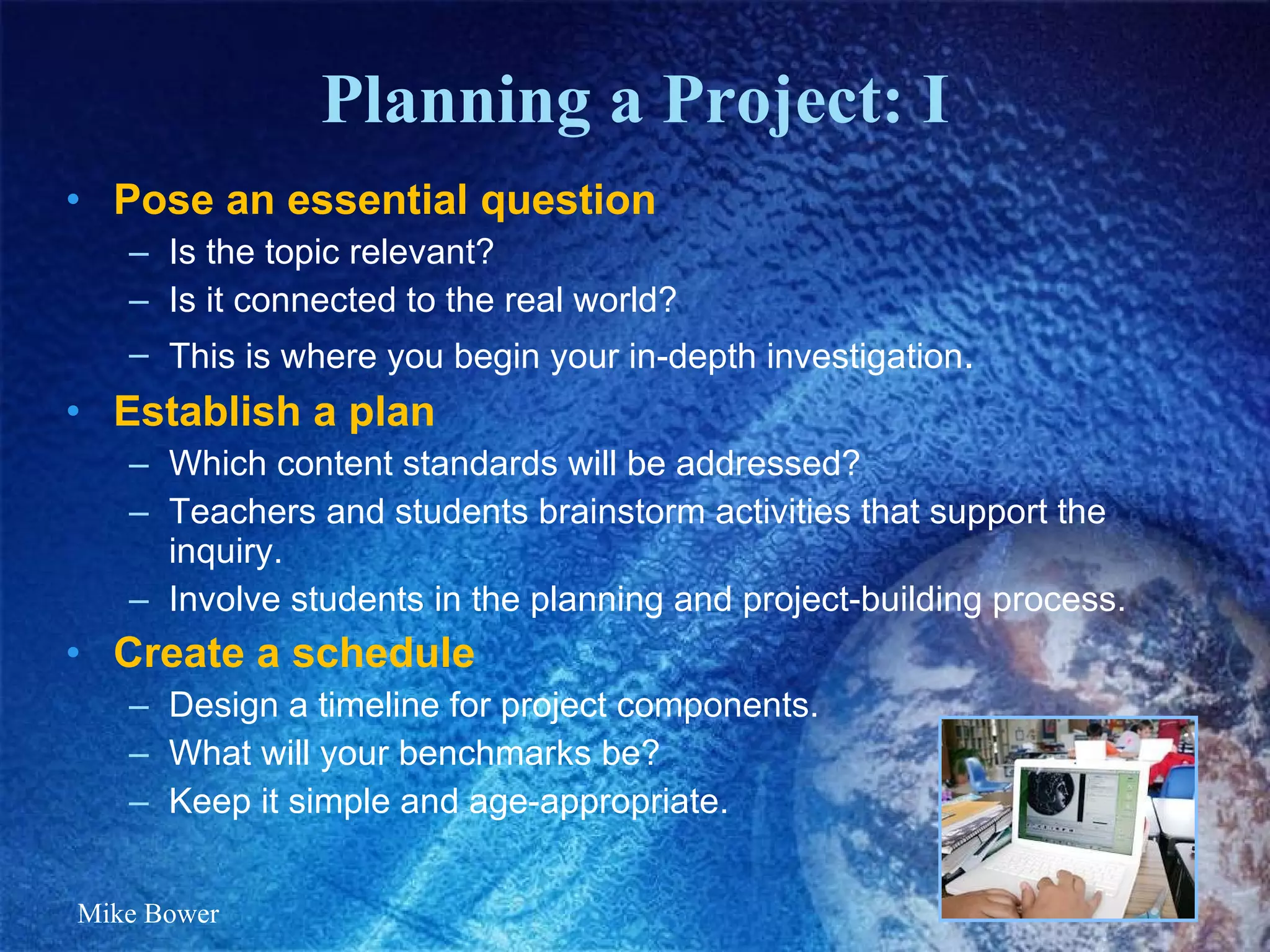
Planning a Project: I Pose an essential question Is the topic relevant? Is it connected to the real world? This is where you begin your in-depth investigation . Establish a plan Which content standards will be addressed? Teachers and students brainstorm activities that support the inquiry. Involve students in the planning and project-building process. Create a schedule Design a timeline for project components.  What will your benchmarks be? Keep it simple and age-appropriate.  Mike Bower
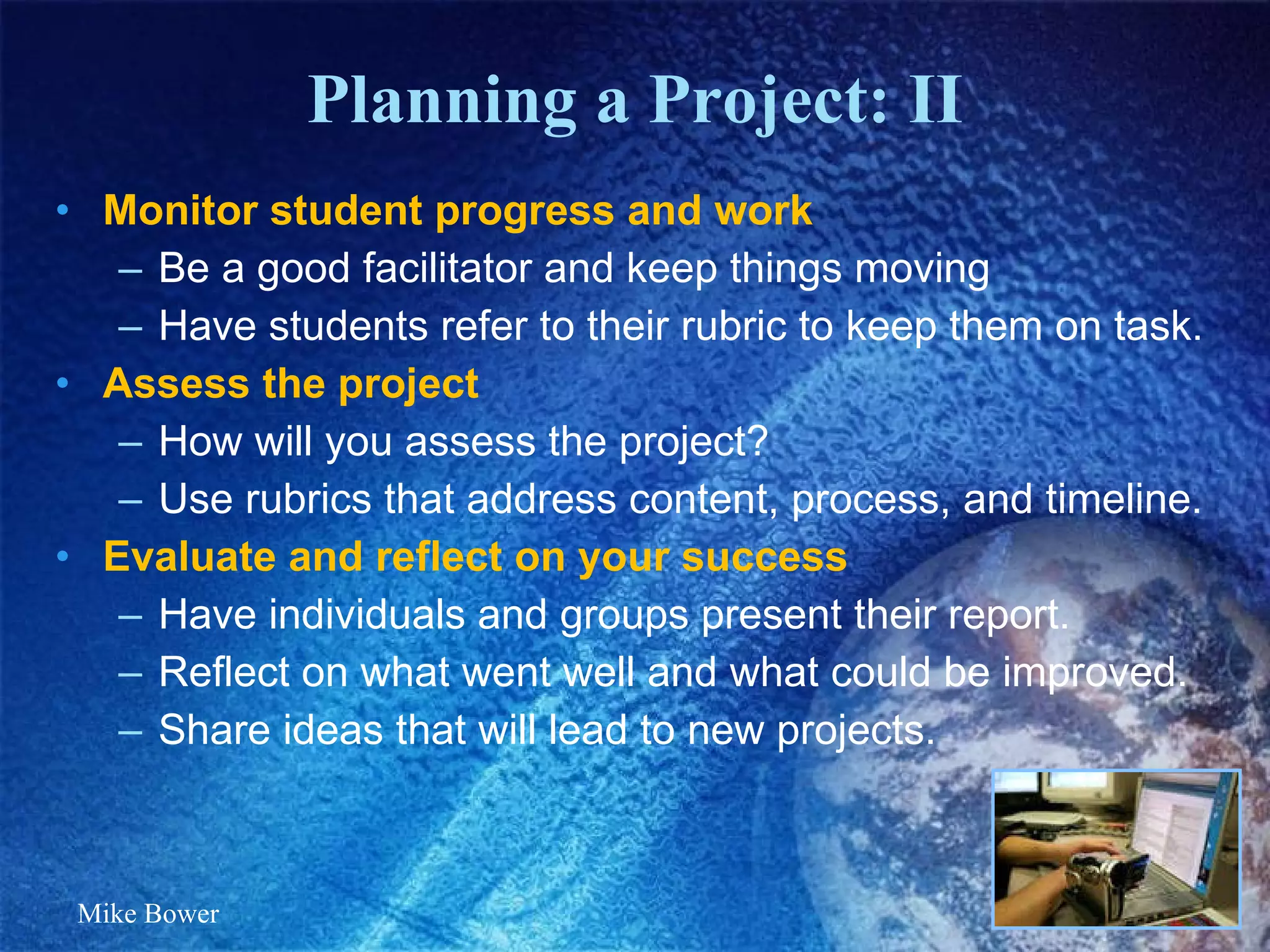
Planning a Project: II Monitor student progress and work Be a good facilitator and keep things moving Have students refer to their rubric to keep them on task. Assess the project How will you assess the project?  Use rubrics that address content, process, and timeline.  Evaluate and reflect on your success  Have individuals and groups present their report. Reflect on what went well and what could be improved.  Share ideas that will lead to new projects.  Mike Bower
References Edutopia:  http://www.edutopia.org/   Project Learning:  http://www.edutopia.org/project-learning   PBL: Project Based Learning -  http://pblchecklist.4teachers.org/index.shtm Problem-Based Learning Checklists -  http://pblchecklist.4teachers.org/checklist.shtml   Problem-Based Learning Online Resource -  http://pbl-online.org/   “ Pedagogy: A Primer on Education Theory for Technical Professionals” – Brahler & Johnson. Washington State University – Download from Microsoft Higher Education Website “ Multiple Intelligences and Technology” – Edwards  (no longer available) Constructivism -  http://www.thirteen.org/edonline/concept2class/constructivism/index.html   Bower, Mike: EDUU451/551 Instructor – Modesto Campus

Pblconstructivism

  • 1.
    Project-Based Learning, Constructivism, and Technology Prepared by Carla Piper, Ed. D.
  • 2.
    Who are ourStudents? Watch this YouTube on K-12 Vision of our Students - http://www.youtube.com/watch?v=_A-ZVCjfWf8
  • 3.
    How do weteach our students? How do children learn? Constructivism Students learn best by being “active” learners. Students learn by constructing their own Bloom’s Taxonomy Levels of Learning - Taxonomy Develop Higher Level Critical Thinking meaning Diverse Learning Styles Multiple Intelligences Students learn in different ways. What does the research say?
  • 4.
    Constructivism Knowledge isconstructed by learner Teacher guides learner to construct knowledge Teacher provides rich context Teacher provides learner centered environment Teacher facilitates, learner controls
  • 5.
    Constructivism in the Classroom Students construct new ideas by incorporating new material into the concepts and thought processes already in place. Allow student thinking to drive lessons Ask thoughtful, open-ended questions Encourage metacognition - thinking about how they are learning Encourage students to interact with each other and YOU – Cooperate and Collaborate. Reflect and Predict!
  • 6.
    Goals for StudentsDevelop higher level critical thinking Understand causes or effects of ideas or actions Become engaged in their own learning Become active and not passive learners Student initiative accepted Student ideas respected and encouraged Independent thinking encouraged Students engage in dialogue Students apply knowledge in authentic problem-solving tasks Brahler & Johnson
  • 7.
    Goals for TeachersAsk open-ended questions and allow wait time for responses Encourage student autonomy, initiative, and collaboration Uses raw data and primary material sources Provides authentic learning experiences Guide and facilitate learning Brahler & Johnson
  • 8.
    Constructivist Classroom: TeachersMay Experience Difficulties Teacher loses some control over what learners will learn May take longer to cover certain topics Testing is more difficult because learning is less structured Standardized testing relies on factual recall and lower level thinking
  • 9.
    Why use Computersin the Classroom? Is your desire to use computers technology-driven or pedagogy-driven? Do you want your classroom to be more teacher centered rather than learner centered? Do you have a diverse student population - culturally, emotionally, economically, environmentally, physically, intellectually, academically?
  • 10.
    Modify Learning Environments with Technology Can “provide pathways into and out of our student’s brains” (Edwards) “ The ways in which intelligences combine and blend are as varied as the faces and personalities of individuals” – Gardner Providing a nurturing, positive, and stimulating learning environment is important Intelligence is changeable – not stagnant Constructivism fosters creativity
  • 11.
    Constructivist Activities withTechnology: 1990s To solve complex and realistic problems To work together to solve those problems To examine the problems from multiple perspectives To take ownership of the learning process (rather than being passive recipients of instruction) To become aware of their own role in the knowledge construction process To participate in authentic learning tasks that reflect the complexity of the real-world environment in which learners will be using the skills they are learning
  • 12.
    How can weuse computers in the classroom to promote student learning and still maintain control of behavior?
  • 13.
    Project-Based Learning: PBLAllows for a variety of learning styles "Real" world oriented - learning has value beyond the demonstrated competence of the learner Risk-free environment - provides positive feedback and allow choice Encourages the use of higher order thinking skills and learning concepts as well as basic facts Utilizes hands-on approaches Kraft - http://www.rmcdenver.com/useguide/pbl.htm
  • 14.
    Project-Based Learning: PBLProvides for in-depth understanding Accessible for all learners Utilizes various modes of communication Assessment is congruent with instruction - performance-based Students are responsible for their own learning Students have ownership of their learning within the curriculum Projects promote meaningful learning, connecting new learning to students' past performances Kraft - http://www.rmcdenver.com/useguide/pbl.htm
  • 15.
    Project-Based Learning: PBLLearning utilizes real time data - investigating data and drawing conclusions The learning process is valued as well as the learning project Learning cuts across curricular areas - multidisciplinary in nature Teacher is a facilitator of learning Student self-assessment of learning is encouraged Kraft - http://www.rmcdenver.com/useguide/pbl.htm
  • 16.
    Project Learning: EdutopiaAccording to research: A dynamic approach to teaching Explore real-world problems and challenges Develop cross-curriculum skills Work in small collaborative groups. Fosters active and engaged learning Inspires students to obtain a deeper knowledge of the subjects they're studying. View Video at: http://www.edutopia.org/project-based-learning-overview
  • 17.
    Project Learning: EdutopiaDevelop confidence and self-direction through both team-based and independent work. More likely to retain the knowledge gained through this approach far more readily than through traditional textbook-centered learning. Read Intro at: http://www.edutopia.org/project-learning-introduction Read World Issues Motivate Students - http://www.edutopia.org/start-pyramid
  • 18.
    Planning a Project:I Pose an essential question Is the topic relevant? Is it connected to the real world? This is where you begin your in-depth investigation . Establish a plan Which content standards will be addressed? Teachers and students brainstorm activities that support the inquiry. Involve students in the planning and project-building process. Create a schedule Design a timeline for project components. What will your benchmarks be? Keep it simple and age-appropriate. Mike Bower
  • 19.
    Planning a Project:II Monitor student progress and work Be a good facilitator and keep things moving Have students refer to their rubric to keep them on task. Assess the project How will you assess the project? Use rubrics that address content, process, and timeline. Evaluate and reflect on your success Have individuals and groups present their report. Reflect on what went well and what could be improved. Share ideas that will lead to new projects. Mike Bower
  • 20.
    References Edutopia: http://www.edutopia.org/ Project Learning: http://www.edutopia.org/project-learning PBL: Project Based Learning - http://pblchecklist.4teachers.org/index.shtm Problem-Based Learning Checklists - http://pblchecklist.4teachers.org/checklist.shtml Problem-Based Learning Online Resource - http://pbl-online.org/ “ Pedagogy: A Primer on Education Theory for Technical Professionals” – Brahler & Johnson. Washington State University – Download from Microsoft Higher Education Website “ Multiple Intelligences and Technology” – Edwards (no longer available) Constructivism - http://www.thirteen.org/edonline/concept2class/constructivism/index.html Bower, Mike: EDUU451/551 Instructor – Modesto Campus