Nature of
Problem-Based
Learning
Teaching and Technology Learning 2
Prepared by:
Mary Ellaine G. Castillo
Christina Chavez
Dc Mar Dorado
Learning is not a spectator sport. Students do not
learn much just by sitting in class listening to
teachers, memorizing prepackaged assignments,
and spitting out answers. They must talk about
what they are learning, write about it, relate it to
past experiences, apply it to their daily lives. They
must make what they learn part of themselves”.
─ Arthur W. Chickering“Seven Principles for Good
Practice” (1987)
Problem- based learning (PBL) is an
approach that involves students working
collaboratively to solve an open-ended
problem. It requires more than one solution
and engages learners in research.
It uses complex real world issues as the
classroom’s subject matter, encouraging
students to develop problem-solving skills
and learn concepts instead of just
absorbing facts.
Students could work independently or in a
group to conceptualize, design, and launch their
innovative product in front of classmates and
community leaders.
Initially students explore the problem using
their prior knowledge and experience followed
by the formulation of hypotheses. Then they
determine what they already know and what
further information is needed to understand
and solve the problem (Kiley, Mullins, Peterson
and Rogers, 2000).
With so many terminologies floating around such
as "active learning , "cooperative learning ,
‟ ‟
"collaborative learning , inquiry - based learning ,
‟ ‟
discovery learning , some academics have become
‟
cynical and regard PBL as another educational fad.
In actual fact, PBL may be regarded as “ all the
above ” . PBL encourages active learning in which
students work cooperatively and collaboratively
delving deeply in the solution of a problem or case
which will require them to conduct research
(inquiry) and search (discover) for information
from multiple sources.
History of PBL
Problem-Based Learning (PBL) originated in
McMaster University's medical school in Canada in
the 1970s, though its conceptual roots can be
traced back to Socrates' Socratic questioning
method, John Dewey's emphasis on active learning
in the 1930s, and Jerome Bruner's discovery
method in the 1960s. PBL was introduced to adapt
to the rapidly evolving field of medical education,
aiming to provide a context for applying knowledge
amid the explosion of medical information and
technology.
• PBL environments foster motivation, relevance,
hands-on practice, active learning, and contextual
understanding better than traditional curricula.
• PBL has since expanded beyond medical
education to fields like engineering, business,
education, and more. Despite methodological
challenges in research, PBL continues to grow in
popularity as a promising educational approach,
though concerns persist about its long-term
sustainability and effectiveness compared to
traditional methods.
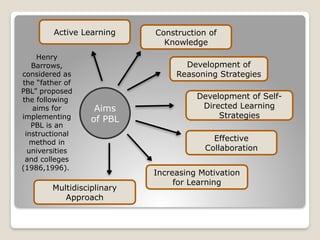
Construction of
Knowledge
Aims
of PBL
Active Learning
Development of
Reasoning Strategies
Development of Self-
Directed Learning
Strategies
Effective
Collaboration
Increasing Motivation
for Learning
Multidisciplinary
Approach
Henry
Barrows,
considered as
the “father of
PBL” proposed
the following
aims for
implementing
PBL is an
instructional
method in
universities
and colleges
(1986,1996).
ACTIVE LEARNING – The student is not a passive
recipient of information(as would happen in a mass
lecture) but rather actively participates in the
learning process which may involve giving opinions,
searching for information, making oral
presentations, analyzing information and so forth.
CONSTRUCTION OF KNOWLEDGE -
The student uses his or her prior knowledge and
combines it with existing information to produce
new information or reconstruct existing information
to produce new information
DEVELOPMENT OF REASONING STRATEGIES –
Through constant contact with real life problems
(authentic problems), students will develop abilities to
perceive a problem and appreciate its features,
formulate and analyze critically possible hypotheses and
finally make decisions about appropriate actions to
solve the problem.
DEVELOPMENT OF SELF-DIRECTED LEARNING
STRATEGIES
The student learns to be a more effective self-directed
learner who is aware of the importance of personal
learning needs and is able to acquire knowledge
through self-study almost independently.
EFFECTIVE COLLABORATORS -
The student works with other students in a group
and collectively solves the problem. In other words,
the student learns social skills such as knowing how
to behave in groups, how to work together and to
help each other get an understanding of what they
are learning.
INCREASING MOTIVATION FOR LEARNING –
When students perceive the problems studied as
relevant, are able to use their prior knowledge and
given the opportunity to actively participate the
learning process; they will be motivated to learn.
MULTISCIPLINARY APPROACH –
The problem posed encourages students to draw from
various sources of information; such as content from
different topics or disciplines towards solution of a
problem.
The advantage is that PBL is more likely to realize these
goals more effectively compared to conventional
instructional methods practiced in higher education. The
key objective of PBL is to stimulate higher order thinking,
where students analyze, synthesize and evaluate
information instead of simply knowing and comprehending
information. Collaboration is an indispensable component
of PBL which is an ability that has to be cultivated because
in the working world students will be regularly working as
members of teams.
Problem Based Learning can be applied to
any school subject, from social studies, and
literature to mathematics, and science. No
matter a field, a good problem based
learning approach should embody features
like:
 Challenging students to understand
classroom concepts on a deeper level.
 Pushing students to make decisions
they’re able to defend.
 Clearly connecting current course
objectives to previous courses and
knowledge.
 Encouraging students to work as a group
to solve the complex issue at hand.
 Engaging students to solve an open-
ended problem in multiple complex
stages.
Benefits of Problem Based learning:
Promote Self- Learning- as a student-
centered approach, problem based learning
pushes kids to take initiative and
responsibility for their own learning. As
they are pushed to use research and
creativity, they develop skills that will
benefit them into adulthood.
Benefits of Problem Based learning:
Highly Engaging- Instead of sitting back,
listening and taking notes, PBL puts
students in the driver’s seat. They have to
stay sharp, apply critical thinking, and think
outside the box to solve problems.
Benefits of Problem Based learning:
Develop Transferrable Skills- The abilities of
students develop don’t just translate to one
classroom or subject matter. They can be
applied to a plethora of school subjects as
well as life beyond, from taking leadership
to solving real-world dilemma's.
Benefits of Problem Based learning:
Improve Teamwork Abilities: Students
collaboration with fellow classmates to
come up with a solution. This teamwork
approach challenges kids to build skills like
collaboration, communication, compromise,
and listening.
Benefits of Problem Based learning:
Encourage Intrinsic rewards- the reward is
much greater than simply an A on an
assignment. Students earn the self-respect
and satisfaction of knowing they’ve solved a
riddle, created an innovative solution, or
manufactured a tangible product.
Conclusion
Problem-Based Learning (PBL) is a student-
centered approach that uses real-world, open-ended
problems to promote deep understanding, critical
thinking, and collaboration. It engages learners by
encouraging self-directed research, teamwork, and
creative problem-solving across various subjects. PBL
not only develops transferable skills like leadership,
communication, and adaptability but also fosters
intrinsic motivation by allowing students to take
ownership of their learning. As a dynamic and versatile
educational method, PBL prepares students for real-life
challenges, making learning meaningful and relevant.
Thank You!

Problem-Based-Learning.pptnaiandoamfsoekwp

  • 1.
    Nature of Problem-Based Learning Teaching andTechnology Learning 2 Prepared by: Mary Ellaine G. Castillo Christina Chavez Dc Mar Dorado
  • 2.
    Learning is nota spectator sport. Students do not learn much just by sitting in class listening to teachers, memorizing prepackaged assignments, and spitting out answers. They must talk about what they are learning, write about it, relate it to past experiences, apply it to their daily lives. They must make what they learn part of themselves”. ─ Arthur W. Chickering“Seven Principles for Good Practice” (1987)
  • 3.
    Problem- based learning(PBL) is an approach that involves students working collaboratively to solve an open-ended problem. It requires more than one solution and engages learners in research. It uses complex real world issues as the classroom’s subject matter, encouraging students to develop problem-solving skills and learn concepts instead of just absorbing facts.
  • 4.
    Students could workindependently or in a group to conceptualize, design, and launch their innovative product in front of classmates and community leaders. Initially students explore the problem using their prior knowledge and experience followed by the formulation of hypotheses. Then they determine what they already know and what further information is needed to understand and solve the problem (Kiley, Mullins, Peterson and Rogers, 2000).
  • 5.
    With so manyterminologies floating around such as "active learning , "cooperative learning , ‟ ‟ "collaborative learning , inquiry - based learning , ‟ ‟ discovery learning , some academics have become ‟ cynical and regard PBL as another educational fad. In actual fact, PBL may be regarded as “ all the above ” . PBL encourages active learning in which students work cooperatively and collaboratively delving deeply in the solution of a problem or case which will require them to conduct research (inquiry) and search (discover) for information from multiple sources.
  • 6.
    History of PBL Problem-BasedLearning (PBL) originated in McMaster University's medical school in Canada in the 1970s, though its conceptual roots can be traced back to Socrates' Socratic questioning method, John Dewey's emphasis on active learning in the 1930s, and Jerome Bruner's discovery method in the 1960s. PBL was introduced to adapt to the rapidly evolving field of medical education, aiming to provide a context for applying knowledge amid the explosion of medical information and technology.
  • 7.
    • PBL environmentsfoster motivation, relevance, hands-on practice, active learning, and contextual understanding better than traditional curricula. • PBL has since expanded beyond medical education to fields like engineering, business, education, and more. Despite methodological challenges in research, PBL continues to grow in popularity as a promising educational approach, though concerns persist about its long-term sustainability and effectiveness compared to traditional methods.
  • 8.
    Construction of Knowledge Aims of PBL ActiveLearning Development of Reasoning Strategies Development of Self- Directed Learning Strategies Effective Collaboration Increasing Motivation for Learning Multidisciplinary Approach Henry Barrows, considered as the “father of PBL” proposed the following aims for implementing PBL is an instructional method in universities and colleges (1986,1996).
  • 9.
    ACTIVE LEARNING –The student is not a passive recipient of information(as would happen in a mass lecture) but rather actively participates in the learning process which may involve giving opinions, searching for information, making oral presentations, analyzing information and so forth. CONSTRUCTION OF KNOWLEDGE - The student uses his or her prior knowledge and combines it with existing information to produce new information or reconstruct existing information to produce new information
  • 10.
    DEVELOPMENT OF REASONINGSTRATEGIES – Through constant contact with real life problems (authentic problems), students will develop abilities to perceive a problem and appreciate its features, formulate and analyze critically possible hypotheses and finally make decisions about appropriate actions to solve the problem. DEVELOPMENT OF SELF-DIRECTED LEARNING STRATEGIES The student learns to be a more effective self-directed learner who is aware of the importance of personal learning needs and is able to acquire knowledge through self-study almost independently.
  • 11.
    EFFECTIVE COLLABORATORS - Thestudent works with other students in a group and collectively solves the problem. In other words, the student learns social skills such as knowing how to behave in groups, how to work together and to help each other get an understanding of what they are learning. INCREASING MOTIVATION FOR LEARNING – When students perceive the problems studied as relevant, are able to use their prior knowledge and given the opportunity to actively participate the learning process; they will be motivated to learn.
  • 12.
    MULTISCIPLINARY APPROACH – Theproblem posed encourages students to draw from various sources of information; such as content from different topics or disciplines towards solution of a problem. The advantage is that PBL is more likely to realize these goals more effectively compared to conventional instructional methods practiced in higher education. The key objective of PBL is to stimulate higher order thinking, where students analyze, synthesize and evaluate information instead of simply knowing and comprehending information. Collaboration is an indispensable component of PBL which is an ability that has to be cultivated because in the working world students will be regularly working as members of teams.
  • 13.
    Problem Based Learningcan be applied to any school subject, from social studies, and literature to mathematics, and science. No matter a field, a good problem based learning approach should embody features like:  Challenging students to understand classroom concepts on a deeper level.
  • 14.
     Pushing studentsto make decisions they’re able to defend.  Clearly connecting current course objectives to previous courses and knowledge.  Encouraging students to work as a group to solve the complex issue at hand.
  • 15.
     Engaging studentsto solve an open- ended problem in multiple complex stages.
  • 16.
    Benefits of ProblemBased learning: Promote Self- Learning- as a student- centered approach, problem based learning pushes kids to take initiative and responsibility for their own learning. As they are pushed to use research and creativity, they develop skills that will benefit them into adulthood.
  • 17.
    Benefits of ProblemBased learning: Highly Engaging- Instead of sitting back, listening and taking notes, PBL puts students in the driver’s seat. They have to stay sharp, apply critical thinking, and think outside the box to solve problems.
  • 18.
    Benefits of ProblemBased learning: Develop Transferrable Skills- The abilities of students develop don’t just translate to one classroom or subject matter. They can be applied to a plethora of school subjects as well as life beyond, from taking leadership to solving real-world dilemma's.
  • 19.
    Benefits of ProblemBased learning: Improve Teamwork Abilities: Students collaboration with fellow classmates to come up with a solution. This teamwork approach challenges kids to build skills like collaboration, communication, compromise, and listening.
  • 20.
    Benefits of ProblemBased learning: Encourage Intrinsic rewards- the reward is much greater than simply an A on an assignment. Students earn the self-respect and satisfaction of knowing they’ve solved a riddle, created an innovative solution, or manufactured a tangible product.
  • 21.
    Conclusion Problem-Based Learning (PBL)is a student- centered approach that uses real-world, open-ended problems to promote deep understanding, critical thinking, and collaboration. It engages learners by encouraging self-directed research, teamwork, and creative problem-solving across various subjects. PBL not only develops transferable skills like leadership, communication, and adaptability but also fosters intrinsic motivation by allowing students to take ownership of their learning. As a dynamic and versatile educational method, PBL prepares students for real-life challenges, making learning meaningful and relevant.
  • 22.