Project Based Learning
Kelly Morgan
What is Project Based Learning?
 Project Base Learning, or PBL, is a
teaching method where students gain
knowledge and skills by working to
investigate and respond to a certain
question or problem.
Example of PBL Assignment
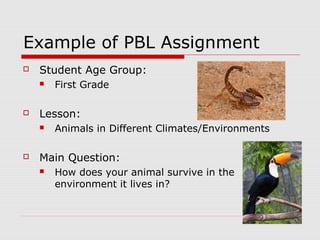
 Student Age Group:
 First Grade
 Lesson:
 Animals in Different Climates/Environments
 Main Question:
 How does your animal survive in the
environment it lives in?
Example of PBL Assignment
 Objective: Students will create a video as a
reporter in their animal’s climate. Include
answers to the required questions about
the animal and their climate.
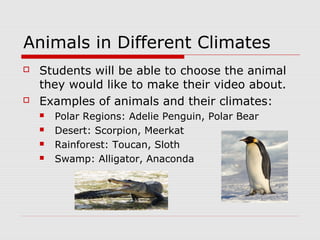
Animals in Different Climates
 Students will be able to choose the animal
they would like to make their video about.
 Examples of animals and their climates:
 Polar Regions: Adelie Penguin, Polar Bear
 Desert: Scorpion, Meerkat
 Rainforest: Toucan, Sloth
 Swamp: Alligator, Anaconda
Required Questions
 The following information must be included
in the students’ video:
 What class (scientific classification) does your animal
belong to?
 What is your animal’s environment like?
 Is your animal endangered, extinct, or have no
threat?
 What does your animal eat?
 Is there anything special about the animal that allows
it to survive in its climate?
 What is your animal’s life expectancy?
 What are three interesting facts you learned about
the animal?
Learning about Different Climates
 The students will research the climates of their
animal and create their own backdrop for their
video.
 They will have the option of either creating
their backdrop with poster board or on the
computer to be projected behind them.
 Examples of what they might include are:
 Polar Regions: Snowy hills, ocean, snowflakes.
 Rainforest: Trees, flowers, insects, rain.
 Desert: Sand dunes, cactus, sun.
 Swamp: Moss, tall grass, swamp water.
Make it Fun!
 Students should be encouraged to have fun
and to be creative with their video!
 Dress up as a reporter, or dress for the weather of
their climate
 Ex: Hat, scarf, winter jacket for polar regions.
 Let them use props
 They can create their own microphone using provided
materials
 Use stuffed animal of their selected animal if they have
one
Deeper Learning
 I believe this activity gives students an opportunity
for deeper learning instead of just “busy work.”
 Students are more connected to their work.
 It is interactive and stimulates motivation.
 Students are excited about learning and working on their
project.
 PBL allows them to retain more information.
 The reason I chose this design is because it is fun,
engaging, and age appropriate. The students can
enjoy themselves while still learning interesting
information.
References
Lewis, M. (2015, February 3). Project-Based Learning In Kindergarten. Retrieved
June 15, 2015, from http://blog.hameraypublishing.com/blog/project-
based-learning-in-kindergarten
What Is PBL? (n.d.). Retrieved June 15, 2015, from
http://bie.org/about/what_pbl

Project Based Learning

  • 1.
  • 2.
    What is ProjectBased Learning?  Project Base Learning, or PBL, is a teaching method where students gain knowledge and skills by working to investigate and respond to a certain question or problem.
  • 3.
    Example of PBLAssignment  Student Age Group:  First Grade  Lesson:  Animals in Different Climates/Environments  Main Question:  How does your animal survive in the environment it lives in?
  • 4.
    Example of PBLAssignment  Objective: Students will create a video as a reporter in their animal’s climate. Include answers to the required questions about the animal and their climate.
  • 5.
    Animals in DifferentClimates  Students will be able to choose the animal they would like to make their video about.  Examples of animals and their climates:  Polar Regions: Adelie Penguin, Polar Bear  Desert: Scorpion, Meerkat  Rainforest: Toucan, Sloth  Swamp: Alligator, Anaconda
  • 6.
    Required Questions  Thefollowing information must be included in the students’ video:  What class (scientific classification) does your animal belong to?  What is your animal’s environment like?  Is your animal endangered, extinct, or have no threat?  What does your animal eat?  Is there anything special about the animal that allows it to survive in its climate?  What is your animal’s life expectancy?  What are three interesting facts you learned about the animal?
  • 7.
    Learning about DifferentClimates  The students will research the climates of their animal and create their own backdrop for their video.  They will have the option of either creating their backdrop with poster board or on the computer to be projected behind them.  Examples of what they might include are:  Polar Regions: Snowy hills, ocean, snowflakes.  Rainforest: Trees, flowers, insects, rain.  Desert: Sand dunes, cactus, sun.  Swamp: Moss, tall grass, swamp water.
  • 8.
    Make it Fun! Students should be encouraged to have fun and to be creative with their video!  Dress up as a reporter, or dress for the weather of their climate  Ex: Hat, scarf, winter jacket for polar regions.  Let them use props  They can create their own microphone using provided materials  Use stuffed animal of their selected animal if they have one
  • 9.
    Deeper Learning  Ibelieve this activity gives students an opportunity for deeper learning instead of just “busy work.”  Students are more connected to their work.  It is interactive and stimulates motivation.  Students are excited about learning and working on their project.  PBL allows them to retain more information.  The reason I chose this design is because it is fun, engaging, and age appropriate. The students can enjoy themselves while still learning interesting information.
  • 10.
    References Lewis, M. (2015,February 3). Project-Based Learning In Kindergarten. Retrieved June 15, 2015, from http://blog.hameraypublishing.com/blog/project- based-learning-in-kindergarten What Is PBL? (n.d.). Retrieved June 15, 2015, from http://bie.org/about/what_pbl