Understanding By Design
DEVELOPING
STANDARDS-BASED
CURRICULUM
The Problem
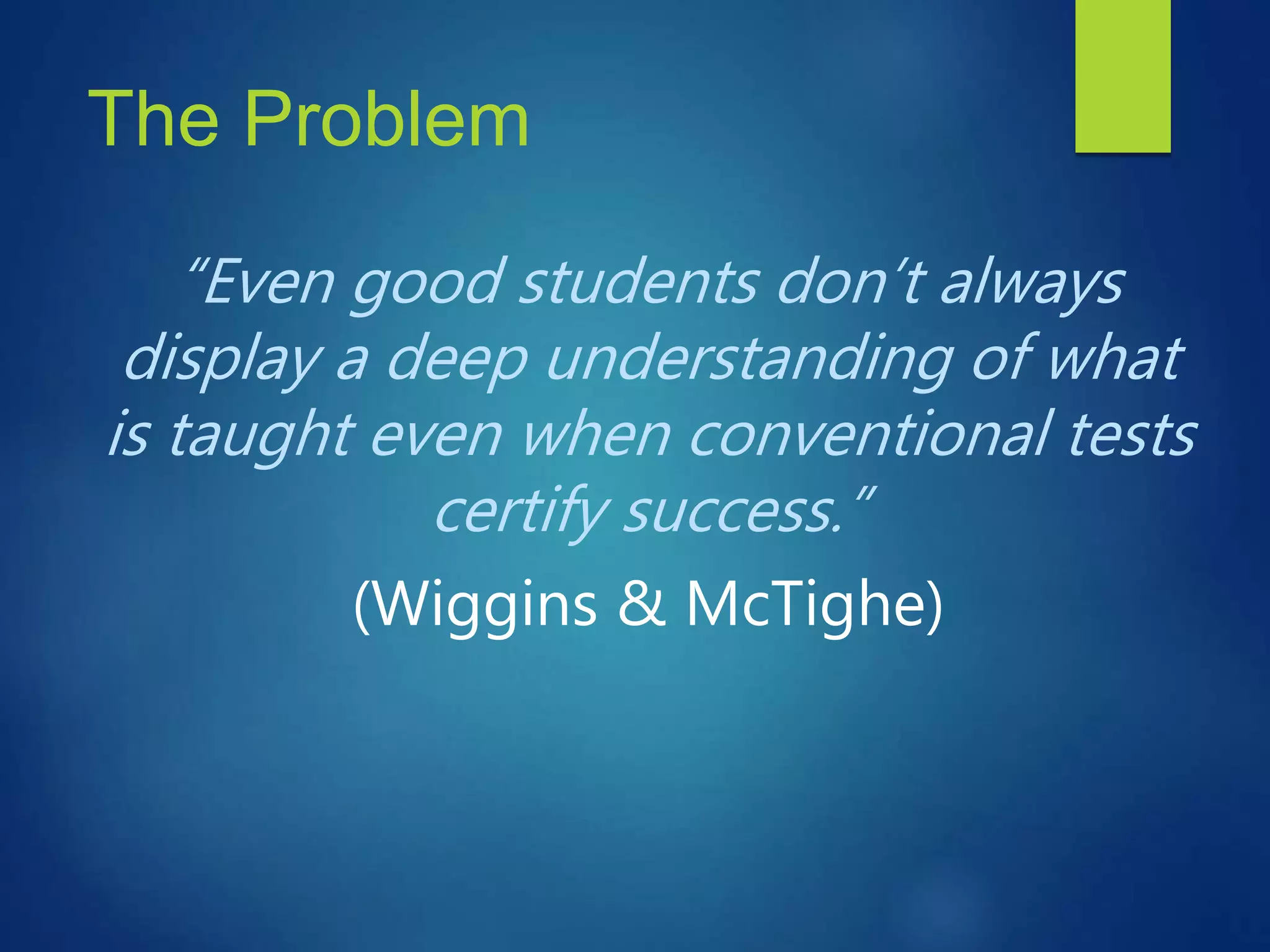
“Even good students don’t always
display a deep understanding of what
is taught even when conventional tests
certify success.”
(Wiggins & McTighe)
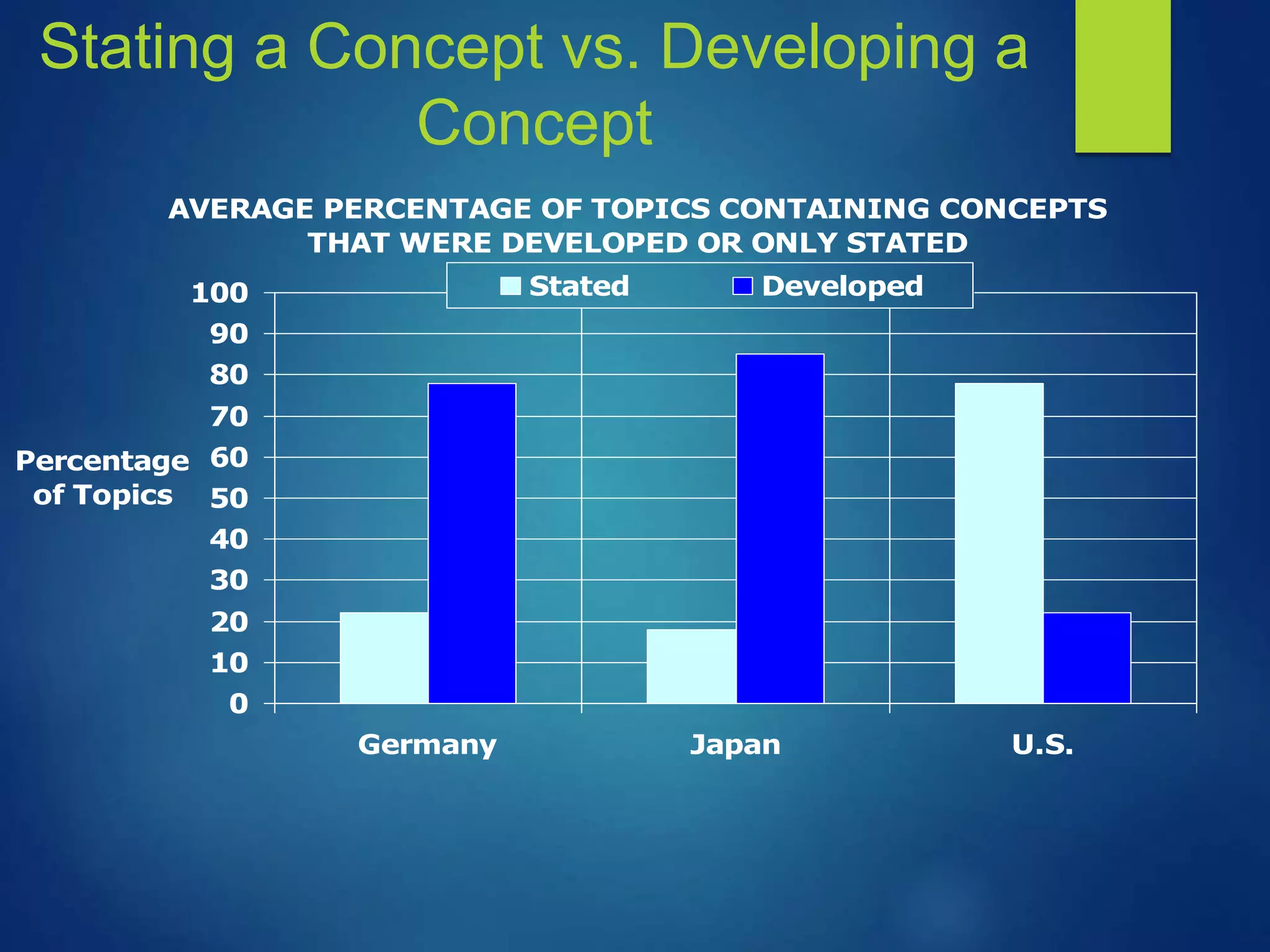
Stating a Concept vs. Developing a
Concept
AVERAGE PERCENTAGE OF TOPICS CONTAINING CONCEPTS
THAT WERE DEVELOPED OR ONLY STATED
0
10
20
30
40
50
60
70
80
90
100
Germany Japan U.S.
Percentage
of Topics
Stated Developed
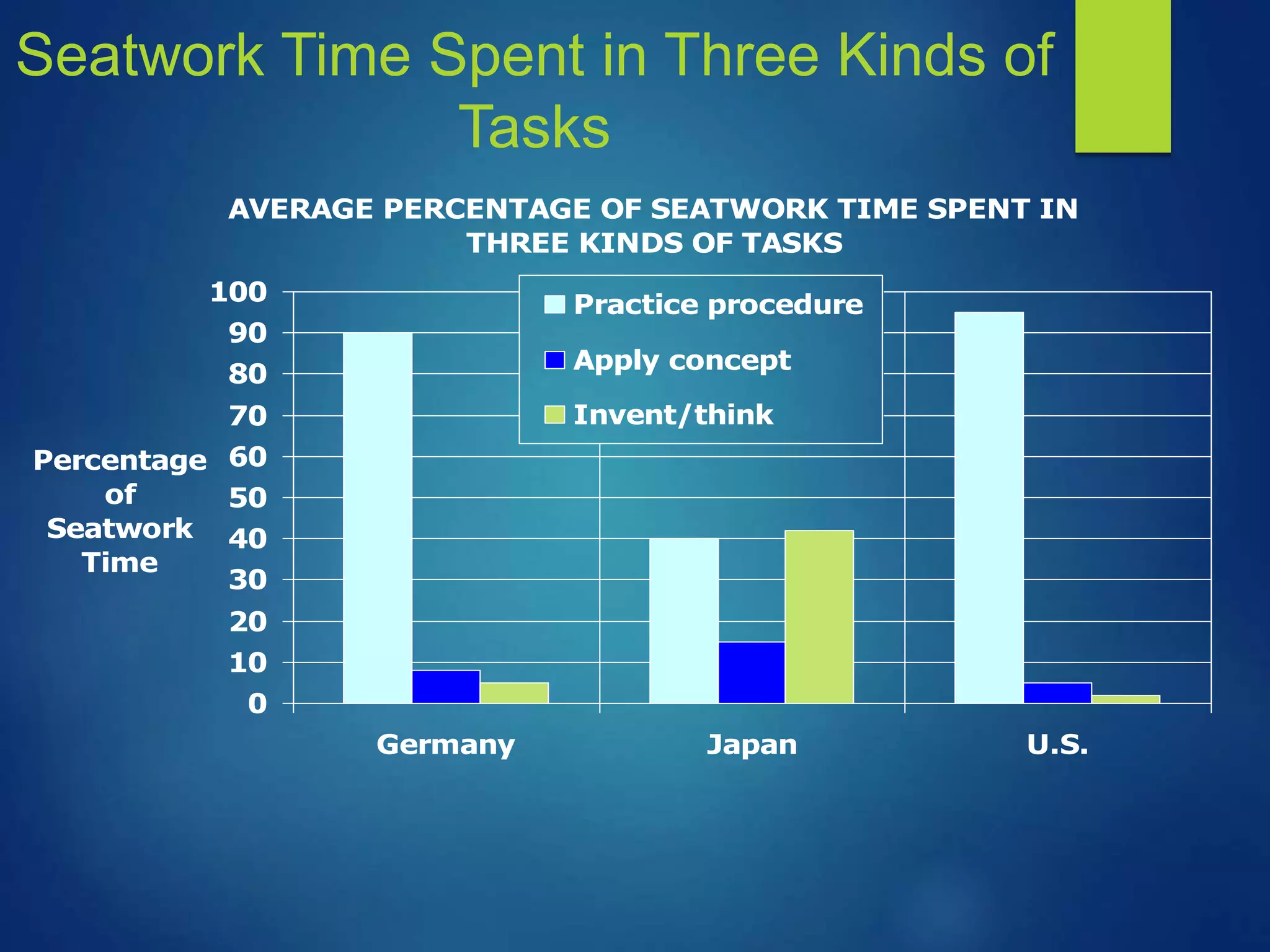
Seatwork Time Spent in Three Kinds of
Tasks
AVERAGE PERCENTAGE OF SEATWORK TIME SPENT IN
THREE KINDS OF TASKS
0
10
20
30
40
50
60
70
80
90
100
Germany Japan U.S.
Percentage
of
Seatwork
Time
Practice procedure
Apply concept
Invent/think
The Question
 So, the question is:
“How do your courses contribute to
academic achievement in your school?”
 Develop curricula that makes a difference
Curriculum is a Means to an End
 Focus on a topic that matters
 Use instructional methods that engage
 Cause deep and enduring learning related
to an important standard
Is it important enough to remember when the
student is 50 years old?
What is Backward Design?
 BD Begins with the end in mind:
Starting with a clear understanding of the
destination
Making sure that you are taking steps in the
right direction (Stephen Covey)
Is justifiable and reliable
Unfortunately, Many Teachers:
Begin with a favored lesson, time-
honored activities (or the next
page in the text)
Backwards design starts with the
end (the desired results).
Backwards Design
We begin BD with the following
question:
What would I accept as evidence that
students have attained the desired
understandings/performances?
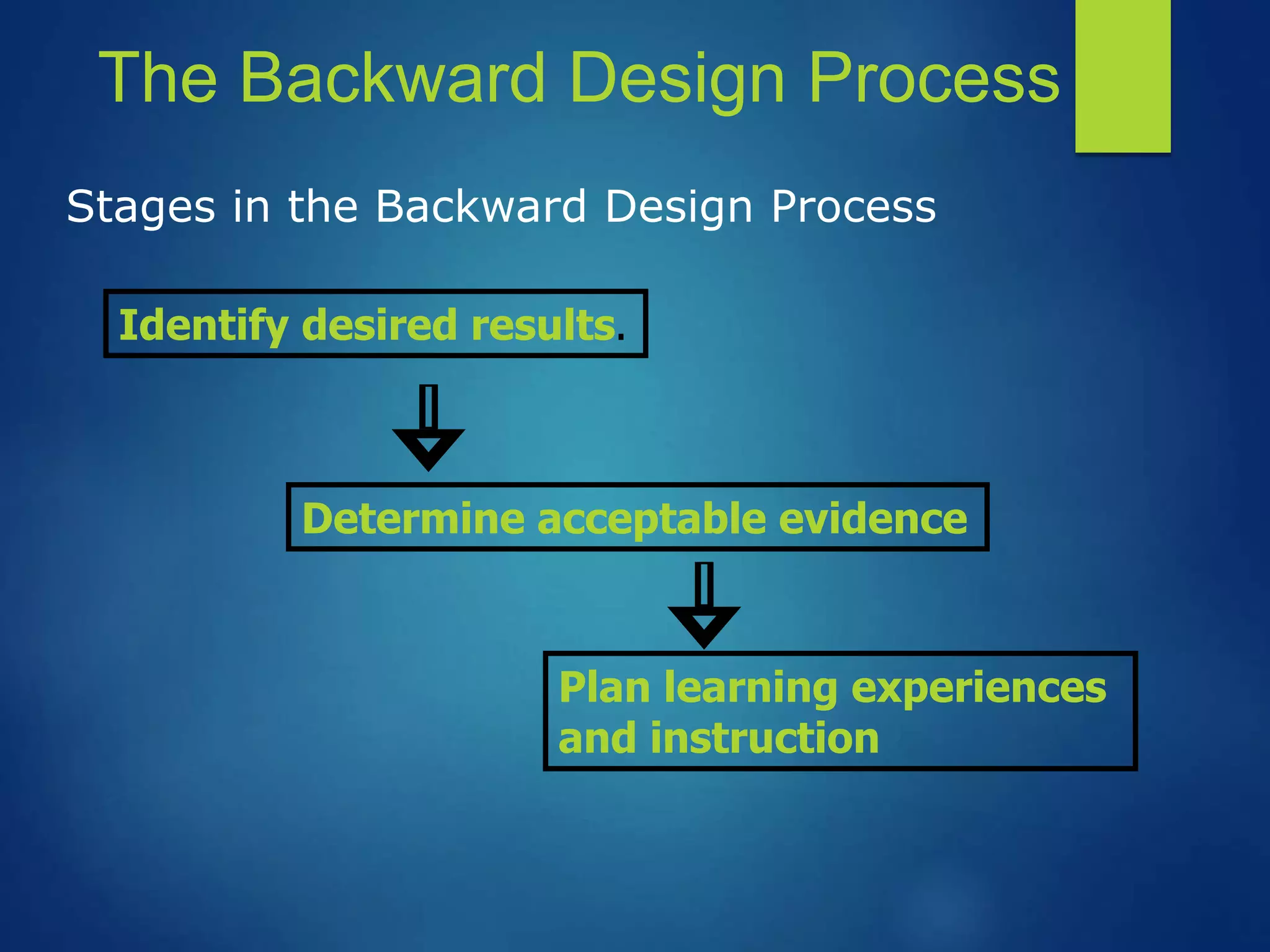
The Backward Design Process
Identify desired results.
Stages in the Backward Design Process
Determine acceptable evidence
Plan learning experiences
and instruction
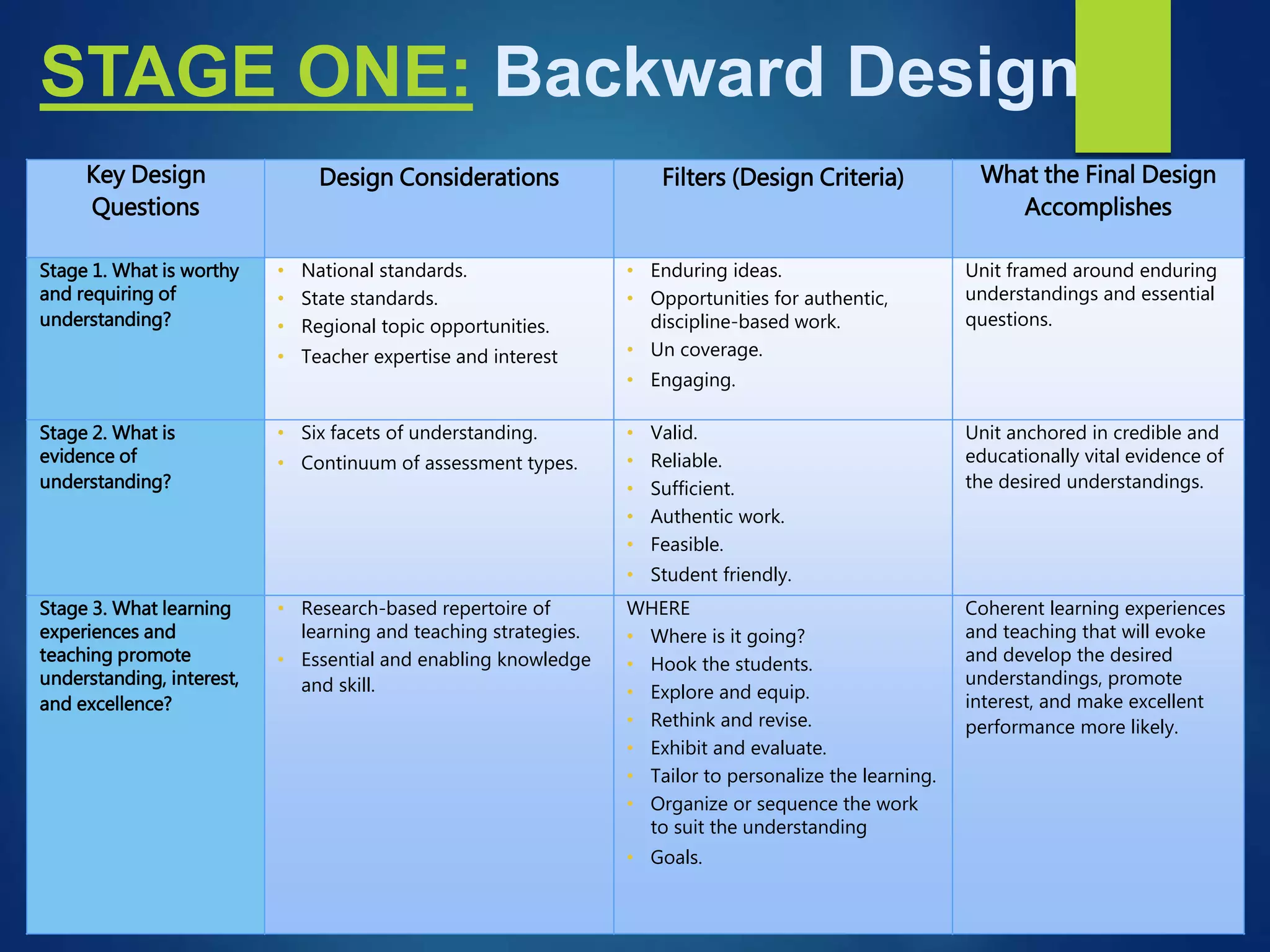
STAGE ONE: Backward Design
Key Design
Questions
Design Considerations Filters (Design Criteria) What the Final Design
Accomplishes
Stage 1. What is worthy
and requiring of
understanding?
• National standards.
• State standards.
• Regional topic opportunities.
• Teacher expertise and interest
• Enduring ideas.
• Opportunities for authentic,
discipline-based work.
• Un coverage.
• Engaging.
Unit framed around enduring
understandings and essential
questions.
Stage 2. What is
evidence of
understanding?
• Six facets of understanding.
• Continuum of assessment types.
• Valid.
• Reliable.
• Sufficient.
• Authentic work.
• Feasible.
• Student friendly.
Unit anchored in credible and
educationally vital evidence of
the desired understandings.
Stage 3. What learning
experiences and
teaching promote
understanding, interest,
and excellence?
• Research-based repertoire of
learning and teaching strategies.
• Essential and enabling knowledge
and skill.
WHERE
• Where is it going?
• Hook the students.
• Explore and equip.
• Rethink and revise.
• Exhibit and evaluate.
• Tailor to personalize the learning.
• Organize or sequence the work
to suit the understanding
• Goals.
Coherent learning experiences
and teaching that will evoke
and develop the desired
understandings, promote
interest, and make excellent
performance more likely.
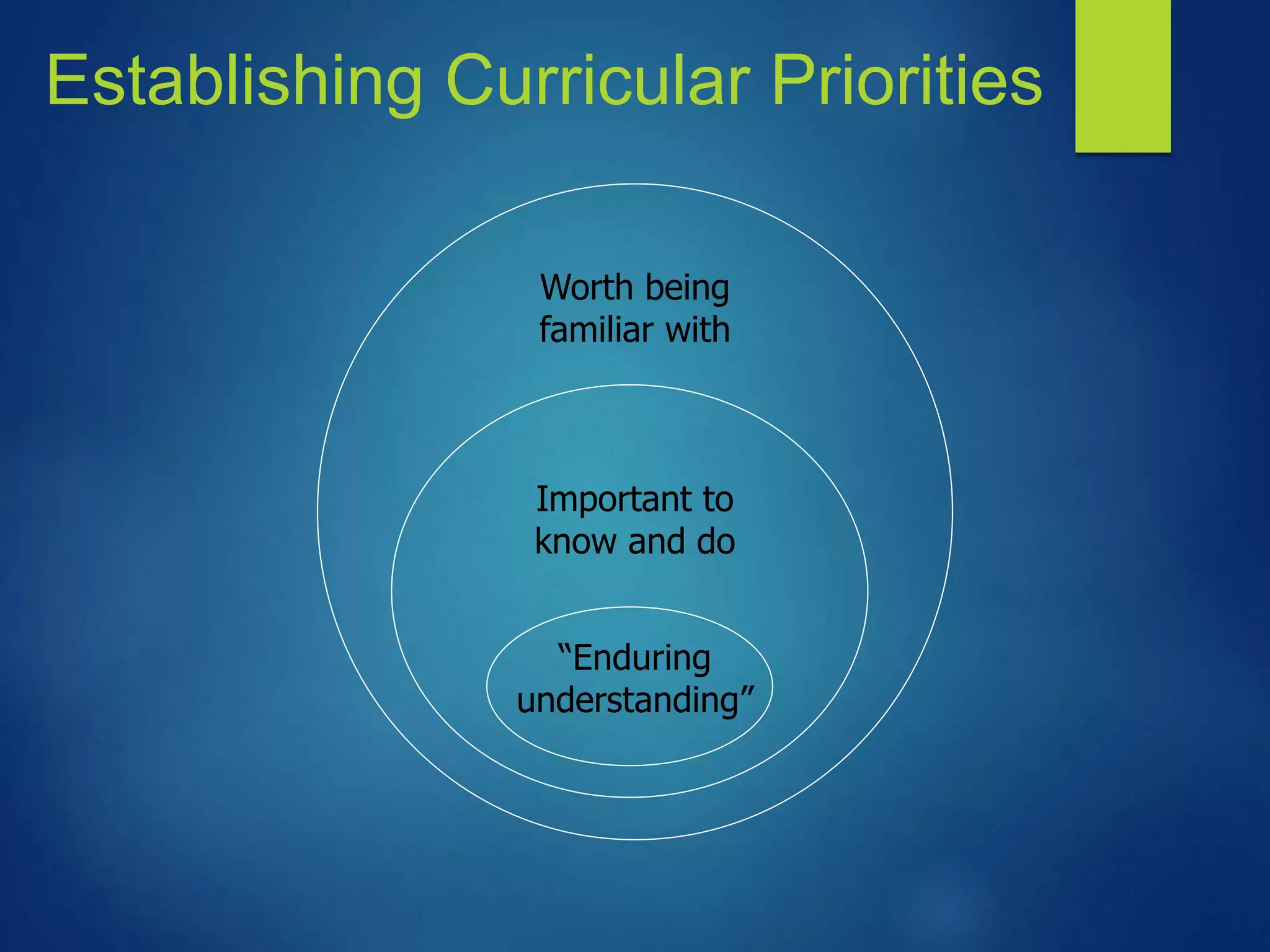
Establishing Curricular Priorities
“Enduring
understanding”
Important to
know and do
Worth being
familiar with
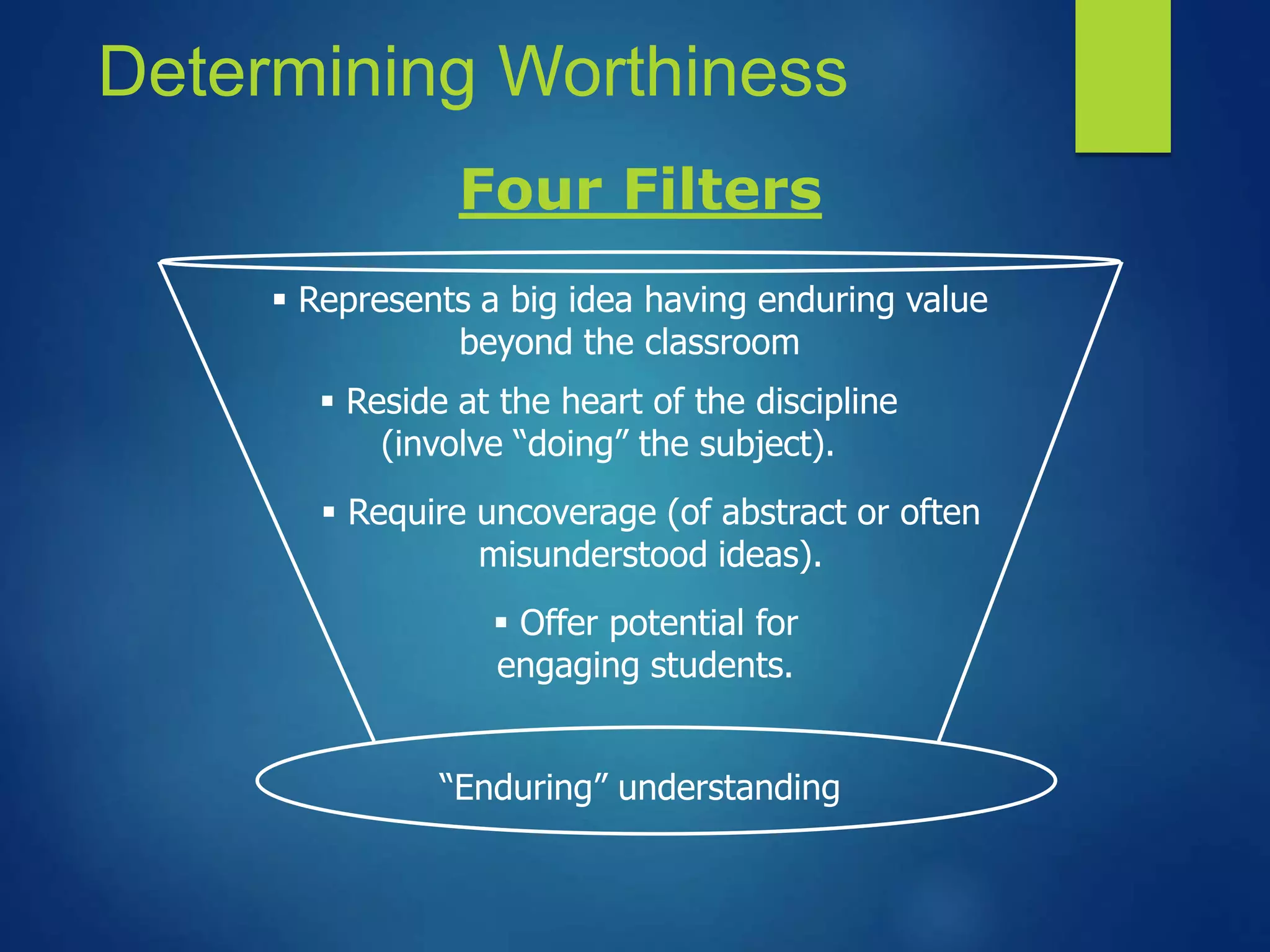
Determining Worthiness
 Represents a big idea having enduring value
beyond the classroom
 Reside at the heart of the discipline
(involve “doing” the subject).
“Enduring” understanding
 Require uncoverage (of abstract or often
misunderstood ideas).
 Offer potential for
engaging students.
Four Filters
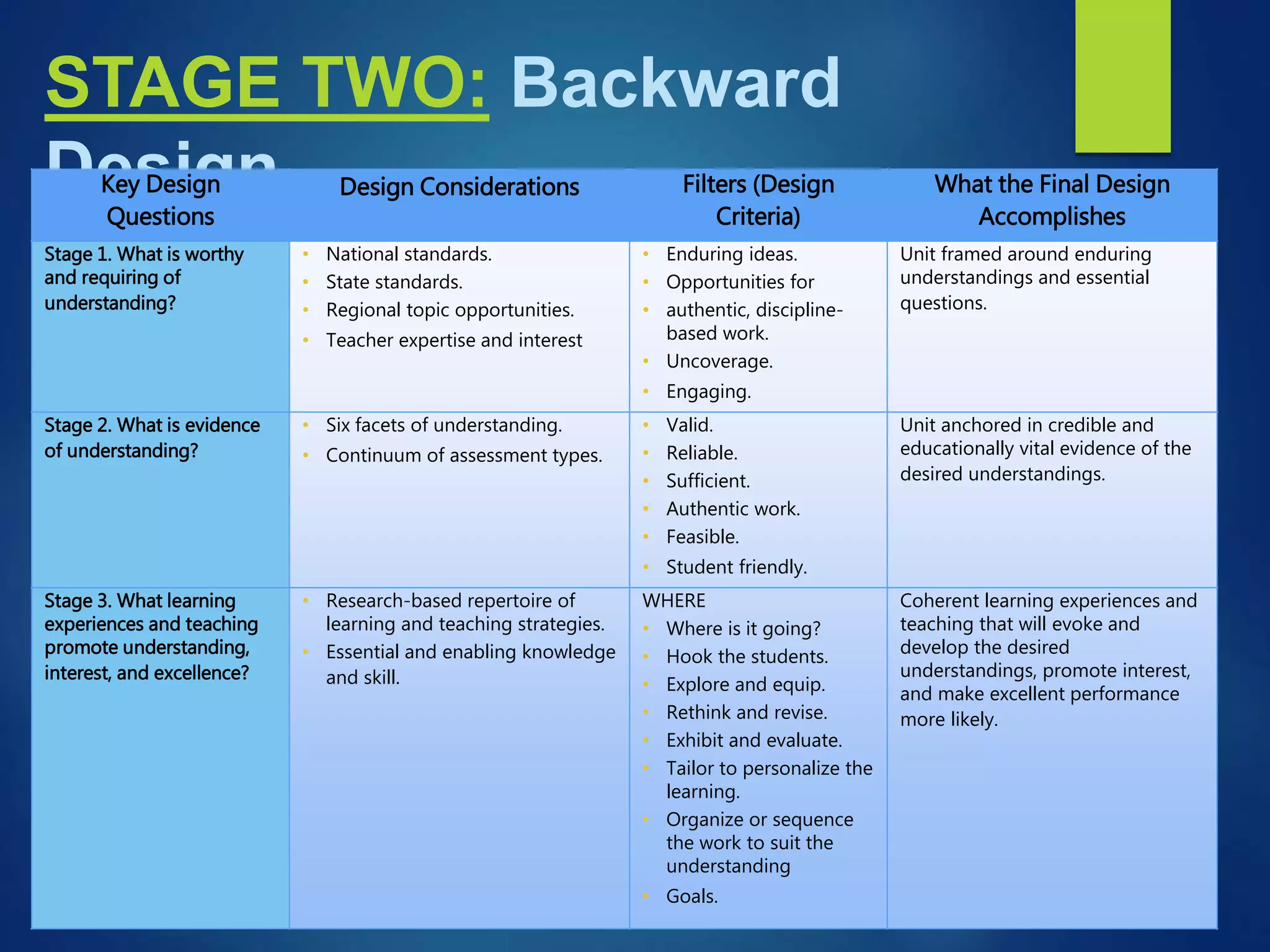
STAGE TWO: Backward
DesignKey Design
Questions
Design Considerations Filters (Design
Criteria)
What the Final Design
Accomplishes
Stage 1. What is worthy
and requiring of
understanding?
• National standards.
• State standards.
• Regional topic opportunities.
• Teacher expertise and interest
• Enduring ideas.
• Opportunities for
• authentic, discipline-
based work.
• Uncoverage.
• Engaging.
Unit framed around enduring
understandings and essential
questions.
Stage 2. What is evidence
of understanding?
• Six facets of understanding.
• Continuum of assessment types.
• Valid.
• Reliable.
• Sufficient.
• Authentic work.
• Feasible.
• Student friendly.
Unit anchored in credible and
educationally vital evidence of the
desired understandings.
Stage 3. What learning
experiences and teaching
promote understanding,
interest, and excellence?
• Research-based repertoire of
learning and teaching strategies.
• Essential and enabling knowledge
and skill.
WHERE
• Where is it going?
• Hook the students.
• Explore and equip.
• Rethink and revise.
• Exhibit and evaluate.
• Tailor to personalize the
learning.
• Organize or sequence
the work to suit the
understanding
• Goals.
Coherent learning experiences and
teaching that will evoke and
develop the desired
understandings, promote interest,
and make excellent performance
more likely.
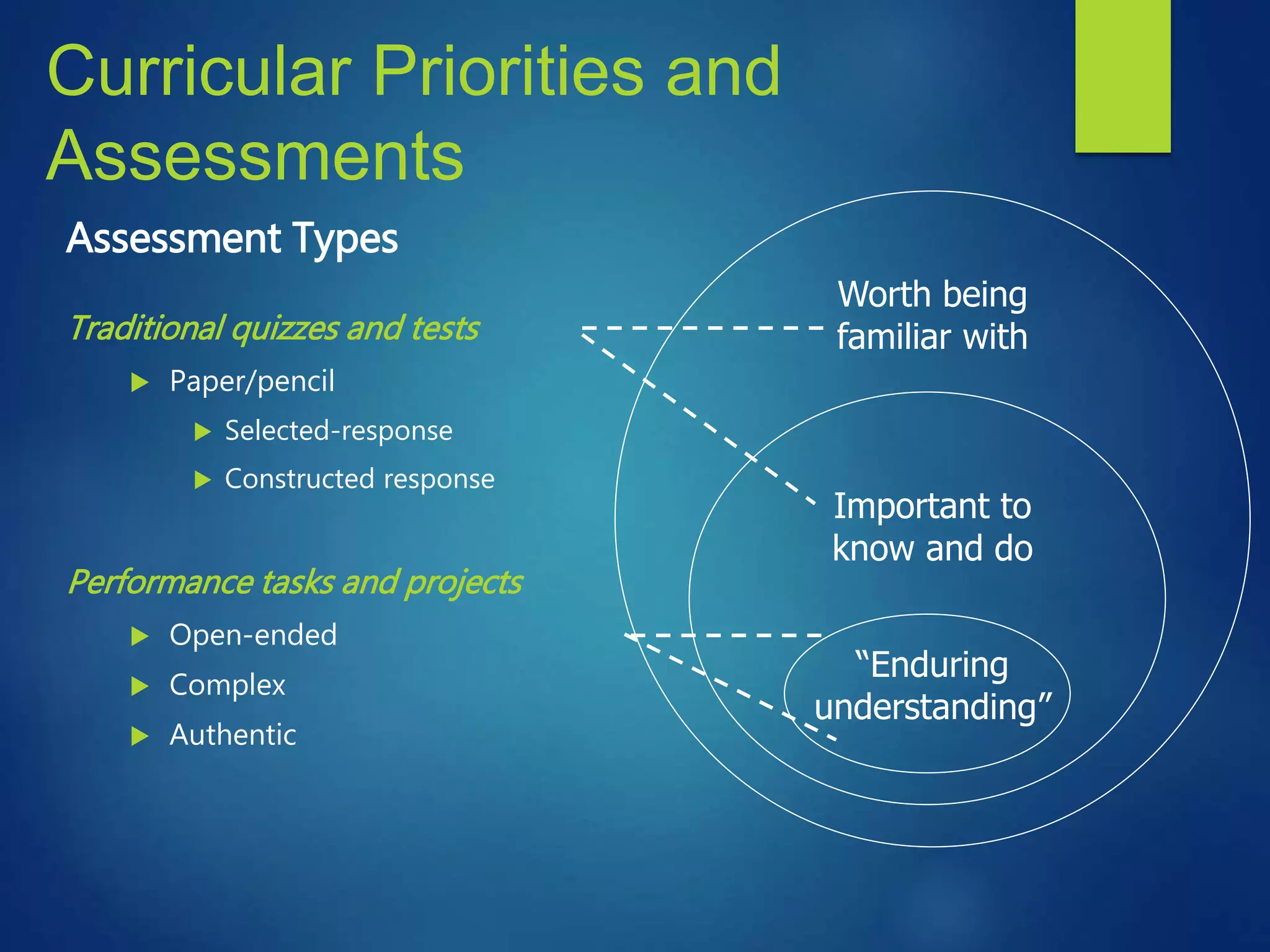
Curricular Priorities and
Assessments
Assessment Types
Traditional quizzes and tests
 Paper/pencil
 Selected-response
 Constructed response
Performance tasks and projects
 Open-ended
 Complex
 Authentic
“Enduring
understanding”
Important to
know and do
Worth being
familiar with
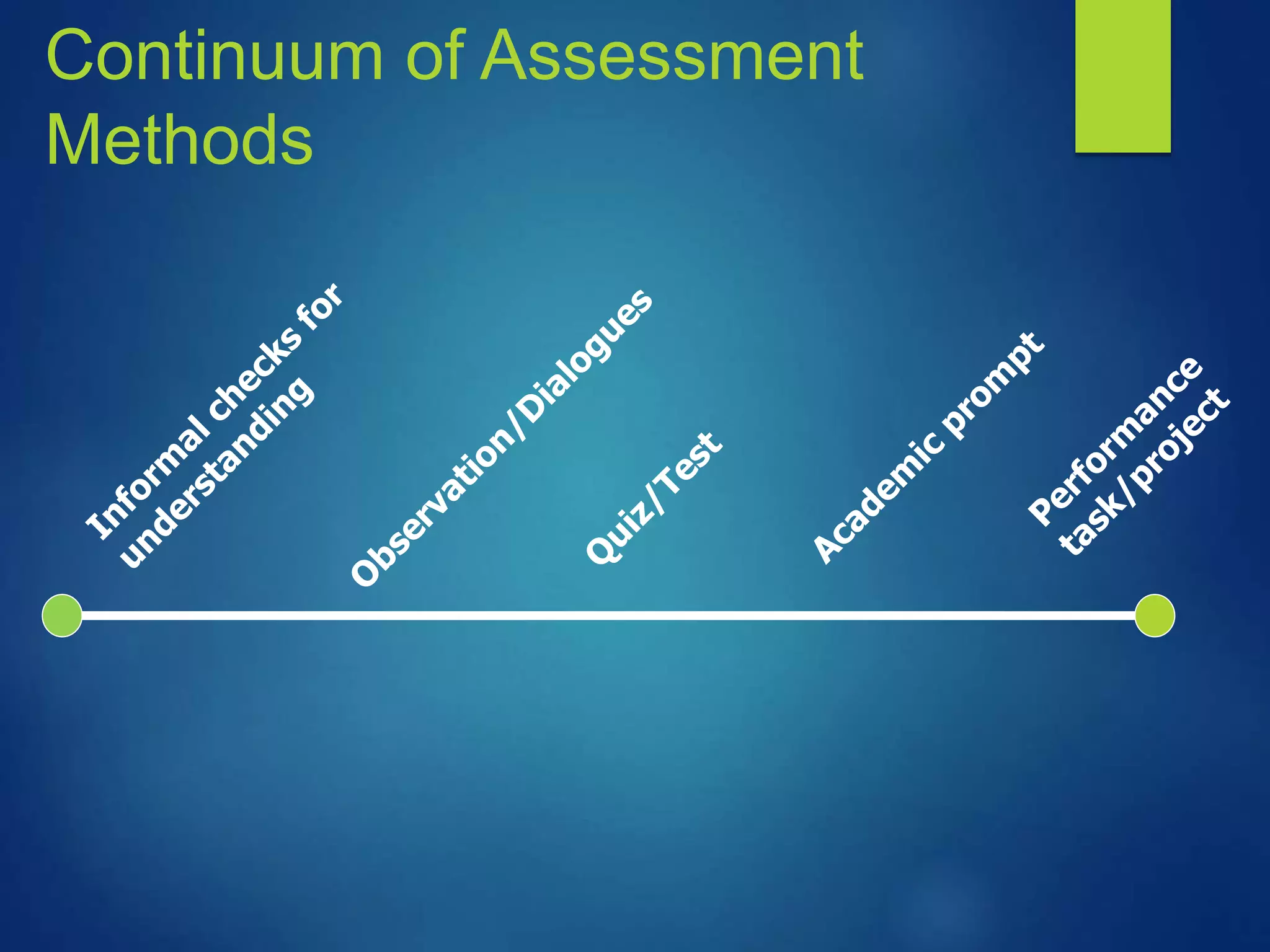
Continuum of Assessment
Methods
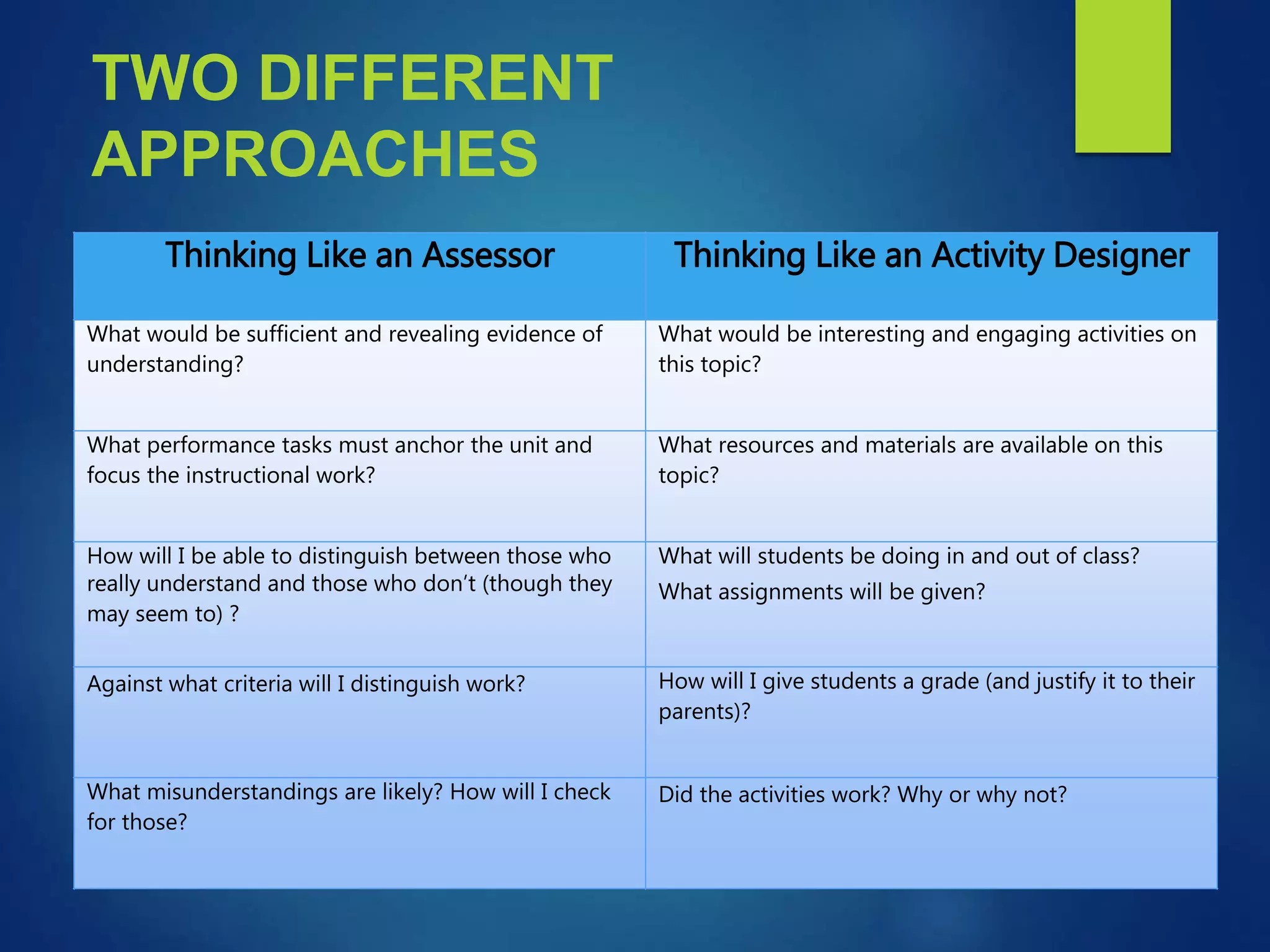
TWO DIFFERENT
APPROACHES
Thinking Like an Assessor Thinking Like an Activity Designer
What would be sufficient and revealing evidence of
understanding?
What would be interesting and engaging activities on
this topic?
What performance tasks must anchor the unit and
focus the instructional work?
What resources and materials are available on this
topic?
How will I be able to distinguish between those who
really understand and those who don’t (though they
may seem to) ?
What will students be doing in and out of class?
What assignments will be given?
Against what criteria will I distinguish work? How will I give students a grade (and justify it to their
parents)?
What misunderstandings are likely? How will I check
for those?
Did the activities work? Why or why not?
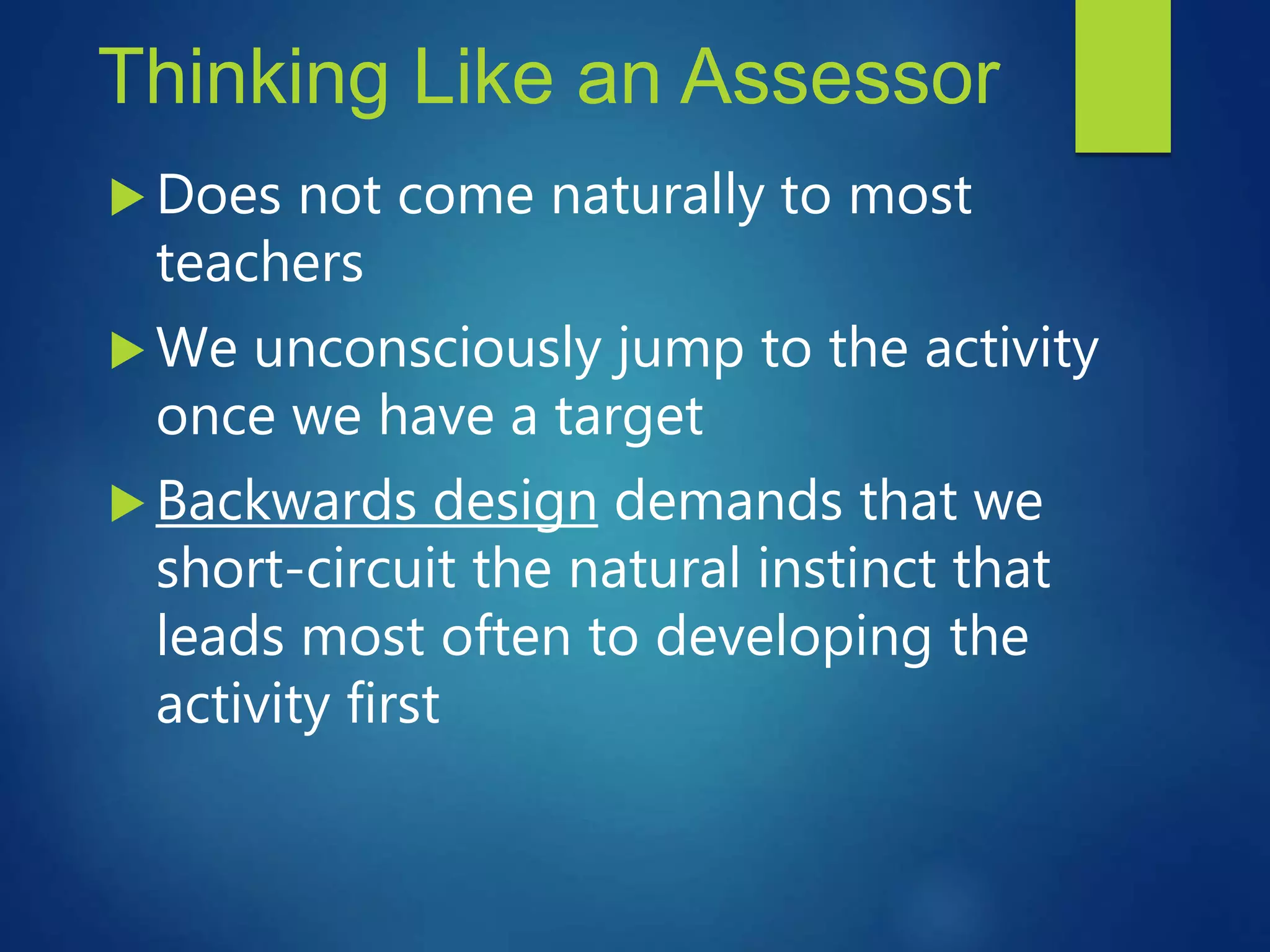
Thinking Like an Assessor
 Does not come naturally to most
teachers
 We unconsciously jump to the activity
once we have a target
 Backwards design demands that we
short-circuit the natural instinct that
leads most often to developing the
activity first
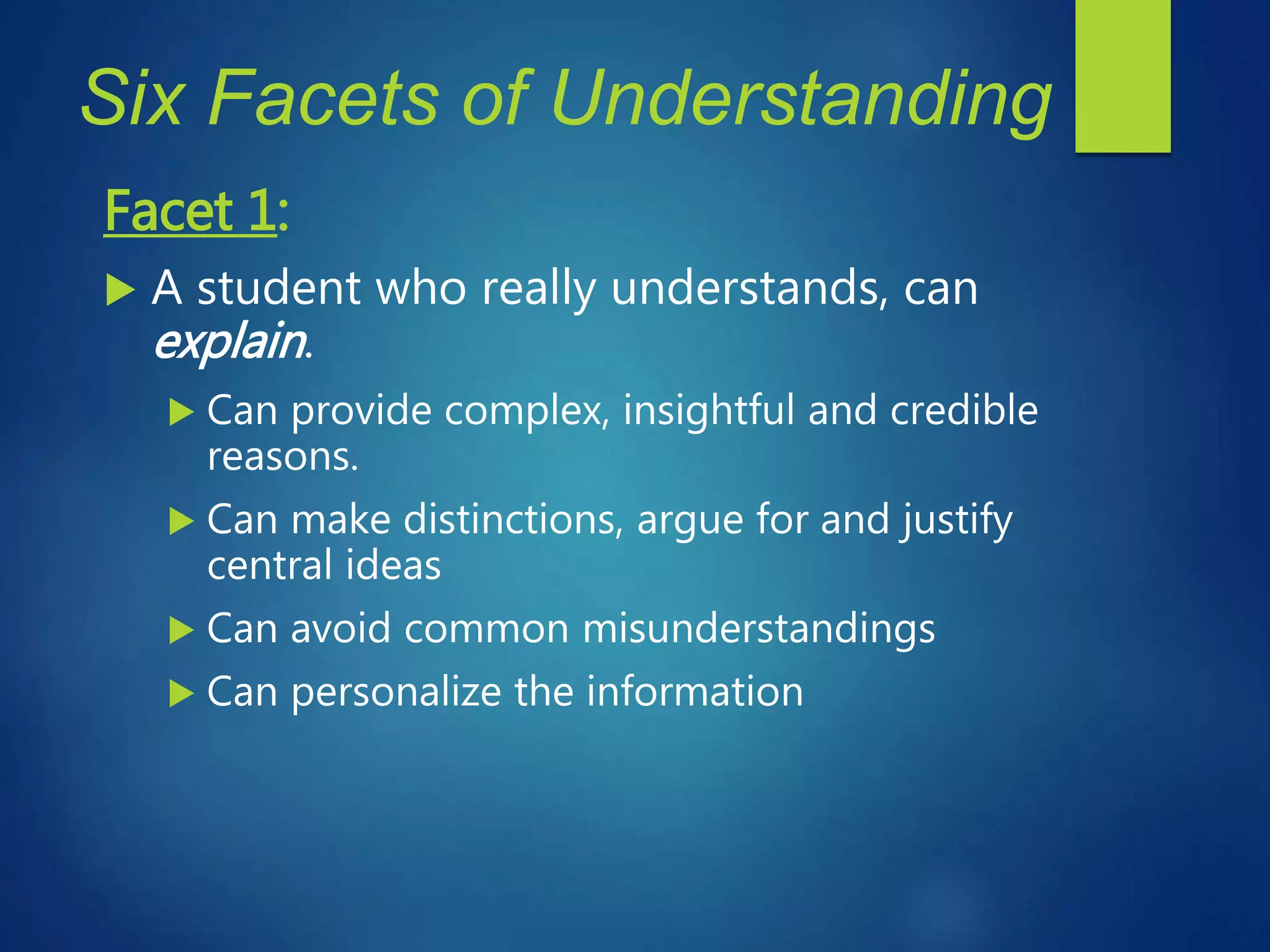
Six Facets of Understanding
Facet 1:
 A student who really understands, can
explain.
 Can provide complex, insightful and credible
reasons.
 Can make distinctions, argue for and justify
central ideas
 Can avoid common misunderstandings
 Can personalize the information
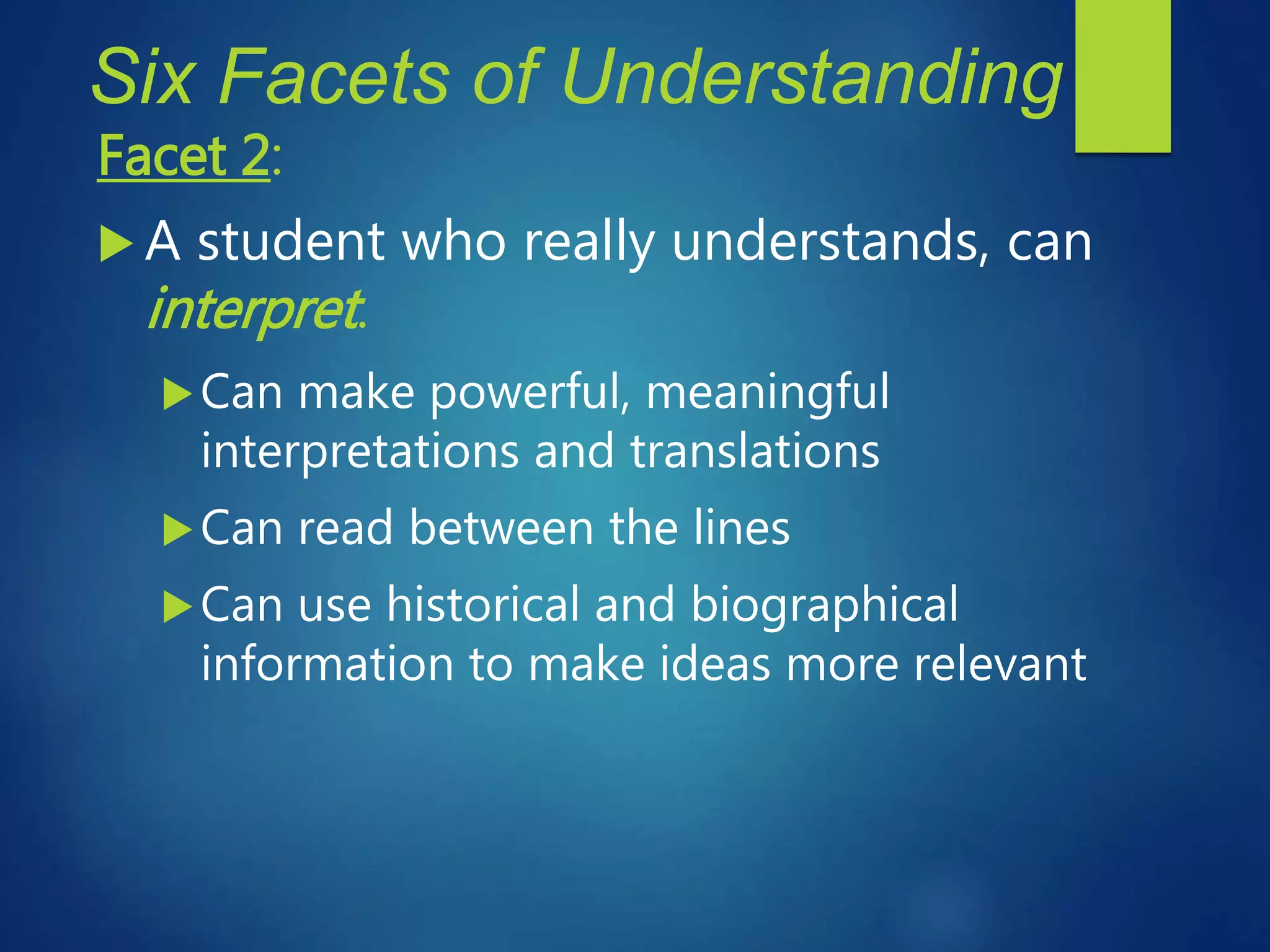
Six Facets of Understanding
Facet 2:
 A student who really understands, can
interpret.
Can make powerful, meaningful
interpretations and translations
Can read between the lines
Can use historical and biographical
information to make ideas more relevant
Six Facets of Understanding
Facet 3:
 A student who really understands, can apply.
 Can extend what he/she knows to realistic,
hands-on situations
 Can make adjustments along the way
 Can apply knowledge in a variety of settings
Six Facets of Understanding
Facet 4:
 A student who really understands, sees
in perspective.
Can critique and justify a position
Understanding the history of an idea
Know the limits as well as the power of an
idea
Can see through biased arguments
Six Facets of Understanding
Facet 5:
 A student who really understands,
demonstrates empathy.
 Can appreciates another’s situation
 Can see when even flawed ideas are plausible
 Can describe how an idea could be misunderstood
by others
 Can listen and hear what others often do not
Six Facets of Understanding
Facet 6:
 A student who really understands, reveals
self-knowledge.
 Can recognize own prejudices and style
 Can think about thinking
 Can question his/her own convictions
 Can self-assess
 Can accept feedback/criticism without
defensiveness
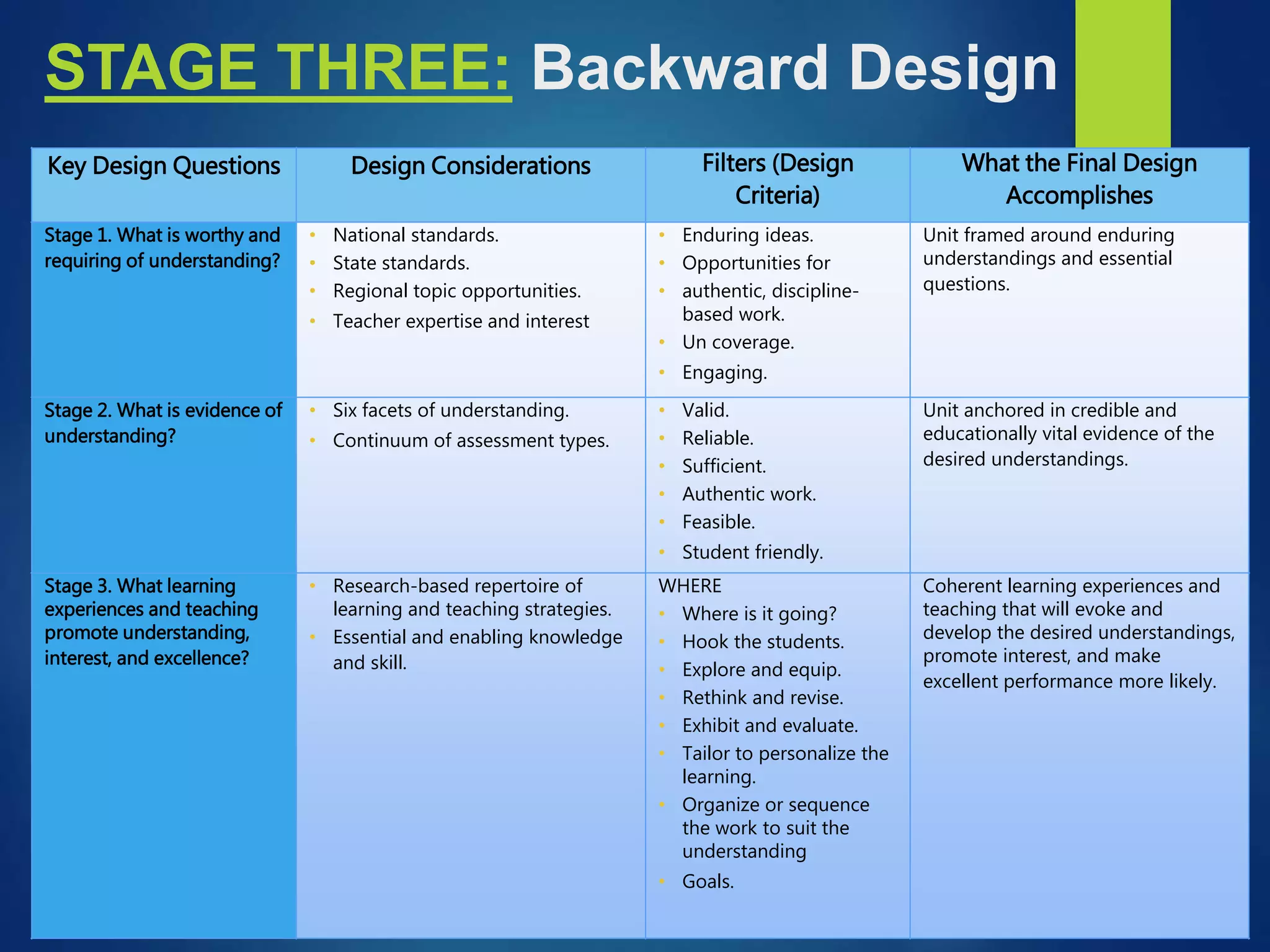
STAGE THREE: Backward Design
Key Design Questions Design Considerations Filters (Design
Criteria)
What the Final Design
Accomplishes
Stage 1. What is worthy and
requiring of understanding?
• National standards.
• State standards.
• Regional topic opportunities.
• Teacher expertise and interest
• Enduring ideas.
• Opportunities for
• authentic, discipline-
based work.
• Un coverage.
• Engaging.
Unit framed around enduring
understandings and essential
questions.
Stage 2. What is evidence of
understanding?
• Six facets of understanding.
• Continuum of assessment types.
• Valid.
• Reliable.
• Sufficient.
• Authentic work.
• Feasible.
• Student friendly.
Unit anchored in credible and
educationally vital evidence of the
desired understandings.
Stage 3. What learning
experiences and teaching
promote understanding,
interest, and excellence?
• Research-based repertoire of
learning and teaching strategies.
• Essential and enabling knowledge
and skill.
WHERE
• Where is it going?
• Hook the students.
• Explore and equip.
• Rethink and revise.
• Exhibit and evaluate.
• Tailor to personalize the
learning.
• Organize or sequence
the work to suit the
understanding
• Goals.
Coherent learning experiences and
teaching that will evoke and
develop the desired understandings,
promote interest, and make
excellent performance more likely.
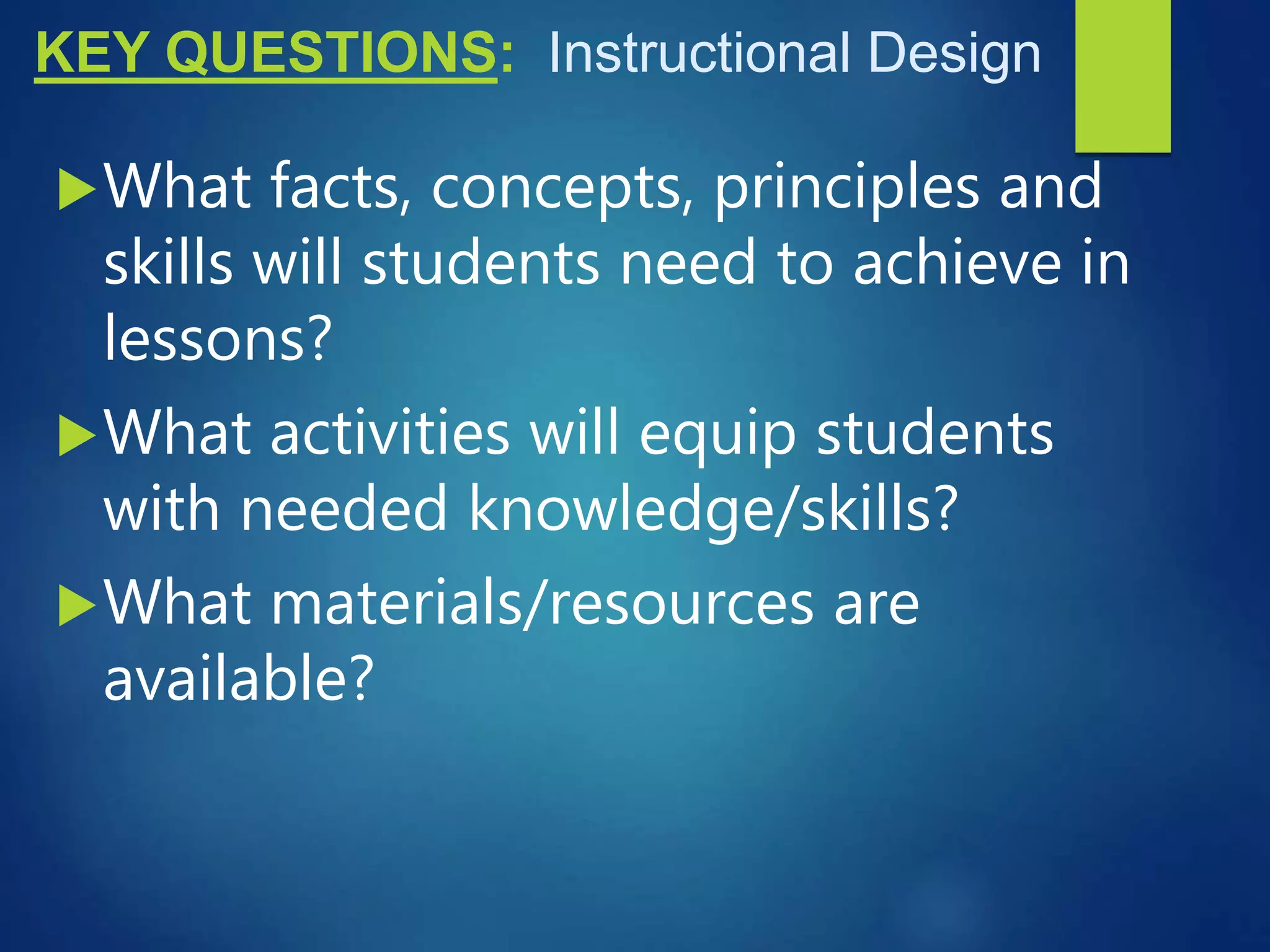
KEY QUESTIONS: Instructional Design
What facts, concepts, principles and
skills will students need to achieve in
lessons?
What activities will equip students
with needed knowledge/skills?
What materials/resources are
available?
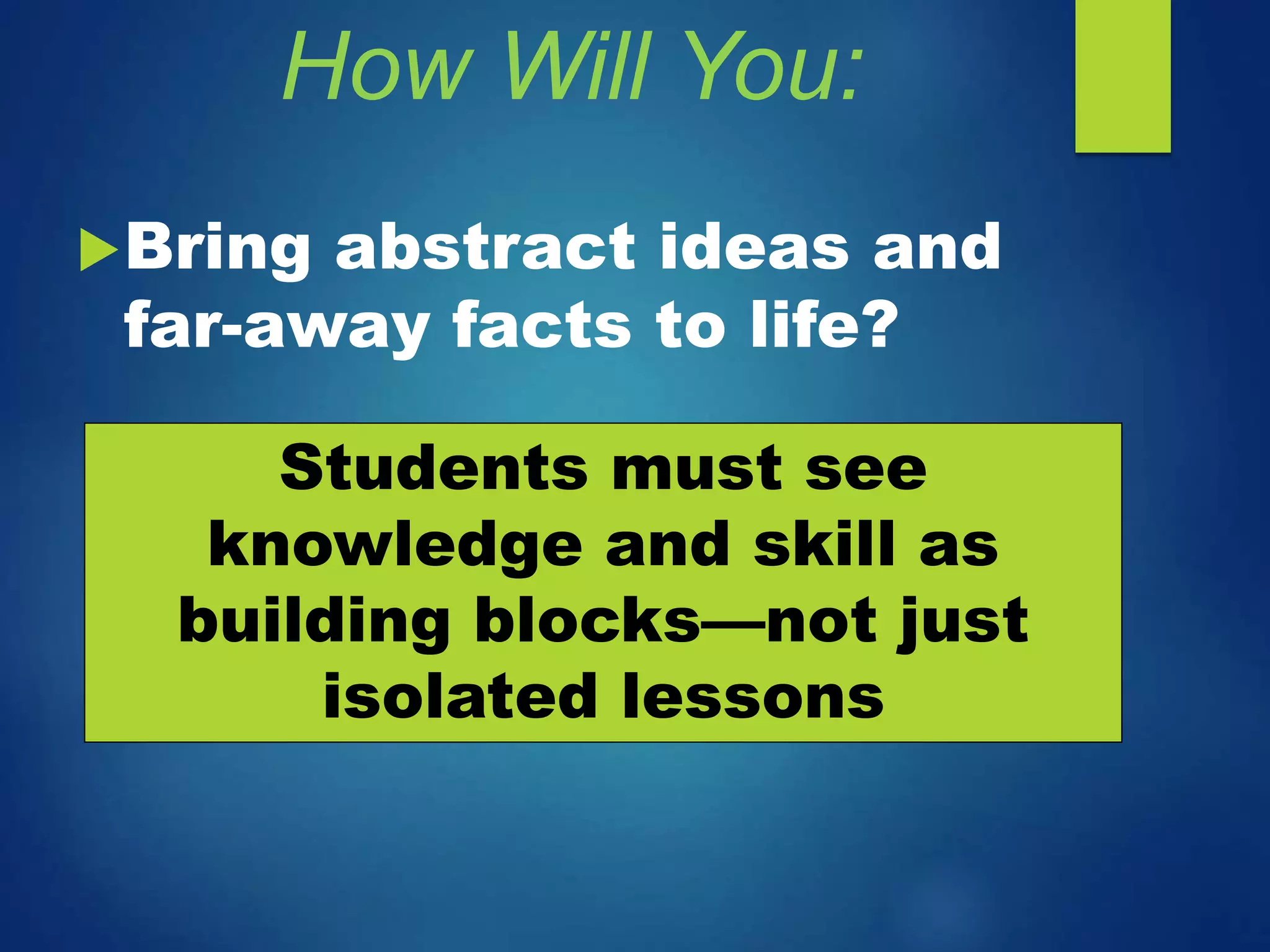
How Will You:
Bring abstract ideas and
far-away facts to life?
Students must see
knowledge and skill as
building blocks—not just
isolated lessons
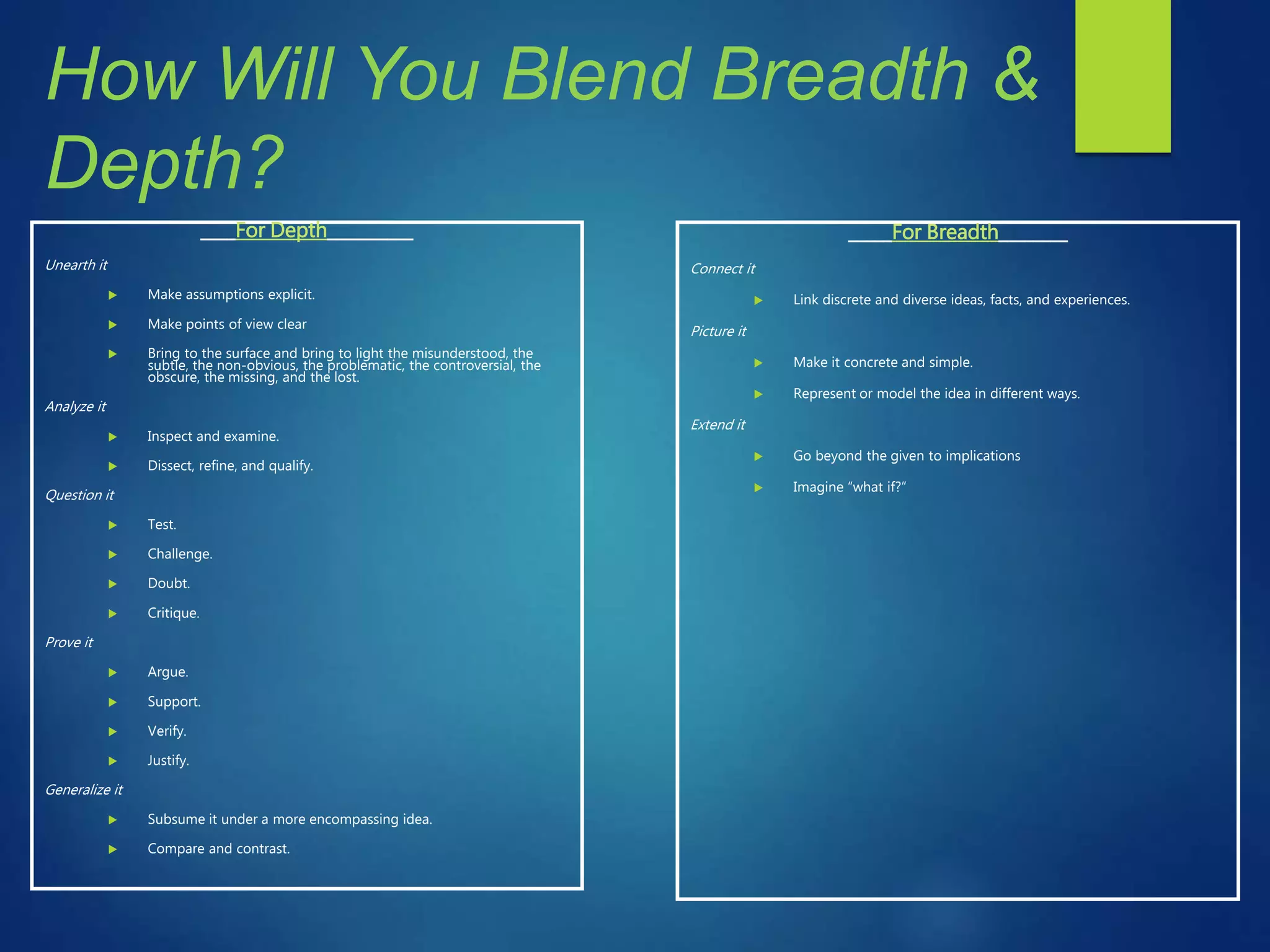
How Will You Blend Breadth &
Depth?
____For Depth__________
Unearth it
 Make assumptions explicit.
 Make points of view clear
 Bring to the surface and bring to light the misunderstood, the
subtle, the non-obvious, the problematic, the controversial, the
obscure, the missing, and the lost.
Analyze it
 Inspect and examine.
 Dissect, refine, and qualify.
Question it
 Test.
 Challenge.
 Doubt.
 Critique.
Prove it
 Argue.
 Support.
 Verify.
 Justify.
Generalize it
 Subsume it under a more encompassing idea.
 Compare and contrast.
_____For Breadth________
Connect it
 Link discrete and diverse ideas, facts, and experiences.
Picture it
 Make it concrete and simple.
 Represent or model the idea in different ways.
Extend it
 Go beyond the given to implications
 Imagine “what if?”
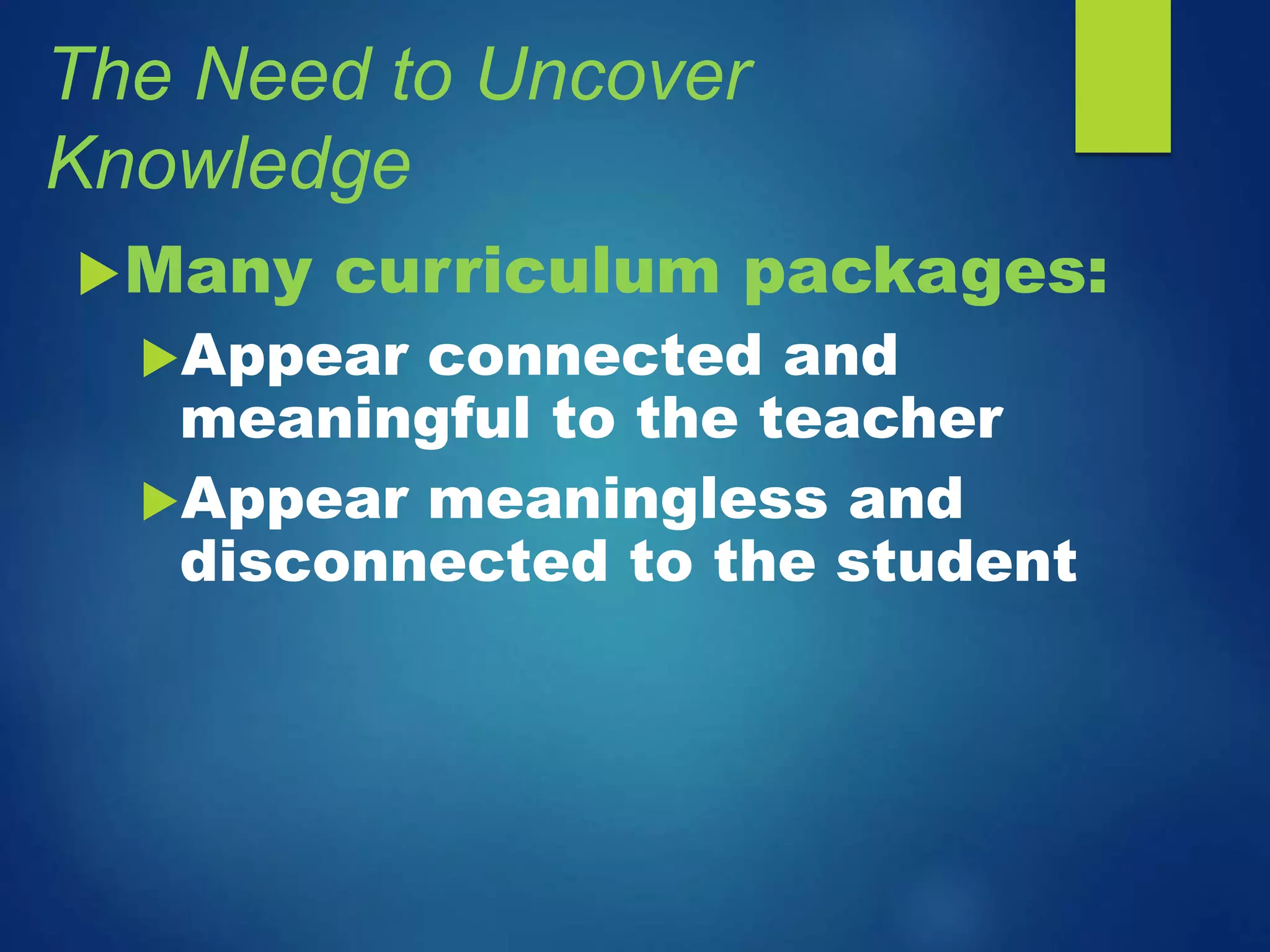
The Need to Uncover
Knowledge
Many curriculum packages:
Appear connected and
meaningful to the teacher
Appear meaningless and
disconnected to the student
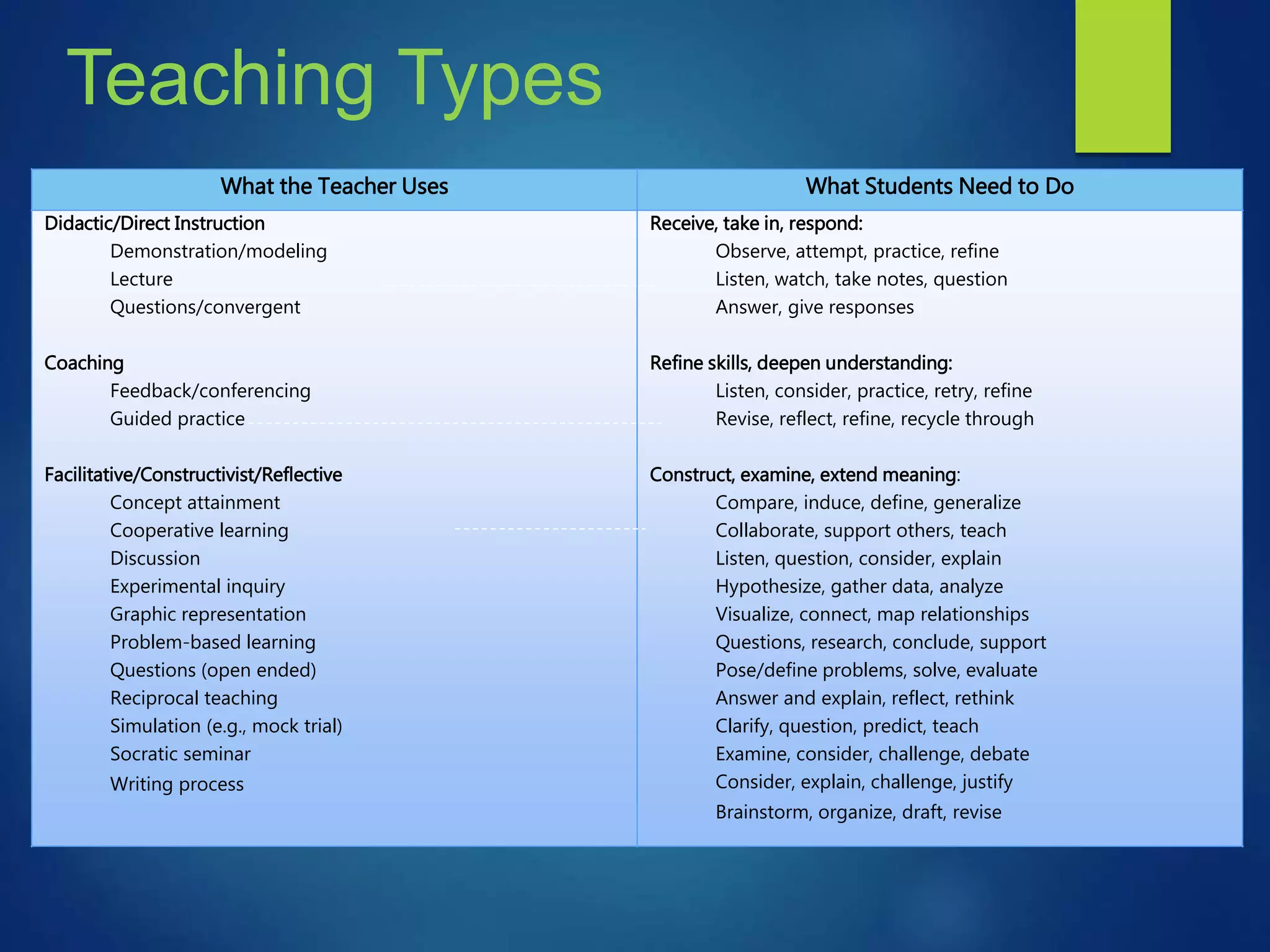
Teaching Types
What the Teacher Uses What Students Need to Do
Didactic/Direct Instruction
Demonstration/modeling
Lecture
Questions/convergent
Coaching
Feedback/conferencing
Guided practice
Facilitative/Constructivist/Reflective
Concept attainment
Cooperative learning
Discussion
Experimental inquiry
Graphic representation
Problem-based learning
Questions (open ended)
Reciprocal teaching
Simulation (e.g., mock trial)
Socratic seminar
Writing process
Receive, take in, respond:
Observe, attempt, practice, refine
Listen, watch, take notes, question
Answer, give responses
Refine skills, deepen understanding:
Listen, consider, practice, retry, refine
Revise, reflect, refine, recycle through
Construct, examine, extend meaning:
Compare, induce, define, generalize
Collaborate, support others, teach
Listen, question, consider, explain
Hypothesize, gather data, analyze
Visualize, connect, map relationships
Questions, research, conclude, support
Pose/define problems, solve, evaluate
Answer and explain, reflect, rethink
Clarify, question, predict, teach
Examine, consider, challenge, debate
Consider, explain, challenge, justify
Brainstorm, organize, draft, revise
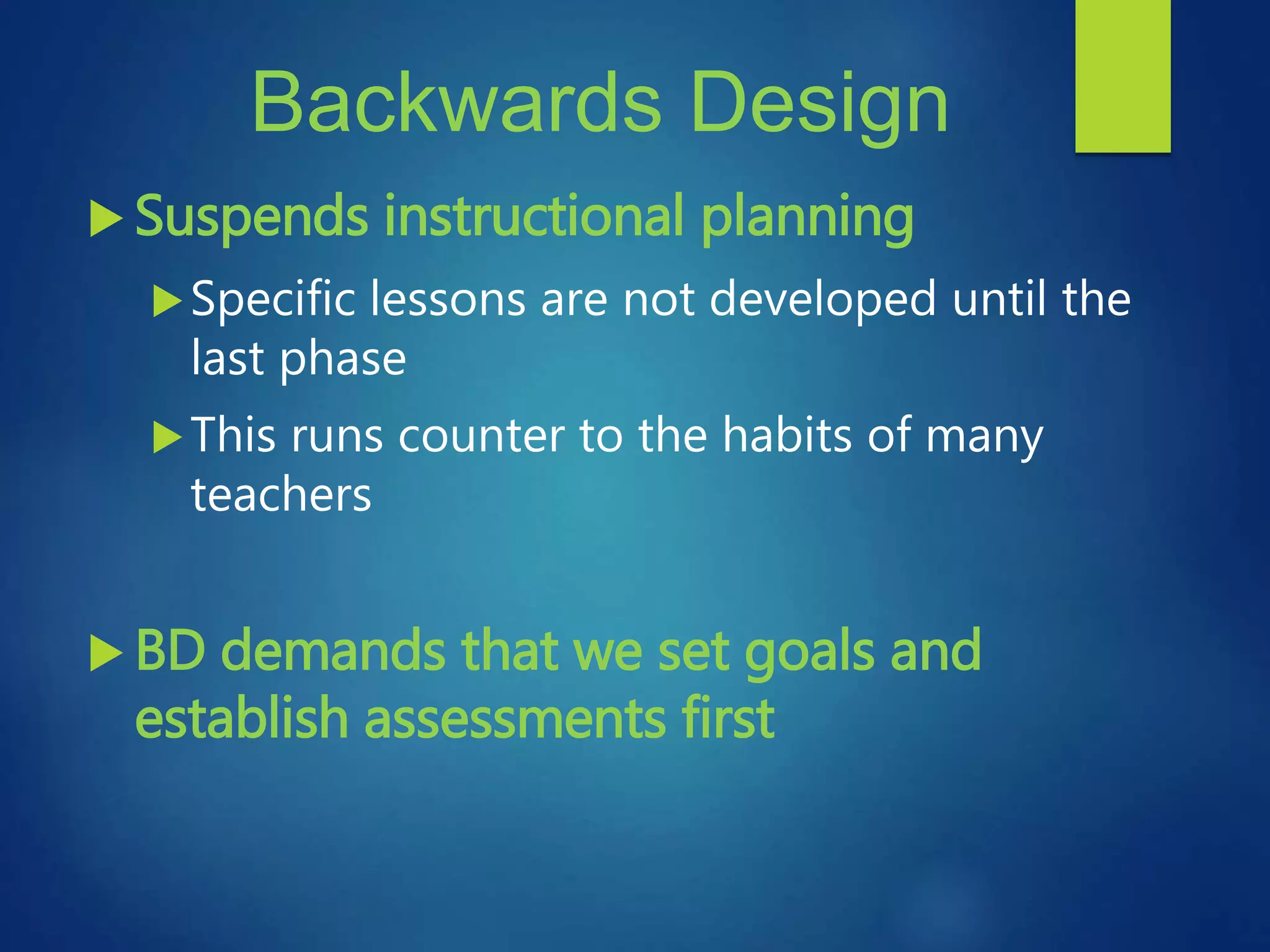
Backwards Design
 Suspends instructional planning
Specific lessons are not developed until the
last phase
This runs counter to the habits of many
teachers
 BD demands that we set goals and
establish assessments first
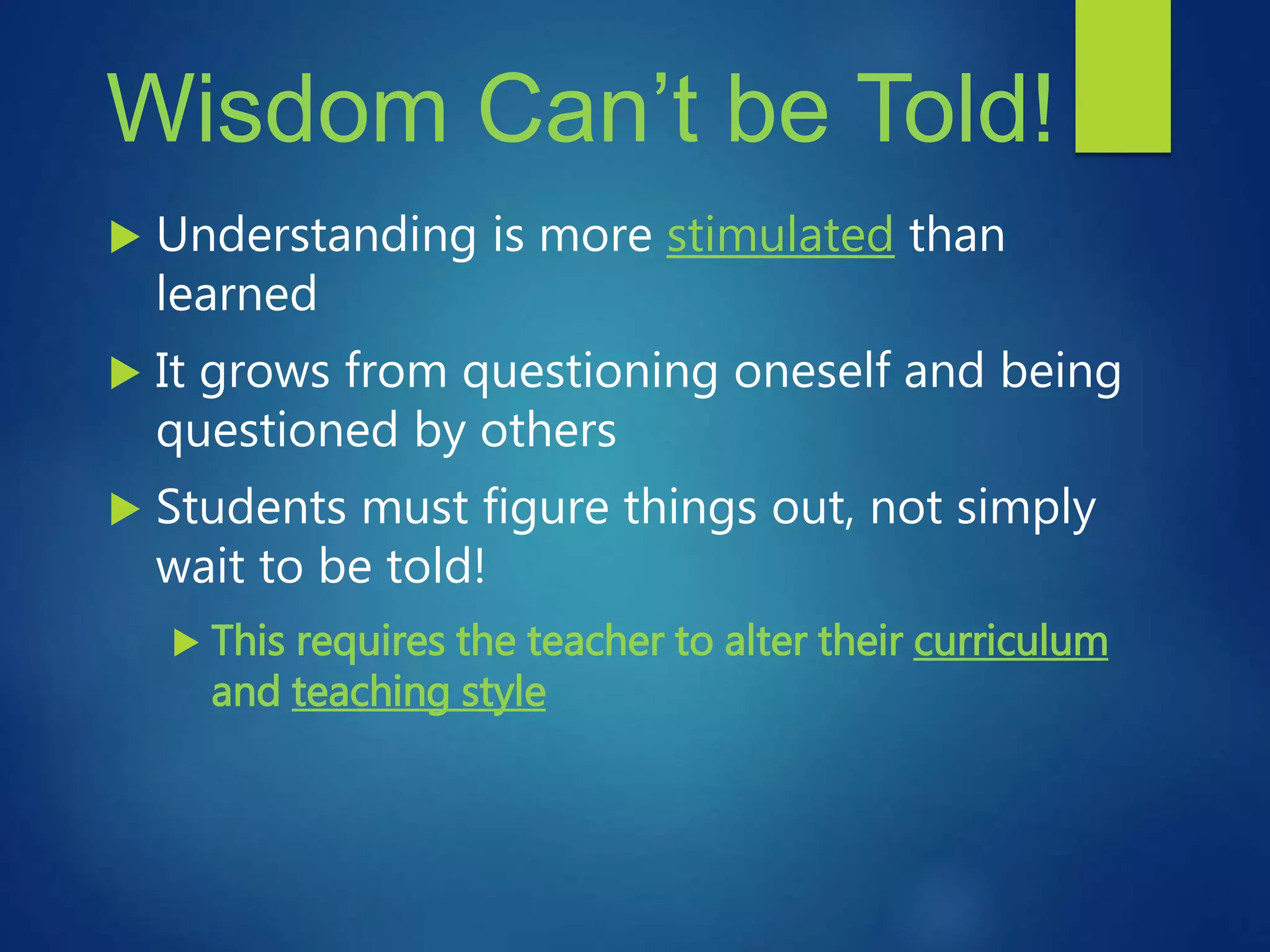
Wisdom Can’t be Told!
 Understanding is more stimulated than
learned
 It grows from questioning oneself and being
questioned by others
 Students must figure things out, not simply
wait to be told!
 This requires the teacher to alter their curriculum
and teaching style
Teaching for Understanding
Requires:
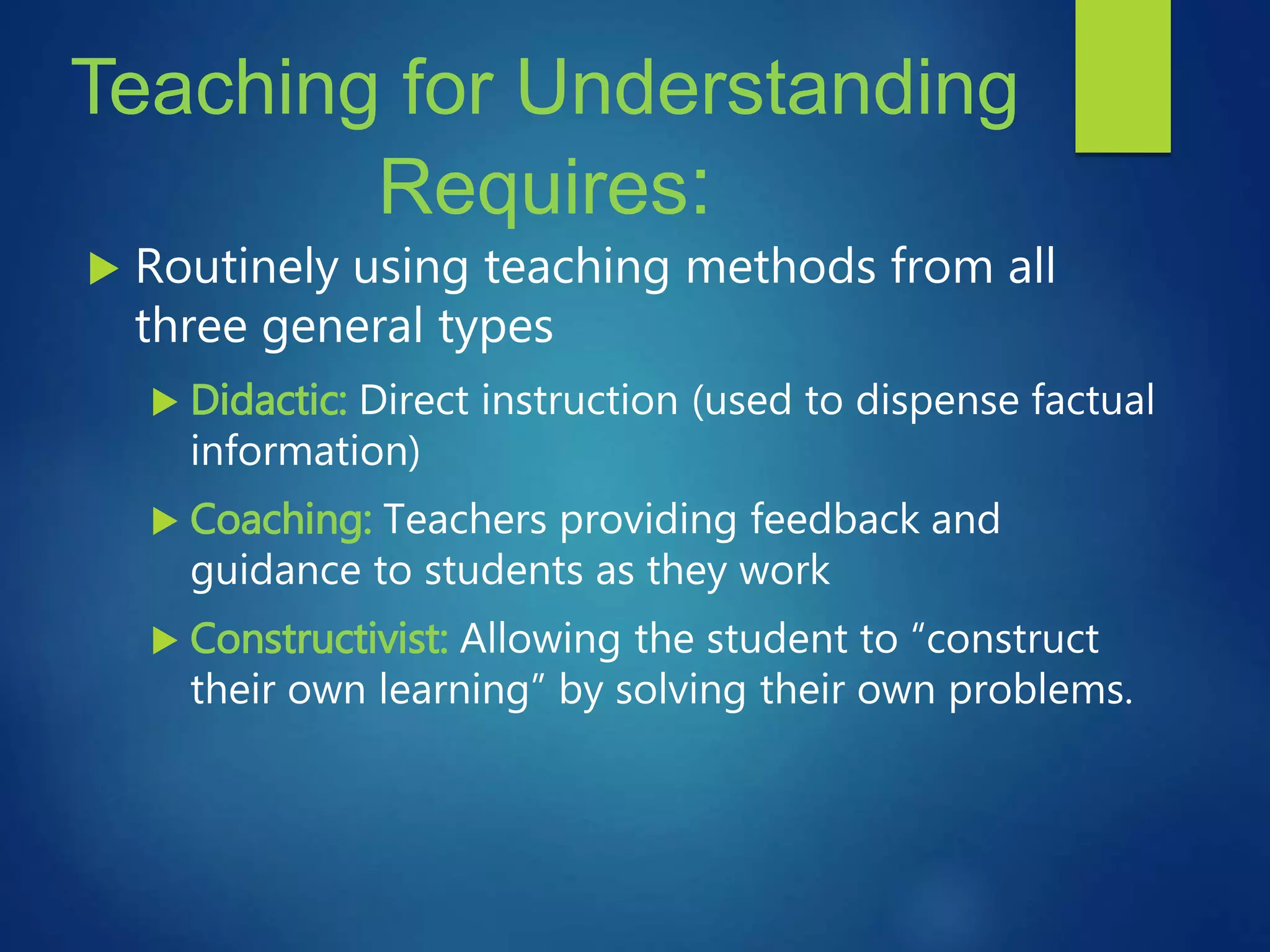
 Routinely using teaching methods from all
three general types
 Didactic: Direct instruction (used to dispense factual
information)
 Coaching: Teachers providing feedback and
guidance to students as they work
 Constructivist: Allowing the student to “construct
their own learning” by solving their own problems.
Direct or Indirect Teaching
Approaches
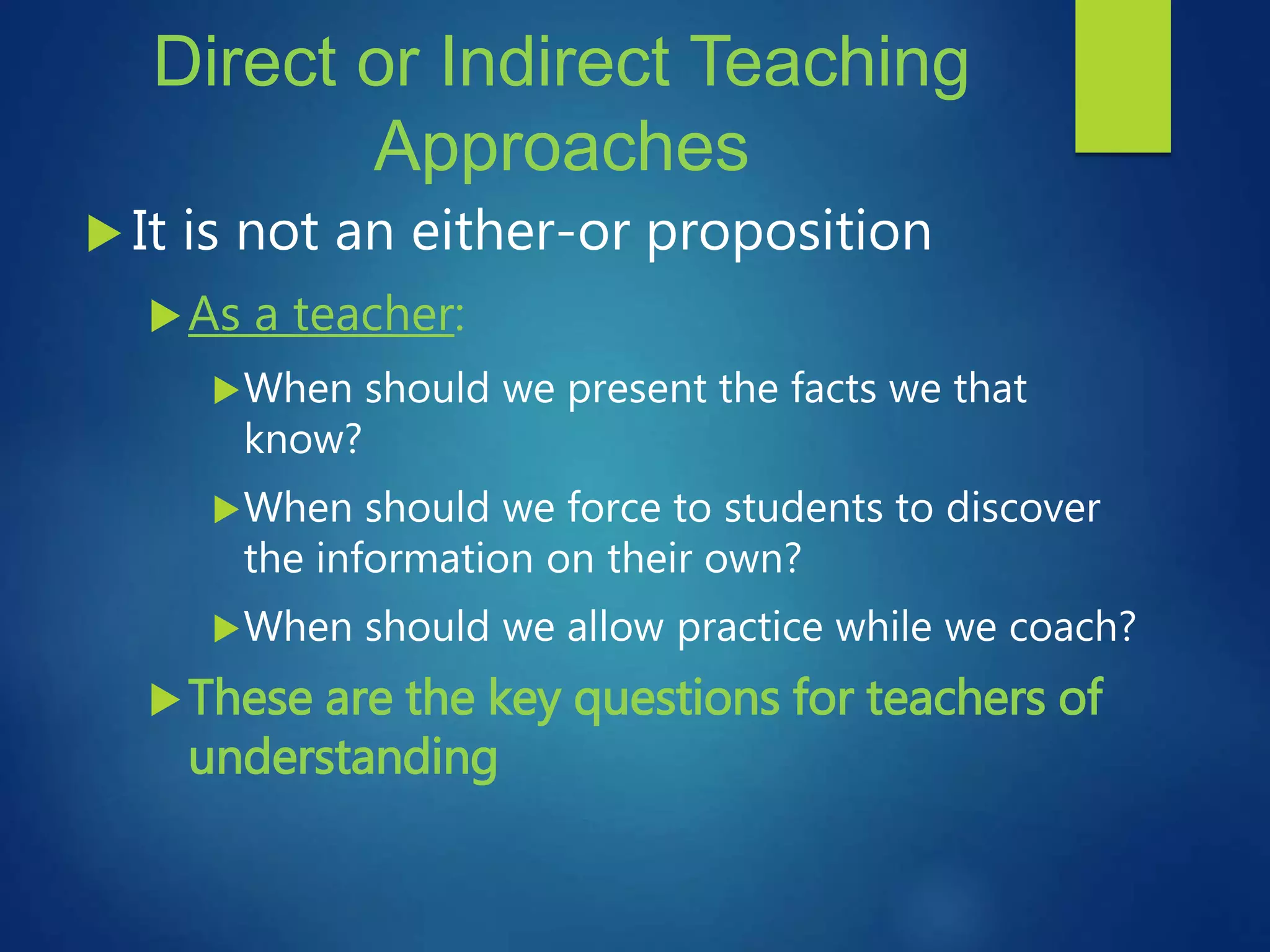
 It is not an either-or proposition
As a teacher:
When should we present the facts we that
know?
When should we force to students to discover
the information on their own?
When should we allow practice while we coach?
These are the key questions for teachers of
understanding
We Should…
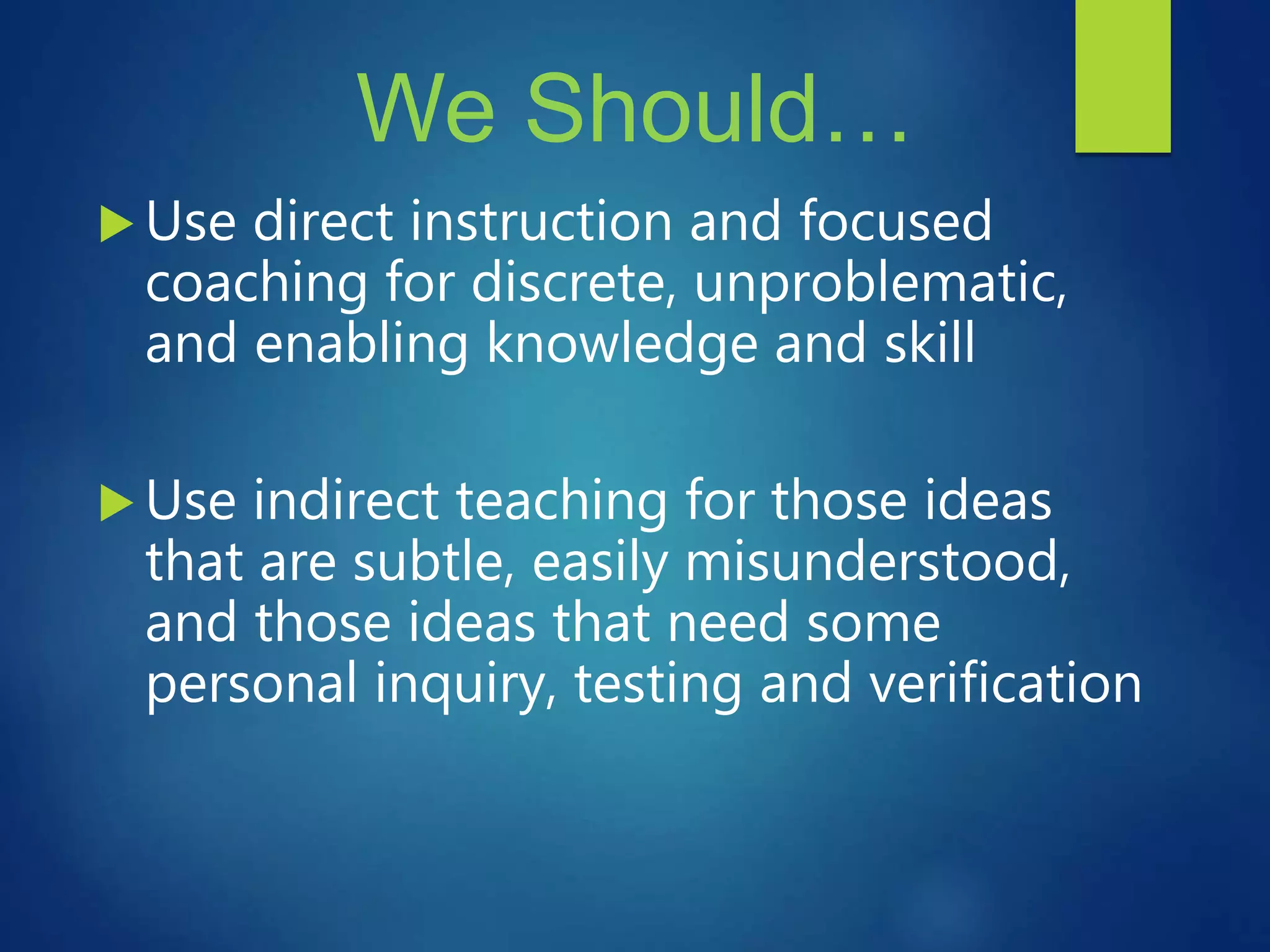
 Use direct instruction and focused
coaching for discrete, unproblematic,
and enabling knowledge and skill
 Use indirect teaching for those ideas
that are subtle, easily misunderstood,
and those ideas that need some
personal inquiry, testing and verification
Guidelines for
Student Autonomous Learning
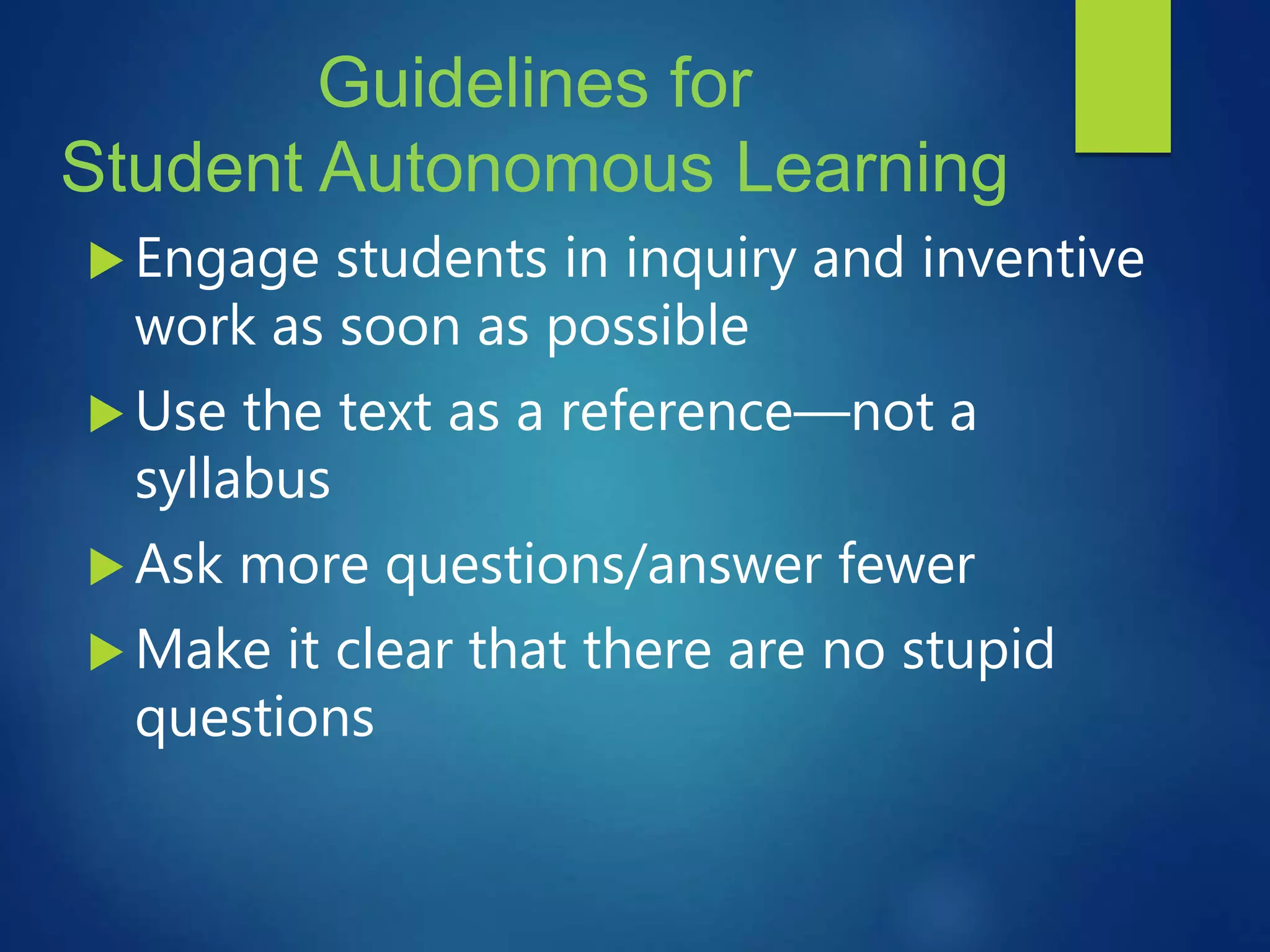
 Engage students in inquiry and inventive
work as soon as possible
 Use the text as a reference—not a
syllabus
 Ask more questions/answer fewer
 Make it clear that there are no stupid
questions
Guidelines for
Student Autonomous Learning
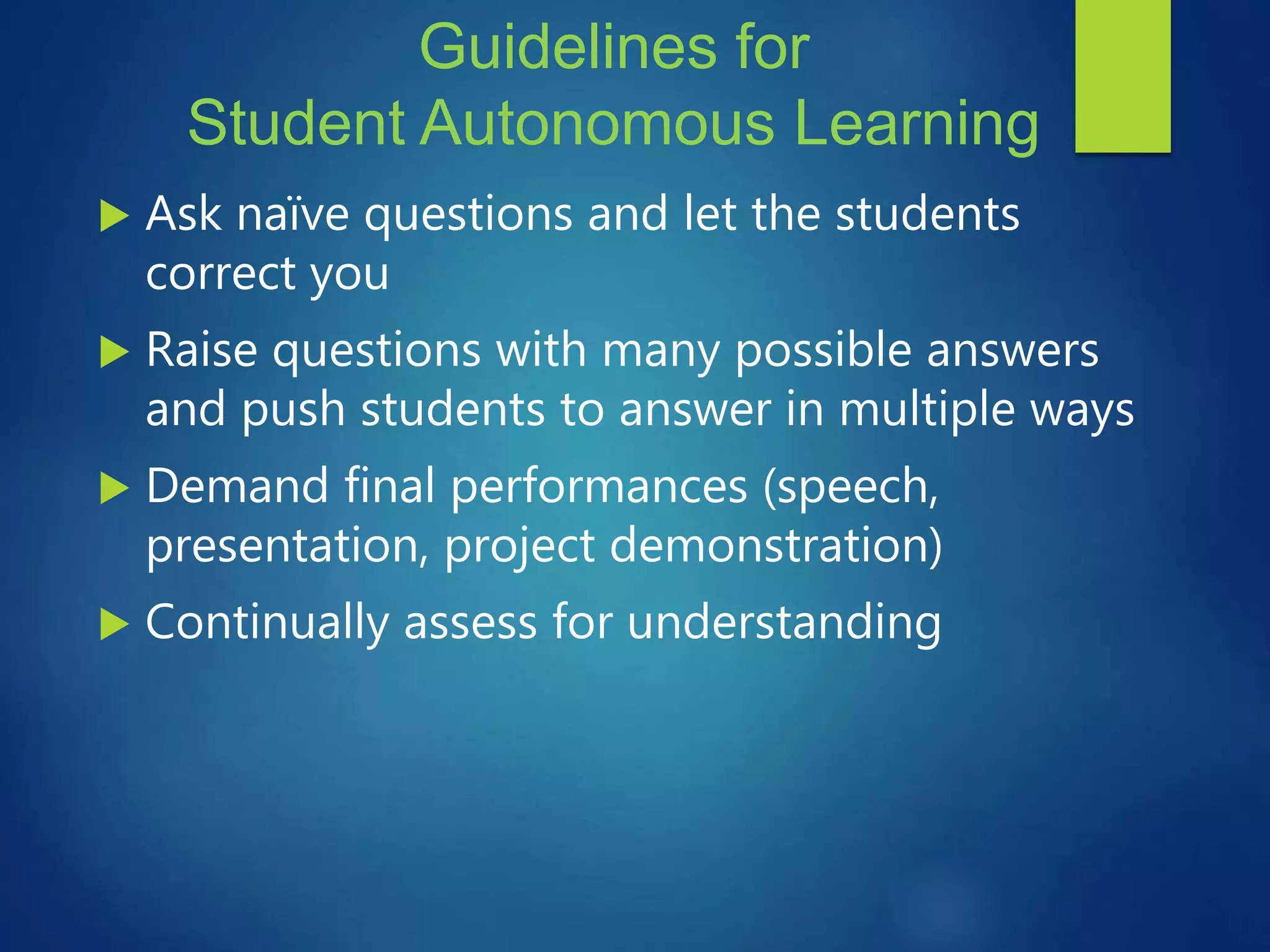
 Ask naïve questions and let the students
correct you
 Raise questions with many possible answers
and push students to answer in multiple ways
 Demand final performances (speech,
presentation, project demonstration)
 Continually assess for understanding

Understanding By Design

  • 1.
  • 2.
    The Problem “Even goodstudents don’t always display a deep understanding of what is taught even when conventional tests certify success.” (Wiggins & McTighe)
  • 3.
    Stating a Conceptvs. Developing a Concept AVERAGE PERCENTAGE OF TOPICS CONTAINING CONCEPTS THAT WERE DEVELOPED OR ONLY STATED 0 10 20 30 40 50 60 70 80 90 100 Germany Japan U.S. Percentage of Topics Stated Developed
  • 4.
    Seatwork Time Spentin Three Kinds of Tasks AVERAGE PERCENTAGE OF SEATWORK TIME SPENT IN THREE KINDS OF TASKS 0 10 20 30 40 50 60 70 80 90 100 Germany Japan U.S. Percentage of Seatwork Time Practice procedure Apply concept Invent/think
  • 5.
    The Question  So,the question is: “How do your courses contribute to academic achievement in your school?”  Develop curricula that makes a difference
  • 6.
    Curriculum is aMeans to an End  Focus on a topic that matters  Use instructional methods that engage  Cause deep and enduring learning related to an important standard Is it important enough to remember when the student is 50 years old?
  • 7.
    What is BackwardDesign?  BD Begins with the end in mind: Starting with a clear understanding of the destination Making sure that you are taking steps in the right direction (Stephen Covey) Is justifiable and reliable
  • 8.
    Unfortunately, Many Teachers: Beginwith a favored lesson, time- honored activities (or the next page in the text) Backwards design starts with the end (the desired results).
  • 9.
    Backwards Design We beginBD with the following question: What would I accept as evidence that students have attained the desired understandings/performances?
  • 10.
    The Backward DesignProcess Identify desired results. Stages in the Backward Design Process Determine acceptable evidence Plan learning experiences and instruction
  • 11.
    STAGE ONE: BackwardDesign Key Design Questions Design Considerations Filters (Design Criteria) What the Final Design Accomplishes Stage 1. What is worthy and requiring of understanding? • National standards. • State standards. • Regional topic opportunities. • Teacher expertise and interest • Enduring ideas. • Opportunities for authentic, discipline-based work. • Un coverage. • Engaging. Unit framed around enduring understandings and essential questions. Stage 2. What is evidence of understanding? • Six facets of understanding. • Continuum of assessment types. • Valid. • Reliable. • Sufficient. • Authentic work. • Feasible. • Student friendly. Unit anchored in credible and educationally vital evidence of the desired understandings. Stage 3. What learning experiences and teaching promote understanding, interest, and excellence? • Research-based repertoire of learning and teaching strategies. • Essential and enabling knowledge and skill. WHERE • Where is it going? • Hook the students. • Explore and equip. • Rethink and revise. • Exhibit and evaluate. • Tailor to personalize the learning. • Organize or sequence the work to suit the understanding • Goals. Coherent learning experiences and teaching that will evoke and develop the desired understandings, promote interest, and make excellent performance more likely.
  • 12.
  • 13.
    Determining Worthiness  Representsa big idea having enduring value beyond the classroom  Reside at the heart of the discipline (involve “doing” the subject). “Enduring” understanding  Require uncoverage (of abstract or often misunderstood ideas).  Offer potential for engaging students. Four Filters
  • 14.
    STAGE TWO: Backward DesignKeyDesign Questions Design Considerations Filters (Design Criteria) What the Final Design Accomplishes Stage 1. What is worthy and requiring of understanding? • National standards. • State standards. • Regional topic opportunities. • Teacher expertise and interest • Enduring ideas. • Opportunities for • authentic, discipline- based work. • Uncoverage. • Engaging. Unit framed around enduring understandings and essential questions. Stage 2. What is evidence of understanding? • Six facets of understanding. • Continuum of assessment types. • Valid. • Reliable. • Sufficient. • Authentic work. • Feasible. • Student friendly. Unit anchored in credible and educationally vital evidence of the desired understandings. Stage 3. What learning experiences and teaching promote understanding, interest, and excellence? • Research-based repertoire of learning and teaching strategies. • Essential and enabling knowledge and skill. WHERE • Where is it going? • Hook the students. • Explore and equip. • Rethink and revise. • Exhibit and evaluate. • Tailor to personalize the learning. • Organize or sequence the work to suit the understanding • Goals. Coherent learning experiences and teaching that will evoke and develop the desired understandings, promote interest, and make excellent performance more likely.
  • 15.
    Curricular Priorities and Assessments AssessmentTypes Traditional quizzes and tests  Paper/pencil  Selected-response  Constructed response Performance tasks and projects  Open-ended  Complex  Authentic “Enduring understanding” Important to know and do Worth being familiar with
  • 16.
  • 17.
    TWO DIFFERENT APPROACHES Thinking Likean Assessor Thinking Like an Activity Designer What would be sufficient and revealing evidence of understanding? What would be interesting and engaging activities on this topic? What performance tasks must anchor the unit and focus the instructional work? What resources and materials are available on this topic? How will I be able to distinguish between those who really understand and those who don’t (though they may seem to) ? What will students be doing in and out of class? What assignments will be given? Against what criteria will I distinguish work? How will I give students a grade (and justify it to their parents)? What misunderstandings are likely? How will I check for those? Did the activities work? Why or why not?
  • 18.
    Thinking Like anAssessor  Does not come naturally to most teachers  We unconsciously jump to the activity once we have a target  Backwards design demands that we short-circuit the natural instinct that leads most often to developing the activity first
  • 19.
    Six Facets ofUnderstanding Facet 1:  A student who really understands, can explain.  Can provide complex, insightful and credible reasons.  Can make distinctions, argue for and justify central ideas  Can avoid common misunderstandings  Can personalize the information
  • 20.
    Six Facets ofUnderstanding Facet 2:  A student who really understands, can interpret. Can make powerful, meaningful interpretations and translations Can read between the lines Can use historical and biographical information to make ideas more relevant
  • 21.
    Six Facets ofUnderstanding Facet 3:  A student who really understands, can apply.  Can extend what he/she knows to realistic, hands-on situations  Can make adjustments along the way  Can apply knowledge in a variety of settings
  • 22.
    Six Facets ofUnderstanding Facet 4:  A student who really understands, sees in perspective. Can critique and justify a position Understanding the history of an idea Know the limits as well as the power of an idea Can see through biased arguments
  • 23.
    Six Facets ofUnderstanding Facet 5:  A student who really understands, demonstrates empathy.  Can appreciates another’s situation  Can see when even flawed ideas are plausible  Can describe how an idea could be misunderstood by others  Can listen and hear what others often do not
  • 24.
    Six Facets ofUnderstanding Facet 6:  A student who really understands, reveals self-knowledge.  Can recognize own prejudices and style  Can think about thinking  Can question his/her own convictions  Can self-assess  Can accept feedback/criticism without defensiveness
  • 25.
    STAGE THREE: BackwardDesign Key Design Questions Design Considerations Filters (Design Criteria) What the Final Design Accomplishes Stage 1. What is worthy and requiring of understanding? • National standards. • State standards. • Regional topic opportunities. • Teacher expertise and interest • Enduring ideas. • Opportunities for • authentic, discipline- based work. • Un coverage. • Engaging. Unit framed around enduring understandings and essential questions. Stage 2. What is evidence of understanding? • Six facets of understanding. • Continuum of assessment types. • Valid. • Reliable. • Sufficient. • Authentic work. • Feasible. • Student friendly. Unit anchored in credible and educationally vital evidence of the desired understandings. Stage 3. What learning experiences and teaching promote understanding, interest, and excellence? • Research-based repertoire of learning and teaching strategies. • Essential and enabling knowledge and skill. WHERE • Where is it going? • Hook the students. • Explore and equip. • Rethink and revise. • Exhibit and evaluate. • Tailor to personalize the learning. • Organize or sequence the work to suit the understanding • Goals. Coherent learning experiences and teaching that will evoke and develop the desired understandings, promote interest, and make excellent performance more likely.
  • 26.
    KEY QUESTIONS: InstructionalDesign What facts, concepts, principles and skills will students need to achieve in lessons? What activities will equip students with needed knowledge/skills? What materials/resources are available?
  • 27.
    How Will You: Bringabstract ideas and far-away facts to life? Students must see knowledge and skill as building blocks—not just isolated lessons
  • 28.
    How Will YouBlend Breadth & Depth? ____For Depth__________ Unearth it  Make assumptions explicit.  Make points of view clear  Bring to the surface and bring to light the misunderstood, the subtle, the non-obvious, the problematic, the controversial, the obscure, the missing, and the lost. Analyze it  Inspect and examine.  Dissect, refine, and qualify. Question it  Test.  Challenge.  Doubt.  Critique. Prove it  Argue.  Support.  Verify.  Justify. Generalize it  Subsume it under a more encompassing idea.  Compare and contrast. _____For Breadth________ Connect it  Link discrete and diverse ideas, facts, and experiences. Picture it  Make it concrete and simple.  Represent or model the idea in different ways. Extend it  Go beyond the given to implications  Imagine “what if?”
  • 29.
    The Need toUncover Knowledge Many curriculum packages: Appear connected and meaningful to the teacher Appear meaningless and disconnected to the student
  • 30.
    Teaching Types What theTeacher Uses What Students Need to Do Didactic/Direct Instruction Demonstration/modeling Lecture Questions/convergent Coaching Feedback/conferencing Guided practice Facilitative/Constructivist/Reflective Concept attainment Cooperative learning Discussion Experimental inquiry Graphic representation Problem-based learning Questions (open ended) Reciprocal teaching Simulation (e.g., mock trial) Socratic seminar Writing process Receive, take in, respond: Observe, attempt, practice, refine Listen, watch, take notes, question Answer, give responses Refine skills, deepen understanding: Listen, consider, practice, retry, refine Revise, reflect, refine, recycle through Construct, examine, extend meaning: Compare, induce, define, generalize Collaborate, support others, teach Listen, question, consider, explain Hypothesize, gather data, analyze Visualize, connect, map relationships Questions, research, conclude, support Pose/define problems, solve, evaluate Answer and explain, reflect, rethink Clarify, question, predict, teach Examine, consider, challenge, debate Consider, explain, challenge, justify Brainstorm, organize, draft, revise
  • 31.
    Backwards Design  Suspendsinstructional planning Specific lessons are not developed until the last phase This runs counter to the habits of many teachers  BD demands that we set goals and establish assessments first
  • 32.
    Wisdom Can’t beTold!  Understanding is more stimulated than learned  It grows from questioning oneself and being questioned by others  Students must figure things out, not simply wait to be told!  This requires the teacher to alter their curriculum and teaching style
  • 33.
    Teaching for Understanding Requires: Routinely using teaching methods from all three general types  Didactic: Direct instruction (used to dispense factual information)  Coaching: Teachers providing feedback and guidance to students as they work  Constructivist: Allowing the student to “construct their own learning” by solving their own problems.
  • 34.
    Direct or IndirectTeaching Approaches  It is not an either-or proposition As a teacher: When should we present the facts we that know? When should we force to students to discover the information on their own? When should we allow practice while we coach? These are the key questions for teachers of understanding
  • 35.
    We Should…  Usedirect instruction and focused coaching for discrete, unproblematic, and enabling knowledge and skill  Use indirect teaching for those ideas that are subtle, easily misunderstood, and those ideas that need some personal inquiry, testing and verification
  • 36.
    Guidelines for Student AutonomousLearning  Engage students in inquiry and inventive work as soon as possible  Use the text as a reference—not a syllabus  Ask more questions/answer fewer  Make it clear that there are no stupid questions
  • 37.
    Guidelines for Student AutonomousLearning  Ask naïve questions and let the students correct you  Raise questions with many possible answers and push students to answer in multiple ways  Demand final performances (speech, presentation, project demonstration)  Continually assess for understanding