The Problem is the Solution PBL in the Social  Studies & Language Arts Glenn Wiebe ESSDACK [email_address] ©2007
Sticky ideas?
Solving problems is  engaging
Research tells us that Problem Based Learning is  good for kids
It’s not a silver bullet, it’s a hammer
Driving question Why were American citizens placed in “relocation camps” against their will during World War II? Is it ever okay to violate the Bill of Rights?
How can we develop an valid argument so that Congressmen do the right thing concerning the compensation of Japanese Americans interned during World War II?
Using evidence  from the WWII Japanese American experience, contemporary documents and contact with mentoring politicians / experts, focus on the following statement: “ Descendants of those interned during WWII should be  entitled to financial compensation  from the federal government.” Your task
GRASPS Goal Persuade the US Congress to support your position concerning financial compensation Role Japanese American Citizens League or Reagan White House Audience Senate Judiciary Committee (Principal / BOE president / Chamber of Commerce president)
Situation You have been asked to present arguments during committee hearings on a bill that would compensate Japanese Americans interned during WWII and/or their descendants Product You need to prepare an  oral argument  for or against the proposed bill
Standards Your presentation should be both textual and visual and include: Accurate data concerning the internment Possible consequences of compensation Amount / Type of compensation   Possible funding sources Constitutional arguments
Based on these two examples and  “What Does Problem-Based Learning Look Like in the Classroom,”   PBL is: And has these characteristics:
What is PBL? “A way to organize learning around ill-structured problems so that students simultaneously acquire new knowledge and experience in wrestling with problems”
Characteristics? An actual or simulated situation  Problem is ill-structured and “messy” Student centered More work than one person can do in time allowed
No clear solution Requires a product or action Students must have a “stakeholder” “ Authentic” assessment
Why PBL?
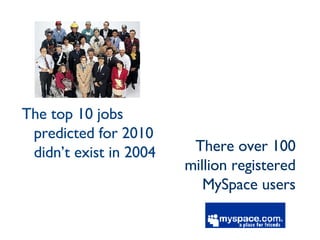
The top 10 jobs predicted for 2010 didn’t exist in 2004 There over 100 million registered MySpace users
The 25% of the population in China with the highest IQs is greater than the total population of North America Last year a seven year-old signed a six figure endorsement deal to play professional video games
So what?
Great communications skills Ability to define problems, gather data, create solutions Play nice in the sandbox Real world?
“ True learning is based on discovery . . .  rather than the transmission of knowledge.” John Dewey
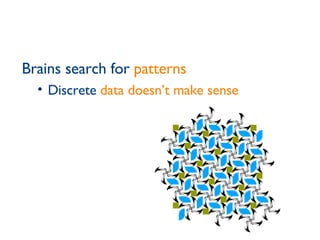
Brains search for  patterns Discrete  data doesn’t make sense
So?  We each have a  personalized mental model  of reality Existing schema  are huge for new learning
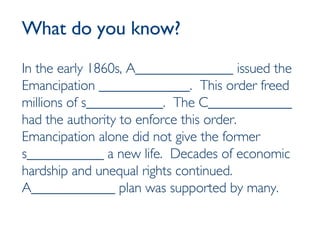
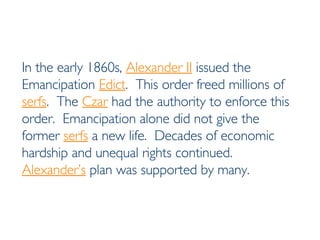
What do you know? In the early 1860s, A______________ issued the Emancipation _____________.  This order freed millions of s___________.  The C____________ had the authority to enforce this order.  Emancipation alone did not give the former s___________ a new life.  Decades of economic hardship and unequal rights continued.  A____________ plan was supported by many.
In the early 1860s,  Alexander II  issued the Emancipation  Edict .  This order freed millions of  serfs .  The  Czar  had the authority to enforce this order.  Emancipation alone did not give the former  serfs  a new life.  Decades of economic hardship and unequal rights continued.  Alexander’s  plan was supported by many.
What do you see? viscog.beckman.uiuc.edu/djs_lab/demos.html
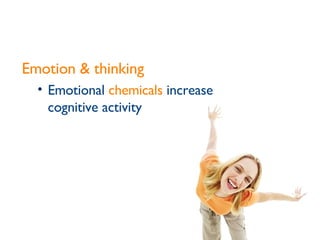
Emotion & thinking Emotional  chemicals  increase  cognitive activity
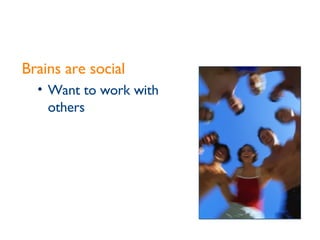
Brains are social Want to work with others
PBLs provide  structured patterns PBLs create  emotional connections PBLs encourage  collaborative learning Simple?
Even simpler?
“ You don’t learn because you’re engaged. You’re engaged because you’re learning” Nick deKanter Muzzy Lane Software
Basic PBL structure What are some basic assumptions we should make concerning PBLs?
History / literature  is incomplete & open to interpretation Facts as “evidence” rather than “truth” Urge use of raw evidence Different “levels”  of PBL Quick activity up to several weeks
Students  must make or do  something Not just a research paper Subject matter  experts provide feedback Need  a hook
Activity should be  “ill structured” Struggle is good for kids Provide access  to the same tools & tech Don’t  get too involved
Provide scaffolding Process / team building  / thinking / reading Incorporate collaboration A balance of individual / group / outside expert work is important Focus on the process  /   not the “correct” answer
Let’s look at some more Aha-aha’s Questions
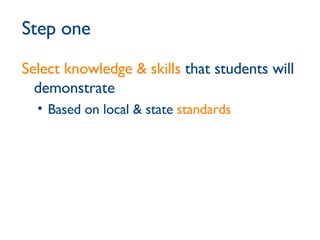
Step one Select knowledge & skills  that students will demonstrate Based on local & state  standards
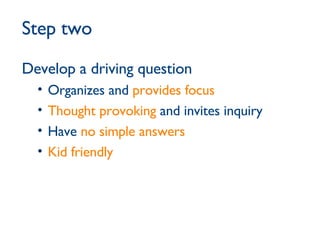
Step two Develop a driving question Organizes and  provides focus   Thought provoking  and invites inquiry  Have  no simple answers Kid friendly
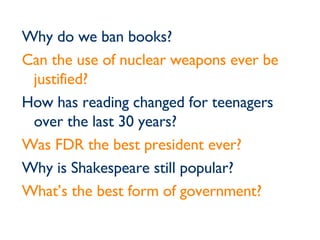
Why do we ban books? Can the use of nuclear weapons ever be justified? How has reading changed for teenagers over the last 30 years? Was FDR the best president ever? Why is Shakespeare still popular? What’s the best form of government?
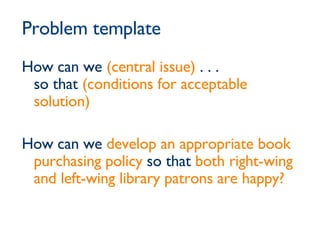
Problem template How can we  (central issue)  . . .  so that  (conditions for acceptable solution) How can we  develop an appropriate book purchasing policy  so that  both right-wing and left-wing library patrons are happy?
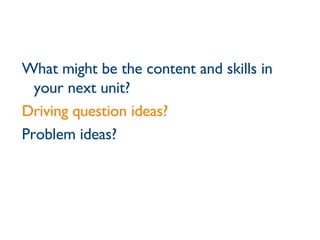
What might be the content and skills in your next unit? Driving question ideas? Problem ideas?
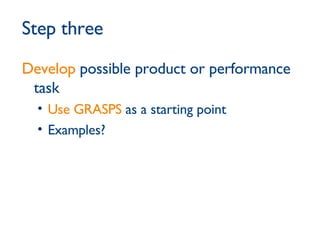
Step three Develop  possible product or performance task Use GRASPS  as a starting point Examples?
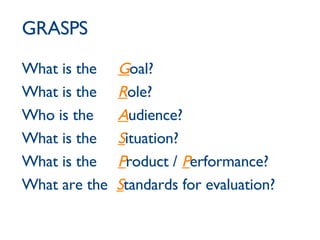
GRASPS   What is the  G oal? What is the  R ole? Who is the  A udience? What is the  S ituation? What is the  P roduct /  P erformance? What are the  S tandards for evaluation?
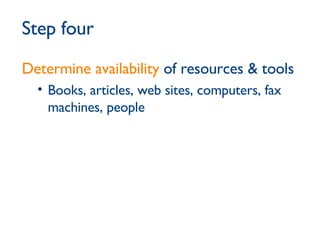
Step four Determine availability  of resources & tools Books, articles, web sites, computers, fax machines, people
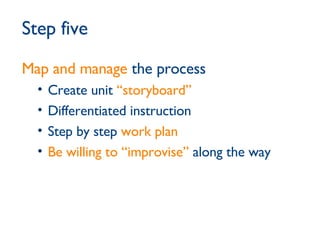
Step five Map and manage  the process Create unit  “storyboard” Differentiated instruction Step by step  work plan Be willing to “improvise”  along the way
Students select a  possible hypothesis Gather data  to prove their hypothesis Share their hypothesis  and research Students  revise hypothesis  based on research and feedback Conduct  additional research Students  create  final product or performance
Step six Evaluation Self-reflection
Is it any good? The Six A’s  & rubric Authenticity Academic Rigor Applied Learning Active Exploration Adult Connections Assessment Practices
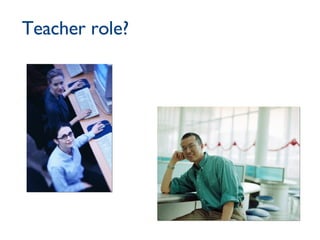
Teacher role?
Create safe environment Content specialist Provide focus & resources Challenge thinking Manage group dynamics Maintain timeline   Assess learning
Other examples? WebQuests Language Arts Archeology unit Who Killed William Robinson? What Really Happened at Thanksgiving? Video games
WebQuests “An  inquiry-oriented activity  in which some or all of the information that the learner interacts with comes from resources on the Internet” Bernie Dodge 1995 Information leads to a  challenging, engaging, and satisfying task
WebQuests Lots of WebQuests  online < webquest.org > Do some searching  at the WebQuest matrix for your content and grade level Nothing? Try Google
LA examples? Students write & submit proposals to potential sponsors to fund a field trip Students develop a booklet of American idioms / slang for school’s ELL students
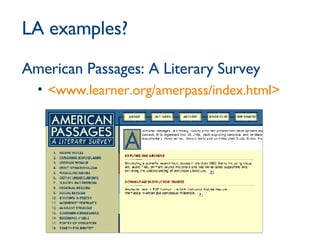
LA examples? American Passages: A Literary Survey <www.learner.org/amerpass/index.html>
Archeology unit This person has taught us more about pre-history than any other person even though the person probably didn’t know the meaning of the word history. How did he die?
Gather  data What can you infer from the evidence? Task group / Share group Possible solutions? Select best & one question you still have Send a rover to “dare & share”  Revise  your original hypothesis
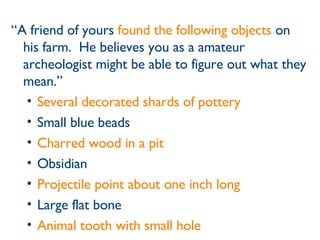
“ A friend of yours  found the following objects  on his farm.  He believes you as a amateur archeologist might be able to figure out what they mean.” Several decorated shards of pottery Small blue beads  Charred wood in a pit Obsidian Projectile point about one inch long Large flat bone Animal tooth with small hole
Your problem “Who left these behind? How do you know?”
Online PBLs Who Killed William Robinson? <web.uvic.ca/history-robinson> What Really Happened at Thanksgiving? <www.plimoth.org/education/olc/ index_js2.html>
“There are many ways of going forward, but only one way of standing still.” Franklin D. Roosevelt
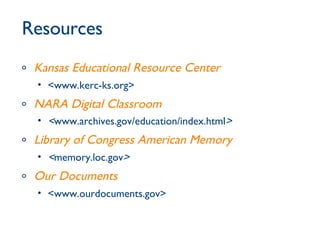
Resources Kansas Educational Resource Center <www.kerc-ks.org>   NARA Digital Classroom < www.archives.gov/education/index.html >   Library of Congress American Memory < memory.loc.gov > Our Documents <www.ourdocuments.gov>
Resources Social Studies Central <www.socialstudiescentral.com> America’s Library <www.americaslibrary.org> University of Kansas links <www.ku.edu/carrie/docs>
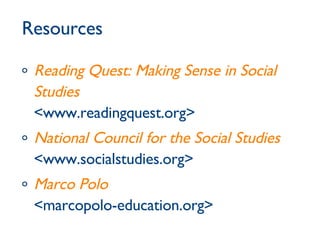
Resources Reading Quest: Making Sense in Social Studies <www.readingquest.org>   National Council for the Social Studies  <www.socialstudies.org> Marco Polo <marcopolo-education.org>
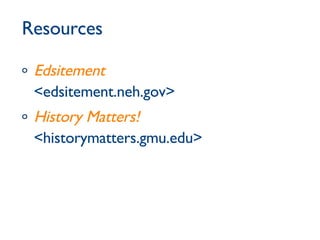
Resources Edsitement   <edsitement.neh.gov> History Matters!   <historymatters.gmu.edu>
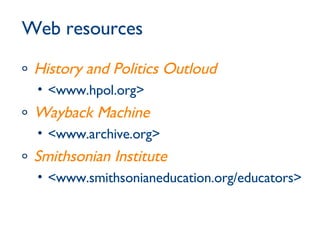
Web resources History and Politics Outloud <www.hpol.org> Wayback Machine <www.archive.org> Smithsonian Institute <www.smithsonianeducation.org/educators>
Web resources Internet History Sourcebook Project <www.fordham.edu/halsall> National Park Service / Links to the Past <www.cr.nps.gov> Teaching & Learning with Historical Documents <www.kn.pacbell.com/wired/fil/pages/ listsocailsca.html>
Resources Caine, Geoffery. (2001)  The Brain, Education, and the Competitive Edge .  Lanham, Maryland: Scarecrow Education.  Committee on Developments in the Science of Learning. (1999)  How People Learn: Brain, Mind, Experience, and School .  Washington, DC: National Academy Press.
Resources Kobrin, David. (1996)  Beyond the Textbook: Teaching History Using Documents & Primary Sources .  Portsmouth, New Hampshire: Heinemann.  Lewin, Larry; Betty Jean Shoemaker. (1998)  Great Performances: Creating Classroom-Based Assessment Tasks .  Alexandria, Virginia: Association of Supervision and Curriculum Development.
Resources Lindquist, Tarry. (1997)  Ways That Work: Putting Social Studies Standards into Practice .  Portsmouth, New Hampshire: Heinemann. Steffey, Stephanie; Wendy Hood. (1994)  If This is Social Studies, Why isn’t it Boring?   York, Maine: Stenhouse Publishers.
Resources Zemelman, Steven, et al. (1998)  Best Practice: New Standards for Teaching & Learning in America’s Schools .  Portsmouth, New Hampshire: Heinemann. Zull, James. (2002)  The Art of Changing the Brain.  Sterling, VA. Stylus Publishing.
Resources Fischer, Max W. (1993)  American History Simulations .  Westminster, CA: Teacher Created Materials. Levstick, Linda, Barton, Keith. (2001)  Doing History: Investigating with Children in Elementary & Middle Schools .  Mahwah, NJ: Lawrence Erlbaum Associates. Irvin, Judith (2002)  Reading Strategies for the Social Studies Classroom.  Holt, Rinehart and Winston.
Resources Beck, John. (2004)  Got Game: How the Gamer Generation is Reshaping Business Forever .  Harvard Business School Press. Gee, James. (2003)  What Video Games Have to Teach Us About Learning & Literacy .  Palgrave / MacMillan.
Resources Johnson, Steven. (2004)  Mind Wide Open:Your Brain and the Neuroscience of Everyday Life .  Scribner. Johnson, Steven. (2005)  Everything bad is Good for You: How Today’s Popular Culture is Actually Making Us Smarter .  Riverhead Books.
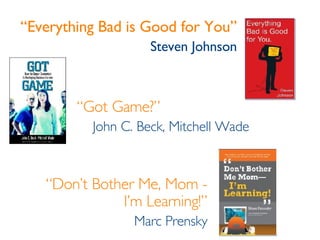
“ Everything Bad is Good for You” Steven Johnson “ Got Game?” John C. Beck, Mitchell Wade “ Don’t Bother Me, Mom - I’m Learning!” Marc Prensky
 
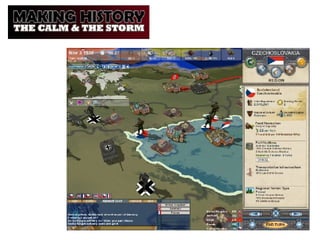
www.making-history.com
 
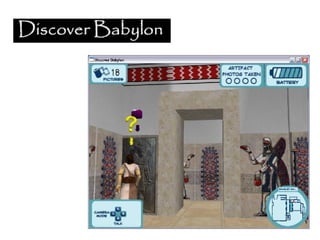
www.discoverbabylon.org
 
www.knowledgematters.com
 
www.educationalsimulations.com
 
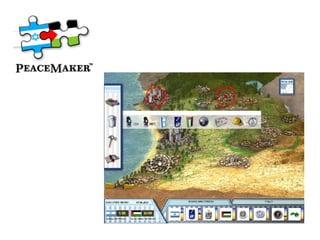
www.peacemakergame.com

PBL for Social Studies & Language Arts

  • 1.
    The Problem isthe Solution PBL in the Social Studies & Language Arts Glenn Wiebe ESSDACK [email_address] ©2007
  • 2.
  • 3.
  • 4.
    Research tells usthat Problem Based Learning is good for kids
  • 5.
    It’s not asilver bullet, it’s a hammer
  • 6.
    Driving question Whywere American citizens placed in “relocation camps” against their will during World War II? Is it ever okay to violate the Bill of Rights?
  • 7.
    How can wedevelop an valid argument so that Congressmen do the right thing concerning the compensation of Japanese Americans interned during World War II?
  • 8.
    Using evidence from the WWII Japanese American experience, contemporary documents and contact with mentoring politicians / experts, focus on the following statement: “ Descendants of those interned during WWII should be entitled to financial compensation from the federal government.” Your task
  • 9.
    GRASPS Goal Persuadethe US Congress to support your position concerning financial compensation Role Japanese American Citizens League or Reagan White House Audience Senate Judiciary Committee (Principal / BOE president / Chamber of Commerce president)
  • 10.
    Situation You havebeen asked to present arguments during committee hearings on a bill that would compensate Japanese Americans interned during WWII and/or their descendants Product You need to prepare an oral argument for or against the proposed bill
  • 11.
    Standards Your presentationshould be both textual and visual and include: Accurate data concerning the internment Possible consequences of compensation Amount / Type of compensation Possible funding sources Constitutional arguments
  • 12.
    Based on thesetwo examples and “What Does Problem-Based Learning Look Like in the Classroom,” PBL is: And has these characteristics:
  • 13.
    What is PBL?“A way to organize learning around ill-structured problems so that students simultaneously acquire new knowledge and experience in wrestling with problems”
  • 14.
    Characteristics? An actualor simulated situation Problem is ill-structured and “messy” Student centered More work than one person can do in time allowed
  • 15.
    No clear solutionRequires a product or action Students must have a “stakeholder” “ Authentic” assessment
  • 16.
  • 17.
    The top 10jobs predicted for 2010 didn’t exist in 2004 There over 100 million registered MySpace users
  • 18.
    The 25% ofthe population in China with the highest IQs is greater than the total population of North America Last year a seven year-old signed a six figure endorsement deal to play professional video games
  • 19.
  • 20.
    Great communications skillsAbility to define problems, gather data, create solutions Play nice in the sandbox Real world?
  • 21.
    “ True learningis based on discovery . . . rather than the transmission of knowledge.” John Dewey
  • 22.
    Brains search for patterns Discrete data doesn’t make sense
  • 23.
    So? Weeach have a personalized mental model of reality Existing schema are huge for new learning
  • 24.
    What do youknow? In the early 1860s, A______________ issued the Emancipation _____________. This order freed millions of s___________. The C____________ had the authority to enforce this order. Emancipation alone did not give the former s___________ a new life. Decades of economic hardship and unequal rights continued. A____________ plan was supported by many.
  • 25.
    In the early1860s, Alexander II issued the Emancipation Edict . This order freed millions of serfs . The Czar had the authority to enforce this order. Emancipation alone did not give the former serfs a new life. Decades of economic hardship and unequal rights continued. Alexander’s plan was supported by many.
  • 26.
    What do yousee? viscog.beckman.uiuc.edu/djs_lab/demos.html
  • 27.
    Emotion & thinkingEmotional chemicals increase cognitive activity
  • 28.
    Brains are socialWant to work with others
  • 29.
    PBLs provide structured patterns PBLs create emotional connections PBLs encourage collaborative learning Simple?
  • 30.
  • 31.
    “ You don’tlearn because you’re engaged. You’re engaged because you’re learning” Nick deKanter Muzzy Lane Software
  • 32.
    Basic PBL structureWhat are some basic assumptions we should make concerning PBLs?
  • 33.
    History / literature is incomplete & open to interpretation Facts as “evidence” rather than “truth” Urge use of raw evidence Different “levels” of PBL Quick activity up to several weeks
  • 34.
    Students mustmake or do something Not just a research paper Subject matter experts provide feedback Need a hook
  • 35.
    Activity should be “ill structured” Struggle is good for kids Provide access to the same tools & tech Don’t get too involved
  • 36.
    Provide scaffolding Process/ team building / thinking / reading Incorporate collaboration A balance of individual / group / outside expert work is important Focus on the process / not the “correct” answer
  • 37.
    Let’s look atsome more Aha-aha’s Questions
  • 38.
    Step one Selectknowledge & skills that students will demonstrate Based on local & state standards
  • 39.
    Step two Developa driving question Organizes and provides focus Thought provoking and invites inquiry Have no simple answers Kid friendly
  • 40.
    Why do weban books? Can the use of nuclear weapons ever be justified? How has reading changed for teenagers over the last 30 years? Was FDR the best president ever? Why is Shakespeare still popular? What’s the best form of government?
  • 41.
    Problem template Howcan we (central issue) . . . so that (conditions for acceptable solution) How can we develop an appropriate book purchasing policy so that both right-wing and left-wing library patrons are happy?
  • 42.
    What might bethe content and skills in your next unit? Driving question ideas? Problem ideas?
  • 43.
    Step three Develop possible product or performance task Use GRASPS as a starting point Examples?
  • 44.
    GRASPS What is the G oal? What is the R ole? Who is the A udience? What is the S ituation? What is the P roduct / P erformance? What are the S tandards for evaluation?
  • 45.
    Step four Determineavailability of resources & tools Books, articles, web sites, computers, fax machines, people
  • 46.
    Step five Mapand manage the process Create unit “storyboard” Differentiated instruction Step by step work plan Be willing to “improvise” along the way
  • 47.
    Students select a possible hypothesis Gather data to prove their hypothesis Share their hypothesis and research Students revise hypothesis based on research and feedback Conduct additional research Students create final product or performance
  • 48.
    Step six EvaluationSelf-reflection
  • 49.
    Is it anygood? The Six A’s & rubric Authenticity Academic Rigor Applied Learning Active Exploration Adult Connections Assessment Practices
  • 50.
  • 51.
    Create safe environmentContent specialist Provide focus & resources Challenge thinking Manage group dynamics Maintain timeline Assess learning
  • 52.
    Other examples? WebQuestsLanguage Arts Archeology unit Who Killed William Robinson? What Really Happened at Thanksgiving? Video games
  • 53.
    WebQuests “An inquiry-oriented activity in which some or all of the information that the learner interacts with comes from resources on the Internet” Bernie Dodge 1995 Information leads to a challenging, engaging, and satisfying task
  • 54.
    WebQuests Lots ofWebQuests online < webquest.org > Do some searching at the WebQuest matrix for your content and grade level Nothing? Try Google
  • 55.
    LA examples? Studentswrite & submit proposals to potential sponsors to fund a field trip Students develop a booklet of American idioms / slang for school’s ELL students
  • 56.
    LA examples? AmericanPassages: A Literary Survey <www.learner.org/amerpass/index.html>
  • 57.
    Archeology unit Thisperson has taught us more about pre-history than any other person even though the person probably didn’t know the meaning of the word history. How did he die?
  • 58.
    Gather dataWhat can you infer from the evidence? Task group / Share group Possible solutions? Select best & one question you still have Send a rover to “dare & share” Revise your original hypothesis
  • 59.
    “ A friendof yours found the following objects on his farm. He believes you as a amateur archeologist might be able to figure out what they mean.” Several decorated shards of pottery Small blue beads Charred wood in a pit Obsidian Projectile point about one inch long Large flat bone Animal tooth with small hole
  • 60.
    Your problem “Wholeft these behind? How do you know?”
  • 61.
    Online PBLs WhoKilled William Robinson? <web.uvic.ca/history-robinson> What Really Happened at Thanksgiving? <www.plimoth.org/education/olc/ index_js2.html>
  • 62.
    “There are manyways of going forward, but only one way of standing still.” Franklin D. Roosevelt
  • 63.
    Resources Kansas EducationalResource Center <www.kerc-ks.org> NARA Digital Classroom < www.archives.gov/education/index.html > Library of Congress American Memory < memory.loc.gov > Our Documents <www.ourdocuments.gov>
  • 64.
    Resources Social StudiesCentral <www.socialstudiescentral.com> America’s Library <www.americaslibrary.org> University of Kansas links <www.ku.edu/carrie/docs>
  • 65.
    Resources Reading Quest:Making Sense in Social Studies <www.readingquest.org> National Council for the Social Studies <www.socialstudies.org> Marco Polo <marcopolo-education.org>
  • 66.
    Resources Edsitement <edsitement.neh.gov> History Matters! <historymatters.gmu.edu>
  • 67.
    Web resources Historyand Politics Outloud <www.hpol.org> Wayback Machine <www.archive.org> Smithsonian Institute <www.smithsonianeducation.org/educators>
  • 68.
    Web resources InternetHistory Sourcebook Project <www.fordham.edu/halsall> National Park Service / Links to the Past <www.cr.nps.gov> Teaching & Learning with Historical Documents <www.kn.pacbell.com/wired/fil/pages/ listsocailsca.html>
  • 69.
    Resources Caine, Geoffery.(2001) The Brain, Education, and the Competitive Edge . Lanham, Maryland: Scarecrow Education. Committee on Developments in the Science of Learning. (1999) How People Learn: Brain, Mind, Experience, and School . Washington, DC: National Academy Press.
  • 70.
    Resources Kobrin, David.(1996) Beyond the Textbook: Teaching History Using Documents & Primary Sources . Portsmouth, New Hampshire: Heinemann. Lewin, Larry; Betty Jean Shoemaker. (1998) Great Performances: Creating Classroom-Based Assessment Tasks . Alexandria, Virginia: Association of Supervision and Curriculum Development.
  • 71.
    Resources Lindquist, Tarry.(1997) Ways That Work: Putting Social Studies Standards into Practice . Portsmouth, New Hampshire: Heinemann. Steffey, Stephanie; Wendy Hood. (1994) If This is Social Studies, Why isn’t it Boring? York, Maine: Stenhouse Publishers.
  • 72.
    Resources Zemelman, Steven,et al. (1998) Best Practice: New Standards for Teaching & Learning in America’s Schools . Portsmouth, New Hampshire: Heinemann. Zull, James. (2002) The Art of Changing the Brain. Sterling, VA. Stylus Publishing.
  • 73.
    Resources Fischer, MaxW. (1993) American History Simulations . Westminster, CA: Teacher Created Materials. Levstick, Linda, Barton, Keith. (2001) Doing History: Investigating with Children in Elementary & Middle Schools . Mahwah, NJ: Lawrence Erlbaum Associates. Irvin, Judith (2002) Reading Strategies for the Social Studies Classroom. Holt, Rinehart and Winston.
  • 74.
    Resources Beck, John.(2004) Got Game: How the Gamer Generation is Reshaping Business Forever . Harvard Business School Press. Gee, James. (2003) What Video Games Have to Teach Us About Learning & Literacy . Palgrave / MacMillan.
  • 75.
    Resources Johnson, Steven.(2004) Mind Wide Open:Your Brain and the Neuroscience of Everyday Life . Scribner. Johnson, Steven. (2005) Everything bad is Good for You: How Today’s Popular Culture is Actually Making Us Smarter . Riverhead Books.
  • 76.
    “ Everything Badis Good for You” Steven Johnson “ Got Game?” John C. Beck, Mitchell Wade “ Don’t Bother Me, Mom - I’m Learning!” Marc Prensky
  • 77.
  • 78.
  • 79.
  • 80.
  • 81.
  • 82.
  • 83.
  • 84.
  • 85.
  • 86.