BACKWARD MAPPING:
B e g in n in g wit h t h e
      e n d in min d


    Tracy Considine  Middle Years ICT Consultant  South Western Sydney Region
What is it?


A framework used to improve
curriculum design in order to
develop and deepen students’
understanding.


   Tracy Considine  Middle Years ICT Consultant  South Western Sydney Region
Where did it come from?

    Jay McTighe & Grant Wiggins
     “Understanding by Design”

The “Twin Sins” of curriculum design:
           aimless activity
         superficial coverage


     Tracy Considine  Middle Years ICT Consultant  South Western Sydney Region
In the words of Covey

“To begin with the end in mind means to start
with a clear understanding of your destination.

It means to know where you’re going so that
you better understand where you are now so
that the steps you take are always in the right
direction.”

 Stephen R Covey, The seven habits of highly effective people


      Tracy Considine  Middle Years ICT Consultant  South Western Sydney Region
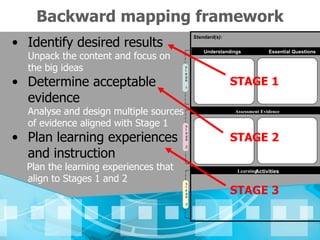
Backward mapping framework
• Identify desired results
                                            Standard(s):

                                                Understandings                     Essential Questions
  Unpack the content and focus on
  the big ideas                         s
                                        t
                                        a


• Determine acceptable                                          STAGE 1
                                        g
                                        e

                                        1


  evidence
  Analyse and design multiple sources                                Assessment Evidence

  of evidence aligned with Stage 1      s
                                        t
                                              Performance Task(s):              Other Evidence:


• Plan learning experiences                                     STAGE 2
                                        a
                                        g
                                        e


  and instruction
                                        2


  Plan the learning experiences that                                         Activities
                                                                      Learning
  align to Stages 1 and 2               s

                                                                STAGE 3
                                        t
                                        a
                                        g
                                        e

                                        3
Backward mapping framework
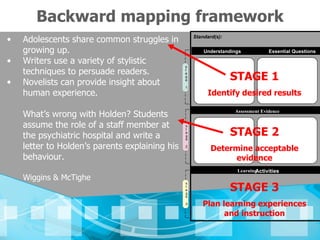
•   Adolescents share common struggles in           Standard(s):

    growing up.                                         Understandings                     Essential Questions

•   Writers use a variety of stylistic          s
    techniques to persuade readers.             t


•   Novelists can provide insight about
                                                a
                                                g
                                                e                       STAGE 1
                                                1

    human experience.                                      Identify desired results

    What’s wrong with Holden? Students                                       Assessment Evidence


    assume the role of a staff member at        s
                                                      Performance Task(s):              Other Evidence:


    the psychiatric hospital and write a
                                                t
                                                a
                                                g
                                                e
                                                                        STAGE 2
    letter to Holden’s parents explaining his   2
                                                             Determine acceptable
    behaviour.                                                    evidence
                                                                                     Activities
                                                                              Learning
    Wiggins & McTighe
                                                                        STAGE 3
                                                s
                                                t
                                                a
                                                g
                                                e

                                                3       Plan learning experiences
                                                              and instruction
Why the backward mapping framework?

Without building courses ‘backward’ from key
tasks, big ideas and performance standards,
there are no clear priorities.
                                Wiggins & McTighe ‘05


By thinking through the assessment upfront,
we ensure greater alignment of our goals,
and therefore teaching is focused on the
desired results.
Links to key DET planning documents
 Curriculum planning and programming,
 assessing and reporting to parents K-12 Policy
 Curriculum Planning and Programming
 • Teaching programs will incorporate assessment
    as an integral component.
 • Teaching programs will indicate the outcomes
    being addressed, the teaching activities planned
    and the intended assessment strategies.
Links to key DET planning documents
 Curriculum planning and programming,
 assessing and reporting to parents K-12 Policy
 Assessing
 Schools plan assessment so that:
 • students can demonstrate achievement of
    outcomes for the relevant stage of learning;
 • valid and reliable assessment strategies are used.
Links to key DET planning documents
 Curriculum planning and programming,
 assessing and reporting to parents K-12 Policy
 Assessing
 • Teachers plan assessment strategies when
   developing teaching programs.
 • Teachers use a variety of appropriate
    assessments for judging student achievement.
Links to key DET planning documents
 K-4 Strategy
 1.0 Learning confidently
 • provide learning opportunities which encourage
    students to use their imagination and to
    investigate and actively explore their environment
 • increase the use of different technologies as tools
    to stimulate inquiry and innovation and to
    broaden children’s understanding of the complex
    world in which they live
Links to key DET planning documents
 K-4 Strategy
  1.0 Learning confidently
 • assist teachers to make more consistent
     judgements about student achievement,
     monitor the progress and achievement of each
     young learner in order to inform the direction
     of teaching and learning
Links to key DET planning documents
 Middle Years Strategy
 1.0 Reaching higher
 • strengthen the implementation of quality teaching
    and raise the level of student expectations,
    engagement and achievement.
 • provide a challenging, cohesive curriculum across
    Years 5-9 that builds on prior learning and
    strengthens the relationship between quality
    teaching, learning and assessment
 • …expand opportunities for students to apply their
    learning in a real world context
Links to key DET planning documents
 Middle Years Strategy

 2.0 Growing towards independence
 • expand the range of opportunities
    available for all students to access
    and engage in learning experiences
    that are challenging, relevant and
    meaningful
Links to key DET planning documents
 Later Years Strategy
 1.0 Aiming higher
 • continue to find innovative and effective ways of
            engaging students in courses that have
 particular significance for university entrance.
 • identify ways to foster critical thinking and
 reflection, creative thinking and develop the skills of
 entrepreneurship linked to curriculum outcomes and
 to the skills that industry wants such as problem
 solving, team work and communication.
Links to key DET planning documents
 Review of Statewide Assessments
 in the context of National
 Developments
 An assessment framework for New South
 Wales schools
 3. High-quality school-based assessment that
 reflects current pedagogy and curriculum, and
 that emphasises assessment for learning.
Links to key DET planning documents
 Review of Statewide Assessments
 in the context of National
 Developments
 An assessment framework for New South
 Wales schools
 6. Appropriate professional learning programs
 on all aspects of assessment…integrating assessment
 and pedagogy, and using information from both school-
 based assessment and formal tests for student and
 school improvement.
Links to key DET planning documents
 Review of Statewide Assessments
 in the context of National
 Developments
 An assessment framework for New South
 Wales schools
 9. An ongoing program of research and development in
 innovative assessment methods and the integration of
 new technologies, and the provision of support material
 for schools.
Links to key DET planning documents
 Corporate Plan 2006-2008
 NSW Department of Education and Training
 GOAL: To deliver education and training that
 inspires students to succeed, fosters high
 expectations and prepares them for
 participation in a democratic and sustainable
 society.
 Strategy: Create learning environments that
 are relevant and engaging and that prepare
 students, in all their diversity, to succeed in the
 modern world.
Links to key DET planning documents

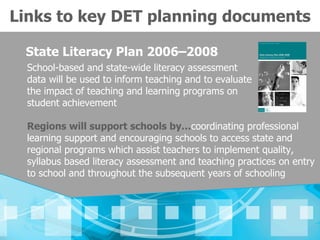
 State Literacy Plan 2006–2008
  School-based and state-wide literacy assessment
  data will be used to inform teaching and to evaluate
  the impact of teaching and learning programs on
  student achievement

  Regions will support schools by…coordinating professional
  learning support and encouraging schools to access state and
  regional programs which assist teachers to implement quality,
  syllabus based literacy assessment and teaching practices on entry
  to school and throughout the subsequent years of schooling
Links to key DET planning documents

 State Numeracy Plan 2006–2008
 Schools will support teachers by…supporting teachers in
 developing and applying optimum teaching practices and to
 share and reflect on successful and unsuccessful approaches
 Implementing teaching programs that develop students’
 numeracy through building upon what they currently know.

 Regions will support schools by…engaging regional
 consultants to support numeracy networks and providing
 focused support on optimum numeracy teaching practices
Links to key DET planning documents

 NSW model of pedagogy

  1.   What do I want my students to learn?
  2.   Why does it matter?
  3.   How will they demonstrate their learning?
  4.   What is the quality that I want them to
       produce?
Students as the experts…

Allowing students opportunities to play
an ‘expert’ role and engage in authentic
tasks for different audiences using a
range of appropriate technologies, will
assist in maximising engagement,
relevance and deep understanding.

Backward mapping presentation

  • 1.
    BACKWARD MAPPING: B eg in n in g wit h t h e e n d in min d Tracy Considine  Middle Years ICT Consultant  South Western Sydney Region
  • 2.
    What is it? Aframework used to improve curriculum design in order to develop and deepen students’ understanding. Tracy Considine  Middle Years ICT Consultant  South Western Sydney Region
  • 3.
    Where did itcome from? Jay McTighe & Grant Wiggins “Understanding by Design” The “Twin Sins” of curriculum design: aimless activity superficial coverage Tracy Considine  Middle Years ICT Consultant  South Western Sydney Region
  • 4.
    In the wordsof Covey “To begin with the end in mind means to start with a clear understanding of your destination. It means to know where you’re going so that you better understand where you are now so that the steps you take are always in the right direction.” Stephen R Covey, The seven habits of highly effective people Tracy Considine  Middle Years ICT Consultant  South Western Sydney Region
  • 5.
    Backward mapping framework •Identify desired results Standard(s): Understandings Essential Questions Unpack the content and focus on the big ideas s t a • Determine acceptable STAGE 1 g e 1 evidence Analyse and design multiple sources Assessment Evidence of evidence aligned with Stage 1 s t Performance Task(s): Other Evidence: • Plan learning experiences STAGE 2 a g e and instruction 2 Plan the learning experiences that Activities Learning align to Stages 1 and 2 s STAGE 3 t a g e 3
  • 6.
    Backward mapping framework • Adolescents share common struggles in Standard(s): growing up. Understandings Essential Questions • Writers use a variety of stylistic s techniques to persuade readers. t • Novelists can provide insight about a g e STAGE 1 1 human experience. Identify desired results What’s wrong with Holden? Students Assessment Evidence assume the role of a staff member at s Performance Task(s): Other Evidence: the psychiatric hospital and write a t a g e STAGE 2 letter to Holden’s parents explaining his 2 Determine acceptable behaviour. evidence Activities Learning Wiggins & McTighe STAGE 3 s t a g e 3 Plan learning experiences and instruction
  • 7.
    Why the backwardmapping framework? Without building courses ‘backward’ from key tasks, big ideas and performance standards, there are no clear priorities. Wiggins & McTighe ‘05 By thinking through the assessment upfront, we ensure greater alignment of our goals, and therefore teaching is focused on the desired results.
  • 8.
    Links to keyDET planning documents
  • 9.
    Links to keyDET planning documents Curriculum planning and programming, assessing and reporting to parents K-12 Policy Curriculum Planning and Programming • Teaching programs will incorporate assessment as an integral component. • Teaching programs will indicate the outcomes being addressed, the teaching activities planned and the intended assessment strategies.
  • 10.
    Links to keyDET planning documents Curriculum planning and programming, assessing and reporting to parents K-12 Policy Assessing Schools plan assessment so that: • students can demonstrate achievement of outcomes for the relevant stage of learning; • valid and reliable assessment strategies are used.
  • 11.
    Links to keyDET planning documents Curriculum planning and programming, assessing and reporting to parents K-12 Policy Assessing • Teachers plan assessment strategies when developing teaching programs. • Teachers use a variety of appropriate assessments for judging student achievement.
  • 12.
    Links to keyDET planning documents K-4 Strategy 1.0 Learning confidently • provide learning opportunities which encourage students to use their imagination and to investigate and actively explore their environment • increase the use of different technologies as tools to stimulate inquiry and innovation and to broaden children’s understanding of the complex world in which they live
  • 13.
    Links to keyDET planning documents K-4 Strategy 1.0 Learning confidently • assist teachers to make more consistent judgements about student achievement, monitor the progress and achievement of each young learner in order to inform the direction of teaching and learning
  • 14.
    Links to keyDET planning documents Middle Years Strategy 1.0 Reaching higher • strengthen the implementation of quality teaching and raise the level of student expectations, engagement and achievement. • provide a challenging, cohesive curriculum across Years 5-9 that builds on prior learning and strengthens the relationship between quality teaching, learning and assessment • …expand opportunities for students to apply their learning in a real world context
  • 15.
    Links to keyDET planning documents Middle Years Strategy 2.0 Growing towards independence • expand the range of opportunities available for all students to access and engage in learning experiences that are challenging, relevant and meaningful
  • 16.
    Links to keyDET planning documents Later Years Strategy 1.0 Aiming higher • continue to find innovative and effective ways of engaging students in courses that have particular significance for university entrance. • identify ways to foster critical thinking and reflection, creative thinking and develop the skills of entrepreneurship linked to curriculum outcomes and to the skills that industry wants such as problem solving, team work and communication.
  • 17.
    Links to keyDET planning documents Review of Statewide Assessments in the context of National Developments An assessment framework for New South Wales schools 3. High-quality school-based assessment that reflects current pedagogy and curriculum, and that emphasises assessment for learning.
  • 18.
    Links to keyDET planning documents Review of Statewide Assessments in the context of National Developments An assessment framework for New South Wales schools 6. Appropriate professional learning programs on all aspects of assessment…integrating assessment and pedagogy, and using information from both school- based assessment and formal tests for student and school improvement.
  • 19.
    Links to keyDET planning documents Review of Statewide Assessments in the context of National Developments An assessment framework for New South Wales schools 9. An ongoing program of research and development in innovative assessment methods and the integration of new technologies, and the provision of support material for schools.
  • 20.
    Links to keyDET planning documents Corporate Plan 2006-2008 NSW Department of Education and Training GOAL: To deliver education and training that inspires students to succeed, fosters high expectations and prepares them for participation in a democratic and sustainable society. Strategy: Create learning environments that are relevant and engaging and that prepare students, in all their diversity, to succeed in the modern world.
  • 21.
    Links to keyDET planning documents State Literacy Plan 2006–2008 School-based and state-wide literacy assessment data will be used to inform teaching and to evaluate the impact of teaching and learning programs on student achievement Regions will support schools by…coordinating professional learning support and encouraging schools to access state and regional programs which assist teachers to implement quality, syllabus based literacy assessment and teaching practices on entry to school and throughout the subsequent years of schooling
  • 22.
    Links to keyDET planning documents State Numeracy Plan 2006–2008 Schools will support teachers by…supporting teachers in developing and applying optimum teaching practices and to share and reflect on successful and unsuccessful approaches Implementing teaching programs that develop students’ numeracy through building upon what they currently know. Regions will support schools by…engaging regional consultants to support numeracy networks and providing focused support on optimum numeracy teaching practices
  • 23.
    Links to keyDET planning documents NSW model of pedagogy 1. What do I want my students to learn? 2. Why does it matter? 3. How will they demonstrate their learning? 4. What is the quality that I want them to produce?
  • 24.
    Students as theexperts… Allowing students opportunities to play an ‘expert’ role and engage in authentic tasks for different audiences using a range of appropriate technologies, will assist in maximising engagement, relevance and deep understanding.