Understanding by Design
 Wiggins & McTighe
     A Brief Introduction
    Center for Technology & School Change
    Teachers College, Columbia University
      Ellen B. Meier, Ed. D., Co-Director
Focus on “Understanding”
• Explains common practices that interfere with
  understanding.
• Explains a backward design process to avoid
  common problems.
• Proposes an approach to curriculum designed to
  engage students in inquiry & “uncovering” ideas.
• Proposes a set of design standards for achieving
  quality control in curriculum & assessment
  designs.
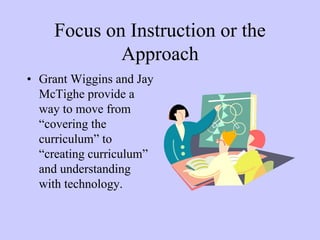
Focus on Instruction or the
            Approach
• Grant Wiggins and Jay
  McTighe provide a
  way to move from
  “covering the
  curriculum” to
  “creating curriculum”
  and understanding
  with technology.
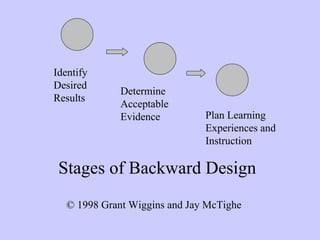
Identify
Desired
              Determine
Results
              Acceptable
              Evidence         Plan Learning
                               Experiences and
                               Instruction

 Stages of Backward Design
   © 1998 Grant Wiggins and Jay McTighe
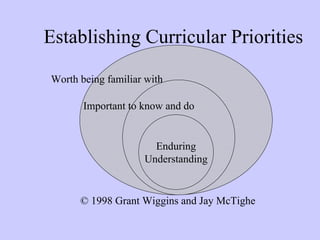
Establishing Curricular Priorities

Worth being familiar with

       Important to know and do


                      Enduring
                    Understanding


      © 1998 Grant Wiggins and Jay McTighe
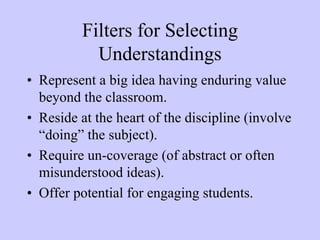
Filters for Selecting
            Understandings
• Represent a big idea having enduring value
  beyond the classroom.
• Reside at the heart of the discipline (involve
  “doing” the subject).
• Require un-coverage (of abstract or often
  misunderstood ideas).
• Offer potential for engaging students.
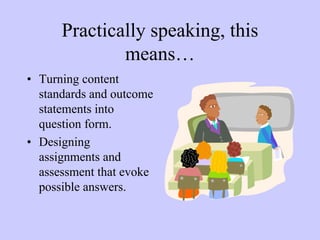
Practically speaking, this
              means…
• Turning content
  standards and outcome
  statements into
  question form.
• Designing
  assignments and
  assessment that evoke
  possible answers.
Some examples of Essential
            Questions
• Is there enough to go
  around (e.g., food, clothes,
  water)?
• Are mathematical ideas
  inventions or discoveries?
• Does art reflect culture or
  shape it?
• Who owns what and why?
• What do we fear?
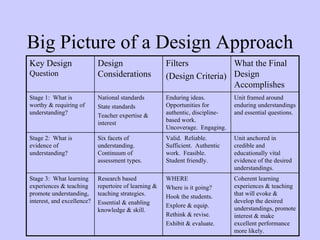
Big Picture of a Design Approach
Key Design                  Design                     Filters           What the Final
Question                    Considerations             (Design Criteria) Design
                                                                         Accomplishes
Stage 1: What is            National standards         Enduring ideas.          Unit framed around
worthy & requiring of       State standards            Opportunities for        enduring understandings
understanding?              Teacher expertise &        authentic, discipline-   and essential questions.
                            interest                   based work.
                                                       Uncoverage. Engaging.
Stage 2: What is            Six facets of              Valid. Reliable.         Unit anchored in
evidence of                 understanding.             Sufficient. Authentic    credible and
understanding?              Continuum of               work. Feasible.          educationally vital
                            assessment types.          Student friendly.        evidence of the desired
                                                                                understandings.
Stage 3: What learning      Research based             WHERE                    Coherent learning
experiences & teaching      repertoire of learning &   Where is it going?       experiences & teaching
promote understanding,      teaching strategies.       Hook the students.       that will evoke &
interest, and excellence?   Essential & enabling                                develop the desired
                                                       Explore & equip.         understandings, promote
                            knowledge & skill.
                                                       Rethink & revise.        interest & make
                                                       Exhibit & evaluate.      excellent performance
                                                                                more likely.
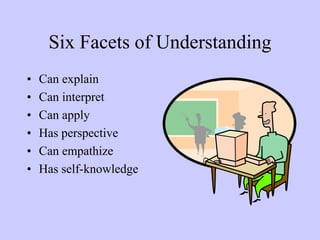
Six Facets of Understanding
•   Can explain
•   Can interpret
•   Can apply
•   Has perspective
•   Can empathize
•   Has self-knowledge
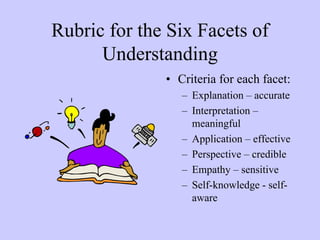
Rubric for the Six Facets of
      Understanding
              • Criteria for each facet:
                 – Explanation – accurate
                 – Interpretation –
                   meaningful
                 – Application – effective
                 – Perspective – credible
                 – Empathy – sensitive
                 – Self-knowledge - self-
                   aware
What the Facets Imply for Unit
            Design
• Uncoverage vs.
  coverage:
  – Text is resource vs.
    text is syllabus.
  – Main ideas suggest the
    kinds of performances
    vs. assessment is
    viewed as a test based
    on text.
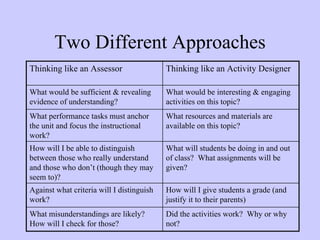
Two Different Approaches
Thinking like an Assessor                  Thinking like an Activity Designer

What would be sufficient & revealing       What would be interesting & engaging
evidence of understanding?                 activities on this topic?
What performance tasks must anchor         What resources and materials are
the unit and focus the instructional       available on this topic?
work?
How will I be able to distinguish          What will students be doing in and out
between those who really understand        of class? What assignments will be
and those who don’t (though they may       given?
seem to)?
Against what criteria will I distinguish   How will I give students a grade (and
work?                                      justify it to their parents)
What misunderstandings are likely?         Did the activities work? Why or why
How will I check for those?                not?
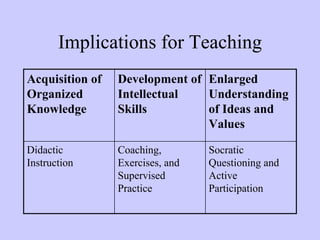
Implications for Teaching
Acquisition of   Development of Enlarged
Organized        Intellectual   Understanding
Knowledge        Skills         of Ideas and
                                Values

Didactic         Coaching,        Socratic
Instruction      Exercises, and   Questioning and
                 Supervised       Active
                 Practice         Participation
Design Standards are Important
• Helps us understand:
   – What is worthy of
     understanding in this unit?
   – What counts as evidence
     that students really
     understand and can use
     what we’re teaching?
   – What knowledge and skills
     must we teach to enable
     them to apply their
     knowledge in meaningful
     ways?
Ideally…
    • Units would be reviewed
      with others in a peer
      review process.
    • Units would be
      documented with all the
      information including
      handouts required and
      exemplars.
    • Units would be made
      available to share.
A Process, not an Event
• Takes place over time
  – 3 to 5 years
  minimum.
• Can adapt any or all of
  these perspectives and
  incorporate others.
• Emphasis on student
  understanding is key.

Ubd Powerpoint

  • 1.
    Understanding by Design Wiggins & McTighe A Brief Introduction Center for Technology & School Change Teachers College, Columbia University Ellen B. Meier, Ed. D., Co-Director
  • 2.
    Focus on “Understanding” •Explains common practices that interfere with understanding. • Explains a backward design process to avoid common problems. • Proposes an approach to curriculum designed to engage students in inquiry & “uncovering” ideas. • Proposes a set of design standards for achieving quality control in curriculum & assessment designs.
  • 3.
    Focus on Instructionor the Approach • Grant Wiggins and Jay McTighe provide a way to move from “covering the curriculum” to “creating curriculum” and understanding with technology.
  • 4.
    Identify Desired Determine Results Acceptable Evidence Plan Learning Experiences and Instruction Stages of Backward Design © 1998 Grant Wiggins and Jay McTighe
  • 5.
    Establishing Curricular Priorities Worthbeing familiar with Important to know and do Enduring Understanding © 1998 Grant Wiggins and Jay McTighe
  • 6.
    Filters for Selecting Understandings • Represent a big idea having enduring value beyond the classroom. • Reside at the heart of the discipline (involve “doing” the subject). • Require un-coverage (of abstract or often misunderstood ideas). • Offer potential for engaging students.
  • 7.
    Practically speaking, this means… • Turning content standards and outcome statements into question form. • Designing assignments and assessment that evoke possible answers.
  • 8.
    Some examples ofEssential Questions • Is there enough to go around (e.g., food, clothes, water)? • Are mathematical ideas inventions or discoveries? • Does art reflect culture or shape it? • Who owns what and why? • What do we fear?
  • 9.
    Big Picture ofa Design Approach Key Design Design Filters What the Final Question Considerations (Design Criteria) Design Accomplishes Stage 1: What is National standards Enduring ideas. Unit framed around worthy & requiring of State standards Opportunities for enduring understandings understanding? Teacher expertise & authentic, discipline- and essential questions. interest based work. Uncoverage. Engaging. Stage 2: What is Six facets of Valid. Reliable. Unit anchored in evidence of understanding. Sufficient. Authentic credible and understanding? Continuum of work. Feasible. educationally vital assessment types. Student friendly. evidence of the desired understandings. Stage 3: What learning Research based WHERE Coherent learning experiences & teaching repertoire of learning & Where is it going? experiences & teaching promote understanding, teaching strategies. Hook the students. that will evoke & interest, and excellence? Essential & enabling develop the desired Explore & equip. understandings, promote knowledge & skill. Rethink & revise. interest & make Exhibit & evaluate. excellent performance more likely.
  • 10.
    Six Facets ofUnderstanding • Can explain • Can interpret • Can apply • Has perspective • Can empathize • Has self-knowledge
  • 11.
    Rubric for theSix Facets of Understanding • Criteria for each facet: – Explanation – accurate – Interpretation – meaningful – Application – effective – Perspective – credible – Empathy – sensitive – Self-knowledge - self- aware
  • 12.
    What the FacetsImply for Unit Design • Uncoverage vs. coverage: – Text is resource vs. text is syllabus. – Main ideas suggest the kinds of performances vs. assessment is viewed as a test based on text.
  • 13.
    Two Different Approaches Thinkinglike an Assessor Thinking like an Activity Designer What would be sufficient & revealing What would be interesting & engaging evidence of understanding? activities on this topic? What performance tasks must anchor What resources and materials are the unit and focus the instructional available on this topic? work? How will I be able to distinguish What will students be doing in and out between those who really understand of class? What assignments will be and those who don’t (though they may given? seem to)? Against what criteria will I distinguish How will I give students a grade (and work? justify it to their parents) What misunderstandings are likely? Did the activities work? Why or why How will I check for those? not?
  • 14.
    Implications for Teaching Acquisitionof Development of Enlarged Organized Intellectual Understanding Knowledge Skills of Ideas and Values Didactic Coaching, Socratic Instruction Exercises, and Questioning and Supervised Active Practice Participation
  • 15.
    Design Standards areImportant • Helps us understand: – What is worthy of understanding in this unit? – What counts as evidence that students really understand and can use what we’re teaching? – What knowledge and skills must we teach to enable them to apply their knowledge in meaningful ways?
  • 16.
    Ideally… • Units would be reviewed with others in a peer review process. • Units would be documented with all the information including handouts required and exemplars. • Units would be made available to share.
  • 17.
    A Process, notan Event • Takes place over time – 3 to 5 years minimum. • Can adapt any or all of these perspectives and incorporate others. • Emphasis on student understanding is key.