Use of    3’Is
                    within the framework of


                                      September __, 2011 @ CJC EdTech Hall 2

Randy A. Tudy
randytudy@gmail.com
http://christianbestgiftideas.blogspot.com/
http://beststocktradingphilippines.blogspot.com/
http://howiloveandenjoymyteachingjob.blogspot.com/
BECOME A PASTOR
• After a church service on Sunday
  morning, a young boy suddenly
  announced to his mother, "Mom,
  I've decided to become a minister
  When I grow up."
• "That's okay with us, but what
  made you decide that?"
• "Well," said the little boy, "I have
  to go to church on Sunday
  anyway, and I figure it will be
  more fun to stand up and yell,
  than to sit and listen."
Change in education
  isEasy to propose
hard to implement
      and extra
           ordinarily
                    difficulty to sustain
Teachers
as agents of
CHANGE
As agents of Change
      KSAs & KUDs
   What
          should we have in order to effectively
          implement the 2010 SEC?
DESIRED RESULT


Teacher effectiveness in the
implementation of the 2010 SEC
MeTHODOLOgY
Examine sample learning plans
Reflect, discuss, share ideas & PLAN
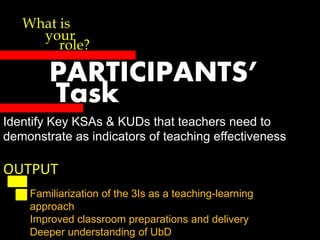
What is
     your
        role?

        PARTICIPANTS’
        Task
Identify Key KSAs & KUDs that teachers need to
demonstrate as indicators of teaching effectiveness

OUTPUT
    Familiarization of the 3Is as a teaching-learning
    approach
    Improved classroom preparations and delivery
    Deeper understanding of UbD
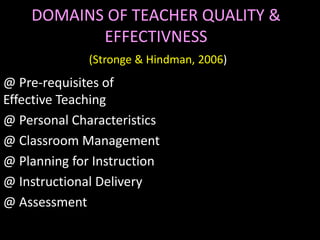
DOMAINS OF TEACHER QUALITY &
           EFFECTIVNESS
              (Stronge & Hindman, 2006)
@ Pre-requisites of
Effective Teaching
@ Personal Characteristics
@ Classroom Management
@ Planning for Instruction
@ Instructional Delivery
@ Assessment
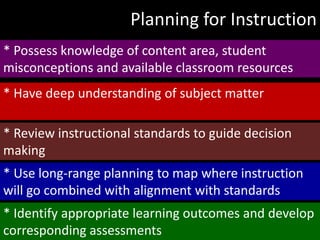
Planning for Instruction
* Possess knowledge of content area, student
misconceptions and available classroom resources
* Have deep understanding of subject matter

* Review instructional standards to guide decision
making
* Use long-range planning to map where instruction
will go combined with alignment with standards
* Identify appropriate learning outcomes and develop
corresponding assessments
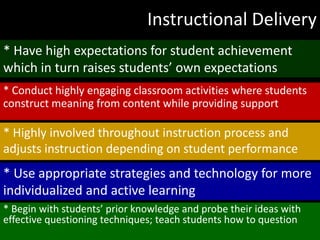
Instructional Delivery
* Have high expectations for student achievement
which in turn raises students’ own expectations
* Conduct highly engaging classroom activities where students
construct meaning from content while providing support

* Highly involved throughout instruction process and
adjusts instruction depending on student performance
* Use appropriate strategies and technology for more
individualized and active learning
* Begin with students’ prior knowledge and probe their ideas with
effective questioning techniques; teach students how to question
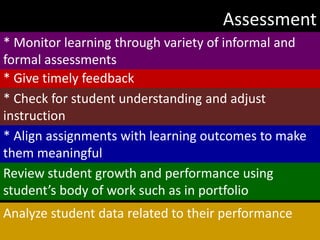
Assessment
* Monitor learning through variety of informal and
formal assessments
* Give timely feedback
* Check for student understanding and adjust
instruction
* Align assignments with learning outcomes to make
them meaningful
Review student growth and performance using
student’s body of work such as in portfolio
Analyze student data related to their performance
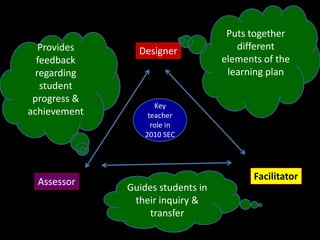
Puts together
   Provides     Designer              different
  feedback                         elements of the
  regarding                         learning plan
   student
 progress &
                     Key
achievement        teacher
                    role in
                  2010 SEC


                                          Facilitator
 Assessor
              Guides students in
               their inquiry &
                   transfer
Stage 1:
DESIRED RESULTS
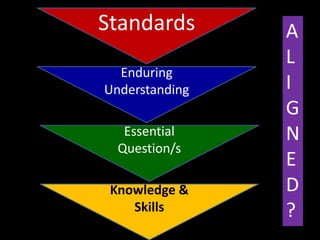
Standards       A
                L
  Enduring
Understanding   I
                G
   Essential    N
  Question/s
                E
 Knowledge &    D
    Skills      ?
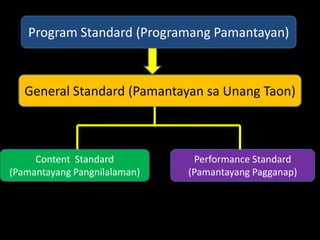
Program Standard (Programang Pamantayan)


   General Standard (Pamantayan sa Unang Taon)


     Content Standard          Performance Standard
(Pamantayang Pangnilalaman)   (Pamantayang Pagganap)
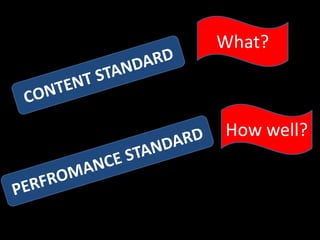
What?


How well?
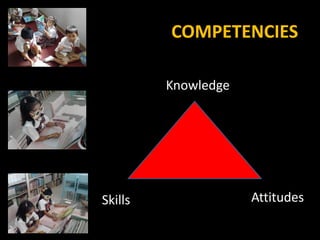
COMPETENCIES

         Knowledge


Skills               Attitudes
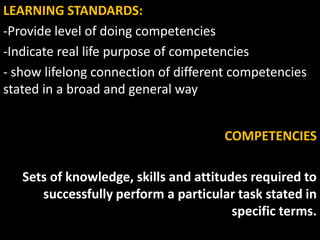
LEARNING STANDARDS:
-Provide level of doing competencies
-Indicate real life purpose of competencies
- show lifelong connection of different competencies
stated in a broad and general way


                                      COMPETENCIES

   Sets of knowledge, skills and attitudes required to
      successfully perform a particular task stated in
                                        specific terms.
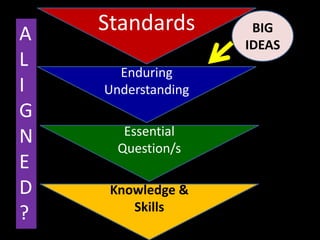
A   Standards        BIG
                    IDEAS
L
      Enduring
I   Understanding
G
N      Essential
      Question/s
E
D    Knowledge &
        Skills
?
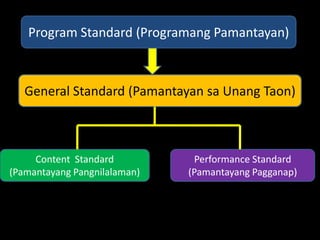
Program Standard (Programang Pamantayan)


   General Standard (Pamantayan sa Unang Taon)


     Content Standard          Performance Standard
(Pamantayang Pangnilalaman)   (Pamantayang Pagganap)
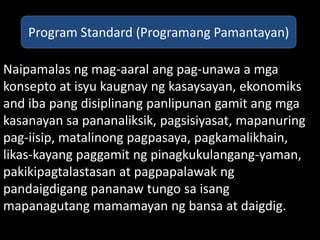
Program Standard (Programang Pamantayan)

Naipamalas ng mag-aaral ang pag-unawa a mga
konsepto at isyu kaugnay ng kasaysayan, ekonomiks
and iba pang disiplinang panlipunan gamit ang mga
kasanayan sa pananaliksik, pagsisiyasat, mapanuring
pag-iisip, matalinong pagpasaya, pagkamalikhain,
likas-kayang paggamit ng pinagkukulangang-yaman,
pakikipagtalastasan at pagpapalawak ng
pandaigdigang pananaw tungo sa isang
mapanagutang mamamayan ng bansa at daigdig.
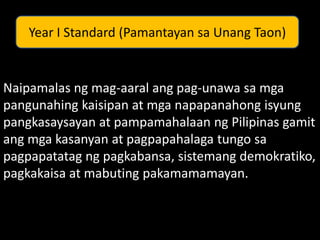
Year I Standard (Pamantayan sa Unang Taon)


Naipamalas ng mag-aaral ang pag-unawa sa mga
pangunahing kaisipan at mga napapanahong isyung
pangkasaysayan at pampamahalaan ng Pilipinas gamit
ang mga kasanyan at pagpapahalaga tungo sa
pagpapatatag ng pagkabansa, sistemang demokratiko,
pagkakaisa at mabuting pakamamamayan.
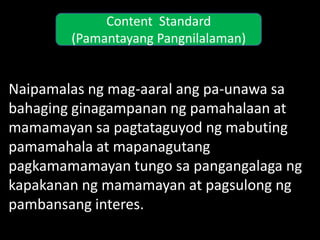
Content Standard
        (Pamantayang Pangnilalaman)


Naipamalas ng mag-aaral ang pa-unawa sa
bahaging ginagampanan ng pamahalaan at
mamamayan sa pagtataguyod ng mabuting
pamamahala at mapanagutang
pagkamamamayan tungo sa pangangalaga ng
kapakanan ng mamamayan at pagsulong ng
pambansang interes.
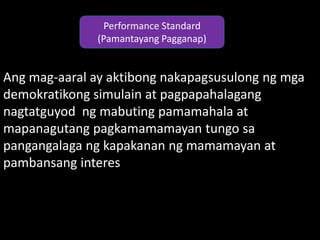
Performance Standard
               (Pamantayang Pagganap)


Ang mag-aaral ay aktibong nakapagsusulong ng mga
demokratikong simulain at pagpapahalagang
nagtatguyod ng mabuting pamamahala at
mapanagutang pagkamamamayan tungo sa
pangangalaga ng kapakanan ng mamamayan at
pambansang interes
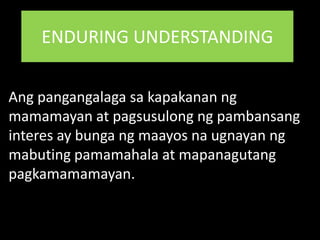
ENDURING UNDERSTANDING


Ang pangangalaga sa kapakanan ng
mamamayan at pagsusulong ng pambansang
interes ay bunga ng maayos na ugnayan ng
mabuting pamamahala at mapanagutang
pagkamamamayan.
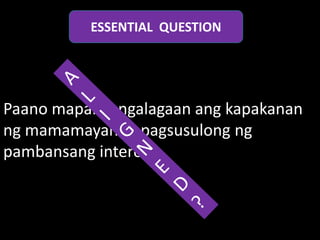
ESSENTIAL QUESTION


Paano mapangangalagaan ang kapakanan
ng mamamayan at pagsusulong ng
pambansang interes?
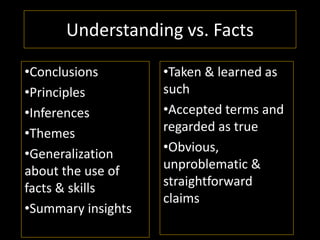
Understanding vs. Facts

•Conclusions        •Taken & learned as
•Principles         such
•Inferences         •Accepted terms and
•Themes             regarded as true
•Generalization     •Obvious,
about the use of    unproblematic &
facts & skills      straightforward
                    claims
•Summary insights
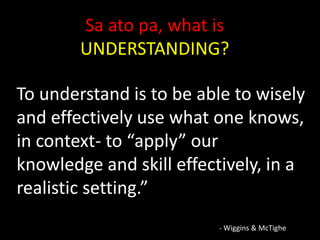
Sa ato pa, what is
        UNDERSTANDING?

To understand is to be able to wisely
and effectively use what one knows,
in context- to “apply” our
knowledge and skill effectively, in a
realistic setting.”
                         - Wiggins & McTighe
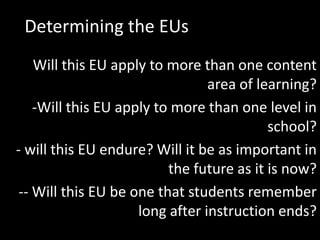
Determining the EUs
    Will this EU apply to more than one content
                                 area of learning?
    -Will this EU apply to more than one level in
                                           school?
- will this EU endure? Will it be as important in
                          the future as it is now?
 -- Will this EU be one that students remember
                     long after instruction ends?
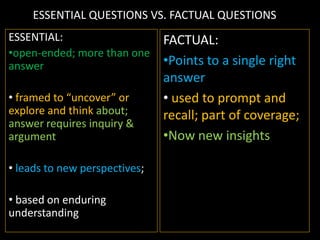
ESSENTIAL QUESTIONS VS. FACTUAL QUESTIONS
ESSENTIAL:                     FACTUAL:
•open-ended; more than one
answer                         •Points to a single right
                               answer
• framed to “uncover” or       • used to prompt and
explore and think about;       recall; part of coverage;
answer requires inquiry &
argument                       •Now new insights

• leads to new perspectives;

• based on enduring
understanding
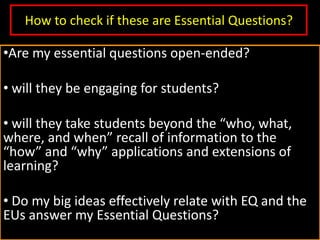
How to check if these are Essential Questions?

•Are my essential questions open-ended?

• will they be engaging for students?

• will they take students beyond the “who, what,
where, and when” recall of information to the
“how” and “why” applications and extensions of
learning?

• Do my big ideas effectively relate with EQ and the
EUs answer my Essential Questions?
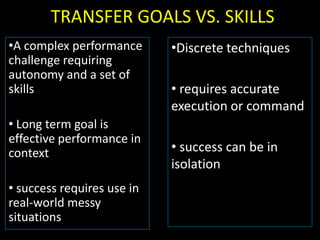
TRANSFER GOALS VS. SKILLS
•A complex performance      •Discrete techniques
challenge requiring
autonomy and a set of
skills                      • requires accurate
                            execution or command
• Long term goal is
effective performance in
context                     • success can be in
                            isolation
• success requires use in
real-world messy
situations
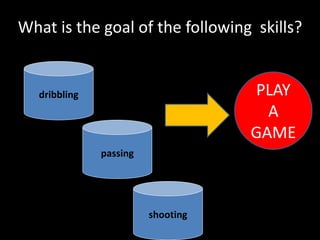
What is the goal of the following skills?


   dribbling                        PLAY
                                      A
                                    GAME
               passing


                         shooting
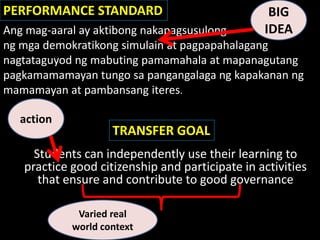
PERFORMANCE STANDARD                              BIG
Ang mag-aaral ay aktibong nakapagsusulong        IDEA
ng mga demokratikong simulain at pagpapahalagang
nagtataguyod ng mabuting pamamahala at mapanagutang
pagkamamamayan tungo sa pangangalaga ng kapakanan ng
mamamayan at pambansang iteres.

  action
                    TRANSFER GOAL
     Students can independently use their learning to
   practice good citizenship and participate in activities
      that ensure and contribute to good governance

             Varied real
            world context
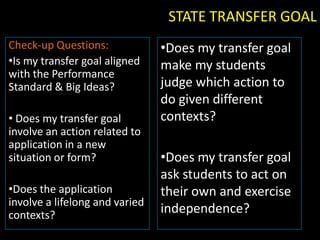
STATE TRANSFER GOAL
Check-up Questions:             •Does my transfer goal
•Is my transfer goal aligned    make my students
with the Performance
Standard & Big Ideas?           judge which action to
                                do given different
• Does my transfer goal         contexts?
involve an action related to
application in a new
situation or form?              •Does my transfer goal
                                ask students to act on
•Does the application           their own and exercise
involve a lifelong and varied
contexts?                       independence?
STAGE 2:
Assessment Evidence
Empowering
 connections
             BUILD
in our hearts.
               THE
                 THE
        SOUL
         OF THE
                        RESPONSE TO GOD
                       FOR GREATER GOOD
   FILIPINO                  JOIE D’ VIVRE
      GIFT OF DIVINE GRACE DEMANDS
ACCOUNTABILITY
            MORAL FIBRE
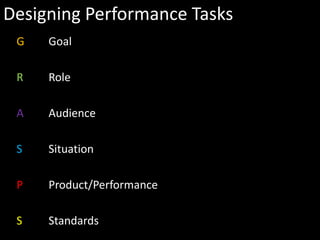
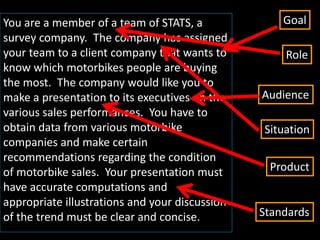
Designing Performance Tasks
 G   Goal

 R   Role

 A   Audience

 S   Situation

 P   Product/Performance

 S   Standards
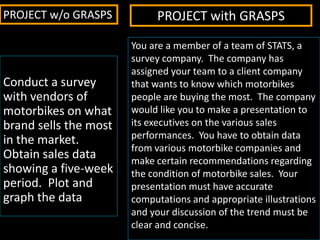
PROJECT w/o GRASPS          PROJECT with GRASPS

                       You are a member of a team of STATS, a
                       survey company. The company has
                       assigned your team to a client company
Conduct a survey       that wants to know which motorbikes
with vendors of        people are buying the most. The company
motorbikes on what     would like you to make a presentation to
brand sells the most   its executives on the various sales
in the market.         performances. You have to obtain data
                       from various motorbike companies and
Obtain sales data      make certain recommendations regarding
showing a five-week    the condition of motorbike sales. Your
period. Plot and       presentation must have accurate
graph the data         computations and appropriate illustrations
                       and your discussion of the trend must be
                       clear and concise.
You are a member of a team of STATS, a              Goal
survey company. The company has assigned
your team to a client company that wants to         Role
know which motorbikes people are buying
the most. The company would like you to
make a presentation to its executives on the    Audience
various sales performances. You have to
obtain data from various motorbike              Situation
companies and make certain
recommendations regarding the condition
of motorbike sales. Your presentation must       Product
have accurate computations and
appropriate illustrations and your discussion
of the trend must be clear and concise.         Standards
TRANSFER DEMAND RUBRIC
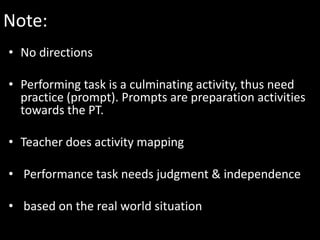
Note:
• No directions

• Performing task is a culminating activity, thus need
  practice (prompt). Prompts are preparation activities
  towards the PT.

• Teacher does activity mapping

• Performance task needs judgment & independence

• based on the real world situation
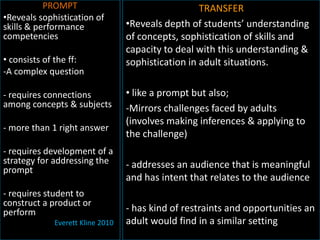
PROMPT                                   TRANSFER
•Reveals sophistication of
skills & performance              •Reveals depth of students’ understanding
competencies                      of concepts, sophistication of skills and
                                  capacity to deal with this understanding &
• consists of the ff:             sophistication in adult situations.
-A complex question

- requires connections            • like a prompt but also;
among concepts & subjects         -Mirrors challenges faced by adults
                                  (involves making inferences & applying to
- more than 1 right answer
                                  the challenge)
- requires development of a
strategy for addressing the       - addresses an audience that is meaningful
prompt
                                  and has intent that relates to the audience
- requires student to
construct a product or
perform                           - has kind of restraints and opportunities an
             Everett Kline 2010   adult would find in a similar setting
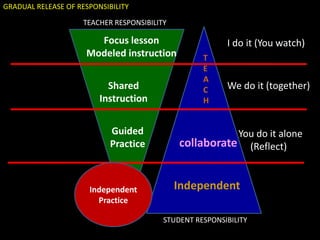
GRADUAL RELEASE OF RESPONSIBILITY

                     TEACHER RESPONSIBILITY

                       Focus lesson                       I do it (You watch)
                     Modeled instruction            T
                                                    E
                                                    A
                           Shared                   C     We do it (together)
                         Instruction                H


                            Guided                       You do it alone
                            Practice          collaborate (Reflect)


                      Independent             Independent
                        Practice

                                          STUDENT RESPONSIBILITY
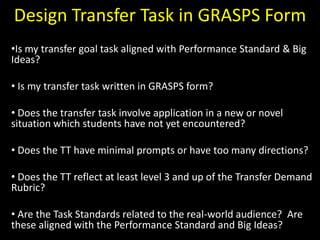
Design Transfer Task in GRASPS Form
•Is my transfer goal task aligned with Performance Standard & Big
Ideas?

• Is my transfer task written in GRASPS form?

• Does the transfer task involve application in a new or novel
situation which students have not yet encountered?

• Does the TT have minimal prompts or have too many directions?

• Does the TT reflect at least level 3 and up of the Transfer Demand
Rubric?

• Are the Task Standards related to the real-world audience? Are
these aligned with the Performance Standard and Big Ideas?
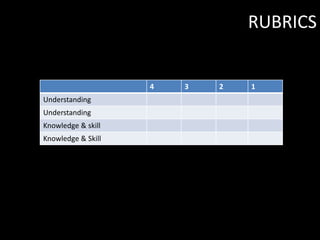
RUBRICS


                    4   3   2   1
Understanding
Understanding
Knowledge & skill
Knowledge & Skill
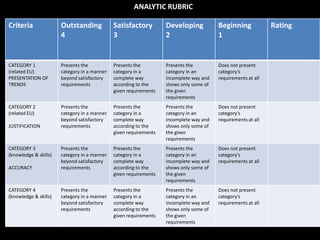
ANALYTIC RUBRIC

Criteria               Outstanding            Satisfactory         Developing           Beginning             Rating
                       4                      3                    2                    1


CATEGORY 1             Presents the           Presents the         Presents the         Does not present
(related EU)           category in a manner   category in a        category in an       category’s
PRESENTATION OF        beyond satisfactory    complete way         incomplete way and   requirements at all
TRENDS                 requirements           according to the     shows only some of
                                              given requirements   the given
                                                                   requirements
CATEGORY 2             Presents the           Presents the         Presents the         Does not present
(related EU)           category in a manner   category in a        category in an       category’s
                       beyond satisfactory    complete way         incomplete way and   requirements at all
JUSTIFICATION          requirements           according to the     shows only some of
                                              given requirements   the given
                                                                   requirements
CATEGORY 3             Presents the           Presents the         Presents the         Does not present
(knowledge & skills)   category in a manner   category in a        category in an       category’s
                       beyond satisfactory    complete way         incomplete way and   requirements at all
ACCURACY               requirements           according to the     shows only some of
                                              given requirements   the given
                                                                   requirements
CATEGORY 4             Presents the           Presents the         Presents the         Does not present
(knowledge & skills)   category in a manner   category in a        category in an       category’s
                       beyond satisfactory    complete way         incomplete way and   requirements at all
                       requirements           according to the     shows only some of
                                              given requirements   the given
                                                                   requirements
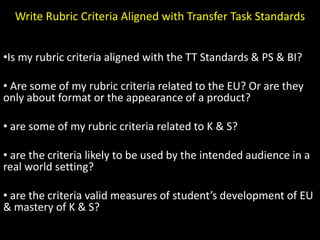
Write Rubric Criteria Aligned with Transfer Task Standards


•Is my rubric criteria aligned with the TT Standards & PS & BI?

• Are some of my rubric criteria related to the EU? Or are they
only about format or the appearance of a product?

• are some of my rubric criteria related to K & S?

• are the criteria likely to be used by the intended audience in a
real world setting?

• are the criteria valid measures of student’s development of EU
& mastery of K & S?
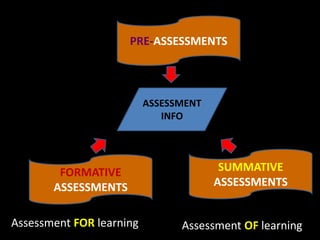
PRE-ASSESSMENTS


                          ASSESSMENT
                             INFO


        FORMATIVE                       SUMMATIVE
       ASSESSMENTS                     ASSESSMENTS


Assessment FOR learning         Assessment OF learning
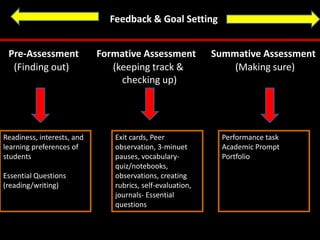
Feedback & Goal Setting


 Pre-Assessment             Formative Assessment           Summative Assessment
  (Finding out)                (keeping track &                (Making sure)
                                 checking up)


Readiness, interests, and      Exit cards, Peer              Performance task
learning preferences of        observation, 3-minuet         Academic Prompt
students                       pauses, vocabulary-           Portfolio
                               quiz/notebooks,
Essential Questions            observations, creating
(reading/writing)              rubrics, self-evaluation,
                               journals- Essential
                               questions
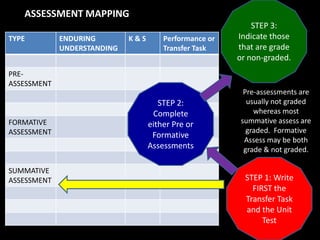
ASSESSMENT MAPPING
                                                            STEP 3:
TYPE         ENDURING        K&S       Performance or   Indicate those
             UNDERSTANDING             Transfer Task    that are grade
                                                        or non-graded.
PRE-
ASSESSMENT
                                                         Pre-assessments are
                                      STEP 2:             usually not graded
                                    Complete                whereas most
FORMATIVE                          either Pre or        summative assess are
ASSESSMENT                                                graded. Formative
                                    Formative
                                                         Assess may be both
                                   Assessments           grade & not graded.

SUMMATIVE
ASSESSMENT                                                STEP 1: Write
                                                            FIRST the
                                                          Transfer Task
                                                          and the Unit
                                                               Test
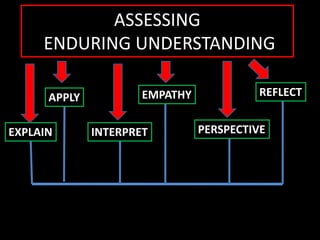
ASSESSING
     ENDURING UNDERSTANDING

      APPLY           EMPATHY             REFLECT


EXPLAIN       INTERPRET         PERSPECTIVE
STAGE 3:

Learning Plan
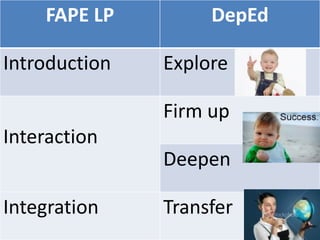
FAPE LP         DepEd

Introduction   Explore

               Firm up
Interaction
               Deepen

Integration    Transfer
3Is a
        as
TEACHING-LEARNING.
      Approach
A. Teacher

1. The teacher has a pleasing personality.                                                                                                                            4   3   2   1

2. The teacher is enthusiastic and maintains a warm and friendly atmosphere conducive to learning.                                                                    4   3   2   1


3. The teacher avoids making embarrassing remarks about the students’ ideas or actions.                                                                               4   3   2   1

4. The teacher explains the lesson in a clear and well-modulated voice.                                                                                               4   3   2   1
5. The teacher praises the students for their sharing and efforts.                                                                                                    4   3   2   1
6. The teacher is confident and shows mastery of the subject matter.                                                                                                  4   3   2   1
7. The teacher is fluent in the medium of instruction.                                                                                                                4   3   2   1
8. The teacher answers the students question in a simple and understandable way.                                                                                      4   3   2   1
9. The teacher maintains discipline and control.                                                                                                                      4   3   2   1

10. The teacher is organized and manages the class time well. The teacher accomplishes the objectives and procedures set for the time period.                         4   3   2   1


11. The teacher shows evident concern for student success and growth in understanding.                                                                                4   3   2   1

AVERAGE
B. TEACHING PROCEDURE
I. INTRODUCTION

1. The teacher introduces Essential Question or EQ in an interesting & engaging way.                                                                                  4   3   2   1

2. The teacher elicits the students’ prior knowledge, perceptions and experiences about the EQ.                                                                       4   3   2   1


3. The teacher encourages students to explain their ideas or ask questions about the EQ.                                                                              4   3   2   1

4. The teacher accepts and records students’ ideas.                                                                                                                   4   3   2   1

5. The teacher asks follow-up thought-provoking questions which lead the students to examine their ideas.                                                             4   3   2   1


6. The teacher explains the purpose of the learning unit and the culminating performance task.                                                                        4   3   2   1

                                                   AVERAGE
II. INTERACTION


1. The teacher is creative and uses a variety of learning resources and activities which enable the students to answer the EQ and develop understanding.              4   3   2   1

2. The teacher stimulates the critical thinking of the students.                                                                                                      4   3   2   1
3. The teacher encourages students to explore their ideas and find the answer.                                                                                        4   3   2   1

4. The teacher provides opportunities for students to interact and collaborate with one another.                                                                      4   3   2   1


5. The teacher processes students’ understanding by asking probing questions and discussing their answers or work.                                                    4   3   2   1


6. The teacher paces the lesson according to the students’ interests, understanding or performance.                                                                   4   3   2   1


FOR CLASSES HELD IN A COMPUTER LAB:
                                                                                                                                                                      4   3   2   1
1. The teacher clearly explains the task related to the use of a particular Website or a multimedia program.


2. The teacher guides students in using interactive programs for practice or gathering different kinds of data.                                                       4   3   2   1


3. The teacher walks around and monitors students’ use of a Website or a multimedia program.                                                                          4   3   2   1


4. The teacher discusses with the students the ideas they gained, questions they developed or works they created with the use of a Website or a multimedia program.   4   3   2   1

                                                                                                                                              AVERAGE

III. INTEGRATION


5. The teacher provides students varied exercises for practices and gives feedback regarding their answers.                                                           4   3   2   1


6. The teacher has students relate or compare their prior knowledge and explain the changes.                                                                          4   3   2   1


7. The teacher has students demonstrate mastery of the lesson or explain the new knowledge in a meaningful way.                                                       4   3   2   1


8. The teacher conducts varied formative assessments and asks students to share their learning difficulties.                                                          4   3   2   1


9. The teacher enables the students to relate the new knowledge with their daily life and transfer their learning to real-world situations.                           4   3   2   1

10. The teacher conducts values clarification and integration.                                                                                                        4   3   2   1

11. The teacher explains the performance or transfer task and the accompanying rubric for the student’s self-evaluating guide.                                        4   3   2   1

12. The teacher encourages students to be creative and revise and improve their work.                                                                                 4   3   2   1

13. The teacher has students share their realizations or reflections about their learning process.                                                                    4   3   2   1

14. The teacher provides a closure to or summary of the lesson.                                                                                                       4   3   2   1
                                                                                                               AVERAGE
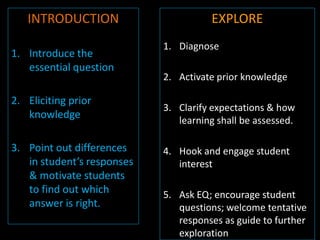
INTRODUCTION                        EXPLORE
                            1. Diagnose
1. Introduce the
   essential question
                            2. Activate prior knowledge

2. Eliciting prior
                            3. Clarify expectations & how
   knowledge                   learning shall be assessed.

3. Point out differences    4. Hook and engage student
   in student’s responses      interest
   & motivate students
   to find out which        5. Ask EQ; encourage student
   answer is right.            questions; welcome tentative
                               responses as guide to further
                               exploration
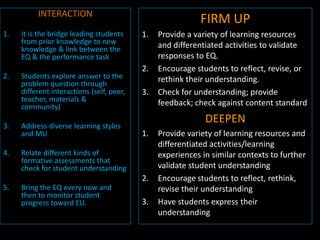
INTERACTION
                                                            FIRM UP
1.   It is the bridge leading students     1.   Provide a variety of learning resources
     from prior knowledge to new                and differentiated activities to validate
     knowledge & link between the
     EQ & the performance task                  responses to EQ.
                                           2.   Encourage students to reflect, revise, or
2.   Students explore answer to the             rethink their understanding.
     problem question through
     different interactions (self, peer,   3.   Check for understanding; provide
     teacher, materials &                       feedback; check against content standard
     community)

3.   Address diverse learning styles
                                                             DEEPEN
     and MU                                1.   Provide variety of learning resources and
                                                differentiated activities/learning
4.   Relate different kinds of                  experiences in similar contexts to further
     formative assessments that
     check for student understanding            validate student understanding
                                           2.   Encourage students to reflect, rethink,
5.   Bring the EQ every now and                 revise their understanding
     then to monitor student
     progress toward EU.                   3.   Have students express their
                                                understanding
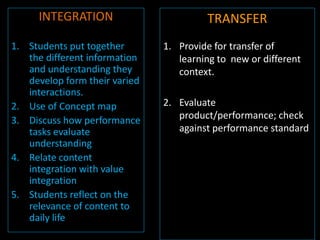
INTEGRATION                        TRANSFER
1. Students put together       1. Provide for transfer of
   the different information      learning to new or different
   and understanding they         context.
   develop form their varied
   interactions.
2. Use of Concept map          2. Evaluate
3. Discuss how performance        product/performance; check
   tasks evaluate                 against performance standard
   understanding
4. Relate content
   integration with value
   integration
5. Students reflect on the
   relevance of content to
   daily life
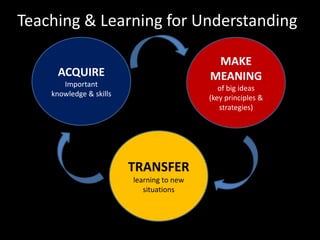
Teaching & Learning for Understanding

                                            MAKE
     ACQUIRE                               MEANING
       Important                              of big ideas
    knowledge & skills                     (key principles &
                                              strategies)


                         TRANSFER
                         learning to new
                            situations
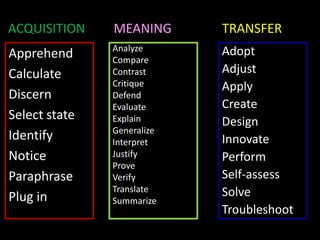
ACQUISITION    MEANING      TRANSFER
               Analyze      Adopt
Apprehend      Compare
Calculate      Contrast     Adjust
               Critique     Apply
Discern        Defend
               Evaluate     Create
Select state   Explain      Design
               Generalize
Identify       Interpret    Innovate
Notice         Justify      Perform
               Prove
Paraphrase     Verify       Self-assess
               Translate    Solve
Plug in        Summarize
                            Troubleshoot
Sample
Learning
Activities
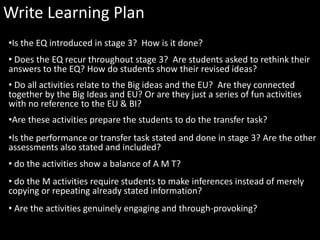
Write Learning Plan
•Is the EQ introduced in stage 3? How is it done?
• Does the EQ recur throughout stage 3? Are students asked to rethink their
answers to the EQ? How do students show their revised ideas?
• Do all activities relate to the Big ideas and the EU? Are they connected
together by the Big Ideas and EU? Or are they just a series of fun activities
with no reference to the EU & BI?
•Are these activities prepare the students to do the transfer task?
•Is the performance or transfer task stated and done in stage 3? Are the other
assessments also stated and included?
• do the activities show a balance of A M T?
• do the M activities require students to make inferences instead of merely
copying or repeating already stated information?
• Are the activities genuinely engaging and through-provoking?
GOOD LUCK
  Future
    TEACHERS
To be a

Cor Jesian               today
                is to
    believe, live   and spread God’s

              LOVE.
Teacher’s Prayer

I want to teach my students how--
      To live this life on earth,
 To face its struggles and its strife
   And to improve their worth.
Not just the lesson in a book,
    Or how the rivers flow,
But to choose the proper path,
    Wherever they may go.
To understand eternal truth,
And know right from wrong,
And gather all the beauty of
    A flower and a song,
For if I help the world to grow
     In wisdom and grace,
 Then I feel that I have won
  And I have filled my place.
And so I ask your guidance, God
    That I may do my part,
 For character and confidence
   And happiness of heart.

            AMEN.

Understanding by Design (UbD)

  • 1.
    Use of 3’Is within the framework of September __, 2011 @ CJC EdTech Hall 2 Randy A. Tudy randytudy@gmail.com http://christianbestgiftideas.blogspot.com/ http://beststocktradingphilippines.blogspot.com/ http://howiloveandenjoymyteachingjob.blogspot.com/
  • 2.
  • 3.
    • After achurch service on Sunday morning, a young boy suddenly announced to his mother, "Mom, I've decided to become a minister When I grow up." • "That's okay with us, but what made you decide that?"
  • 4.
    • "Well," saidthe little boy, "I have to go to church on Sunday anyway, and I figure it will be more fun to stand up and yell, than to sit and listen."
  • 5.
    Change in education isEasy to propose hard to implement and extra ordinarily difficulty to sustain
  • 6.
  • 7.
    As agents ofChange KSAs & KUDs What should we have in order to effectively implement the 2010 SEC?
  • 8.
    DESIRED RESULT Teacher effectivenessin the implementation of the 2010 SEC
  • 9.
    MeTHODOLOgY Examine sample learningplans Reflect, discuss, share ideas & PLAN
  • 10.
    What is your role? PARTICIPANTS’ Task Identify Key KSAs & KUDs that teachers need to demonstrate as indicators of teaching effectiveness OUTPUT Familiarization of the 3Is as a teaching-learning approach Improved classroom preparations and delivery Deeper understanding of UbD
  • 11.
    DOMAINS OF TEACHERQUALITY & EFFECTIVNESS (Stronge & Hindman, 2006) @ Pre-requisites of Effective Teaching @ Personal Characteristics @ Classroom Management @ Planning for Instruction @ Instructional Delivery @ Assessment
  • 12.
    Planning for Instruction *Possess knowledge of content area, student misconceptions and available classroom resources * Have deep understanding of subject matter * Review instructional standards to guide decision making * Use long-range planning to map where instruction will go combined with alignment with standards * Identify appropriate learning outcomes and develop corresponding assessments
  • 13.
    Instructional Delivery * Havehigh expectations for student achievement which in turn raises students’ own expectations * Conduct highly engaging classroom activities where students construct meaning from content while providing support * Highly involved throughout instruction process and adjusts instruction depending on student performance * Use appropriate strategies and technology for more individualized and active learning * Begin with students’ prior knowledge and probe their ideas with effective questioning techniques; teach students how to question
  • 14.
    Assessment * Monitor learningthrough variety of informal and formal assessments * Give timely feedback * Check for student understanding and adjust instruction * Align assignments with learning outcomes to make them meaningful Review student growth and performance using student’s body of work such as in portfolio Analyze student data related to their performance
  • 15.
    Puts together Provides Designer different feedback elements of the regarding learning plan student progress & Key achievement teacher role in 2010 SEC Facilitator Assessor Guides students in their inquiry & transfer
  • 16.
  • 17.
    Standards A L Enduring Understanding I G Essential N Question/s E Knowledge & D Skills ?
  • 18.
    Program Standard (ProgramangPamantayan) General Standard (Pamantayan sa Unang Taon) Content Standard Performance Standard (Pamantayang Pangnilalaman) (Pamantayang Pagganap)
  • 19.
  • 20.
    COMPETENCIES Knowledge Skills Attitudes
  • 21.
    LEARNING STANDARDS: -Provide levelof doing competencies -Indicate real life purpose of competencies - show lifelong connection of different competencies stated in a broad and general way COMPETENCIES Sets of knowledge, skills and attitudes required to successfully perform a particular task stated in specific terms.
  • 22.
    A Standards BIG IDEAS L Enduring I Understanding G N Essential Question/s E D Knowledge & Skills ?
  • 23.
    Program Standard (ProgramangPamantayan) General Standard (Pamantayan sa Unang Taon) Content Standard Performance Standard (Pamantayang Pangnilalaman) (Pamantayang Pagganap)
  • 24.
    Program Standard (ProgramangPamantayan) Naipamalas ng mag-aaral ang pag-unawa a mga konsepto at isyu kaugnay ng kasaysayan, ekonomiks and iba pang disiplinang panlipunan gamit ang mga kasanayan sa pananaliksik, pagsisiyasat, mapanuring pag-iisip, matalinong pagpasaya, pagkamalikhain, likas-kayang paggamit ng pinagkukulangang-yaman, pakikipagtalastasan at pagpapalawak ng pandaigdigang pananaw tungo sa isang mapanagutang mamamayan ng bansa at daigdig.
  • 25.
    Year I Standard(Pamantayan sa Unang Taon) Naipamalas ng mag-aaral ang pag-unawa sa mga pangunahing kaisipan at mga napapanahong isyung pangkasaysayan at pampamahalaan ng Pilipinas gamit ang mga kasanyan at pagpapahalaga tungo sa pagpapatatag ng pagkabansa, sistemang demokratiko, pagkakaisa at mabuting pakamamamayan.
  • 26.
    Content Standard (Pamantayang Pangnilalaman) Naipamalas ng mag-aaral ang pa-unawa sa bahaging ginagampanan ng pamahalaan at mamamayan sa pagtataguyod ng mabuting pamamahala at mapanagutang pagkamamamayan tungo sa pangangalaga ng kapakanan ng mamamayan at pagsulong ng pambansang interes.
  • 27.
    Performance Standard (Pamantayang Pagganap) Ang mag-aaral ay aktibong nakapagsusulong ng mga demokratikong simulain at pagpapahalagang nagtatguyod ng mabuting pamamahala at mapanagutang pagkamamamayan tungo sa pangangalaga ng kapakanan ng mamamayan at pambansang interes
  • 28.
    ENDURING UNDERSTANDING Ang pangangalagasa kapakanan ng mamamayan at pagsusulong ng pambansang interes ay bunga ng maayos na ugnayan ng mabuting pamamahala at mapanagutang pagkamamamayan.
  • 29.
    ESSENTIAL QUESTION Paano mapangangalagaanang kapakanan ng mamamayan at pagsusulong ng pambansang interes?
  • 30.
    Understanding vs. Facts •Conclusions •Taken & learned as •Principles such •Inferences •Accepted terms and •Themes regarded as true •Generalization •Obvious, about the use of unproblematic & facts & skills straightforward claims •Summary insights
  • 31.
    Sa ato pa,what is UNDERSTANDING? To understand is to be able to wisely and effectively use what one knows, in context- to “apply” our knowledge and skill effectively, in a realistic setting.” - Wiggins & McTighe
  • 32.
    Determining the EUs Will this EU apply to more than one content area of learning? -Will this EU apply to more than one level in school? - will this EU endure? Will it be as important in the future as it is now? -- Will this EU be one that students remember long after instruction ends?
  • 33.
    ESSENTIAL QUESTIONS VS.FACTUAL QUESTIONS ESSENTIAL: FACTUAL: •open-ended; more than one answer •Points to a single right answer • framed to “uncover” or • used to prompt and explore and think about; recall; part of coverage; answer requires inquiry & argument •Now new insights • leads to new perspectives; • based on enduring understanding
  • 34.
    How to checkif these are Essential Questions? •Are my essential questions open-ended? • will they be engaging for students? • will they take students beyond the “who, what, where, and when” recall of information to the “how” and “why” applications and extensions of learning? • Do my big ideas effectively relate with EQ and the EUs answer my Essential Questions?
  • 35.
    TRANSFER GOALS VS.SKILLS •A complex performance •Discrete techniques challenge requiring autonomy and a set of skills • requires accurate execution or command • Long term goal is effective performance in context • success can be in isolation • success requires use in real-world messy situations
  • 36.
    What is thegoal of the following skills? dribbling PLAY A GAME passing shooting
  • 37.
    PERFORMANCE STANDARD BIG Ang mag-aaral ay aktibong nakapagsusulong IDEA ng mga demokratikong simulain at pagpapahalagang nagtataguyod ng mabuting pamamahala at mapanagutang pagkamamamayan tungo sa pangangalaga ng kapakanan ng mamamayan at pambansang iteres. action TRANSFER GOAL Students can independently use their learning to practice good citizenship and participate in activities that ensure and contribute to good governance Varied real world context
  • 38.
    STATE TRANSFER GOAL Check-upQuestions: •Does my transfer goal •Is my transfer goal aligned make my students with the Performance Standard & Big Ideas? judge which action to do given different • Does my transfer goal contexts? involve an action related to application in a new situation or form? •Does my transfer goal ask students to act on •Does the application their own and exercise involve a lifelong and varied contexts? independence?
  • 39.
  • 40.
    Empowering connections BUILD in our hearts. THE THE SOUL OF THE RESPONSE TO GOD FOR GREATER GOOD FILIPINO JOIE D’ VIVRE GIFT OF DIVINE GRACE DEMANDS ACCOUNTABILITY MORAL FIBRE
  • 41.
    Designing Performance Tasks G Goal R Role A Audience S Situation P Product/Performance S Standards
  • 42.
    PROJECT w/o GRASPS PROJECT with GRASPS You are a member of a team of STATS, a survey company. The company has assigned your team to a client company Conduct a survey that wants to know which motorbikes with vendors of people are buying the most. The company motorbikes on what would like you to make a presentation to brand sells the most its executives on the various sales in the market. performances. You have to obtain data from various motorbike companies and Obtain sales data make certain recommendations regarding showing a five-week the condition of motorbike sales. Your period. Plot and presentation must have accurate graph the data computations and appropriate illustrations and your discussion of the trend must be clear and concise.
  • 43.
    You are amember of a team of STATS, a Goal survey company. The company has assigned your team to a client company that wants to Role know which motorbikes people are buying the most. The company would like you to make a presentation to its executives on the Audience various sales performances. You have to obtain data from various motorbike Situation companies and make certain recommendations regarding the condition of motorbike sales. Your presentation must Product have accurate computations and appropriate illustrations and your discussion of the trend must be clear and concise. Standards
  • 44.
  • 45.
    Note: • No directions •Performing task is a culminating activity, thus need practice (prompt). Prompts are preparation activities towards the PT. • Teacher does activity mapping • Performance task needs judgment & independence • based on the real world situation
  • 46.
    PROMPT TRANSFER •Reveals sophistication of skills & performance •Reveals depth of students’ understanding competencies of concepts, sophistication of skills and capacity to deal with this understanding & • consists of the ff: sophistication in adult situations. -A complex question - requires connections • like a prompt but also; among concepts & subjects -Mirrors challenges faced by adults (involves making inferences & applying to - more than 1 right answer the challenge) - requires development of a strategy for addressing the - addresses an audience that is meaningful prompt and has intent that relates to the audience - requires student to construct a product or perform - has kind of restraints and opportunities an Everett Kline 2010 adult would find in a similar setting
  • 47.
    GRADUAL RELEASE OFRESPONSIBILITY TEACHER RESPONSIBILITY Focus lesson I do it (You watch) Modeled instruction T E A Shared C We do it (together) Instruction H Guided You do it alone Practice collaborate (Reflect) Independent Independent Practice STUDENT RESPONSIBILITY
  • 48.
    Design Transfer Taskin GRASPS Form •Is my transfer goal task aligned with Performance Standard & Big Ideas? • Is my transfer task written in GRASPS form? • Does the transfer task involve application in a new or novel situation which students have not yet encountered? • Does the TT have minimal prompts or have too many directions? • Does the TT reflect at least level 3 and up of the Transfer Demand Rubric? • Are the Task Standards related to the real-world audience? Are these aligned with the Performance Standard and Big Ideas?
  • 49.
    RUBRICS 4 3 2 1 Understanding Understanding Knowledge & skill Knowledge & Skill
  • 50.
    ANALYTIC RUBRIC Criteria Outstanding Satisfactory Developing Beginning Rating 4 3 2 1 CATEGORY 1 Presents the Presents the Presents the Does not present (related EU) category in a manner category in a category in an category’s PRESENTATION OF beyond satisfactory complete way incomplete way and requirements at all TRENDS requirements according to the shows only some of given requirements the given requirements CATEGORY 2 Presents the Presents the Presents the Does not present (related EU) category in a manner category in a category in an category’s beyond satisfactory complete way incomplete way and requirements at all JUSTIFICATION requirements according to the shows only some of given requirements the given requirements CATEGORY 3 Presents the Presents the Presents the Does not present (knowledge & skills) category in a manner category in a category in an category’s beyond satisfactory complete way incomplete way and requirements at all ACCURACY requirements according to the shows only some of given requirements the given requirements CATEGORY 4 Presents the Presents the Presents the Does not present (knowledge & skills) category in a manner category in a category in an category’s beyond satisfactory complete way incomplete way and requirements at all requirements according to the shows only some of given requirements the given requirements
  • 51.
    Write Rubric CriteriaAligned with Transfer Task Standards •Is my rubric criteria aligned with the TT Standards & PS & BI? • Are some of my rubric criteria related to the EU? Or are they only about format or the appearance of a product? • are some of my rubric criteria related to K & S? • are the criteria likely to be used by the intended audience in a real world setting? • are the criteria valid measures of student’s development of EU & mastery of K & S?
  • 52.
    PRE-ASSESSMENTS ASSESSMENT INFO FORMATIVE SUMMATIVE ASSESSMENTS ASSESSMENTS Assessment FOR learning Assessment OF learning
  • 53.
    Feedback & GoalSetting Pre-Assessment Formative Assessment Summative Assessment (Finding out) (keeping track & (Making sure) checking up) Readiness, interests, and Exit cards, Peer Performance task learning preferences of observation, 3-minuet Academic Prompt students pauses, vocabulary- Portfolio quiz/notebooks, Essential Questions observations, creating (reading/writing) rubrics, self-evaluation, journals- Essential questions
  • 54.
    ASSESSMENT MAPPING STEP 3: TYPE ENDURING K&S Performance or Indicate those UNDERSTANDING Transfer Task that are grade or non-graded. PRE- ASSESSMENT Pre-assessments are STEP 2: usually not graded Complete whereas most FORMATIVE either Pre or summative assess are ASSESSMENT graded. Formative Formative Assess may be both Assessments grade & not graded. SUMMATIVE ASSESSMENT STEP 1: Write FIRST the Transfer Task and the Unit Test
  • 55.
    ASSESSING ENDURING UNDERSTANDING APPLY EMPATHY REFLECT EXPLAIN INTERPRET PERSPECTIVE
  • 56.
  • 57.
    FAPE LP DepEd Introduction Explore Firm up Interaction Deepen Integration Transfer
  • 58.
    3Is a as TEACHING-LEARNING. Approach
  • 59.
    A. Teacher 1. Theteacher has a pleasing personality. 4 3 2 1 2. The teacher is enthusiastic and maintains a warm and friendly atmosphere conducive to learning. 4 3 2 1 3. The teacher avoids making embarrassing remarks about the students’ ideas or actions. 4 3 2 1 4. The teacher explains the lesson in a clear and well-modulated voice. 4 3 2 1 5. The teacher praises the students for their sharing and efforts. 4 3 2 1 6. The teacher is confident and shows mastery of the subject matter. 4 3 2 1 7. The teacher is fluent in the medium of instruction. 4 3 2 1 8. The teacher answers the students question in a simple and understandable way. 4 3 2 1 9. The teacher maintains discipline and control. 4 3 2 1 10. The teacher is organized and manages the class time well. The teacher accomplishes the objectives and procedures set for the time period. 4 3 2 1 11. The teacher shows evident concern for student success and growth in understanding. 4 3 2 1 AVERAGE B. TEACHING PROCEDURE I. INTRODUCTION 1. The teacher introduces Essential Question or EQ in an interesting & engaging way. 4 3 2 1 2. The teacher elicits the students’ prior knowledge, perceptions and experiences about the EQ. 4 3 2 1 3. The teacher encourages students to explain their ideas or ask questions about the EQ. 4 3 2 1 4. The teacher accepts and records students’ ideas. 4 3 2 1 5. The teacher asks follow-up thought-provoking questions which lead the students to examine their ideas. 4 3 2 1 6. The teacher explains the purpose of the learning unit and the culminating performance task. 4 3 2 1 AVERAGE II. INTERACTION 1. The teacher is creative and uses a variety of learning resources and activities which enable the students to answer the EQ and develop understanding. 4 3 2 1 2. The teacher stimulates the critical thinking of the students. 4 3 2 1 3. The teacher encourages students to explore their ideas and find the answer. 4 3 2 1 4. The teacher provides opportunities for students to interact and collaborate with one another. 4 3 2 1 5. The teacher processes students’ understanding by asking probing questions and discussing their answers or work. 4 3 2 1 6. The teacher paces the lesson according to the students’ interests, understanding or performance. 4 3 2 1 FOR CLASSES HELD IN A COMPUTER LAB: 4 3 2 1 1. The teacher clearly explains the task related to the use of a particular Website or a multimedia program. 2. The teacher guides students in using interactive programs for practice or gathering different kinds of data. 4 3 2 1 3. The teacher walks around and monitors students’ use of a Website or a multimedia program. 4 3 2 1 4. The teacher discusses with the students the ideas they gained, questions they developed or works they created with the use of a Website or a multimedia program. 4 3 2 1 AVERAGE III. INTEGRATION 5. The teacher provides students varied exercises for practices and gives feedback regarding their answers. 4 3 2 1 6. The teacher has students relate or compare their prior knowledge and explain the changes. 4 3 2 1 7. The teacher has students demonstrate mastery of the lesson or explain the new knowledge in a meaningful way. 4 3 2 1 8. The teacher conducts varied formative assessments and asks students to share their learning difficulties. 4 3 2 1 9. The teacher enables the students to relate the new knowledge with their daily life and transfer their learning to real-world situations. 4 3 2 1 10. The teacher conducts values clarification and integration. 4 3 2 1 11. The teacher explains the performance or transfer task and the accompanying rubric for the student’s self-evaluating guide. 4 3 2 1 12. The teacher encourages students to be creative and revise and improve their work. 4 3 2 1 13. The teacher has students share their realizations or reflections about their learning process. 4 3 2 1 14. The teacher provides a closure to or summary of the lesson. 4 3 2 1 AVERAGE
  • 60.
    INTRODUCTION EXPLORE 1. Diagnose 1. Introduce the essential question 2. Activate prior knowledge 2. Eliciting prior 3. Clarify expectations & how knowledge learning shall be assessed. 3. Point out differences 4. Hook and engage student in student’s responses interest & motivate students to find out which 5. Ask EQ; encourage student answer is right. questions; welcome tentative responses as guide to further exploration
  • 61.
    INTERACTION FIRM UP 1. It is the bridge leading students 1. Provide a variety of learning resources from prior knowledge to new and differentiated activities to validate knowledge & link between the EQ & the performance task responses to EQ. 2. Encourage students to reflect, revise, or 2. Students explore answer to the rethink their understanding. problem question through different interactions (self, peer, 3. Check for understanding; provide teacher, materials & feedback; check against content standard community) 3. Address diverse learning styles DEEPEN and MU 1. Provide variety of learning resources and differentiated activities/learning 4. Relate different kinds of experiences in similar contexts to further formative assessments that check for student understanding validate student understanding 2. Encourage students to reflect, rethink, 5. Bring the EQ every now and revise their understanding then to monitor student progress toward EU. 3. Have students express their understanding
  • 62.
    INTEGRATION TRANSFER 1. Students put together 1. Provide for transfer of the different information learning to new or different and understanding they context. develop form their varied interactions. 2. Use of Concept map 2. Evaluate 3. Discuss how performance product/performance; check tasks evaluate against performance standard understanding 4. Relate content integration with value integration 5. Students reflect on the relevance of content to daily life
  • 63.
    Teaching & Learningfor Understanding MAKE ACQUIRE MEANING Important of big ideas knowledge & skills (key principles & strategies) TRANSFER learning to new situations
  • 64.
    ACQUISITION MEANING TRANSFER Analyze Adopt Apprehend Compare Calculate Contrast Adjust Critique Apply Discern Defend Evaluate Create Select state Explain Design Generalize Identify Interpret Innovate Notice Justify Perform Prove Paraphrase Verify Self-assess Translate Solve Plug in Summarize Troubleshoot
  • 65.
  • 66.
    Write Learning Plan •Isthe EQ introduced in stage 3? How is it done? • Does the EQ recur throughout stage 3? Are students asked to rethink their answers to the EQ? How do students show their revised ideas? • Do all activities relate to the Big ideas and the EU? Are they connected together by the Big Ideas and EU? Or are they just a series of fun activities with no reference to the EU & BI? •Are these activities prepare the students to do the transfer task? •Is the performance or transfer task stated and done in stage 3? Are the other assessments also stated and included? • do the activities show a balance of A M T? • do the M activities require students to make inferences instead of merely copying or repeating already stated information? • Are the activities genuinely engaging and through-provoking?
  • 67.
    GOOD LUCK Future TEACHERS
  • 68.
    To be a CorJesian today is to believe, live and spread God’s LOVE.
  • 69.
    Teacher’s Prayer I wantto teach my students how-- To live this life on earth, To face its struggles and its strife And to improve their worth.
  • 70.
    Not just thelesson in a book, Or how the rivers flow, But to choose the proper path, Wherever they may go.
  • 71.
    To understand eternaltruth, And know right from wrong, And gather all the beauty of A flower and a song,
  • 72.
    For if Ihelp the world to grow In wisdom and grace, Then I feel that I have won And I have filled my place.
  • 73.
    And so Iask your guidance, God That I may do my part, For character and confidence And happiness of heart. AMEN.