The Renaissance
Unit 1

Day 2
1
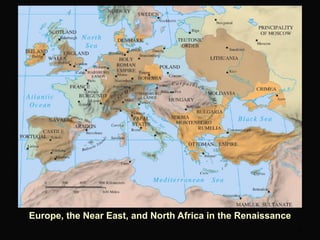
Europe, the Near East, and North Africa in the Renaissance
2

©2004 Wadsworth, a division of Thomson Learning, Inc. Thomson Learning™ is a trademark used herein under license.
The Renaissance
– Renaissance is a French term which means
“rebirth” or “revival” ****
– In European history, it is roughly a 200 year period
from 1350 and 1550 ****

– The Renaissance marked a rediscovery of
ancient Greek and Roman ideas, art, culture
and philosophy ****
– Urban society in Renaissance Italy
– Recovery from the Black Death ****
– Emphasis on individual ability
– “Universal person”
– Not just art but many areas including
literature****
– The decline of feudalism opened the way for
the Renaissance in Western Europe ****
3
Renaissance Beginnings- Italy
• Why the Renaissance Began in the Italian
City-States

– Italy was the initial center of the Renaissance
because the ruins and remains of the Roman
Empire stimulated curiosity about this past
civilization. ****
– In addition, these city-states were close to the
advanced civilizations of the Byzantines,
Muslim Arabs, and Ottoman Turks, with whom
they were impressed and from whom they
received new ideas.
– Money into city states bound for Western
Europe- funded pursuit of knowledge/arts

4
• The Renaissance Moves Northward
– By the middle of the 16th century, Italy had
begun to decline as a center of the
Renaissance.
• By then, most of the important trade routes were
via the Atlantic, therefore the Mediterranean
declined as an entry spot for eastern goods.
• Thus, most of the more notable advances of this
movement began to be made in the Netherlands,
France, and England, while Portugal and Spain
took the early lead in overseas exploration.

– As the Renaissance shifted northward, its
character changed, coming to differ
significantly from the Italian in several
respects… ****
5
• Northern Renaissance
– The north was less concerned with sensuality,
aesthetics, and the enjoyment of life, which
had characterized the Italian Renaissance ****
– More religious in nature- concerned with
purifying the Christian religion ****
– Politics
• In the area of politics, the northern Renaissance
saw an increase in pomp and ceremony
• The northern European Renaissance witnessed
newly powerful, independent monarchs' first
attempts to gain control over the Catholic churches
within their realms.
• This contest for power between the church and the
state in European politics will be known as the
Reformation
6
Renaissance Society
– Three estates: ****
• clergy (first estate)
• nobility (second estates)
• peasants and inhabitants of towns and cities (third
estate)

– Nobility
• 2 to 3 percent of the population
• Political posts
• Ideals of the aristocrat, Baldassare Castiglione
(1478-1529), The Book of the Courtier ****
– Impeccable character, “breeding”/dignity, military service,
standards of conduct, classical education, welldeveloped personality ****
7
Peasants and Townspeople
– Peasants and Townspeople
• Peasants 85-90 percent of the total population
– Decline of manorialism and continuing erosion of serfdom
– Peasants as hired workers

• Patricians at the top of the urban society (trade, industry,
and banking)
• Petty burghers (shopkeepers, artisans, guildmasters, and
guildsmen)
• Property less workers (30 to 40 percent of the urban
population)

Family and Marriage in Renaissance Italy ****
– Arranged marriages
– Father-husband at the center
• Authority was absolute

– Wife manages the household
8
The Intellectual Renaissance
• Italian Renaissance Humanism
– The intellectual and cultural movement known as
humanism arose from the study of classical Greek
and Roman culture. ****
– These "Humanist" scholars studied history,
astronomy, physics, mathematics, chemistry,
medicine, poetry, philosophy, politics, and the fine
arts= human potential and achievements ****
– Renaissance individualism was characterized by
the search for great heroes and great
accomplishments--the person was elevated over
the spirit.

9
• Impact of Printing
– The northern Humanists' desire to reform the Bible
and attack the abuses of the Church naturally led
them to conclude that the public ought to be able to
read the Bible for themselves

– Johannes Gutenberg
• Movable metal type, 1445-1450 ****
• Bible, 1455 or 1456- first full-sized book printed ****
• Circulated widely and were printed in the vernacular-common native languages ****

– Development of scholarly research ****
– Standard textbooks were developed ****
– Lay reading public- cook books, novels etc. ****
10
Artistic Italian Renaissance
• The Italians were very much aware of the fact
that in the distant past Italy, with Rome her
capital, had been the center of the civilized
world, and that her power and glory had waned
since the Germanic tribes, Goths and Vandals,
had invaded the country and broken up the
Roman Empire
• The ideas of a revival were closely connected in
the minds of the Italians with the ideas of a
rebirth of „the grandeur that was Rome.‟ ****
11
The Artistic Renaissance

• Early Renaissance ****

– Masaccio (1401-1428) ****
• Frescos ****

• New Renaissance style
– Laws of perspective and geometrical organization
of outdoor space and light
– Investigation of movement and anatomical structure
• High Renaissance
– Leonardo da Vinci (1452-1519)
• Realism and idealism

– Raphael (1483-1520)
• Ideal of beauty

– Michelangelo (1475-1564)
• Divine beauty

12
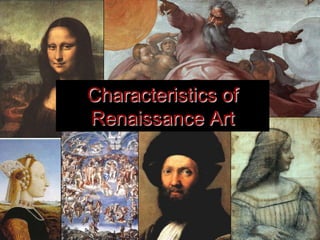
Characteristics of
Renaissance Art

13
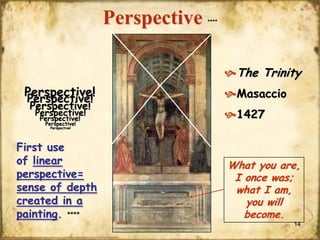
Perspective

****

 The Trinity

Perspective!
Perspective!
Perspective!
Perspective!
Perspective!
Perspective!

Masaccio
1427

Perspective!

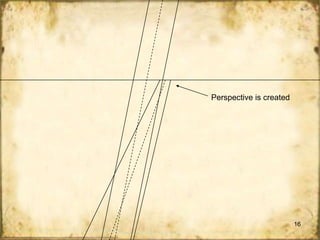
First use
of linear
perspective=
sense of depth
created in a
painting. ****

What you are,
I once was;
what I am,
you will
become.
14
15
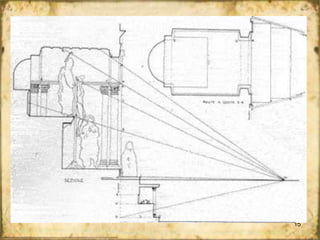
Perspective is created

16
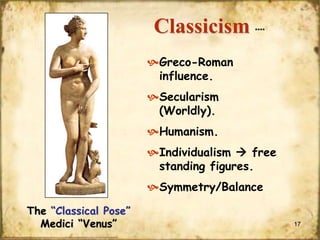
Classicism

****

Greco-Roman
influence.
Secularism
(Worldly).
Humanism.
Individualism  free
standing figures.
Symmetry/Balance
The “Classical Pose”
Medici “Venus”

17
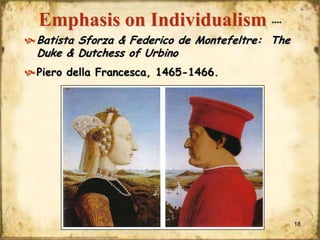
Emphasis on Individualism

****

 Batista Sforza & Federico de Montefeltre: The

Duke & Dutchess of Urbino

 Piero della Francesca, 1465-1466.

18
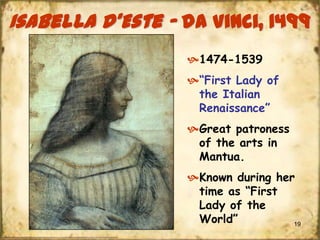
Isabella d’Este – da Vinci, 1499
1474-1539
“First Lady of
the Italian
Renaissance”
Great patroness
of the arts in
Mantua.
Known during her
time as “First
Lady of the
World”
19
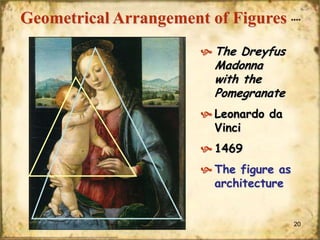
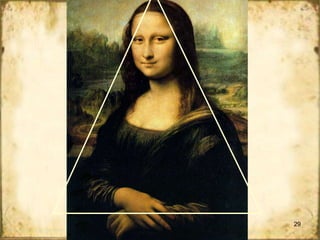
Geometrical Arrangement of Figures

****

 The Dreyfus

Madonna
with the
Pomegranate

 Leonardo da
Vinci
 1469
 The figure as
architecture

20
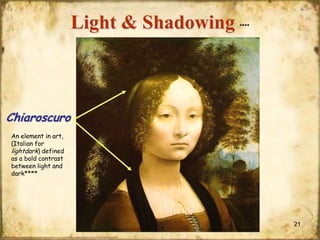
Light & Shadowing

****

Chiaroscuro
An element in art,
(Italian for
lightdark) defined
as a bold contrast
between light and
dark****

21
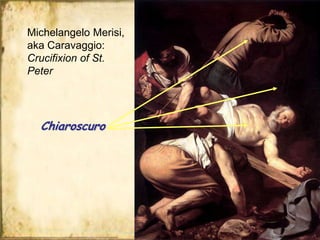
Michelangelo Merisi,
aka Caravaggio:
Crucifixion of St.
Peter

Chiaroscuro

22
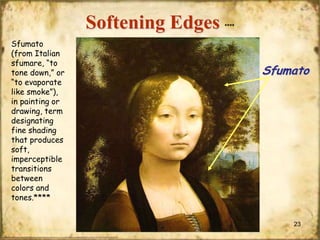
Softening Edges
Sfumato
(from Italian
sfumare, “to
tone down,” or
“to evaporate
like smoke”),
in painting or
drawing, term
designating
fine shading
that produces
soft,
imperceptible
transitions
between
colors and
tones.****

****

Sfumato

23
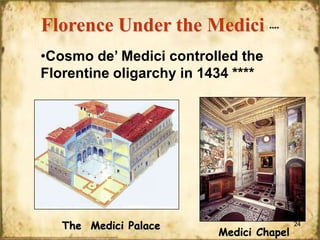
Florence Under the Medici

****

•Cosmo de’ Medici controlled the
Florentine oligarchy in 1434 ****

The Medici Palace

Medici Chapel

24
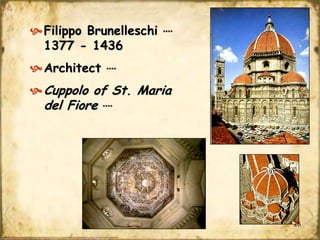
 Filippo Brunelleschi
1377 - 1436
 Architect

****

****

 Cuppolo of St. Maria

del Fiore

****

25
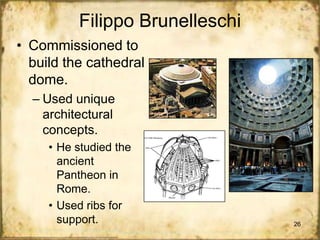
Filippo Brunelleschi
• Commissioned to
build the cathedral
dome.
– Used unique
architectural
concepts.
• He studied the
ancient
Pantheon in
Rome.
• Used ribs for
support.

26
The Renaissance “Man”
• Broad knowledge about many things in
different fields. ****
• Deep knowledge/skill in one area.
• Able to link information from different
areas/disciplines and create new
knowledge.
• The Greek ideal of the “well-rounded
man” was at the heart of Renaissance
education.
27
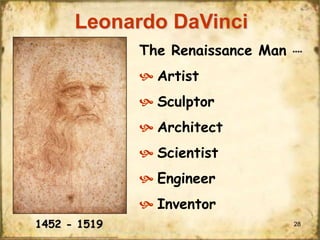
Leonardo DaVinci
The Renaissance Man

****

 Artist
 Sculptor
 Architect
 Scientist
 Engineer

 Inventor
1452 - 1519

28
29
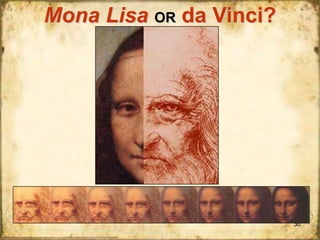
Mona Lisa OR da Vinci?

30
31
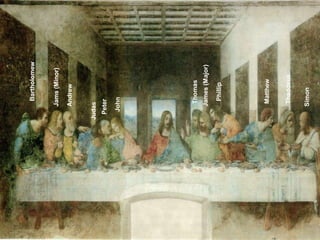
Simon

Thaddeus

Matthew

Phillip

James (Major)

Thomas

John

Peter

Judas

Andrew

Jams (Minor)

Bartholomew
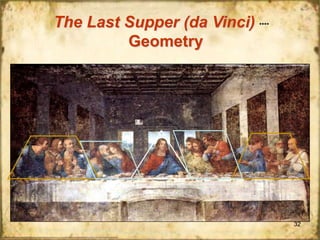
The Last Supper (da Vinci)
Geometry

****

32
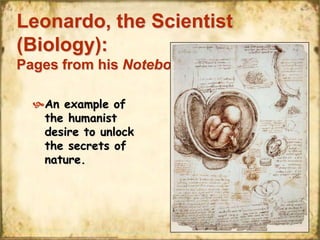
Leonardo, the Scientist
(Biology):
Pages from his Notebook
An example of
the humanist
desire to unlock
the secrets of
nature.

33
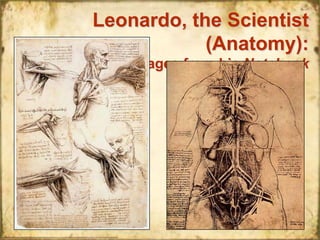
Leonardo, the Scientist
(Anatomy):
Pages from his Notebook

34
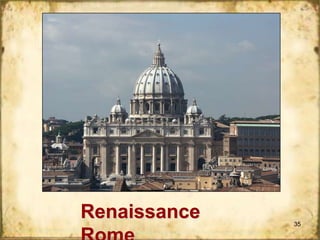
Renaissance

35
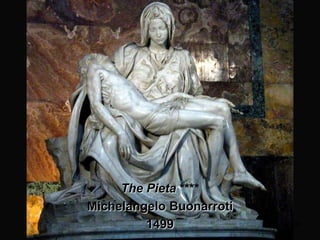
The Pieta ****
Michelangelo Buonarroti
1499

36
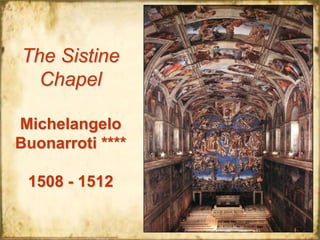
The Sistine
Chapel
Michelangelo
Buonarroti ****
1508 - 1512
37
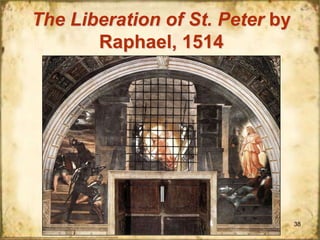
The Liberation of St. Peter by
Raphael, 1514

38
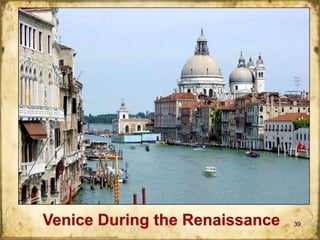
Venice During the Renaissance

39
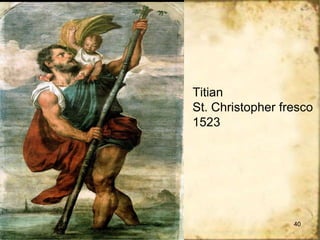
Titian
St. Christopher fresco
1523

40

Unit 1 renaissance- power point notes

  • 1.
  • 2.
    Europe, the NearEast, and North Africa in the Renaissance 2 ©2004 Wadsworth, a division of Thomson Learning, Inc. Thomson Learning™ is a trademark used herein under license.
  • 3.
    The Renaissance – Renaissanceis a French term which means “rebirth” or “revival” **** – In European history, it is roughly a 200 year period from 1350 and 1550 **** – The Renaissance marked a rediscovery of ancient Greek and Roman ideas, art, culture and philosophy **** – Urban society in Renaissance Italy – Recovery from the Black Death **** – Emphasis on individual ability – “Universal person” – Not just art but many areas including literature**** – The decline of feudalism opened the way for the Renaissance in Western Europe **** 3
  • 4.
    Renaissance Beginnings- Italy •Why the Renaissance Began in the Italian City-States – Italy was the initial center of the Renaissance because the ruins and remains of the Roman Empire stimulated curiosity about this past civilization. **** – In addition, these city-states were close to the advanced civilizations of the Byzantines, Muslim Arabs, and Ottoman Turks, with whom they were impressed and from whom they received new ideas. – Money into city states bound for Western Europe- funded pursuit of knowledge/arts 4
  • 5.
    • The RenaissanceMoves Northward – By the middle of the 16th century, Italy had begun to decline as a center of the Renaissance. • By then, most of the important trade routes were via the Atlantic, therefore the Mediterranean declined as an entry spot for eastern goods. • Thus, most of the more notable advances of this movement began to be made in the Netherlands, France, and England, while Portugal and Spain took the early lead in overseas exploration. – As the Renaissance shifted northward, its character changed, coming to differ significantly from the Italian in several respects… **** 5
  • 6.
    • Northern Renaissance –The north was less concerned with sensuality, aesthetics, and the enjoyment of life, which had characterized the Italian Renaissance **** – More religious in nature- concerned with purifying the Christian religion **** – Politics • In the area of politics, the northern Renaissance saw an increase in pomp and ceremony • The northern European Renaissance witnessed newly powerful, independent monarchs' first attempts to gain control over the Catholic churches within their realms. • This contest for power between the church and the state in European politics will be known as the Reformation 6
  • 7.
    Renaissance Society – Threeestates: **** • clergy (first estate) • nobility (second estates) • peasants and inhabitants of towns and cities (third estate) – Nobility • 2 to 3 percent of the population • Political posts • Ideals of the aristocrat, Baldassare Castiglione (1478-1529), The Book of the Courtier **** – Impeccable character, “breeding”/dignity, military service, standards of conduct, classical education, welldeveloped personality **** 7
  • 8.
    Peasants and Townspeople –Peasants and Townspeople • Peasants 85-90 percent of the total population – Decline of manorialism and continuing erosion of serfdom – Peasants as hired workers • Patricians at the top of the urban society (trade, industry, and banking) • Petty burghers (shopkeepers, artisans, guildmasters, and guildsmen) • Property less workers (30 to 40 percent of the urban population) Family and Marriage in Renaissance Italy **** – Arranged marriages – Father-husband at the center • Authority was absolute – Wife manages the household 8
  • 9.
    The Intellectual Renaissance •Italian Renaissance Humanism – The intellectual and cultural movement known as humanism arose from the study of classical Greek and Roman culture. **** – These "Humanist" scholars studied history, astronomy, physics, mathematics, chemistry, medicine, poetry, philosophy, politics, and the fine arts= human potential and achievements **** – Renaissance individualism was characterized by the search for great heroes and great accomplishments--the person was elevated over the spirit. 9
  • 10.
    • Impact ofPrinting – The northern Humanists' desire to reform the Bible and attack the abuses of the Church naturally led them to conclude that the public ought to be able to read the Bible for themselves – Johannes Gutenberg • Movable metal type, 1445-1450 **** • Bible, 1455 or 1456- first full-sized book printed **** • Circulated widely and were printed in the vernacular-common native languages **** – Development of scholarly research **** – Standard textbooks were developed **** – Lay reading public- cook books, novels etc. **** 10
  • 11.
    Artistic Italian Renaissance •The Italians were very much aware of the fact that in the distant past Italy, with Rome her capital, had been the center of the civilized world, and that her power and glory had waned since the Germanic tribes, Goths and Vandals, had invaded the country and broken up the Roman Empire • The ideas of a revival were closely connected in the minds of the Italians with the ideas of a rebirth of „the grandeur that was Rome.‟ **** 11
  • 12.
    The Artistic Renaissance •Early Renaissance **** – Masaccio (1401-1428) **** • Frescos **** • New Renaissance style – Laws of perspective and geometrical organization of outdoor space and light – Investigation of movement and anatomical structure • High Renaissance – Leonardo da Vinci (1452-1519) • Realism and idealism – Raphael (1483-1520) • Ideal of beauty – Michelangelo (1475-1564) • Divine beauty 12
  • 13.
  • 14.
    Perspective ****  The Trinity Perspective! Perspective! Perspective! Perspective! Perspective! Perspective! Masaccio 1427 Perspective! Firstuse of linear perspective= sense of depth created in a painting. **** What you are, I once was; what I am, you will become. 14
  • 15.
  • 16.
  • 17.
    Classicism **** Greco-Roman influence. Secularism (Worldly). Humanism. Individualism  free standingfigures. Symmetry/Balance The “Classical Pose” Medici “Venus” 17
  • 18.
    Emphasis on Individualism **** Batista Sforza & Federico de Montefeltre: The Duke & Dutchess of Urbino  Piero della Francesca, 1465-1466. 18
  • 19.
    Isabella d’Este –da Vinci, 1499 1474-1539 “First Lady of the Italian Renaissance” Great patroness of the arts in Mantua. Known during her time as “First Lady of the World” 19
  • 20.
    Geometrical Arrangement ofFigures ****  The Dreyfus Madonna with the Pomegranate  Leonardo da Vinci  1469  The figure as architecture 20
  • 21.
    Light & Shadowing **** Chiaroscuro Anelement in art, (Italian for lightdark) defined as a bold contrast between light and dark**** 21
  • 22.
  • 23.
    Softening Edges Sfumato (from Italian sfumare,“to tone down,” or “to evaporate like smoke”), in painting or drawing, term designating fine shading that produces soft, imperceptible transitions between colors and tones.**** **** Sfumato 23
  • 24.
    Florence Under theMedici **** •Cosmo de’ Medici controlled the Florentine oligarchy in 1434 **** The Medici Palace Medici Chapel 24
  • 25.
     Filippo Brunelleschi 1377- 1436  Architect **** ****  Cuppolo of St. Maria del Fiore **** 25
  • 26.
    Filippo Brunelleschi • Commissionedto build the cathedral dome. – Used unique architectural concepts. • He studied the ancient Pantheon in Rome. • Used ribs for support. 26
  • 27.
    The Renaissance “Man” •Broad knowledge about many things in different fields. **** • Deep knowledge/skill in one area. • Able to link information from different areas/disciplines and create new knowledge. • The Greek ideal of the “well-rounded man” was at the heart of Renaissance education. 27
  • 28.
    Leonardo DaVinci The RenaissanceMan ****  Artist  Sculptor  Architect  Scientist  Engineer  Inventor 1452 - 1519 28
  • 29.
  • 30.
    Mona Lisa ORda Vinci? 30
  • 31.
  • 32.
    The Last Supper(da Vinci) Geometry **** 32
  • 33.
    Leonardo, the Scientist (Biology): Pagesfrom his Notebook An example of the humanist desire to unlock the secrets of nature. 33
  • 34.
  • 35.
  • 36.
    The Pieta **** MichelangeloBuonarroti 1499 36
  • 37.
  • 38.
    The Liberation ofSt. Peter by Raphael, 1514 38
  • 39.
    Venice During theRenaissance 39
  • 40.