Gandhinagar Institute of
Technology
Subject :-Machine Designing and industrial drafting
– 130120119126- Pandya Kartik
Topic :- Welding Processes
MECHANICAL
ENGINEERING
4th - B : 3
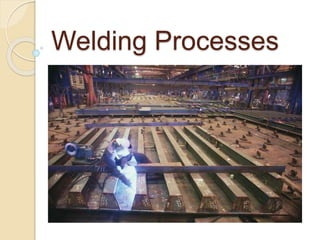
Welding Processes
What do you mean by welded
joints??
A welded joint is a permanent joint which is obtained by the
fusion of the edges of the two parts to be joined together, with
or without the application of pressure and a filler material.
Welding is extensively used in fabrication as an alternative
method for casting or forging and as a replacement for bol
ted & riveted joints.
e.g. to reunite metal at a crack, to build up a small part th
at has broken off such
as gear tooth or to repair a worn surface such as a bearin
g
Surface.
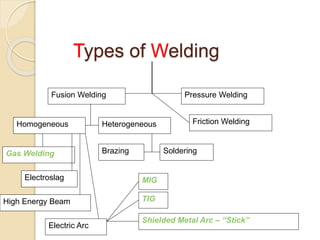
Types of Welding
Fusion Welding Pressure Welding
Homogeneous Heterogeneous
Brazing SolderingGas Welding
Electroslag
High Energy Beam
Electric Arc
MIG
TIG
Shielded Metal Arc – “Stick”
Friction Welding
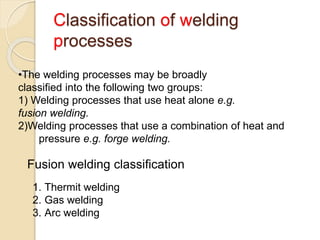
Classification of welding
processes
•The welding processes may be broadly
classified into the following two groups:
1) Welding processes that use heat alone e.g.
fusion welding.
2)Welding processes that use a combination of heat and
pressure e.g. forge welding.
Fusion welding classification
1. Thermit welding
2. Gas welding
3. Arc welding
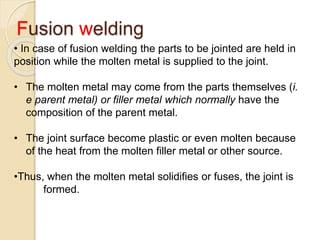
Fusion welding
• In case of fusion welding the parts to be jointed are held in
position while the molten metal is supplied to the joint.
• The molten metal may come from the parts themselves (i.
e parent metal) or filler metal which normally have the
composition of the parent metal.
• The joint surface become plastic or even molten because
of the heat from the molten filler metal or other source.
•Thus, when the molten metal solidifies or fuses, the joint is
formed.
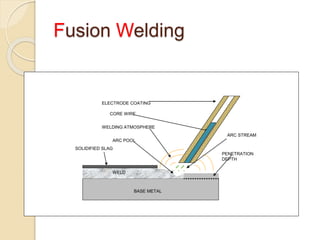
Fusion Welding
BASE METAL
WELD
SOLIDIFIED SLAG
ARC POOL
WELDING ATMOSPHERE
CORE WIRE
ELECTRODE COATING
ARC STREAM
PENETRATION
DEPTH
Thermit welding
• In thermit
welding, a mixture of iron oxide and aluminium
called thermit is ignited and the iron oxide is reduced
to molten iron.
• The molten iron is poured into a mould made around th
e joint and fuses with the parts to be welded.
• The thermit
welding is often used in joining iron and steel
parts that are too large to be manufactured in one piece
, such as rails, truck frames, locomotive frames
etc….
Gas welding
• A gas welding is made by applying the flame of an oxy-
acetylene or hydrogen gas from a welding torch upon the
surfaces of the prepared joint.
• The intense heat at the white cone of the flame heats up
the local surfaces to fusion point while the operator mani
pulates a welding rod to supply the metal for the weld.
• A flux is being used to remove the slag. Since the heatin
g rate
in gas welding is slow, therefore it can be used on thinner
materials.
Electric arc welding
• electric arc welding, the work is prepared in the same mann
er as for gas welding.
In this case the filler metal is supplied by metal welding electro
de.
• The base metal in the path of the arc stream is melted, formi
ng a pool of molten metal, which seems to be forced out of t
he pool by the blast from the arc.
• A small depression is formed in the base metal and the molt
en metal is deposited around the edge of this depression,
which is called the arc crater.
• The slag is brushed off after
the joint has cooled.
Arc welding
Electric current flowing through a high resistance air gap ge
nerates an intense arc with temperatures ranging
3,000 to 5,500 centigrade.
Arc welding is the most
common
method used with structural
steel
Types of welded Joints
The American Welding Society defines a joint as
“the manner in which materials f it together . there are f ive basic types of weld
joints:
•Butt joint.
•T -joint.
•Lap joint.
•Corner joint.
•Edge joint.
Joint Preparation
Weld joints may be initially prepared in a
number
Of ways.
These include:
•Shearing.,Casting,Forging.
•Machining,Stamping,Filing,Routing.
•Oxyacetylene cutting (thermal cutting process).
•Plasma arc cutting (thermal cutting process).
•Grinding.
Joint Design
BUTT JOINT
STRAP JOINT
LAP JOINT
FILLET JOINT
CORNER JOINT
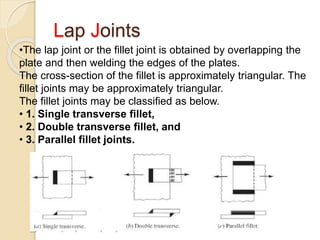
Lap Joints
•The lap joint or the fillet joint is obtained by overlapping the
plate and then welding the edges of the plates.
The cross-section of the fillet is approximately triangular. The
fillet joints may be approximately triangular.
The fillet joints may be classified as below.
• 1. Single transverse fillet,
• 2. Double transverse fillet, and
• 3. Parallel fillet joints.
Butt Joints
•The butt joint is obtained by placing the plates edge to edge. In butt welds,
the plate edges do not require bevelling if the thickness of plate is less
than 5 mm. On the other hand, if the plate thickness is 5 mm to 12.5 mm,
the edges should be bevelled to V or U-groove on both sides The
buttthe edges should be bevelled to V or U-groove on both sides.
The butt joints may be
• 1. Square butt joint,
• 2. Single V-butt joint
• 3. Single U-butt joint,
• 4. Double V-butt joint, and
• 5. Double U-butt joint
Other joints
•The other type of welded joints are corner joint, edge joint and T-joint
The main considerations involved in the selection
of weld type are:
1. The shape of the welded component required,
2. The thickness of the plates to be welded, and
3. The direction of the forces applied.
Welding Positions
FLAT
HORIZONTAL
VERTICAL
OVERHEAD
INCREASING DIFFICULTY
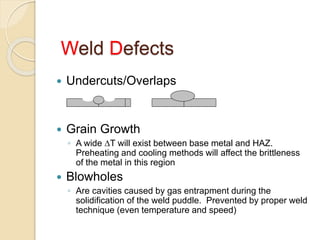
Weld Defects
 Undercuts/Overlaps
 Grain Growth
◦ A wide T will exist between base metal and HAZ.
Preheating and cooling methods will affect the brittleness
of the metal in this region
 Blowholes
◦ Are cavities caused by gas entrapment during the
solidification of the weld puddle. Prevented by proper weld
technique (even temperature and speed)
Weld Defects
 Inclusions
◦ Impurities or foreign substances which are forced into the weld
puddle during the welding process. Has the same effect as a
crack. Prevented by proper technique/cleanliness.
 Segregation
◦ Condition where some regions of the metal are enriched with an
alloy ingredient and others aren’t. Can be prevented by proper
heat treatment and cooling.
 Porosity
◦ The formation of tiny pinholes generated by atmospheric
contamination. Prevented by keeping a protective shield over the
molten weld puddle.
Weld Symbols (Butt Joints)
Backing
Weld Symbol (Fillet Joints)
Weld Symbol (Corner Joints)
Welding Process 130120119126

Welding Process 130120119126

  • 1.
    Gandhinagar Institute of Technology Subject:-Machine Designing and industrial drafting – 130120119126- Pandya Kartik Topic :- Welding Processes MECHANICAL ENGINEERING 4th - B : 3
  • 2.
  • 3.
    What do youmean by welded joints?? A welded joint is a permanent joint which is obtained by the fusion of the edges of the two parts to be joined together, with or without the application of pressure and a filler material. Welding is extensively used in fabrication as an alternative method for casting or forging and as a replacement for bol ted & riveted joints. e.g. to reunite metal at a crack, to build up a small part th at has broken off such as gear tooth or to repair a worn surface such as a bearin g Surface.
  • 4.
    Types of Welding FusionWelding Pressure Welding Homogeneous Heterogeneous Brazing SolderingGas Welding Electroslag High Energy Beam Electric Arc MIG TIG Shielded Metal Arc – “Stick” Friction Welding
  • 5.
    Classification of welding processes •Thewelding processes may be broadly classified into the following two groups: 1) Welding processes that use heat alone e.g. fusion welding. 2)Welding processes that use a combination of heat and pressure e.g. forge welding. Fusion welding classification 1. Thermit welding 2. Gas welding 3. Arc welding
  • 6.
    Fusion welding • Incase of fusion welding the parts to be jointed are held in position while the molten metal is supplied to the joint. • The molten metal may come from the parts themselves (i. e parent metal) or filler metal which normally have the composition of the parent metal. • The joint surface become plastic or even molten because of the heat from the molten filler metal or other source. •Thus, when the molten metal solidifies or fuses, the joint is formed.
  • 7.
    Fusion Welding BASE METAL WELD SOLIDIFIEDSLAG ARC POOL WELDING ATMOSPHERE CORE WIRE ELECTRODE COATING ARC STREAM PENETRATION DEPTH
  • 8.
    Thermit welding • Inthermit welding, a mixture of iron oxide and aluminium called thermit is ignited and the iron oxide is reduced to molten iron. • The molten iron is poured into a mould made around th e joint and fuses with the parts to be welded. • The thermit welding is often used in joining iron and steel parts that are too large to be manufactured in one piece , such as rails, truck frames, locomotive frames etc….
  • 9.
    Gas welding • Agas welding is made by applying the flame of an oxy- acetylene or hydrogen gas from a welding torch upon the surfaces of the prepared joint. • The intense heat at the white cone of the flame heats up the local surfaces to fusion point while the operator mani pulates a welding rod to supply the metal for the weld. • A flux is being used to remove the slag. Since the heatin g rate in gas welding is slow, therefore it can be used on thinner materials.
  • 10.
    Electric arc welding •electric arc welding, the work is prepared in the same mann er as for gas welding. In this case the filler metal is supplied by metal welding electro de. • The base metal in the path of the arc stream is melted, formi ng a pool of molten metal, which seems to be forced out of t he pool by the blast from the arc. • A small depression is formed in the base metal and the molt en metal is deposited around the edge of this depression, which is called the arc crater. • The slag is brushed off after the joint has cooled.
  • 11.
    Arc welding Electric currentflowing through a high resistance air gap ge nerates an intense arc with temperatures ranging 3,000 to 5,500 centigrade. Arc welding is the most common method used with structural steel
  • 12.
    Types of weldedJoints The American Welding Society defines a joint as “the manner in which materials f it together . there are f ive basic types of weld joints: •Butt joint. •T -joint. •Lap joint. •Corner joint. •Edge joint. Joint Preparation Weld joints may be initially prepared in a number Of ways. These include: •Shearing.,Casting,Forging. •Machining,Stamping,Filing,Routing. •Oxyacetylene cutting (thermal cutting process). •Plasma arc cutting (thermal cutting process). •Grinding.
  • 13.
    Joint Design BUTT JOINT STRAPJOINT LAP JOINT FILLET JOINT CORNER JOINT
  • 14.
    Lap Joints •The lapjoint or the fillet joint is obtained by overlapping the plate and then welding the edges of the plates. The cross-section of the fillet is approximately triangular. The fillet joints may be approximately triangular. The fillet joints may be classified as below. • 1. Single transverse fillet, • 2. Double transverse fillet, and • 3. Parallel fillet joints.
  • 15.
    Butt Joints •The buttjoint is obtained by placing the plates edge to edge. In butt welds, the plate edges do not require bevelling if the thickness of plate is less than 5 mm. On the other hand, if the plate thickness is 5 mm to 12.5 mm, the edges should be bevelled to V or U-groove on both sides The buttthe edges should be bevelled to V or U-groove on both sides. The butt joints may be • 1. Square butt joint, • 2. Single V-butt joint • 3. Single U-butt joint, • 4. Double V-butt joint, and • 5. Double U-butt joint
  • 16.
    Other joints •The othertype of welded joints are corner joint, edge joint and T-joint The main considerations involved in the selection of weld type are: 1. The shape of the welded component required, 2. The thickness of the plates to be welded, and 3. The direction of the forces applied.
  • 17.
  • 18.
    Weld Defects  Undercuts/Overlaps Grain Growth ◦ A wide T will exist between base metal and HAZ. Preheating and cooling methods will affect the brittleness of the metal in this region  Blowholes ◦ Are cavities caused by gas entrapment during the solidification of the weld puddle. Prevented by proper weld technique (even temperature and speed)
  • 19.
    Weld Defects  Inclusions ◦Impurities or foreign substances which are forced into the weld puddle during the welding process. Has the same effect as a crack. Prevented by proper technique/cleanliness.  Segregation ◦ Condition where some regions of the metal are enriched with an alloy ingredient and others aren’t. Can be prevented by proper heat treatment and cooling.  Porosity ◦ The formation of tiny pinholes generated by atmospheric contamination. Prevented by keeping a protective shield over the molten weld puddle.
  • 20.
    Weld Symbols (ButtJoints) Backing
  • 21.
  • 22.