1 1
WELDING
Definition :
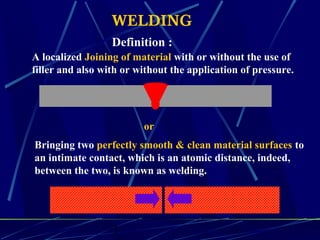
A localized Joining of material with or without the use of
filler and also with or without the application of pressure.
or
Bringing two perfectly smooth & clean material surfaces to
an intimate contact, which is an atomic distance, indeed,
between the two, is known as welding.
1 2
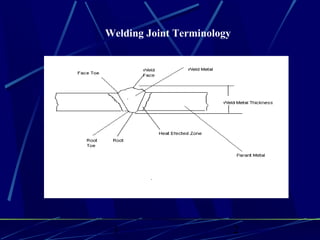
Welding Joint Terminology
1 3
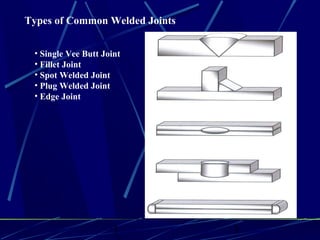
Types of Common Welded Joints
• Single Vee Butt Joint
• Fillet Joint
• Spot Welded Joint
• Plug Welded Joint
• Edge Joint
1 4
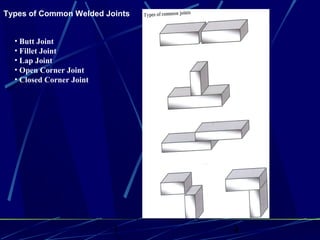
Types of Common Welded Joints
• Butt Joint
• Fillet Joint
• Lap Joint
• Open Corner Joint
• Closed Corner Joint
1 5
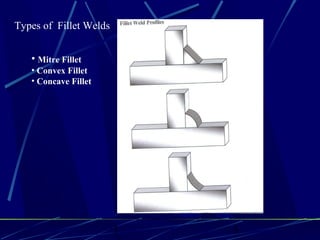
Types of Fillet Welds
• Mitre Fillet
• Convex Fillet
• Concave Fillet
1 6
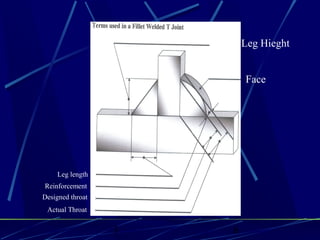
Leg length
Reinforcement
Designed throat
Actual Throat
Face
Leg Hieght
1 7
Weld Positions
• Weld Slope
• Weld Rotation
• Flat Position
• Horizontal Vertical Position
• Horizontal Position
• Over Head Position
• Vertical Up Position
• Vertical Down Position
• Inclined Position
1 8
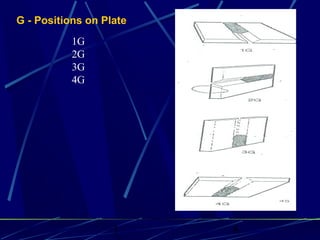
G - Positions on Plate
1G
2G
3G
4G
1 9
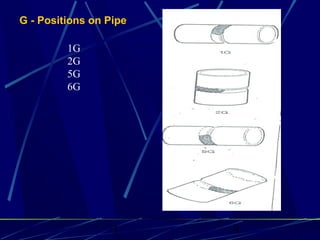
G - Positions on Pipe
1G
2G
5G
6G
1 10
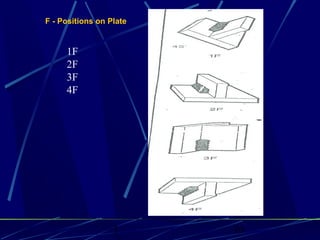
F - Positions on Plate
1F
2F
3F
4F
1 11
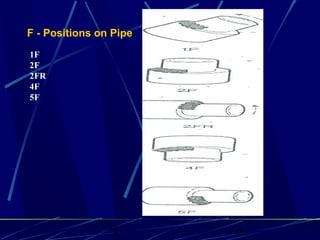
F - Positions on Pipe
1F
2F
2FR
4F
5F
1 12
Welding Processes
Following are the common Welding Processes Used in the Industries
1. Oxy- Gas Welding
2. Manual Metal Arc ( M.M.A ) Welding
3. Metal Inert Gas ( MIG), Metal Active Gas ( MAG ) Welding
4. Tungsten Inert Gas ( TIG) Welding
5. Plasma Arc Welding( PAW )
6. Submerged Arc Welding ( SAW )
7. Electro slag Welding
1 13
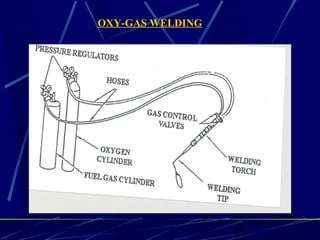
OXY-GAS WELDING
1 14
OXY-GAS WELDING
• It is a fusion welding process
• Uses a fuel gas and oxygen to provide a flame hot enough to
melt the materials to be joined.
• Suitable for almost all thicknesses and types of ferrous and
most non-ferrous metals.
• All positions welding is possible
• Relatively cheep method
• Reasonable ease of operation
1 15
This Method is suitable for
• Welding of most metals including carbon steels,
stainless steels, cast iron, bronze, copper, aluminum etc.
• Metals less than 5 mm thickness
The main disadvantages are
• Slow speed of travel
• High heat input
OXY-GAS WELDING
1 16
Process Technique
• A flame temperature of 31000 C is produced
• This high temperature flame is used to bring a small area of
parent metal tip to melting point.• Separate filler wire is then dipped into the molten pool
• The filler is melted off and mixes with the base metal
to produce the weld
OXY-GAS WELDING
1 17
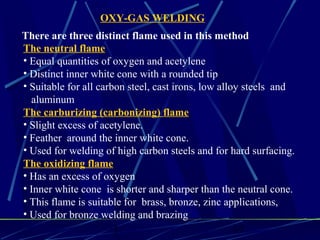
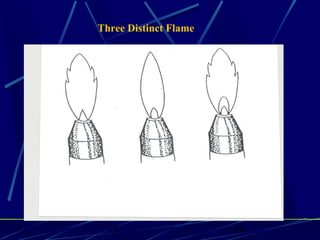
The neutral flame
• Equal quantities of oxygen and acetylene
• Distinct inner white cone with a rounded tip
• Suitable for all carbon steel, cast irons, low alloy steels and
aluminum
The carburizing (carbonizing) flame
• Slight excess of acetylene.
• Feather around the inner white cone.
• Used for welding of high carbon steels and for hard surfacing.
The oxidizing flame
• Has an excess of oxygen
• Inner white cone is shorter and sharper than the neutral cone.
• This flame is suitable for brass, bronze, zinc applications,
• Used for bronze welding and brazing
There are three distinct flame used in this method
OXY-GAS WELDING
1 18
Three Distinct Flame
1 19
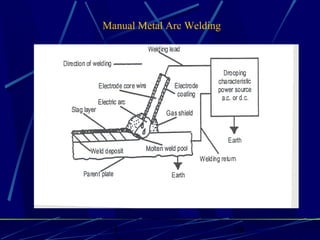
Manual Metal Arc Welding
1 20
Manual Metal Arc Welding
• Most Versatile Welding Process
• Suitable for almost all types of metals and all positions
• Its operation is comparatively easy
• It is a fusion welding
• The heat being provided by electric arc
• The arc has an average temperature of around 6,000 degree
C
• M.M.A welding is carried out using either a.c. or d.c.
• In case of d.c. current + ve or – ve polarity may be used
• A high open circuit voltage (o.c.v.) required is 65-90 volts
• Lower welding voltage required is 20-40 volts
• Reasonable range of current must be available; 30-350 amps
1 21
Effect of Amperage too high
Excessive penetration,
burn through,
porosity,
spatter,
deep craters,
undercut,
electrode overheats,
high deposition (positional welding difficult).
Effect of Amperage too low
Poor penetration or fusion,
unstable arc,
irregular bead shape,
slag inclusion,
porosity,
electrode freezes to the weld,
possible stray arc strikes.
1 22
Effect of Voltage too low
Poor penetration,
Electrode freezes to work
Possible stray arcs
Fusion defects
Slag inclusions
Unstable arc
Irregular bead shape.
Effect of Voltage too high
Porosity
Spatter
Irregular bead
Slag inclusion
Very fluid weld pool
positional welding difficult.
1 23
Travel speed too slow
Excessive deposition
Cold laps
Slag inclusions
Irregular bead shape.
Travel speed too Fast
Narrow thin bead
Slag inclusion
Fast cooling
Undercut
Poor fusion and Penetration
1 24
An electrode connected to the d.c.+ve pole will have two thirds of
the available energy.The remaining one third of the energy in the
parent material
It will result in:
wide and shallow weld pool
Broad HAZ
Slow Rate of Cooling
Hydrogen Intrapment
An electrode connected to the d.c. –ve pole has One third of the
energy develops at the electrode and two thirds of the energy in the
parent material.
This will result in
Weld pool which is narrow, deep and fast freezing
limited HAZ.
May lead to hydrogen entrapment and a brittle metallurgical
structure
1 25
In A.C. The polarity is reversing 100 times per second (50 c.p.s.).
Effect of equalizing the heat distribution
Heat at the electrode and half in the parent material.
Types of Consumables used in MMA
Rutile: Titanium Dioxide, Clay , Sodium silicate
Cellulosic: Cellulose( wood pulp), Titanium Dioxide, Sodium silicate
Basic: Lime stone ( Calcium carbonate ), Titanium Dioxide, Sodium
silicate
1 26
The MIG./MAG. welding process
uses a bare wire consumable
electrode .
The wire, typically 0.8-1.6 mm
diameter, is continuously fed from
a coil through a specially designed
welding gun.
1 27
Eliminate the possibility of atmospheric contamination by
introducing a shielding gas.
Argon is an efficient shielding gas, being inert, it doesnot
chemically react with the weld metal.
When an inert gas is used for shielding the welding process is
know as metal inert-gas (MIG) welding.
Deoxidizers must exist in the wire.
This process is widely referred to as CO2 welding is also called
metal active-gas (m.a.g.) welding.
Metal transfer modes
Spray or free flight transfer,
Dip transfer (semi-short circuiting arc),
Globular transfer, Pulsed transfer.
1 28
Spray or free flight transfer
The weld metal transfers across the arc in the form of a fine
spray.
High deposition rates and deep penetration welds.
Suited to thick materials,
The flat or horizontal welding positions.
Dip transfer (semi-short circuiting arc)
Amperage and low arc volts are required.
Used on thinner sections for all positional
welding,
Vertical down welding
1 29
For m.I.g./m.a.g. welding is usually electrode d.c. +ve of a flat
Characteristic.
Advantages
minimal wastage of consumable electrode,
no frequent changing of consumable electrode,
little or no interpass cleaning required (no slag produced)
heavier weld beads are produced, faster welding process,
low hydrogen process – preheat may not be required.
Disadvantages
increased risk or porosity – due
to displacement of the gas shield, more maintenance of plant
involved, high risk of lack or fusion.

Welding 1

  • 1.
    1 1 WELDING Definition : Alocalized Joining of material with or without the use of filler and also with or without the application of pressure. or Bringing two perfectly smooth & clean material surfaces to an intimate contact, which is an atomic distance, indeed, between the two, is known as welding.
  • 2.
    1 2 Welding JointTerminology
  • 3.
    1 3 Types ofCommon Welded Joints • Single Vee Butt Joint • Fillet Joint • Spot Welded Joint • Plug Welded Joint • Edge Joint
  • 4.
    1 4 Types ofCommon Welded Joints • Butt Joint • Fillet Joint • Lap Joint • Open Corner Joint • Closed Corner Joint
  • 5.
    1 5 Types ofFillet Welds • Mitre Fillet • Convex Fillet • Concave Fillet
  • 6.
    1 6 Leg length Reinforcement Designedthroat Actual Throat Face Leg Hieght
  • 7.
    1 7 Weld Positions •Weld Slope • Weld Rotation • Flat Position • Horizontal Vertical Position • Horizontal Position • Over Head Position • Vertical Up Position • Vertical Down Position • Inclined Position
  • 8.
    1 8 G -Positions on Plate 1G 2G 3G 4G
  • 9.
    1 9 G -Positions on Pipe 1G 2G 5G 6G
  • 10.
    1 10 F -Positions on Plate 1F 2F 3F 4F
  • 11.
    1 11 F -Positions on Pipe 1F 2F 2FR 4F 5F
  • 12.
    1 12 Welding Processes Followingare the common Welding Processes Used in the Industries 1. Oxy- Gas Welding 2. Manual Metal Arc ( M.M.A ) Welding 3. Metal Inert Gas ( MIG), Metal Active Gas ( MAG ) Welding 4. Tungsten Inert Gas ( TIG) Welding 5. Plasma Arc Welding( PAW ) 6. Submerged Arc Welding ( SAW ) 7. Electro slag Welding
  • 13.
  • 14.
    1 14 OXY-GAS WELDING •It is a fusion welding process • Uses a fuel gas and oxygen to provide a flame hot enough to melt the materials to be joined. • Suitable for almost all thicknesses and types of ferrous and most non-ferrous metals. • All positions welding is possible • Relatively cheep method • Reasonable ease of operation
  • 15.
    1 15 This Methodis suitable for • Welding of most metals including carbon steels, stainless steels, cast iron, bronze, copper, aluminum etc. • Metals less than 5 mm thickness The main disadvantages are • Slow speed of travel • High heat input OXY-GAS WELDING
  • 16.
    1 16 Process Technique •A flame temperature of 31000 C is produced • This high temperature flame is used to bring a small area of parent metal tip to melting point.• Separate filler wire is then dipped into the molten pool • The filler is melted off and mixes with the base metal to produce the weld OXY-GAS WELDING
  • 17.
    1 17 The neutralflame • Equal quantities of oxygen and acetylene • Distinct inner white cone with a rounded tip • Suitable for all carbon steel, cast irons, low alloy steels and aluminum The carburizing (carbonizing) flame • Slight excess of acetylene. • Feather around the inner white cone. • Used for welding of high carbon steels and for hard surfacing. The oxidizing flame • Has an excess of oxygen • Inner white cone is shorter and sharper than the neutral cone. • This flame is suitable for brass, bronze, zinc applications, • Used for bronze welding and brazing There are three distinct flame used in this method OXY-GAS WELDING
  • 18.
  • 19.
    1 19 Manual MetalArc Welding
  • 20.
    1 20 Manual MetalArc Welding • Most Versatile Welding Process • Suitable for almost all types of metals and all positions • Its operation is comparatively easy • It is a fusion welding • The heat being provided by electric arc • The arc has an average temperature of around 6,000 degree C • M.M.A welding is carried out using either a.c. or d.c. • In case of d.c. current + ve or – ve polarity may be used • A high open circuit voltage (o.c.v.) required is 65-90 volts • Lower welding voltage required is 20-40 volts • Reasonable range of current must be available; 30-350 amps
  • 21.
    1 21 Effect ofAmperage too high Excessive penetration, burn through, porosity, spatter, deep craters, undercut, electrode overheats, high deposition (positional welding difficult). Effect of Amperage too low Poor penetration or fusion, unstable arc, irregular bead shape, slag inclusion, porosity, electrode freezes to the weld, possible stray arc strikes.
  • 22.
    1 22 Effect ofVoltage too low Poor penetration, Electrode freezes to work Possible stray arcs Fusion defects Slag inclusions Unstable arc Irregular bead shape. Effect of Voltage too high Porosity Spatter Irregular bead Slag inclusion Very fluid weld pool positional welding difficult.
  • 23.
    1 23 Travel speedtoo slow Excessive deposition Cold laps Slag inclusions Irregular bead shape. Travel speed too Fast Narrow thin bead Slag inclusion Fast cooling Undercut Poor fusion and Penetration
  • 24.
    1 24 An electrodeconnected to the d.c.+ve pole will have two thirds of the available energy.The remaining one third of the energy in the parent material It will result in: wide and shallow weld pool Broad HAZ Slow Rate of Cooling Hydrogen Intrapment An electrode connected to the d.c. –ve pole has One third of the energy develops at the electrode and two thirds of the energy in the parent material. This will result in Weld pool which is narrow, deep and fast freezing limited HAZ. May lead to hydrogen entrapment and a brittle metallurgical structure
  • 25.
    1 25 In A.C.The polarity is reversing 100 times per second (50 c.p.s.). Effect of equalizing the heat distribution Heat at the electrode and half in the parent material. Types of Consumables used in MMA Rutile: Titanium Dioxide, Clay , Sodium silicate Cellulosic: Cellulose( wood pulp), Titanium Dioxide, Sodium silicate Basic: Lime stone ( Calcium carbonate ), Titanium Dioxide, Sodium silicate
  • 26.
    1 26 The MIG./MAG.welding process uses a bare wire consumable electrode . The wire, typically 0.8-1.6 mm diameter, is continuously fed from a coil through a specially designed welding gun.
  • 27.
    1 27 Eliminate thepossibility of atmospheric contamination by introducing a shielding gas. Argon is an efficient shielding gas, being inert, it doesnot chemically react with the weld metal. When an inert gas is used for shielding the welding process is know as metal inert-gas (MIG) welding. Deoxidizers must exist in the wire. This process is widely referred to as CO2 welding is also called metal active-gas (m.a.g.) welding. Metal transfer modes Spray or free flight transfer, Dip transfer (semi-short circuiting arc), Globular transfer, Pulsed transfer.
  • 28.
    1 28 Spray orfree flight transfer The weld metal transfers across the arc in the form of a fine spray. High deposition rates and deep penetration welds. Suited to thick materials, The flat or horizontal welding positions. Dip transfer (semi-short circuiting arc) Amperage and low arc volts are required. Used on thinner sections for all positional welding, Vertical down welding
  • 29.
    1 29 For m.I.g./m.a.g.welding is usually electrode d.c. +ve of a flat Characteristic. Advantages minimal wastage of consumable electrode, no frequent changing of consumable electrode, little or no interpass cleaning required (no slag produced) heavier weld beads are produced, faster welding process, low hydrogen process – preheat may not be required. Disadvantages increased risk or porosity – due to displacement of the gas shield, more maintenance of plant involved, high risk of lack or fusion.