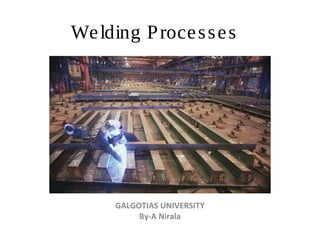
We lding Proce s s e s 
GALGOTIAS UNIVERSITY 
By-A Nirala
A Brief History of Welding 
• Late 19th Century 
– Scientists/engineers apply advances in electricity to heat and/or 
join metals (Le Chatelier, Joule, etc.) 
• 1930’s and 40’s 
– Industrial welding gains acceptance and is used extensively in 
the war effort to build tanks, aircraft, ships, etc. 
• Modern Welding 
– the nuclear/space age helps bring welding from an art to a 
science
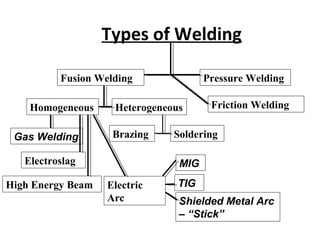
Types of Welding 
Fusion Welding Pressure Welding 
Homogeneous Heterogeneous 
Brazing Soldering 
MIG 
TIG 
Shielded Metal Arc 
– “Stick” 
Gas Welding 
Electroslag 
High Energy Beam Electric 
Arc 
Friction Welding
Weldability of a Metal 
• Metallurgical Capacity 
– Parent metal will join with the weld metal 
without formation of deleterious constituents or 
alloys 
• Mechanical Soundness 
– Joint will be free from discontinuities, gas 
porosity, shrinkage, slag, or cracks 
• Serviceability 
– Weld is able to perform under varying conditions 
or service (e.g., extreme temperatures, corrosive 
environments, fatigue, high pressures, etc.)
Fusion Welding Principles 
• Base metal is melted 
• Filler metal may be added 
• Heat is supplied by various means 
– Oxyacetylene gas 
– Electric Arc 
– Plasma Arc 
– Laser
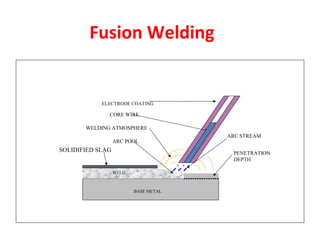
Fusion Welding 
ELECTRODE COATING 
CORE WIRE 
WELDING ATMOSPHERE 
BASE METAL 
WELD 
SOLIDIFIED SLAG 
ARC POOL 
ARC STREAM 
PENETRATION 
DEPTH
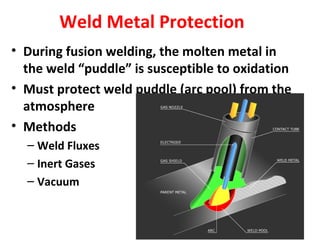
Weld Metal Protection 
• During fusion welding, the molten metal in 
the weld “puddle” is susceptible to oxidation 
• Must protect weld puddle (arc pool) from the 
atmosphere 
• Methods 
– Weld Fluxes 
– Inert Gases 
– Vacuum
Weld Fluxes 
• Typical fluxes 
– SiO2, TiO2, FeO, MgO, Al2O3 
– Produces a gaseous shield to prevent 
contamination 
– Act as scavengers to reduce oxides 
– Add alloying elements to the weld 
– Influence shape of weld bead during 
solidification
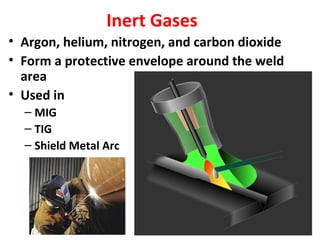
Inert Gases 
• Argon, helium, nitrogen, and carbon dioxide 
• Form a protective envelope around the weld 
area 
• Used in 
– MIG 
– TIG 
– Shield Metal Arc
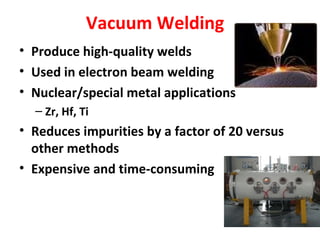
Vacuum Welding 
• Produce high-quality welds 
• Used in electron beam welding 
• Nuclear/special metal applications 
– Zr, Hf, Ti 
• Reduces impurities by a factor of 20 versus 
other methods 
• Expensive and time-consuming
Types of Fusion Welding 
• Oxyacetylene Cutting/Welding 
• Shielded Metal Arc (“Stick”) 
• Metal Inert Gas (MIG) 
• Tungsten Inert Gas (TIG)
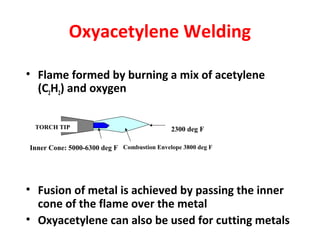
Oxyacetylene Welding 
• Flame formed by burning a mix of acetylene 
(C2H2) and oxygen 
TORCH TIP 2300 deg F 
Inner Cone: 5000-6300 deg F Combustion Envelope 3800 deg F 
• Fusion of metal is achieved by passing the inner 
cone of the flame over the metal 
• Oxyacetylene can also be used for cutting metals
Shielded Metal Arc (Stick) 
• An electric arc is generated between a coated 
electrode and the parent metal 
• The coated electrode carries the electric current to 
form the arc, produces a gas to control the 
atmosphere and provides filler metal for the weld 
bead 
• Electric current may be AC or DC. If the current is 
DC, the polarity will affect the weld size and 
application
Shielded Metal Arc (con’t) 
• Process: 
– Intense heat at the arc melts the tip of the 
electrode 
– Tiny drops of metal enter the arc stream and are 
deposited on the parent metal 
– As molten metal is deposited, a slag forms over 
the bead which serves as an insulation against air 
contaminants during cooling 
– After a weld ‘pass’ is allowed the cool, the oxide 
layer is removed by a chipping hammer and then 
cleaned with a wirebrush before the next pass.
Inert Gas Welding 
• For materials such as Al or Ti which quickly 
form oxide layers, a method to place an inert 
atmosphere around the weld puddle had to 
be developed
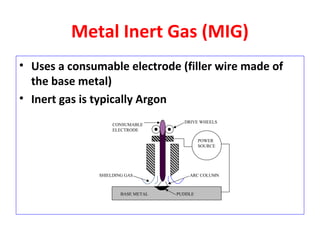
Metal Inert Gas (MIG) 
• Uses a consumable electrode (filler wire made of 
the base metal) 
• Inert gas is typically Argon 
CONSUMABLE DRIVE WHEELS 
ELECTRODE 
BASE METAL PUDDLE 
POWER 
SOURCE 
SHIELDING GAS ARC COLUMN
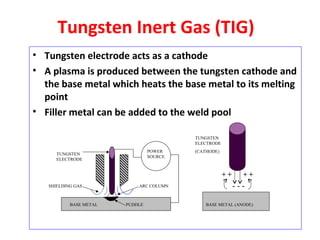
Tungsten Inert Gas (TIG) 
• Tungsten electrode acts as a cathode 
• A plasma is produced between the tungsten cathode and 
the base metal which heats the base metal to its melting 
point 
• Filler metal can be added to the weld pool 
TUNGSTEN 
ELECTRODE 
BASE METAL PUDDLE 
POWER 
SOURCE 
SHIELDING GAS ARC COLUMN 
+ + 
TUNGSTEN 
ELECTRODE 
(CATHODE) 
- - - 
+ + 
BASE METAL (ANODE)
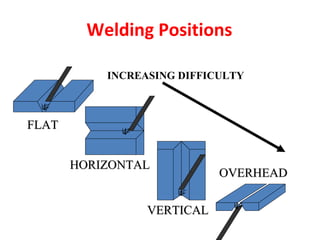
Welding Positions 
FFLLAATT 
INCREASING DIFFICULTY 
HHOORRIIZZOONNTTAALL 
VVEERRTTIICCAALL 
OOVVEERRHHEEAADD
Weld Defects 
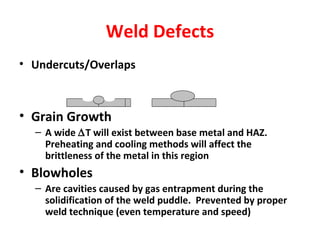
• Undercuts/Overlaps 
• Grain Growth 
– A wide DT will exist between base metal and HAZ. 
Preheating and cooling methods will affect the 
brittleness of the metal in this region 
• Blowholes 
– Are cavities caused by gas entrapment during the 
solidification of the weld puddle. Prevented by proper 
weld technique (even temperature and speed)
Weld Defects 
• Inclusions 
– Impurities or foreign substances which are forced into the 
weld puddle during the welding process. Has the same effect 
as a crack. Prevented by proper technique/cleanliness. 
• Segregation 
– Condition where some regions of the metal are enriched with 
an alloy ingredient and others aren’t. Can be prevented by 
proper heat treatment and cooling. 
• Porosity 
– The formation of tiny pinholes generated by atmospheric 
contamination. Prevented by keeping a protective shield over 
the molten weld puddle.
Residual Stresses 
• Rapid heating and cooling results in thermal 
stresses detrimental to joint strength. 
• Prevention 
– Edge Preparation/Alignment – beveled edges and 
space between components to allow movement 
– Control of heat input – skip or intermittent weld 
technique 
– Preheating – reduces expansion/contraction forces 
(alloys) and removes moisture from the surface 
– Peening – help metal stretch as it cools by hitting with 
a hammer. Use with care since it may work harden 
the metal 
– Heat Treatment – “soak” the metal at a high 
temperature to relieve stresses 
– Jigs and Fixtures – prevent distortion by holding 
metal fixed 
– Number of Passes – the fewer the better.
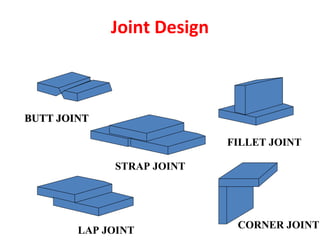
Joint Design 
BBUUTTTT JJOOIINNTT 
STRAP JOINT 
LAP JOINT 
FILLET JOINT 
CORNER JOINT
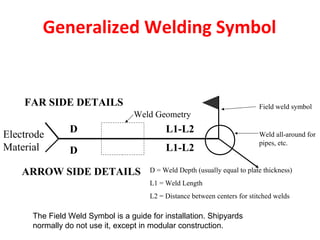
Generalized Welding Symbol 
FAR SIDE DETAILS 
Electrode 
Material 
D 
D 
Weld Geometry 
ARROW SIDE DETAILS 
Field weld symbol 
Weld all-around for 
pipes, etc. 
L1-L2 
L1-L2 
D = Weld Depth (usually equal to plate thickness) 
L1 = Weld Length 
L2 = Distance between centers for stitched welds 
The Field Weld Symbol is a guide for installation. Shipyards 
normally do not use it, except in modular construction.
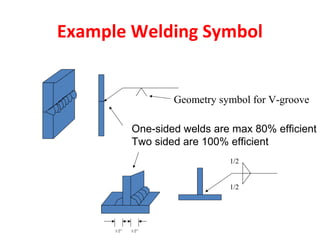
Example Welding Symbol 
Geometry symbol for V-groove 
One-sided welds are max 80% efficient 
Two sided are 100% efficient 
1/2” 1/2” 
1/2 
1/2
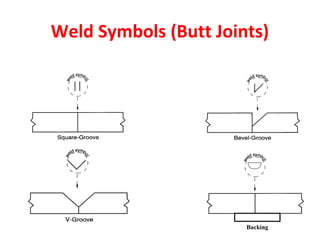
Weld Symbols (Butt Joints) 
Backing
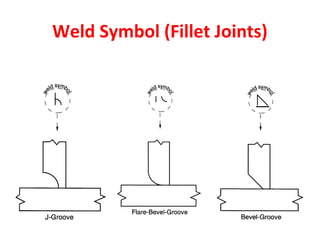
Weld Symbol (Fillet Joints)
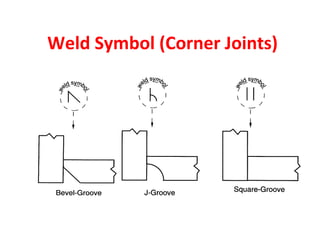
Weld Symbol (Corner Joints)

Welding for class

  • 1.
    We lding Proces s e s GALGOTIAS UNIVERSITY By-A Nirala
  • 2.
    A Brief Historyof Welding • Late 19th Century – Scientists/engineers apply advances in electricity to heat and/or join metals (Le Chatelier, Joule, etc.) • 1930’s and 40’s – Industrial welding gains acceptance and is used extensively in the war effort to build tanks, aircraft, ships, etc. • Modern Welding – the nuclear/space age helps bring welding from an art to a science
  • 3.
    Types of Welding Fusion Welding Pressure Welding Homogeneous Heterogeneous Brazing Soldering MIG TIG Shielded Metal Arc – “Stick” Gas Welding Electroslag High Energy Beam Electric Arc Friction Welding
  • 4.
    Weldability of aMetal • Metallurgical Capacity – Parent metal will join with the weld metal without formation of deleterious constituents or alloys • Mechanical Soundness – Joint will be free from discontinuities, gas porosity, shrinkage, slag, or cracks • Serviceability – Weld is able to perform under varying conditions or service (e.g., extreme temperatures, corrosive environments, fatigue, high pressures, etc.)
  • 5.
    Fusion Welding Principles • Base metal is melted • Filler metal may be added • Heat is supplied by various means – Oxyacetylene gas – Electric Arc – Plasma Arc – Laser
  • 6.
    Fusion Welding ELECTRODECOATING CORE WIRE WELDING ATMOSPHERE BASE METAL WELD SOLIDIFIED SLAG ARC POOL ARC STREAM PENETRATION DEPTH
  • 7.
    Weld Metal Protection • During fusion welding, the molten metal in the weld “puddle” is susceptible to oxidation • Must protect weld puddle (arc pool) from the atmosphere • Methods – Weld Fluxes – Inert Gases – Vacuum
  • 8.
    Weld Fluxes •Typical fluxes – SiO2, TiO2, FeO, MgO, Al2O3 – Produces a gaseous shield to prevent contamination – Act as scavengers to reduce oxides – Add alloying elements to the weld – Influence shape of weld bead during solidification
  • 9.
    Inert Gases •Argon, helium, nitrogen, and carbon dioxide • Form a protective envelope around the weld area • Used in – MIG – TIG – Shield Metal Arc
  • 10.
    Vacuum Welding •Produce high-quality welds • Used in electron beam welding • Nuclear/special metal applications – Zr, Hf, Ti • Reduces impurities by a factor of 20 versus other methods • Expensive and time-consuming
  • 11.
    Types of FusionWelding • Oxyacetylene Cutting/Welding • Shielded Metal Arc (“Stick”) • Metal Inert Gas (MIG) • Tungsten Inert Gas (TIG)
  • 12.
    Oxyacetylene Welding •Flame formed by burning a mix of acetylene (C2H2) and oxygen TORCH TIP 2300 deg F Inner Cone: 5000-6300 deg F Combustion Envelope 3800 deg F • Fusion of metal is achieved by passing the inner cone of the flame over the metal • Oxyacetylene can also be used for cutting metals
  • 13.
    Shielded Metal Arc(Stick) • An electric arc is generated between a coated electrode and the parent metal • The coated electrode carries the electric current to form the arc, produces a gas to control the atmosphere and provides filler metal for the weld bead • Electric current may be AC or DC. If the current is DC, the polarity will affect the weld size and application
  • 14.
    Shielded Metal Arc(con’t) • Process: – Intense heat at the arc melts the tip of the electrode – Tiny drops of metal enter the arc stream and are deposited on the parent metal – As molten metal is deposited, a slag forms over the bead which serves as an insulation against air contaminants during cooling – After a weld ‘pass’ is allowed the cool, the oxide layer is removed by a chipping hammer and then cleaned with a wirebrush before the next pass.
  • 15.
    Inert Gas Welding • For materials such as Al or Ti which quickly form oxide layers, a method to place an inert atmosphere around the weld puddle had to be developed
  • 16.
    Metal Inert Gas(MIG) • Uses a consumable electrode (filler wire made of the base metal) • Inert gas is typically Argon CONSUMABLE DRIVE WHEELS ELECTRODE BASE METAL PUDDLE POWER SOURCE SHIELDING GAS ARC COLUMN
  • 17.
    Tungsten Inert Gas(TIG) • Tungsten electrode acts as a cathode • A plasma is produced between the tungsten cathode and the base metal which heats the base metal to its melting point • Filler metal can be added to the weld pool TUNGSTEN ELECTRODE BASE METAL PUDDLE POWER SOURCE SHIELDING GAS ARC COLUMN + + TUNGSTEN ELECTRODE (CATHODE) - - - + + BASE METAL (ANODE)
  • 18.
    Welding Positions FFLLAATT INCREASING DIFFICULTY HHOORRIIZZOONNTTAALL VVEERRTTIICCAALL OOVVEERRHHEEAADD
  • 19.
    Weld Defects •Undercuts/Overlaps • Grain Growth – A wide DT will exist between base metal and HAZ. Preheating and cooling methods will affect the brittleness of the metal in this region • Blowholes – Are cavities caused by gas entrapment during the solidification of the weld puddle. Prevented by proper weld technique (even temperature and speed)
  • 20.
    Weld Defects •Inclusions – Impurities or foreign substances which are forced into the weld puddle during the welding process. Has the same effect as a crack. Prevented by proper technique/cleanliness. • Segregation – Condition where some regions of the metal are enriched with an alloy ingredient and others aren’t. Can be prevented by proper heat treatment and cooling. • Porosity – The formation of tiny pinholes generated by atmospheric contamination. Prevented by keeping a protective shield over the molten weld puddle.
  • 21.
    Residual Stresses •Rapid heating and cooling results in thermal stresses detrimental to joint strength. • Prevention – Edge Preparation/Alignment – beveled edges and space between components to allow movement – Control of heat input – skip or intermittent weld technique – Preheating – reduces expansion/contraction forces (alloys) and removes moisture from the surface – Peening – help metal stretch as it cools by hitting with a hammer. Use with care since it may work harden the metal – Heat Treatment – “soak” the metal at a high temperature to relieve stresses – Jigs and Fixtures – prevent distortion by holding metal fixed – Number of Passes – the fewer the better.
  • 22.
    Joint Design BBUUTTTTJJOOIINNTT STRAP JOINT LAP JOINT FILLET JOINT CORNER JOINT
  • 23.
    Generalized Welding Symbol FAR SIDE DETAILS Electrode Material D D Weld Geometry ARROW SIDE DETAILS Field weld symbol Weld all-around for pipes, etc. L1-L2 L1-L2 D = Weld Depth (usually equal to plate thickness) L1 = Weld Length L2 = Distance between centers for stitched welds The Field Weld Symbol is a guide for installation. Shipyards normally do not use it, except in modular construction.
  • 24.
    Example Welding Symbol Geometry symbol for V-groove One-sided welds are max 80% efficient Two sided are 100% efficient 1/2” 1/2” 1/2 1/2
  • 25.
    Weld Symbols (ButtJoints) Backing
  • 26.
  • 27.