CUIN 6371 Models of  Teaching Fall, 2003 Howard L. Jones
Teaching Making and following decisions which when implemented will increase the probability of learning
A Beginning Teacher to  Bruce Joyce, December 1995 Last September, 100 years ago, I thought teaching was one job with a few variations. I had an image of the one kind of teaching I could do well, with the one kind of student I could see myself teaching well.  It turned out that it is 20 jobs to do with 20 different personalities.
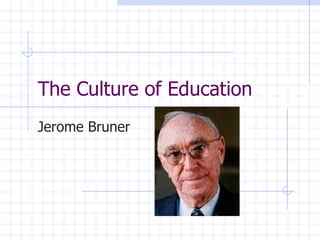
The Culture of Education Jerome Bruner
Culture of Education Assumption 1 The mind is a computational device and knowing how this device works will help in teaching the human mind Assumption 2 The mind exists but is shaped by the culture that it inhabits
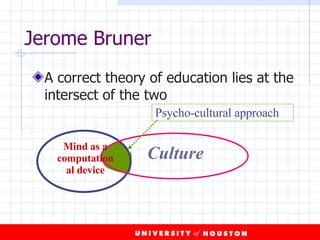
Jerome Bruner A correct theory of education lies at the intersect of the two Mind as a computational device Culture Psycho-cultural approach
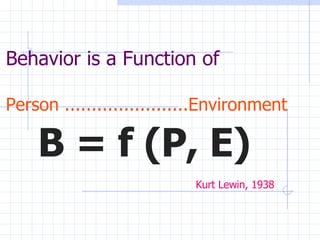
Behavior is a Function of Person .......................Environment B = f (P, E) Kurt Lewin, 1938
Models of Mind and Teaching Imitative In traditional classrooms learners are expected to master skills and imitate what the teacher does
Models of Mind and Teaching Didactic Exposure Learners are shown or told rules and concepts Remember them Apply Them
Models of Mind and Teaching Learner as Thinker Learners think about – reflect upon - what they do Metacognition
Models of Mind and Teaching Learner as Knowledgeable Building beliefs about beliefs Question what culture considers as true and compare with own reality
The verb “to teach” Originally meant “to show”
The Most Common  Teaching Pattern •  Providing Information •  Verification of information •  Application of Information (after Renner) Guided Tour Approach
A Place Called School   John Goodlad “ Elementary teachers use 3-4 strategies almost exclusively;  secondary teachers 1 or 2 .”
Once Block scheduling was implemented Teachers continued to use the lecture method…. George & McEwin (1998)
On the Other Hand… Perspective 1 Effective Teachers have an extensive array of alternative approaches to use in teaching.  Many   approaches   are practical   They are  sufficiently different  … that  different outcomes will result     (see Joyce and Weil 1996)
Curriculum Requirements Introducing Facts/Labels/Vocabulary/Discourse Concepts Generalizations Assuring Mastery of Problem Solving Creative Expression/Inventiveness Personal Understanding and Social Skills Motor Skills
Curriculum Requirements Encouraging Personal Understanding Personal Decision Making
Perspective Two  … Methods make a difference in what is learned as well as how it is learned.  -  The difference is probabilistic: particular methods boost certain outcomes and diminish others, but rarely do they guarantee some while obliterating the rest. Effect  Size
Perspective Three … Students are a powerful part of the learning experience being created, and they react differently to any given teaching method.   - A combination of personality, aptitudes, interpersonal skills, and previous achievement contributes to configurations of learning styles, so that no two people react exactly the same way to any one model of teaching.
Teaching Contexts Changes in Worldwide and local society Goals of schooling Changing demographics The development of technology The recognition that different types of learning require different types of teaching The emergence of research-based  teaching patterns  Etc....(TAAS Concerns, Parental Issues)
Teaching Contexts Changes in Worldwide and local society Goals of schooling
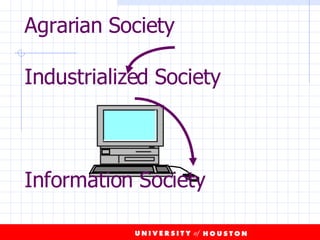
Agrarian Society Industrialized Society Information Society
Teaching Contexts Changes in Worldwide and local society Goals of schooling Changing demographics
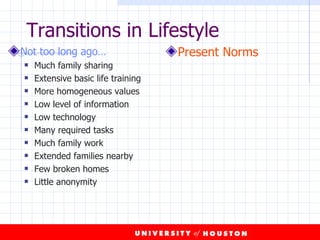
Transitions in Lifestyle Not too long ago… Much family sharing Extensive basic life training More homogeneous values Low level of information Low technology Many required tasks Much family work Extended families nearby Few broken homes Little anonymity Present Norms
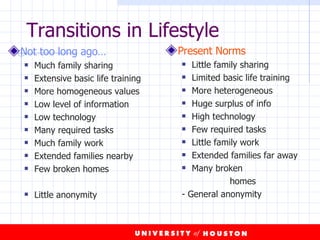
Transitions in Lifestyle Not too long ago… Much family sharing Extensive basic life training More homogeneous values Low level of information Low technology Many required tasks Much family work Extended families nearby Few broken homes Little anonymity Present Norms Little family sharing Limited basic life training More heterogeneous Huge surplus of info High technology Few required tasks Little family work Extended families far away Many broken  homes - General anonymity
At-Riskness
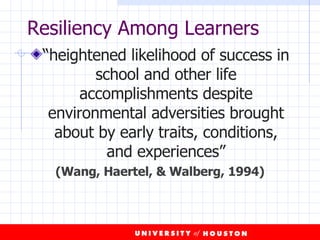
Resiliency Among Learners “ heightened likelihood of success in school and other life accomplishments despite environmental adversities brought about by early traits, conditions, and experiences” (Wang, Haertel, & Walberg, 1994)
Resilient Learners are more optimistic, responsible and goal-setting, inquisitive, and able to solve problems autonomous and purposeful yet social punctual, flexible, and energetic  Other studies have shown more  heightened senses of humor , to be  in service to others , and somewhere to have a  supportive adult relationship
Question? Have Schools Really Changed That Much in  50+ Years?
General Motors Assumptions Pre-1988 (Mitroff, 1988) GM is in the business of making money, not cars Cars are primarily status symbols; styling is therefore more important than quality The American car market is isolated from the rest of the world Workers do not have an important impact on productivity or product quality All connected with the system has no need for more than a fragmented, compartmentalized understanding of the business
General Motors Assumptions Pre-1988 (Mitroff, 1988) GM is in the business of making money, not cars Cars are primarily status symbols; styling is therefore more important than quality The American car market is isolated from the rest of the world Workers do not have an important impact on productivity or product quality All connected with the system has no need for more than a fragmented, compartmentalized understanding of the business Present Assumptions About Schooling in the U.S... (Jones) Schools sort learners based on relative achievement within a fixed calendar Teaching is the delivery of information to passive students The focus is on content Learning is the acquisition of information Teachers do the best they can with those students who are willing to learn
Present Assumptions About Schooling in the U.S... (Jones) “ Home effect” is responsible for differences in achievement
Teaching Contexts Changes in Worldwide and local society Goals of schooling Changing demographics Changes in technology
Arthur Clarke’s Third Law Any sufficiently advanced  technology is indistinguishable from magic.
CYBERPHOBIA
Teaching Contexts Changes in Worldwide and local society Goals of schooling Changing demographics Changes in technology The recognition that different types of learning call for different types of teaching
* Direct Outcomes  - there are research- based instructional  strategies that  will bring about predicted outcomes * Incidental Outcomes  - these strategies  also have some quite pleasant – or  unpleasant – side effects Curriculum Drives Everything
A Teaching Model Strong philosophic or psychological base Generates significant gains in student knowledge, skills, and/or attitudes Is applicable in the “real world”
Teaching is the   creation of environments   in which students’ cognitive structures can emerge and change
A Model of Teaching * Instructional Strategies Lecturing Small group work Discovery activities Laboratory-like activities Role Playing Drill/Practice/Recitation Problem-Oriented  Instruction  Simulations… *Belief Systems - How Do People  Learn? - What Should the  Educational  Environment Do?
Belief Systems How Do People Learn?  What are Influences Over Learning? Freud     Skinner  Gagne’   Bruner  Piaget   Becker Gordon Engleman   Wolpe   Ausubel Bloom Levin   Atkinson Bandura  Maslow Rogers   Glasser   Kohlberg   Vygotsky …
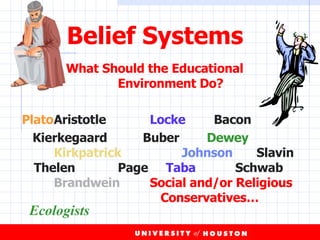
Belief Systems What Should the Educational    Environment Do? Plato Aristotle Locke Bacon Kierkegaard   Buber   Dewey Kirkpatrick Johnson   Slavin  Thelen Page  Taba   Schwab Brandwein Social and/or Religious    Conservatives… Ecologists
Teaching Contexts Changes in Worldwide and local society Goals of schooling Changing demographics The development of technology The recognition that different types of learning require different types of teaching The emergence of research-based  teaching patterns
Bruce Joyce & Marsha Weil Model “Families” * Information Processing *  Social Interaction *  Personal Growth *  Behavioral Systems
Information Processing Inductive - Jerome Bruner/ Hilda Taba Deductive - David Ausubel Inquiry -  J. J. Schwab/J. Richard Suchman Jean Piaget/ L. Kohlberg Memory - R. Atkinson/J. Levin/J. Lucas Creativity - W. J. J. Gordon
Social Interaction Teaching About Society Jurisprudential  Oliver and Shaver Role Playing/Simulations Teaching Social Skills National Training Laboratory Teaching Academic Content  & Social Skills Various Forms of Cooperative Learning
Personal Growth Awareness of Self Awareness Training -  F. Perls, et al.  Enhancing Personal Goals Non-Directive -  Carl Rogers Classroom Meeting - William Glasser
Behavioral Systems Operant Conditioning   - B. F. Skinner Counter Conditioning   -   Wolpe and  others Training   -   Robert Gagne’,  A. Bandura, et al.
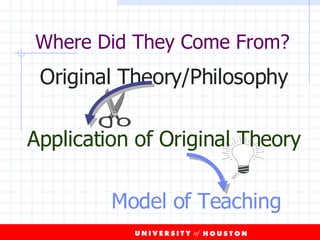
Where Did They Come From? Original Theory/Philosophy Application of Original Theory Model of Teaching
Teaching Contexts Changes in Worldwide and local society Goals of schooling Changing demographics The development of technology The recognition that different types of learning require different types of teaching The emergence of research-based  teaching patterns  Etc....(TAAS Concerns, Parental Issues)
Teachers have an extensive array of alternative approaches to use in teaching.  Methods make a difference in what is learned as well as how it is learned. The difference is probabilistic. Students are a powerful part of the learning experience being created, and they react differently to any given teaching method. Three Perspectives
Bruce Joyce “ These are really  models of learning .  They each empower students to cope with situations that they will encounter well beyond their school days.”
The Message? Many models to explore…  many to master
We Start With National Training Laboratory  …a precursor to Cooperative Learning and a few other teaching models of this century

Introductory Pp Models

  • 1.
    CUIN 6371 Modelsof Teaching Fall, 2003 Howard L. Jones
  • 2.
    Teaching Making andfollowing decisions which when implemented will increase the probability of learning
  • 3.
    A Beginning Teacherto Bruce Joyce, December 1995 Last September, 100 years ago, I thought teaching was one job with a few variations. I had an image of the one kind of teaching I could do well, with the one kind of student I could see myself teaching well. It turned out that it is 20 jobs to do with 20 different personalities.
  • 4.
    The Culture ofEducation Jerome Bruner
  • 5.
    Culture of EducationAssumption 1 The mind is a computational device and knowing how this device works will help in teaching the human mind Assumption 2 The mind exists but is shaped by the culture that it inhabits
  • 6.
    Jerome Bruner Acorrect theory of education lies at the intersect of the two Mind as a computational device Culture Psycho-cultural approach
  • 7.
    Behavior is aFunction of Person .......................Environment B = f (P, E) Kurt Lewin, 1938
  • 8.
    Models of Mindand Teaching Imitative In traditional classrooms learners are expected to master skills and imitate what the teacher does
  • 9.
    Models of Mindand Teaching Didactic Exposure Learners are shown or told rules and concepts Remember them Apply Them
  • 10.
    Models of Mindand Teaching Learner as Thinker Learners think about – reflect upon - what they do Metacognition
  • 11.
    Models of Mindand Teaching Learner as Knowledgeable Building beliefs about beliefs Question what culture considers as true and compare with own reality
  • 12.
    The verb “toteach” Originally meant “to show”
  • 13.
    The Most Common Teaching Pattern • Providing Information • Verification of information • Application of Information (after Renner) Guided Tour Approach
  • 14.
    A Place CalledSchool John Goodlad “ Elementary teachers use 3-4 strategies almost exclusively; secondary teachers 1 or 2 .”
  • 15.
    Once Block schedulingwas implemented Teachers continued to use the lecture method…. George & McEwin (1998)
  • 16.
    On the OtherHand… Perspective 1 Effective Teachers have an extensive array of alternative approaches to use in teaching. Many approaches are practical They are sufficiently different … that different outcomes will result (see Joyce and Weil 1996)
  • 17.
    Curriculum Requirements IntroducingFacts/Labels/Vocabulary/Discourse Concepts Generalizations Assuring Mastery of Problem Solving Creative Expression/Inventiveness Personal Understanding and Social Skills Motor Skills
  • 18.
    Curriculum Requirements EncouragingPersonal Understanding Personal Decision Making
  • 19.
    Perspective Two … Methods make a difference in what is learned as well as how it is learned. - The difference is probabilistic: particular methods boost certain outcomes and diminish others, but rarely do they guarantee some while obliterating the rest. Effect Size
  • 20.
    Perspective Three …Students are a powerful part of the learning experience being created, and they react differently to any given teaching method. - A combination of personality, aptitudes, interpersonal skills, and previous achievement contributes to configurations of learning styles, so that no two people react exactly the same way to any one model of teaching.
  • 21.
    Teaching Contexts Changesin Worldwide and local society Goals of schooling Changing demographics The development of technology The recognition that different types of learning require different types of teaching The emergence of research-based teaching patterns Etc....(TAAS Concerns, Parental Issues)
  • 22.
    Teaching Contexts Changesin Worldwide and local society Goals of schooling
  • 23.
    Agrarian Society IndustrializedSociety Information Society
  • 24.
    Teaching Contexts Changesin Worldwide and local society Goals of schooling Changing demographics
  • 25.
    Transitions in LifestyleNot too long ago… Much family sharing Extensive basic life training More homogeneous values Low level of information Low technology Many required tasks Much family work Extended families nearby Few broken homes Little anonymity Present Norms
  • 26.
    Transitions in LifestyleNot too long ago… Much family sharing Extensive basic life training More homogeneous values Low level of information Low technology Many required tasks Much family work Extended families nearby Few broken homes Little anonymity Present Norms Little family sharing Limited basic life training More heterogeneous Huge surplus of info High technology Few required tasks Little family work Extended families far away Many broken homes - General anonymity
  • 27.
  • 28.
    Resiliency Among Learners“ heightened likelihood of success in school and other life accomplishments despite environmental adversities brought about by early traits, conditions, and experiences” (Wang, Haertel, & Walberg, 1994)
  • 29.
    Resilient Learners aremore optimistic, responsible and goal-setting, inquisitive, and able to solve problems autonomous and purposeful yet social punctual, flexible, and energetic Other studies have shown more heightened senses of humor , to be in service to others , and somewhere to have a supportive adult relationship
  • 30.
    Question? Have SchoolsReally Changed That Much in 50+ Years?
  • 31.
    General Motors AssumptionsPre-1988 (Mitroff, 1988) GM is in the business of making money, not cars Cars are primarily status symbols; styling is therefore more important than quality The American car market is isolated from the rest of the world Workers do not have an important impact on productivity or product quality All connected with the system has no need for more than a fragmented, compartmentalized understanding of the business
  • 32.
    General Motors AssumptionsPre-1988 (Mitroff, 1988) GM is in the business of making money, not cars Cars are primarily status symbols; styling is therefore more important than quality The American car market is isolated from the rest of the world Workers do not have an important impact on productivity or product quality All connected with the system has no need for more than a fragmented, compartmentalized understanding of the business Present Assumptions About Schooling in the U.S... (Jones) Schools sort learners based on relative achievement within a fixed calendar Teaching is the delivery of information to passive students The focus is on content Learning is the acquisition of information Teachers do the best they can with those students who are willing to learn
  • 33.
    Present Assumptions AboutSchooling in the U.S... (Jones) “ Home effect” is responsible for differences in achievement
  • 34.
    Teaching Contexts Changesin Worldwide and local society Goals of schooling Changing demographics Changes in technology
  • 35.
    Arthur Clarke’s ThirdLaw Any sufficiently advanced technology is indistinguishable from magic.
  • 36.
  • 37.
    Teaching Contexts Changesin Worldwide and local society Goals of schooling Changing demographics Changes in technology The recognition that different types of learning call for different types of teaching
  • 38.
    * Direct Outcomes - there are research- based instructional strategies that will bring about predicted outcomes * Incidental Outcomes - these strategies also have some quite pleasant – or unpleasant – side effects Curriculum Drives Everything
  • 39.
    A Teaching ModelStrong philosophic or psychological base Generates significant gains in student knowledge, skills, and/or attitudes Is applicable in the “real world”
  • 40.
    Teaching is the creation of environments in which students’ cognitive structures can emerge and change
  • 41.
    A Model ofTeaching * Instructional Strategies Lecturing Small group work Discovery activities Laboratory-like activities Role Playing Drill/Practice/Recitation Problem-Oriented Instruction Simulations… *Belief Systems - How Do People Learn? - What Should the Educational Environment Do?
  • 42.
    Belief Systems HowDo People Learn? What are Influences Over Learning? Freud Skinner Gagne’ Bruner Piaget Becker Gordon Engleman Wolpe Ausubel Bloom Levin Atkinson Bandura Maslow Rogers Glasser Kohlberg Vygotsky …
  • 43.
    Belief Systems WhatShould the Educational Environment Do? Plato Aristotle Locke Bacon Kierkegaard Buber Dewey Kirkpatrick Johnson Slavin Thelen Page Taba Schwab Brandwein Social and/or Religious Conservatives… Ecologists
  • 44.
    Teaching Contexts Changesin Worldwide and local society Goals of schooling Changing demographics The development of technology The recognition that different types of learning require different types of teaching The emergence of research-based teaching patterns
  • 45.
    Bruce Joyce &Marsha Weil Model “Families” * Information Processing * Social Interaction * Personal Growth * Behavioral Systems
  • 46.
    Information Processing Inductive- Jerome Bruner/ Hilda Taba Deductive - David Ausubel Inquiry - J. J. Schwab/J. Richard Suchman Jean Piaget/ L. Kohlberg Memory - R. Atkinson/J. Levin/J. Lucas Creativity - W. J. J. Gordon
  • 47.
    Social Interaction TeachingAbout Society Jurisprudential Oliver and Shaver Role Playing/Simulations Teaching Social Skills National Training Laboratory Teaching Academic Content & Social Skills Various Forms of Cooperative Learning
  • 48.
    Personal Growth Awarenessof Self Awareness Training - F. Perls, et al. Enhancing Personal Goals Non-Directive - Carl Rogers Classroom Meeting - William Glasser
  • 49.
    Behavioral Systems OperantConditioning - B. F. Skinner Counter Conditioning - Wolpe and others Training - Robert Gagne’, A. Bandura, et al.
  • 50.
    Where Did TheyCome From? Original Theory/Philosophy Application of Original Theory Model of Teaching
  • 51.
    Teaching Contexts Changesin Worldwide and local society Goals of schooling Changing demographics The development of technology The recognition that different types of learning require different types of teaching The emergence of research-based teaching patterns Etc....(TAAS Concerns, Parental Issues)
  • 52.
    Teachers have anextensive array of alternative approaches to use in teaching. Methods make a difference in what is learned as well as how it is learned. The difference is probabilistic. Students are a powerful part of the learning experience being created, and they react differently to any given teaching method. Three Perspectives
  • 53.
    Bruce Joyce “These are really models of learning . They each empower students to cope with situations that they will encounter well beyond their school days.”
  • 54.
    The Message? Manymodels to explore… many to master
  • 55.
    We Start WithNational Training Laboratory …a precursor to Cooperative Learning and a few other teaching models of this century