TECHNOLOGICAL
PERSPECTIVE OF
EDUCATION
Assignment of Unit 2
Submitted to: Dr. Arun Kumar
Submitted by: Mahak Gupta
Date: 20/12/2022
Department of Education
University of Lucknow
Contents
 Teaching
 Learning
 Levels of Teaching
 Phases of Teaching
 Principles of Teaching
 Maxims of Teaching
 Teaching Methods and Strategies
 Mass Media & Technological
Media in Education
 Audio-Visual Aids in Education
References
Teaching
 Introduction
Man is a social animal because he learns to live according
to social norms. The main difference between a man and
animal is that a human being tries to adjust
himself/herself according to her/his culture and
surroundings which an animal cannot. She/he learns all
these from a teacher. The first teacher in his/her life is
his/her mother and then the family members and lastly,
the society. But the formal teaching is possible in an
educational institution only. Here comes the role of a
teacher and teaching process. In this unit assignment, we
shall try to understand what actually the word ‘teaching’
means.
 Meaning and Definitions of Teaching
According to Oxford Dictionary ‘Teaching’ means “impart
knowledge or skill, give instruction or lessons, instill and
inspire with”.
Teaching, in simple terms, is referred to as either an
occupation or profession of a group known as teachers or
an activity or activities of a group undertaken to help an
individual to learn or acquire some knowledge, skills,
attitudes or interests. However, the meaning and concept
of teaching is not so simple. It is a very complex social,
cultural and ethical process designed in a social or cultural
context. Some of these definitions are presented as
follows:
H.C. Morrison (1934): Teaching is an intimate contact
between a more mature personality and a less mature one
which is designed to further the education of the later.
John Brubacher (1939): Teaching is an arrangement and
manipulation of a situation in which there are gaps and
obstructions which an individual will seek to overcome
and from which he will learn in the course of doing so.
B.O. Smith (1960): Teaching is a system of actions
intended to produce learning.
N.L. Gage (1962): Teaching is a form of interpersonal
influence aimed at changing the behaviour potential of
another person.
B.O. Smith (1963): Teaching is a system of actions
involving an agent, an end in view, and a situation
including two sets of factors-those over which the agent
has no control (class size, size of classroom, physical
characteristics of pupils, etc.) and those that he can
modify (way of asking questions about instruction and
ways of structuring information or ideas gleaned)
Edmund Amidon (1967): Teaching is defined as an
interactive process, primarily involving classroom talk
which takes place between teachers and pupils and
occurs during certain definable activities.
Clarke (1970): Teaching refers to activities that are
designed and performed to produce change in student
(pupil) behaviour.
Thomas F. Green (1971): Teaching is the task of a
teacher which is performed for the development of a child.
 Characteristics of Teaching
 Communicating Information
 Cause to Learn
 Helps to Adjust Himself to his Environment
 Stimulation and Encouragement
 Guidance and Training
 Conscious and Unconscious Process
 Formal as well as Informal
 Social Service
 Teaching as a Skilled Occupation.
 Teaching is Both an Art and Science
 A professional activity
 Aims of Teaching
The teaching act performed at the understanding level is
aimed to achieve the following objectives:
1. Knowledge objective: Acquisition of required factual
information or body of facts.
2. Understanding objective: Under this objective the
learners are able:
to see relationship between acquired facts
to comprehend the meaning of the acquired facts or
factual information
to identify the similarities and dissimilarities between the
acquired facts.
to seek generalization out of the specific facts
to apply the generalized fact, rule or principle for learning
new facts in practical life situations.
 Need and Importance of Teaching
 Giving Knowledge and Passing Information
 Acquiring Skills for Changing Behaviour
 Development of Personality
 Sets and Maintains High Aspirations and
Expectations
 Promotes Interaction between Teacher and Learner
 Promotes Positive Discipline Strategies
 Prepares Students for Challenges of World
 Encourages Learner to Reflect on their Learning
 Difference between Teaching and
Instruction
 Teaching is a process of educating a person and it is a
kind of a knowledge transfer between a teacher and a
student. Teaching is complex in nature.
 Instruction is that process which diverts the towards
the pupils towards the objectives of cognitive aspects.
it is not as complex as teaching.
 Difference Between Teaching and
Indoctrination
 Teaching aims at developing brains of students, it
provides them with the opportunity to argue things
and evaluate things and then forms an opinion.
 Indoctrination means teaching or inculcating a
doctrine, principal, or ideology especially one with a
particular point of view.
Indoctrination aims at teaching rigid beliefs, and
these beliefs may not have any evidence to be true.
Learning
 Introduction
Learning is a modification of behaviour through
experience and training Learning is defined as a relatively
permanent change in behaviour or behavioural potential
produced by practice or experience.
 Meaning and Definitions of Learning
According to Henry P. Smith, "Learning is the
acquisition of new behaviour of strengthening or
weakening of old behaviour as the result of experience."
According to Crow and Crow, "Learning is the
acquisition of habit knowledge and attitudes. It involves
new ways of doing things, and it operates an individual's
attempt to overcome obstacles or to adjust to new
situations."
According to Skinner. "Learning is the process of
progressive behaviour adaptation."
According to Gates and others, "Learning is the
modification of behaviour through experience and
training."
 Characteristics of Learning
 Learning is Growth
 Learning is Adjustment
 Learning is Purposeful
 Learning is Experience
 Learning is Intelligent
 Learning is Active
 Learning is both Individual and Social
 Learning is the Product of the Environment
 Learning Affects the Conduct of the Learner
 Domains of Learning
As we know, that education is development of body mind
and spirit. If we try to correlate physical, intellectual
emotional and spiritual development, with the domains of
learning, we find that development of intellect falls in the
cognitive domain, while emotional and spiritual
development is concerned with affective domain and
physical development is through skills which comprise of
the psychomotor domain.
o Cognitive Domain
o Affective Domain
o Psychomotor Domain
Levels of Teaching
According to Bigge (1967), can be performed at various
levels ranging from the least thoughtful to the most
thoughtful behaviour or mode of action.
Accordingly, psychologist and educationists have clearly
identified three such levels of teaching-learning act,
namely memory level, understanding level and reflective
level.
o Memory Level of Teaching: Teaching-learning act
at the memory level represents the involvement of
the least thoughtful behaviour. This definition
conveys that the classroom task at the memory level
of teaching is confined merely to the memorization
of the facts or associations related to the content
material of a subject.
o Understanding level of teaching: Understanding
level of teaching represents relatively a high level in
the teaching process as compared to memory level.
It calls for the use of one's thought processes and
cognitive abilities in the form of reasoning and
thinking powers, powers of imagination, analysis,
synthesis, comparision and drawing inferences, etc.
o Reflective Level of teaching: Teaching at
reflective level represents the highest level of the
teaching act that can be carried out at the most
thoughtful modes of operation providing the
desirable quality of teaching.
Phases of Teaching
The term tasks of teaching, teaching as a job of the
person called teacher may involve a number of
teaching acts or operations which need systematic
planning and careful execution. In doing so, the
teaching has proceed in some sequential and
organized steps. These steps or stages are known as
phases of teaching.
o The Pre-active Phase: It is the planning phase
of the teaching act. A good planning makes the
task of the teacher smooth, functionable and
successful.
o The Interactive Phase of Teaching: The
interactive stage is the actual implementation
phase of the planned instructional system. It is so
crucial that without Planning includes interaction,
no teaching could be said to have occurred. The
verbal as well as its learning, the non-verbal
behaviours of teacher and pupils are involved in
the process of interaction.
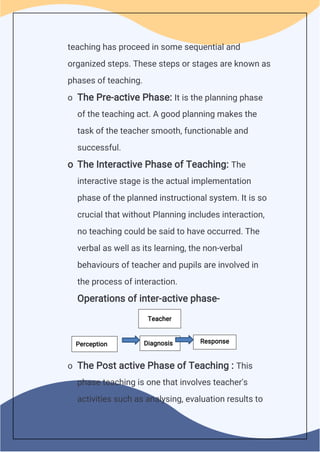
Operations of inter-active phase-
o The Post active Phase of Teaching : This
phase teaching is one that involves teacher's
activities such as analysing, evaluation results to
Diagnosis Response
Teacher
Perception
determine students' learning, especially their
problems in understanding specific areas, to
reflect on the teaching by self, and to decide on the
necessary changes to be brought in the system in
the next instructional period.
Principles of Teaching
The principles are necessary to control the behaviour of
the teacher; the following two types of teaching principles:
1) General principles of Teaching: The principles are
necessary to control the behaviour of the teacher.
 Principles of Motivation
 Principle of interest
 Principle of learning by doing
 Principle of linking with life.
 Principle of Selection of contents,
 Principle of Recognizing individual differences
 Principle of planning.
 Principle of Creation and Recreation etc.
2) Psychological principles of Teaching: The psychological
principles of teaching affect the teaching-process directly or
indirectly. These principles are used for turning the
learning-process effective.
 Principle of Motivation and Interest
 Principle of Imparting Training to Senses
 Principle of Encouraging Creativity and Self-Expression
 Principle of Repetition and Exercise
 Principle of Reinforcement
Maxims of Teaching
 Introduction
A maxim is a ground rule or fundamental principle that has
evolved over a period of time. It is a guide for future action
or behaviour. Teaching has also a set of maxims.
According to Rayment, "Maxims of teaching illustrate
the ways in which theory may be expected to help practice.
 Types/forms of Maxims of
Teaching
From known to unknown.
From seen to Unseen
From Simple to Complex
From Particular to General.
From Indefinite to Definite
From Concrete to Abstract
From whole to Part
From Psychological to Logical
From Analysis to Synthesis
From Empirical to Rational
Encouragement to self study
Teaching Methods and
Strategies
 Teaching Methods
The term teaching method refers to "the general principles,
pedagogy and management strategies used for classroom
instruction."
Teaching method is a style of the presentation of content
in classroom. M. Varma has defined the term method as,
"Method is an abstract as logical entities that we can
distinguish between manner and methods, in reality, they
form an organic whole and matter determines method
analogously as objective determines means: content and
spirit determine style and form of literature".
1) Telling Methods: Lecture Questioning. Discussion etc.
2) Showing Methods: Demonstration, Excursion.
Laboratory work, etc.
3)Doing Methods: Project, Role playing. Practical, etc.
 Teaching Strategy
Teaching strategy is a generalized plan for a lesson which
includes structure, instructional objectives and an outline
of planned tactics, necessary to implement the strategies.
Objectives of Teaching Strategy
1) To help students learn basic skills, such as reading,
writing, speaking, listening, and computation.
2) To help students understand and remember the facts
and concepts taught in school settings.
3) To help students learn independently and transfer
knowledge to non-school situations.
Classification of Teaching
methods/strategies
The teaching strategies can be divided into two categories
1.Autocratic Strategies :The autocratic strategies
are traditional teaching strategies and are also called
convergent approach. These are content centered and
teacher-centered.
Autocratic teaching strategies include:
 Lecture Strategy
 Tutorial Strategy
 lustration Strategy
 Description Strategy
 Explanation Strategy
 Review Strategy
 Demonstration Strategy
 Narration Strategy
 Exposition Strategy
 Supervised Teaching Strategy
 Programmed Instruction Strategy.
2.Democratic Strategies: The democratic strategies
are child centered as the students determine themselves
the content.
Democratic teaching strategies include:
 Group-work Strategy
 Discovery or Heuristic Strategy
 Project Strategy,
 Assignment Strategy
 Brain-Storming Strategy,
 Role-Playing Strategy
 Team Teaching Strategy,
 Problem Solving Strategy,
 Question-Answering Teaching Strategy,
 Dramatization Strategy,
 Independent Study Strategy,
 Drill Work Strategy,
 Excursion Strategy
 Group Discussion Strategy,
 Sensitivity Training Strategy
 Computer-Assisted Instruction Strategy.
Mass Media &
Technological Media in
Education
Mass media refers to a diverse array of media
technologies that reach a large audience via mass
communication.
Mass media is communication—whether written,
broadcast, or spoken—that reaches a large
audience.
GENERAL PRINCIPLES OF USING MASS
MEDIA
some general principles of using the mass media.
1. Organisation: Mass media should be organised as
integral part of the educational programmes
2. Selection: Mass media should be properly selected and
coordinated by the teacher. An experienced and trained
teacher can select the mass media according to the needs
of the students.
3. Planning: Mass media should be available according to
the need of the instructional programme.
4. Experience: Mass media should be related to pupil’s
experience.
5. Preparation: There should be adequate preparation on
the part of pupils. The teacher should prepare himself
before using it.
6. Evaluation: Mass media should be evaluated at regular
intervals in regards to their use, effect on learning and
their functions.
Types of Mass Media
The most cannon types of Media are:
1.Print Media : It is composed of newspapers,
community newsletters, wire services, magazines, and
other publications. Within these publications, there are
two main divisions of labour.ie, reporting and editing.
Print media refers to "paper publications circulated in the
form of physical editions of books, magazines, journals
and newsletters, eg, magazine. newspaper, scholarly
journal and other materials.
2.Electronic Media: It is the media that uses electronics or
electromechanical energy for the end user (audience) to
access the content. This is in contrast to static media
(mainly print media), which today are most often created
electronically.
Classification of Media
There are different ways to classify media:
1) Print Media, Non-Print Media and Electronic
Media
i) Print Media: It includes books, journals, magazines,
newspapers, workbook, and textbooks.
ii) Non-Print Media: It include projected and non-projected
media.
iii) Electronic Media: It include Audio media, Visual media
and Audio-Visual
2) Projected Media and Non-Projected Media
i) Projected Media: They require light source for projection.
For example, film projector slides etc.
ii) Non-Projected Media: They do not require light source.
They include 3dimensional objects, dimensional objects,
prints, charts, models, etc.
3) Audio, Visual and Audio-Visual Media
i) Audio Media: This form of media carry sounds alone.
For example, audio tapes, record player.
ii) Visual Media: These are the ones that can be seen. For
example, TV, computer, white board.
iii) Audio-Visual: This term refers to those instructional
materials which provide students with audio and visual
experiences by appearing to the hearing and seeing
senses at the same time. For example, T.V., video tapes,
Closed Circuit Television (CCTV).
4) Hardware and Software
i) Hardware: This is classification of machines or
equipment used instructional process. It is upon these
gadgets that the software transmitted. For example,
television set tape recorder, etc.
ii) Software: This classification consists of all materials
used with the pres machine. They are the real carrier of
knowledge or information. They include, films, tapes
transparencies.
Importance of Mass Media
o Mass media acts as an agency of social change.
o Mass Media provide information to the mass within a
less time.
o It takes a wide coverage of information.
o It brings the entire world to the individual or to the
classroom
o Mass media are useful for reinforcing group
dynamics and interpersonal communication.
Technological Media in Education
Teaching with technology can deepen student learning by
supporting instructional objectives.
Technology also changes the way teachers teach, offering
educators effective ways to reach different types of
learners and assess student understanding through
multiple means. It also enhances the relationship between
teacher and student.
Use of Teaching-Learning Technologies
1.Tele-Conferencing (Face-to-Face Distance Mode of Education):
The word Tele' means distance the word 'Conference' means
consultations, discussions. Through teleconferencing two or more
locations situated at a distance are connected so that they can
hear or both see and hear each other. It allows the distant sites to
interact with each other and with the teaching end through phone,
fax, and e-mail.
2.Language Laboratory: The language laboratory plays an
important role in the language learning process As it is a
technological aid for learning. The language laboratory is a very
helpful tool for practicing and assessing one's speech in any
language.
3.E-Mail: Short form of electronic mail, email (or e-mail) is defined
as the transmission of messages over communications networks.
Typically, the messages are no entered from the keyboard or
electronic files stored on disk.
4.Smart Class: Smart class is a modern and smart class using
multimedia, internet and e-learning devices in classroom teaching.
These classes are something different to traditional classes,
because traditional classes use traditional teaching learning
devices. Smart classroom is a "white board classroom", using
white board (projector), computers and multimedia in classroom
teaching learning.
5.Internet : The word Internet exactly means "network of networks".
The Internet consists of thousands of smaller regional networks
spread throughout the world."Internet is a place where you can get
information, make information available (for free or for sale) and
where you can meet people."
6.Open Educational Resources(OER):OER are teaching. learning,
and research resources. Open educational resources include full
courses, course materials, modules, textbooks, streaming videos,
tests, software, and any other tools, materials, or techniques used
to support access to knowledge.
Audio-Visual Aids in
Education
Meaning and Definitions of Audio-Visual
Aids
Audio-Visual aids are also called instructional material.
'Audio' literally means hearing and 'visual' means that
which is found by seeing.
According to Kinder S. Janies, Audio-visual aids are any
device which can be used to make the learning experience
more concrete, more realistic and more dynamic"
According to Burton, "Audio-visual aids are those sensory
objects or images which initiate or stimulate and reinforce
learning."
According to Carter V. Good, "Audio-visual aids are those
aids which help in completing the triangular process of
learning that is motivation, classification and stimulation."
According to Edger Dale, "Audio-visual aids are those
devices by the use of which communication of ideas
between persons and groups in various teaching and
training situations is helped. These are also termed as
multi-sensory materials."
According to K.P. Neeraja, "An audio-visual aid is an
instructional device in which the message can be heard as
well as seen."
Objectives of Audio-Visual Aids
1) To enhance teachers skills which help to make
teaching-learning process effective.
2) Make learners active in the classroom
3) Communicate them according to their capabilities
4) Develop lesson plan and build interest.
5) To make students good observer
6) Develop easy and understandable learning material.
7) Follow child related leaning process.
8) Involve intimation in objectives.
9) To create interest in different groups.
10) To make teaching process more effective
Classification of Audio-Visual Aids
1. Audio Materials :These teaching aids produce
sound and act through the ear for which peaceful
and calm atmosphere is necessary. Ability to listen
attentively should be foster among the students.
 Audio
 Tapes
 Cassette
 Recorder
 Radio : Radio is a powerful mass medium used
in education for disseminating information,
imparting instruction and giving entertainment.
2. Visual Materials: Visual aids allow children the time
they need to process what they are being asked to do.
They do not dappear into thin air to be forgotten as
spoken words or hand gestures do.
 Calculator
 Computer
 Electronic Board
3. Audio-Visual Materials: Audio-visual aids are
materials of visual, audio and audio-visual categories that
help To make concepts abstract and ideas concrete in the
teaching-learning process. They are also materials, which
the teacher uses in supplementing his teachings.
 TV: Television is an audio-visual and
sophisticated scientific device. It telecasts
programmes from far and wide areas of the
country and abroad. It has an important role to
play for entertainment and education of people
all over the world.
 Video
 Tape
 Cinema
 Film : Motion pictures usually termed as films, which
represent an effective instructional aid calling upon
auditory as well visual senses of the learners. They
are useful and suitable aids in order to cater the
student's attention and create interest among them
towards effective learning. Educational films may be
prepared on any content material or any aspect of
knowledge, the correct attitude and behaviour.
Usually we have available general educational films,
classroom films, basic teaching films and
supplementary teaching films.
References
Links :
https://books.google.co.in/
http://www.ignou.ac.in/
www.drarockiasamy.wordpress.com
Books:
"Essentials of Education Technology"
( S.K.Mangal & Uma Mangal)
"Education Technology"
(R.A.Sharma)
i
Thank You

Technological Perspective Of Education Notes

  • 1.
    TECHNOLOGICAL PERSPECTIVE OF EDUCATION Assignment ofUnit 2 Submitted to: Dr. Arun Kumar Submitted by: Mahak Gupta Date: 20/12/2022 Department of Education University of Lucknow
  • 2.
    Contents  Teaching  Learning Levels of Teaching  Phases of Teaching  Principles of Teaching  Maxims of Teaching  Teaching Methods and Strategies  Mass Media & Technological Media in Education  Audio-Visual Aids in Education References
  • 3.
    Teaching  Introduction Man isa social animal because he learns to live according to social norms. The main difference between a man and animal is that a human being tries to adjust himself/herself according to her/his culture and surroundings which an animal cannot. She/he learns all these from a teacher. The first teacher in his/her life is his/her mother and then the family members and lastly, the society. But the formal teaching is possible in an educational institution only. Here comes the role of a teacher and teaching process. In this unit assignment, we shall try to understand what actually the word ‘teaching’ means.  Meaning and Definitions of Teaching According to Oxford Dictionary ‘Teaching’ means “impart knowledge or skill, give instruction or lessons, instill and inspire with”. Teaching, in simple terms, is referred to as either an occupation or profession of a group known as teachers or an activity or activities of a group undertaken to help an
  • 4.
    individual to learnor acquire some knowledge, skills, attitudes or interests. However, the meaning and concept of teaching is not so simple. It is a very complex social, cultural and ethical process designed in a social or cultural context. Some of these definitions are presented as follows: H.C. Morrison (1934): Teaching is an intimate contact between a more mature personality and a less mature one which is designed to further the education of the later. John Brubacher (1939): Teaching is an arrangement and manipulation of a situation in which there are gaps and obstructions which an individual will seek to overcome and from which he will learn in the course of doing so. B.O. Smith (1960): Teaching is a system of actions intended to produce learning. N.L. Gage (1962): Teaching is a form of interpersonal influence aimed at changing the behaviour potential of another person. B.O. Smith (1963): Teaching is a system of actions involving an agent, an end in view, and a situation including two sets of factors-those over which the agent has no control (class size, size of classroom, physical
  • 5.
    characteristics of pupils,etc.) and those that he can modify (way of asking questions about instruction and ways of structuring information or ideas gleaned) Edmund Amidon (1967): Teaching is defined as an interactive process, primarily involving classroom talk which takes place between teachers and pupils and occurs during certain definable activities. Clarke (1970): Teaching refers to activities that are designed and performed to produce change in student (pupil) behaviour. Thomas F. Green (1971): Teaching is the task of a teacher which is performed for the development of a child.  Characteristics of Teaching  Communicating Information  Cause to Learn  Helps to Adjust Himself to his Environment  Stimulation and Encouragement  Guidance and Training  Conscious and Unconscious Process  Formal as well as Informal  Social Service  Teaching as a Skilled Occupation.
  • 6.
     Teaching isBoth an Art and Science  A professional activity  Aims of Teaching The teaching act performed at the understanding level is aimed to achieve the following objectives: 1. Knowledge objective: Acquisition of required factual information or body of facts. 2. Understanding objective: Under this objective the learners are able: to see relationship between acquired facts to comprehend the meaning of the acquired facts or factual information to identify the similarities and dissimilarities between the acquired facts. to seek generalization out of the specific facts to apply the generalized fact, rule or principle for learning new facts in practical life situations.  Need and Importance of Teaching  Giving Knowledge and Passing Information  Acquiring Skills for Changing Behaviour  Development of Personality  Sets and Maintains High Aspirations and
  • 7.
    Expectations  Promotes Interactionbetween Teacher and Learner  Promotes Positive Discipline Strategies  Prepares Students for Challenges of World  Encourages Learner to Reflect on their Learning  Difference between Teaching and Instruction  Teaching is a process of educating a person and it is a kind of a knowledge transfer between a teacher and a student. Teaching is complex in nature.  Instruction is that process which diverts the towards the pupils towards the objectives of cognitive aspects. it is not as complex as teaching.  Difference Between Teaching and Indoctrination  Teaching aims at developing brains of students, it provides them with the opportunity to argue things and evaluate things and then forms an opinion.  Indoctrination means teaching or inculcating a doctrine, principal, or ideology especially one with a particular point of view.
  • 8.
    Indoctrination aims atteaching rigid beliefs, and these beliefs may not have any evidence to be true. Learning  Introduction Learning is a modification of behaviour through experience and training Learning is defined as a relatively permanent change in behaviour or behavioural potential produced by practice or experience.  Meaning and Definitions of Learning According to Henry P. Smith, "Learning is the acquisition of new behaviour of strengthening or weakening of old behaviour as the result of experience." According to Crow and Crow, "Learning is the acquisition of habit knowledge and attitudes. It involves new ways of doing things, and it operates an individual's attempt to overcome obstacles or to adjust to new situations."
  • 9.
    According to Skinner."Learning is the process of progressive behaviour adaptation." According to Gates and others, "Learning is the modification of behaviour through experience and training."  Characteristics of Learning  Learning is Growth  Learning is Adjustment  Learning is Purposeful  Learning is Experience  Learning is Intelligent  Learning is Active  Learning is both Individual and Social  Learning is the Product of the Environment  Learning Affects the Conduct of the Learner  Domains of Learning As we know, that education is development of body mind and spirit. If we try to correlate physical, intellectual emotional and spiritual development, with the domains of learning, we find that development of intellect falls in the cognitive domain, while emotional and spiritual development is concerned with affective domain and
  • 10.
    physical development isthrough skills which comprise of the psychomotor domain. o Cognitive Domain o Affective Domain o Psychomotor Domain Levels of Teaching According to Bigge (1967), can be performed at various levels ranging from the least thoughtful to the most thoughtful behaviour or mode of action. Accordingly, psychologist and educationists have clearly identified three such levels of teaching-learning act, namely memory level, understanding level and reflective level. o Memory Level of Teaching: Teaching-learning act at the memory level represents the involvement of the least thoughtful behaviour. This definition conveys that the classroom task at the memory level of teaching is confined merely to the memorization
  • 11.
    of the factsor associations related to the content material of a subject. o Understanding level of teaching: Understanding level of teaching represents relatively a high level in the teaching process as compared to memory level. It calls for the use of one's thought processes and cognitive abilities in the form of reasoning and thinking powers, powers of imagination, analysis, synthesis, comparision and drawing inferences, etc. o Reflective Level of teaching: Teaching at reflective level represents the highest level of the teaching act that can be carried out at the most thoughtful modes of operation providing the desirable quality of teaching. Phases of Teaching The term tasks of teaching, teaching as a job of the person called teacher may involve a number of teaching acts or operations which need systematic planning and careful execution. In doing so, the
  • 12.
    teaching has proceedin some sequential and organized steps. These steps or stages are known as phases of teaching. o The Pre-active Phase: It is the planning phase of the teaching act. A good planning makes the task of the teacher smooth, functionable and successful. o The Interactive Phase of Teaching: The interactive stage is the actual implementation phase of the planned instructional system. It is so crucial that without Planning includes interaction, no teaching could be said to have occurred. The verbal as well as its learning, the non-verbal behaviours of teacher and pupils are involved in the process of interaction. Operations of inter-active phase- o The Post active Phase of Teaching : This phase teaching is one that involves teacher's activities such as analysing, evaluation results to Diagnosis Response Teacher Perception
  • 13.
    determine students' learning,especially their problems in understanding specific areas, to reflect on the teaching by self, and to decide on the necessary changes to be brought in the system in the next instructional period.
  • 14.
    Principles of Teaching Theprinciples are necessary to control the behaviour of the teacher; the following two types of teaching principles: 1) General principles of Teaching: The principles are necessary to control the behaviour of the teacher.  Principles of Motivation  Principle of interest  Principle of learning by doing  Principle of linking with life.  Principle of Selection of contents,  Principle of Recognizing individual differences  Principle of planning.  Principle of Creation and Recreation etc. 2) Psychological principles of Teaching: The psychological principles of teaching affect the teaching-process directly or indirectly. These principles are used for turning the learning-process effective.  Principle of Motivation and Interest  Principle of Imparting Training to Senses  Principle of Encouraging Creativity and Self-Expression  Principle of Repetition and Exercise
  • 15.
     Principle ofReinforcement Maxims of Teaching  Introduction A maxim is a ground rule or fundamental principle that has evolved over a period of time. It is a guide for future action or behaviour. Teaching has also a set of maxims. According to Rayment, "Maxims of teaching illustrate the ways in which theory may be expected to help practice.  Types/forms of Maxims of Teaching From known to unknown. From seen to Unseen From Simple to Complex From Particular to General. From Indefinite to Definite From Concrete to Abstract From whole to Part From Psychological to Logical From Analysis to Synthesis From Empirical to Rational
  • 16.
    Encouragement to selfstudy Teaching Methods and Strategies  Teaching Methods The term teaching method refers to "the general principles, pedagogy and management strategies used for classroom instruction." Teaching method is a style of the presentation of content in classroom. M. Varma has defined the term method as, "Method is an abstract as logical entities that we can distinguish between manner and methods, in reality, they form an organic whole and matter determines method analogously as objective determines means: content and spirit determine style and form of literature". 1) Telling Methods: Lecture Questioning. Discussion etc. 2) Showing Methods: Demonstration, Excursion.
  • 17.
    Laboratory work, etc. 3)DoingMethods: Project, Role playing. Practical, etc.  Teaching Strategy Teaching strategy is a generalized plan for a lesson which includes structure, instructional objectives and an outline of planned tactics, necessary to implement the strategies. Objectives of Teaching Strategy 1) To help students learn basic skills, such as reading, writing, speaking, listening, and computation. 2) To help students understand and remember the facts and concepts taught in school settings. 3) To help students learn independently and transfer knowledge to non-school situations. Classification of Teaching methods/strategies The teaching strategies can be divided into two categories
  • 18.
    1.Autocratic Strategies :Theautocratic strategies are traditional teaching strategies and are also called convergent approach. These are content centered and teacher-centered. Autocratic teaching strategies include:  Lecture Strategy  Tutorial Strategy  lustration Strategy  Description Strategy  Explanation Strategy  Review Strategy  Demonstration Strategy  Narration Strategy  Exposition Strategy  Supervised Teaching Strategy  Programmed Instruction Strategy. 2.Democratic Strategies: The democratic strategies are child centered as the students determine themselves the content. Democratic teaching strategies include:  Group-work Strategy
  • 19.
     Discovery orHeuristic Strategy  Project Strategy,  Assignment Strategy  Brain-Storming Strategy,  Role-Playing Strategy  Team Teaching Strategy,  Problem Solving Strategy,  Question-Answering Teaching Strategy,  Dramatization Strategy,  Independent Study Strategy,  Drill Work Strategy,  Excursion Strategy  Group Discussion Strategy,  Sensitivity Training Strategy  Computer-Assisted Instruction Strategy.
  • 20.
    Mass Media & TechnologicalMedia in Education Mass media refers to a diverse array of media technologies that reach a large audience via mass communication. Mass media is communication—whether written, broadcast, or spoken—that reaches a large audience. GENERAL PRINCIPLES OF USING MASS MEDIA some general principles of using the mass media. 1. Organisation: Mass media should be organised as integral part of the educational programmes 2. Selection: Mass media should be properly selected and coordinated by the teacher. An experienced and trained teacher can select the mass media according to the needs of the students. 3. Planning: Mass media should be available according to the need of the instructional programme. 4. Experience: Mass media should be related to pupil’s
  • 21.
    experience. 5. Preparation: Thereshould be adequate preparation on the part of pupils. The teacher should prepare himself before using it. 6. Evaluation: Mass media should be evaluated at regular intervals in regards to their use, effect on learning and their functions. Types of Mass Media The most cannon types of Media are: 1.Print Media : It is composed of newspapers, community newsletters, wire services, magazines, and other publications. Within these publications, there are two main divisions of labour.ie, reporting and editing. Print media refers to "paper publications circulated in the form of physical editions of books, magazines, journals and newsletters, eg, magazine. newspaper, scholarly journal and other materials. 2.Electronic Media: It is the media that uses electronics or electromechanical energy for the end user (audience) to access the content. This is in contrast to static media (mainly print media), which today are most often created electronically.
  • 22.
    Classification of Media Thereare different ways to classify media: 1) Print Media, Non-Print Media and Electronic Media i) Print Media: It includes books, journals, magazines, newspapers, workbook, and textbooks. ii) Non-Print Media: It include projected and non-projected media. iii) Electronic Media: It include Audio media, Visual media and Audio-Visual 2) Projected Media and Non-Projected Media i) Projected Media: They require light source for projection. For example, film projector slides etc. ii) Non-Projected Media: They do not require light source. They include 3dimensional objects, dimensional objects, prints, charts, models, etc. 3) Audio, Visual and Audio-Visual Media i) Audio Media: This form of media carry sounds alone. For example, audio tapes, record player. ii) Visual Media: These are the ones that can be seen. For example, TV, computer, white board. iii) Audio-Visual: This term refers to those instructional
  • 23.
    materials which providestudents with audio and visual experiences by appearing to the hearing and seeing senses at the same time. For example, T.V., video tapes, Closed Circuit Television (CCTV). 4) Hardware and Software i) Hardware: This is classification of machines or equipment used instructional process. It is upon these gadgets that the software transmitted. For example, television set tape recorder, etc. ii) Software: This classification consists of all materials used with the pres machine. They are the real carrier of knowledge or information. They include, films, tapes transparencies. Importance of Mass Media o Mass media acts as an agency of social change. o Mass Media provide information to the mass within a less time. o It takes a wide coverage of information. o It brings the entire world to the individual or to the classroom o Mass media are useful for reinforcing group dynamics and interpersonal communication.
  • 24.
    Technological Media inEducation Teaching with technology can deepen student learning by supporting instructional objectives. Technology also changes the way teachers teach, offering educators effective ways to reach different types of learners and assess student understanding through multiple means. It also enhances the relationship between teacher and student. Use of Teaching-Learning Technologies 1.Tele-Conferencing (Face-to-Face Distance Mode of Education): The word Tele' means distance the word 'Conference' means consultations, discussions. Through teleconferencing two or more locations situated at a distance are connected so that they can hear or both see and hear each other. It allows the distant sites to interact with each other and with the teaching end through phone, fax, and e-mail. 2.Language Laboratory: The language laboratory plays an important role in the language learning process As it is a technological aid for learning. The language laboratory is a very helpful tool for practicing and assessing one's speech in any language. 3.E-Mail: Short form of electronic mail, email (or e-mail) is defined
  • 25.
    as the transmissionof messages over communications networks. Typically, the messages are no entered from the keyboard or electronic files stored on disk. 4.Smart Class: Smart class is a modern and smart class using multimedia, internet and e-learning devices in classroom teaching. These classes are something different to traditional classes, because traditional classes use traditional teaching learning devices. Smart classroom is a "white board classroom", using white board (projector), computers and multimedia in classroom teaching learning. 5.Internet : The word Internet exactly means "network of networks". The Internet consists of thousands of smaller regional networks spread throughout the world."Internet is a place where you can get information, make information available (for free or for sale) and where you can meet people." 6.Open Educational Resources(OER):OER are teaching. learning, and research resources. Open educational resources include full courses, course materials, modules, textbooks, streaming videos, tests, software, and any other tools, materials, or techniques used to support access to knowledge.
  • 26.
    Audio-Visual Aids in Education Meaningand Definitions of Audio-Visual Aids Audio-Visual aids are also called instructional material. 'Audio' literally means hearing and 'visual' means that which is found by seeing. According to Kinder S. Janies, Audio-visual aids are any device which can be used to make the learning experience more concrete, more realistic and more dynamic" According to Burton, "Audio-visual aids are those sensory objects or images which initiate or stimulate and reinforce learning." According to Carter V. Good, "Audio-visual aids are those aids which help in completing the triangular process of learning that is motivation, classification and stimulation." According to Edger Dale, "Audio-visual aids are those devices by the use of which communication of ideas between persons and groups in various teaching and training situations is helped. These are also termed as
  • 27.
    multi-sensory materials." According toK.P. Neeraja, "An audio-visual aid is an instructional device in which the message can be heard as well as seen." Objectives of Audio-Visual Aids 1) To enhance teachers skills which help to make teaching-learning process effective. 2) Make learners active in the classroom 3) Communicate them according to their capabilities 4) Develop lesson plan and build interest. 5) To make students good observer 6) Develop easy and understandable learning material. 7) Follow child related leaning process. 8) Involve intimation in objectives. 9) To create interest in different groups. 10) To make teaching process more effective Classification of Audio-Visual Aids 1. Audio Materials :These teaching aids produce sound and act through the ear for which peaceful and calm atmosphere is necessary. Ability to listen attentively should be foster among the students.
  • 28.
     Audio  Tapes Cassette  Recorder  Radio : Radio is a powerful mass medium used in education for disseminating information, imparting instruction and giving entertainment. 2. Visual Materials: Visual aids allow children the time they need to process what they are being asked to do. They do not dappear into thin air to be forgotten as spoken words or hand gestures do.  Calculator  Computer  Electronic Board 3. Audio-Visual Materials: Audio-visual aids are materials of visual, audio and audio-visual categories that help To make concepts abstract and ideas concrete in the teaching-learning process. They are also materials, which the teacher uses in supplementing his teachings.  TV: Television is an audio-visual and sophisticated scientific device. It telecasts programmes from far and wide areas of the
  • 29.
    country and abroad.It has an important role to play for entertainment and education of people all over the world.  Video  Tape  Cinema  Film : Motion pictures usually termed as films, which represent an effective instructional aid calling upon auditory as well visual senses of the learners. They are useful and suitable aids in order to cater the student's attention and create interest among them towards effective learning. Educational films may be prepared on any content material or any aspect of knowledge, the correct attitude and behaviour. Usually we have available general educational films, classroom films, basic teaching films and supplementary teaching films.
  • 30.
    References Links : https://books.google.co.in/ http://www.ignou.ac.in/ www.drarockiasamy.wordpress.com Books: "Essentials ofEducation Technology" ( S.K.Mangal & Uma Mangal) "Education Technology" (R.A.Sharma) i Thank You