Web Proxy ServerWeb Proxy Server
BY:
Mohit Dhankhar
Hindu Institute of Management
Sonepat-131001
ProxyProxy
Proxy means a person authorized to act
on behalf of another. In communication,
a proxy is something that act as a server,
but when given request from client, act
itself as a client to the real server. For
example: An HTTP Proxy does not forward
every request sent through it.
3
Proxy Server?Proxy Server?
Proxy server is a server that acts as an
intermediary for requests from clients seeking
resources from other servers. A client connects to
the proxy server, requesting some service, such
as a file, connection, web page, or other resource
available from a different server. The proxy
server evaluates the request according to its
filtering rules. For example, it may filter traffic
by IP address or protocol.
What is a Web Proxy Server?What is a Web Proxy Server?
It is a specialized HTTP Server.
Functions as a firewall.
– Protects client computers from Hackers by
limiting outside access to clients.
Allows all clients connected to Web Proxy
Server to access Internet from behind
“firewall.”
Client computer(s) are allowed access past
firewall with minimum effort and without
compromising security.
How Does A Web ProxyHow Does A Web Proxy
Server Work?Server Work?
Web Proxy Server listens for any request
from clients.
All requests are forwarded to remote
internet servers outside firewall.
Also listens for responses or request from
outside the firewall (external servers) and
sends to them to internal client computers.
Usually, all clients with a subnet use the
same proxy server.
This makes it possible for the proxy server
to cache documents that are requested by
one or more clients (repeatedly).
For clients using a web proxy server, it is as
if they are getting responses directly from a
remote server.
Types of proxyTypes of proxy
Forward proxies
Open proxies
Reverse proxies
Transport proxies
Anonymous proxies
Distorting proxies
7
TCP Connection TerminationTCP Connection Termination
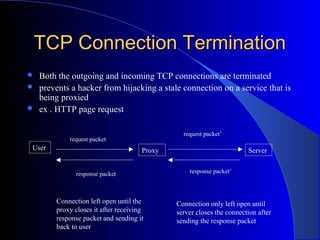
 Both the outgoing and incoming TCP connections are terminated
 prevents a hacker from hijacking a stale connection on a service that is
being proxied
 ex . HTTP page request
User Proxy Server
request packet
request packet’
response packet’response packet
Connection left open until the
proxy closes it after receiving
response packet and sending it
back to user
Connection only left open until
server closes the connection after
sending the response packet
Proxy Server ExamplesProxy Server Examples
 A caching web proxy is a simple example of an
HTTP intermediary
Best PracticesBest Practices
 Use a Real Firewall
 Disable Routing
 Secure the Base Operating System
– harden the OS
 Disable External Access
 Disable unneeded Services
Security AdvantagesSecurity Advantages
 To provide security
 Hide internal clients from external network
 Hiding machine or another server from public
 To speed up access to resources
 Increase the performance
 Web proxies are commonly used to cache webpage from web server
 To protect your real identity on internet
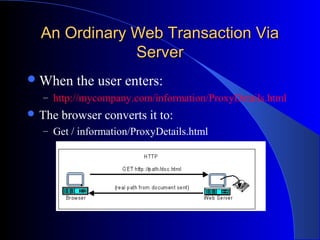
An Ordinary Web Transaction ViaAn Ordinary Web Transaction Via
ServerServer
When the user enters:
– http://mycompany.com/information/ProxyDetails.html
 The browser converts it to:
– Get / information/ProxyDetails.html
Communicating Via Proxy ServerCommunicating Via Proxy Server
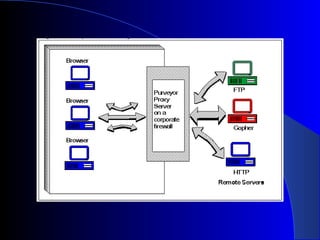
 The Proxy server acts as both a server system and a client
system.
 The proxy server uses the header fields passed to it by the
browser without modification when it connects to the
remote server.
 A complete proxy server should be able to communicate
all the Web protocols, the most important ones being
HTTP, FTP, Gopher, and WAIS.
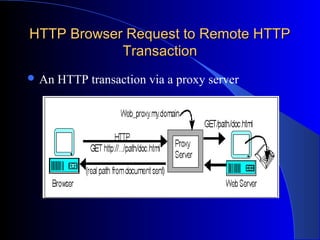
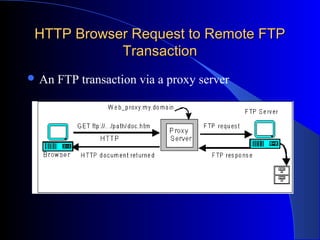
 When a browser sends a request through a proxy server,
the browser always uses HTTP for the transactions with
the proxy server.
HTTP Browser Request to Remote HTTPHTTP Browser Request to Remote HTTP
TransactionTransaction
 An HTTP transaction via a proxy server
HTTP Browser Request to Remote FTPHTTP Browser Request to Remote FTP
TransactionTransaction
 An FTP transaction via a proxy server
Managing Cached DocumentsManaging Cached Documents
 Many documents available on the Internet are
“living” documents.
 Determining when documents should be updated
or deleted can be difficult task.
– Some documents can remain stable for a very long time
and then suddenly change.
– Other documents can change weekly or a daily basis.
 You need to decide carefully how often to refresh
or delete the documents held in cache.

Web Proxy Server

  • 1.
    Web Proxy ServerWebProxy Server BY: Mohit Dhankhar Hindu Institute of Management Sonepat-131001
  • 2.
    ProxyProxy Proxy means aperson authorized to act on behalf of another. In communication, a proxy is something that act as a server, but when given request from client, act itself as a client to the real server. For example: An HTTP Proxy does not forward every request sent through it.
  • 3.
    3 Proxy Server?Proxy Server? Proxyserver is a server that acts as an intermediary for requests from clients seeking resources from other servers. A client connects to the proxy server, requesting some service, such as a file, connection, web page, or other resource available from a different server. The proxy server evaluates the request according to its filtering rules. For example, it may filter traffic by IP address or protocol.
  • 4.
    What is aWeb Proxy Server?What is a Web Proxy Server? It is a specialized HTTP Server. Functions as a firewall. – Protects client computers from Hackers by limiting outside access to clients. Allows all clients connected to Web Proxy Server to access Internet from behind “firewall.” Client computer(s) are allowed access past firewall with minimum effort and without compromising security.
  • 5.
    How Does AWeb ProxyHow Does A Web Proxy Server Work?Server Work? Web Proxy Server listens for any request from clients. All requests are forwarded to remote internet servers outside firewall. Also listens for responses or request from outside the firewall (external servers) and sends to them to internal client computers.
  • 6.
    Usually, all clientswith a subnet use the same proxy server. This makes it possible for the proxy server to cache documents that are requested by one or more clients (repeatedly). For clients using a web proxy server, it is as if they are getting responses directly from a remote server.
  • 7.
    Types of proxyTypesof proxy Forward proxies Open proxies Reverse proxies Transport proxies Anonymous proxies Distorting proxies 7
  • 8.
    TCP Connection TerminationTCPConnection Termination  Both the outgoing and incoming TCP connections are terminated  prevents a hacker from hijacking a stale connection on a service that is being proxied  ex . HTTP page request User Proxy Server request packet request packet’ response packet’response packet Connection left open until the proxy closes it after receiving response packet and sending it back to user Connection only left open until server closes the connection after sending the response packet
  • 10.
    Proxy Server ExamplesProxyServer Examples  A caching web proxy is a simple example of an HTTP intermediary
  • 11.
    Best PracticesBest Practices Use a Real Firewall  Disable Routing  Secure the Base Operating System – harden the OS  Disable External Access  Disable unneeded Services
  • 12.
    Security AdvantagesSecurity Advantages To provide security  Hide internal clients from external network  Hiding machine or another server from public  To speed up access to resources  Increase the performance  Web proxies are commonly used to cache webpage from web server  To protect your real identity on internet
  • 13.
    An Ordinary WebTransaction ViaAn Ordinary Web Transaction Via ServerServer When the user enters: – http://mycompany.com/information/ProxyDetails.html  The browser converts it to: – Get / information/ProxyDetails.html
  • 14.
    Communicating Via ProxyServerCommunicating Via Proxy Server  The Proxy server acts as both a server system and a client system.  The proxy server uses the header fields passed to it by the browser without modification when it connects to the remote server.  A complete proxy server should be able to communicate all the Web protocols, the most important ones being HTTP, FTP, Gopher, and WAIS.  When a browser sends a request through a proxy server, the browser always uses HTTP for the transactions with the proxy server.
  • 15.
    HTTP Browser Requestto Remote HTTPHTTP Browser Request to Remote HTTP TransactionTransaction  An HTTP transaction via a proxy server
  • 16.
    HTTP Browser Requestto Remote FTPHTTP Browser Request to Remote FTP TransactionTransaction  An FTP transaction via a proxy server
  • 17.
    Managing Cached DocumentsManagingCached Documents  Many documents available on the Internet are “living” documents.  Determining when documents should be updated or deleted can be difficult task. – Some documents can remain stable for a very long time and then suddenly change. – Other documents can change weekly or a daily basis.  You need to decide carefully how often to refresh or delete the documents held in cache.