UsesUses
To keep machines behind it anonymous, mainly for security.

To speed up access to resources. Web proxies are commonly used to
cache web pages from a web server.

To prevent downloading the same content multiple times.

To log / audit usage, e.g. to provide company employee Internet
usage reporting.

To scan transmitted content for malware before delivery.

To scan outbound content, e.g., for data loss prevention.

To bypass website restrictions at work.

Access enhancement/restriction
How do I use a Proxy Server?How do I use a Proxy Server?
Please be aware that the use of proxy servers
without the express permission from the
owner of the proxy server may be illegal in
some states and/or countries. Use at your
own risk.Use your favorite search engine
and search for 'proxy server list'. You'll find
many sites with lists of proxy servers, their
IP address, the port they listen on, and
usually what country they are in. Write down
a few of them.
Proxy TypesProxy Types
Transparent ProxyTransparent Proxy
This type of proxy server identifies itself as a
proxy server and also makes the original IP
address available through the http headers.
These are generally used for their ability to
cache websites and do not effectively
provide any anonymity to those who use
them. However, the use of a transparent
proxy will get you around simple IP bans.
They are transparent in the terms that your
IP address is exposed, not transparent in
the terms that you do not know that you are
using it
Anonymous ProxyAnonymous Proxy
This type of proxy server indentifies itself as a
proxy server, but does not make the original
IP address available. This type of proxy
server is detectable, but provides
reasonable anonymity for most users.
Distorting ProxyDistorting Proxy
This type of proxy server identifies itself as a
proxy server, but make an incorrect original
IP address available through the http
headers.
High Anonymity ProxyHigh Anonymity Proxy
This type of proxy server does not identify
itself as a proxy server and does not make
available the original IP address.
Web proxiesWeb proxies
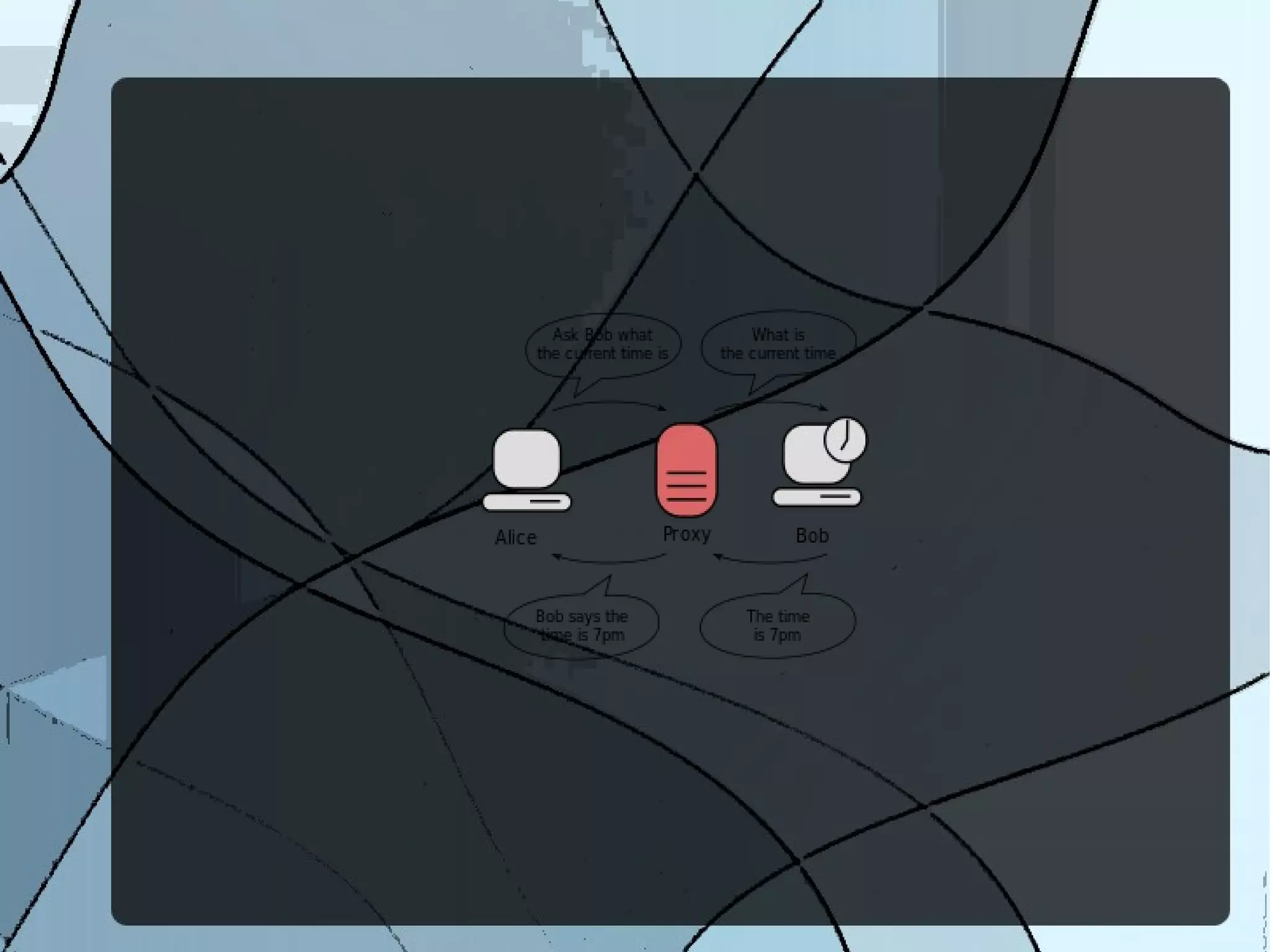
A common proxy application is a caching Web
proxy. This provides a nearby cache of Web
pages and files available on remote Web
servers, allowing local network clients to
access them more quickly or reliably.
When it receives a request for a Web
resource (specified by a URL), a caching
proxy looks for the resulting URL in its local
cache. If found, it returns the document
immediately. Otherwise it fetches it from the
remote server, returns it to the requester
and saves a copy in the cache. The cache
usually uses an expiry algorithm to remove
documents from the cache, according to
their age, size, and access history. Two
simple cache algorithms are Least Recently
Used (LRU) and Least Frequently Used
Web proxies can also filter the content of Web
pages served. Some censorware
applications - which attempt to block
offensive Web content - are implemented as
Web proxies. Other web proxies reformat
web pages for a specific purpose or
audience; for example, Skweezer reformats
web pages for cell phones and PDAs.
Network operators can also deploy proxies
to intercept computer viruses and other
hostile content served from remote Web
pages.
Thanking you...Thanking you...
Presented by Proxiesforrent..
Located at Mumbai....

Uses of proxies

  • 2.
    UsesUses To keep machinesbehind it anonymous, mainly for security.  To speed up access to resources. Web proxies are commonly used to cache web pages from a web server.  To prevent downloading the same content multiple times.  To log / audit usage, e.g. to provide company employee Internet usage reporting.  To scan transmitted content for malware before delivery.  To scan outbound content, e.g., for data loss prevention.  To bypass website restrictions at work.  Access enhancement/restriction
  • 4.
    How do Iuse a Proxy Server?How do I use a Proxy Server? Please be aware that the use of proxy servers without the express permission from the owner of the proxy server may be illegal in some states and/or countries. Use at your own risk.Use your favorite search engine and search for 'proxy server list'. You'll find many sites with lists of proxy servers, their IP address, the port they listen on, and usually what country they are in. Write down a few of them.
  • 5.
  • 6.
    Transparent ProxyTransparent Proxy Thistype of proxy server identifies itself as a proxy server and also makes the original IP address available through the http headers. These are generally used for their ability to cache websites and do not effectively provide any anonymity to those who use them. However, the use of a transparent proxy will get you around simple IP bans. They are transparent in the terms that your IP address is exposed, not transparent in the terms that you do not know that you are using it
  • 7.
    Anonymous ProxyAnonymous Proxy Thistype of proxy server indentifies itself as a proxy server, but does not make the original IP address available. This type of proxy server is detectable, but provides reasonable anonymity for most users.
  • 8.
    Distorting ProxyDistorting Proxy Thistype of proxy server identifies itself as a proxy server, but make an incorrect original IP address available through the http headers.
  • 9.
    High Anonymity ProxyHighAnonymity Proxy This type of proxy server does not identify itself as a proxy server and does not make available the original IP address.
  • 11.
    Web proxiesWeb proxies Acommon proxy application is a caching Web proxy. This provides a nearby cache of Web pages and files available on remote Web servers, allowing local network clients to access them more quickly or reliably.
  • 12.
    When it receivesa request for a Web resource (specified by a URL), a caching proxy looks for the resulting URL in its local cache. If found, it returns the document immediately. Otherwise it fetches it from the remote server, returns it to the requester and saves a copy in the cache. The cache usually uses an expiry algorithm to remove documents from the cache, according to their age, size, and access history. Two simple cache algorithms are Least Recently Used (LRU) and Least Frequently Used
  • 13.
    Web proxies canalso filter the content of Web pages served. Some censorware applications - which attempt to block offensive Web content - are implemented as Web proxies. Other web proxies reformat web pages for a specific purpose or audience; for example, Skweezer reformats web pages for cell phones and PDAs. Network operators can also deploy proxies to intercept computer viruses and other hostile content served from remote Web pages.
  • 14.
    Thanking you...Thanking you... Presentedby Proxiesforrent.. Located at Mumbai....