Chapter Nine: Water Resource Planning & Management Models
Definition
What are water resource models? Its analytical tools used to determine the
consequences of proposed actions or forecast the quantity or quality of the
water in the Nation’s rivers, lakes, or ground waters. These models, which
range in sophistication from simple work with a desk calculator to complex
computer programs, are the scientific community’s way of understanding and
predicting the workings of a water system.
Cont..
A model is a ‘‘numerical representation’ of how the real world or
some part of it, a lake, a dam, or a community works. More precisely,
a model uses numbers or symbols to represent relationships among the
components of these real-world systems.
Models are simply series of equations that express such relationships
in mathematical form.
Some water resource models are:-
SWAT-Soil and water assessment Tools
HEC-RAS-Hydrologic Engineering center River analysis system
Crop Wat- used for determining of CWR and IWR
Cont..
SWAT
SWAT is acronym for soil and water assessment tool, river basin, or water shed,
scale model developed by Dr Jeff Armold for The USDA agricultural Research
service(ARS).SWAT was developed to predict the impact of land management
practice on water, sediment and agricultural chemical yields in large complex
watersheds with varying soils, land use and management conditions over long
period of time.
HEC-RAS is acronym Hydrologic Engineering center River analysis system, used
for flow simulation of river.
 Models are used to synthesize and analyze the substantial amounts of water
quality, quantity.
 Models can also be used as Predictive tools.
Water resources models can also be characterized by the purpose for which they are
used. These include:-
1. Operations and Management;
2. Planning
3. Policy Development
4. Regulation; and
Use of models in water resource planning and management
1.Models for operations and management
Are used to support short-term managerial decisions. These models might be used to control the
operation of a sewage treatment plant or to regulate water flows through a system of reservoirs within
a river basin.
2.Models that support Planning
Activities are often broader in scope than operations and management models, as they are
used as an aid to medium-range decision making. Planning models might be used to
evaluate alternatives for future expansion of a treatment plant or to study the impact of the
proposed development of a water-consuming industry along a river or stream.
Cont..
3.Models for regulation
Are those used in direct support of enforcement or promulgation of standards or in
the insurance of permits. For example, a regulation model might be used to
determine the allowable discharge level for a sewage treatment facility prior to the
issuance of a permit for facility expansion.
Cont..
Water Resources Feasibility and Design
Feasibility Study
Feasibility Study can be considered as preliminary investigation that helps the
management to take decision about whether study of system should be feasible for
development or not. It identifies the possibility of improving an existing system,
developing a new system, and produce refined estimates for further development of
system. It is used to obtain the outline of the problem and decide whether feasible
or appropriate solution exists or not. The main objective of a feasibility study is to
acquire problem scope instead of solving the problem. The output of a feasibility
study is a formal system proposal act as decision document which includes the
complete nature and scope of the proposed system.
Steps Involved in Feasibility Analysis
The following steps are to be followed while performing feasibility analysis −
1. Form a project team and appoint a project leader.
2. Develop system flowcharts.
3. Identify the deficiencies of current system and set goals.
4. Enumerate the alternative solution or potential candidate system to meet goals.
5. Determine the feasibility of each alternative such as technical feasibility,
operational feasibility, etc.
6.Weight the performance and cost effectiveness of each candidate system.
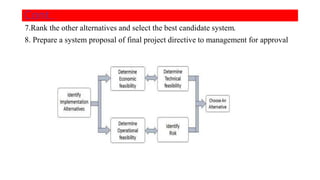
7.Rank the other alternatives and select the best candidate system.
8. Prepare a system proposal of final project directive to management for approval
Cont..
Types of Feasibilities
Economic Feasibility
 It is evaluating the effectiveness of candidate system by using cost/benefit
analysis method.
 It demonstrates the net benefit from the candidate system in terms of benefits
and costs to the organization.
The main aim of Economic Feasibility Analysis (EFS) is to estimate the
economic requirements of candidate system before investments funds are
committed to proposal.
It prefers the alternative which will maximize the net worth of organization
by earliest and highest return of funds along with lowest level of risk
involved in developing the candidate system.
Technical Feasibility
 It investigates the technical feasibility of each implementation alternative.
 It analyzes and determines whether the solution can be supported by
existing technology or not.
The analyst determines whether current technical resources be upgraded or
added it that fulfill the new requirements.
Cont..
It ensures that the candidate system provides appropriate responses to what extent
it can support the technical enhancement
Operational Feasibility
 It determines whether the system is operating effectively once it is developed and
implemented.
 It ensures that the management should support the proposed system and its
working feasible in the current organizational environment.
 It analyzes whether the users will be affected and they accept the modified or new
business methods that affect the possible system benefits.
Cont..
It also ensures that the computer resources and network architecture of candidate
system are workable.
Behavioral Feasibility
 It evaluates and estimates the user attitude or behavior towards the development
of new system.
 It helps in determining if the system requires special effort to educate, retrain,
transfer, and changes in employee’s job status on new ways of conducting
business. Schedule Feasibility
It ensures that the project should be completed within given time constraint or
schedule.
Cont..
Concept of master plan
The Master Plan, also known as the Comprehensive Plan, provides a long-term
vision for the community's development. It assists in guiding you on how to use
lands appropriately within municipal orders. And helps protect public health, safety,
and general welfare.
A Master Plan study includes the following:-
Population
Economy
Housing
Transportation
Community Facilities
Land-Use Analysis
Recommendations & Suggestions for a Site's Population Size
Community Facilities
Transportation
Cont..
A master plan can assist in deciding on the following:-
 Dependable location for residential, commercial, and mixed-use development
 Increasing density and city structure through redevelopment
 Opportunities to expand open space, civic facilities, and so on
 Boost economic development
 Keep the topics that require discussion
 Provides solutions to traffic congestion
Features of a good master plan
Features of a good master plan include:-
 Adaptability
 Community involvement
 Based on stakeholder suggestions
 Have a legal foundation
 Greater likelihood of success
Importance of a Master Plan
A master plan has numerous advantages for both investors and users.
 It serves as a road map for all future project development decisions.
 Master-planned projects have a much higher success rate than unplanned ones.
 An effective master plan reduces project costs in the long run. It has effective
utility, street network, material, and climate-responsive design planning.
 It evolves with input from stakeholders and investors, avoiding future conflicts of
interest.
 Master planning aids in determining the timeline and cost of a project. This aids
in effectively phasing the project. Which further aids in generating revenue even
before the project is completed.
 The process ultimately boosts the credibility and visibility of a development
project. This is achieved by showcasing its perspective with clearly estimated
figures.
 It is prudent that a master plan to direct your town's future development will pay
you in the long run because it:
Cont..

Water Resource Planning & Management Models

  • 1.
    Chapter Nine: WaterResource Planning & Management Models Definition What are water resource models? Its analytical tools used to determine the consequences of proposed actions or forecast the quantity or quality of the water in the Nation’s rivers, lakes, or ground waters. These models, which range in sophistication from simple work with a desk calculator to complex computer programs, are the scientific community’s way of understanding and predicting the workings of a water system.
  • 2.
    Cont.. A model isa ‘‘numerical representation’ of how the real world or some part of it, a lake, a dam, or a community works. More precisely, a model uses numbers or symbols to represent relationships among the components of these real-world systems. Models are simply series of equations that express such relationships in mathematical form.
  • 3.
    Some water resourcemodels are:- SWAT-Soil and water assessment Tools HEC-RAS-Hydrologic Engineering center River analysis system Crop Wat- used for determining of CWR and IWR Cont..
  • 4.
    SWAT SWAT is acronymfor soil and water assessment tool, river basin, or water shed, scale model developed by Dr Jeff Armold for The USDA agricultural Research service(ARS).SWAT was developed to predict the impact of land management practice on water, sediment and agricultural chemical yields in large complex watersheds with varying soils, land use and management conditions over long period of time. HEC-RAS is acronym Hydrologic Engineering center River analysis system, used for flow simulation of river.
  • 5.
     Models areused to synthesize and analyze the substantial amounts of water quality, quantity.  Models can also be used as Predictive tools. Water resources models can also be characterized by the purpose for which they are used. These include:- 1. Operations and Management; 2. Planning 3. Policy Development 4. Regulation; and Use of models in water resource planning and management
  • 6.
    1.Models for operationsand management Are used to support short-term managerial decisions. These models might be used to control the operation of a sewage treatment plant or to regulate water flows through a system of reservoirs within a river basin. 2.Models that support Planning Activities are often broader in scope than operations and management models, as they are used as an aid to medium-range decision making. Planning models might be used to evaluate alternatives for future expansion of a treatment plant or to study the impact of the proposed development of a water-consuming industry along a river or stream. Cont..
  • 7.
    3.Models for regulation Arethose used in direct support of enforcement or promulgation of standards or in the insurance of permits. For example, a regulation model might be used to determine the allowable discharge level for a sewage treatment facility prior to the issuance of a permit for facility expansion. Cont..
  • 8.
    Water Resources Feasibilityand Design Feasibility Study Feasibility Study can be considered as preliminary investigation that helps the management to take decision about whether study of system should be feasible for development or not. It identifies the possibility of improving an existing system, developing a new system, and produce refined estimates for further development of system. It is used to obtain the outline of the problem and decide whether feasible or appropriate solution exists or not. The main objective of a feasibility study is to acquire problem scope instead of solving the problem. The output of a feasibility study is a formal system proposal act as decision document which includes the complete nature and scope of the proposed system.
  • 9.
    Steps Involved inFeasibility Analysis The following steps are to be followed while performing feasibility analysis − 1. Form a project team and appoint a project leader. 2. Develop system flowcharts. 3. Identify the deficiencies of current system and set goals. 4. Enumerate the alternative solution or potential candidate system to meet goals. 5. Determine the feasibility of each alternative such as technical feasibility, operational feasibility, etc. 6.Weight the performance and cost effectiveness of each candidate system.
  • 10.
    7.Rank the otheralternatives and select the best candidate system. 8. Prepare a system proposal of final project directive to management for approval Cont..
  • 11.
    Types of Feasibilities EconomicFeasibility  It is evaluating the effectiveness of candidate system by using cost/benefit analysis method.  It demonstrates the net benefit from the candidate system in terms of benefits and costs to the organization. The main aim of Economic Feasibility Analysis (EFS) is to estimate the economic requirements of candidate system before investments funds are committed to proposal.
  • 12.
    It prefers thealternative which will maximize the net worth of organization by earliest and highest return of funds along with lowest level of risk involved in developing the candidate system. Technical Feasibility  It investigates the technical feasibility of each implementation alternative.  It analyzes and determines whether the solution can be supported by existing technology or not. The analyst determines whether current technical resources be upgraded or added it that fulfill the new requirements. Cont..
  • 13.
    It ensures thatthe candidate system provides appropriate responses to what extent it can support the technical enhancement Operational Feasibility  It determines whether the system is operating effectively once it is developed and implemented.  It ensures that the management should support the proposed system and its working feasible in the current organizational environment.  It analyzes whether the users will be affected and they accept the modified or new business methods that affect the possible system benefits. Cont..
  • 14.
    It also ensuresthat the computer resources and network architecture of candidate system are workable. Behavioral Feasibility  It evaluates and estimates the user attitude or behavior towards the development of new system.  It helps in determining if the system requires special effort to educate, retrain, transfer, and changes in employee’s job status on new ways of conducting business. Schedule Feasibility It ensures that the project should be completed within given time constraint or schedule. Cont..
  • 15.
    Concept of masterplan The Master Plan, also known as the Comprehensive Plan, provides a long-term vision for the community's development. It assists in guiding you on how to use lands appropriately within municipal orders. And helps protect public health, safety, and general welfare. A Master Plan study includes the following:- Population Economy Housing Transportation Community Facilities
  • 16.
    Land-Use Analysis Recommendations &Suggestions for a Site's Population Size Community Facilities Transportation Cont..
  • 17.
    A master plancan assist in deciding on the following:-  Dependable location for residential, commercial, and mixed-use development  Increasing density and city structure through redevelopment  Opportunities to expand open space, civic facilities, and so on  Boost economic development  Keep the topics that require discussion  Provides solutions to traffic congestion
  • 18.
    Features of agood master plan Features of a good master plan include:-  Adaptability  Community involvement  Based on stakeholder suggestions  Have a legal foundation  Greater likelihood of success
  • 19.
    Importance of aMaster Plan A master plan has numerous advantages for both investors and users.  It serves as a road map for all future project development decisions.  Master-planned projects have a much higher success rate than unplanned ones.  An effective master plan reduces project costs in the long run. It has effective utility, street network, material, and climate-responsive design planning.  It evolves with input from stakeholders and investors, avoiding future conflicts of interest.  Master planning aids in determining the timeline and cost of a project. This aids in effectively phasing the project. Which further aids in generating revenue even before the project is completed.
  • 20.
     The processultimately boosts the credibility and visibility of a development project. This is achieved by showcasing its perspective with clearly estimated figures.  It is prudent that a master plan to direct your town's future development will pay you in the long run because it: Cont..