SUB SURFACE
WATER
• Water in a soil mantle is called as sub surface water.
• Water beneath the surface can essentially be divided into
two zones
• the unsaturated zone (also known as the "zone of aeration")
which includes soil water zone,
• The zone of saturation which includes ground water.
• Sometimes, especially during times of high rainfall, these pore
spaces are filled with water.
• The water table divides the zone of aeration from the zone of
saturation.
• In the saturation zone, all the pores of soil are filled with
water.
• In the aeration zone, soil pores are partially saturated with
water.
• The aeration zone has 3 sub-zones.
i) Soil water zone
ii)Intermediate zone
Iii) Capillary fringe
SOIL WATER ZONE:
• Soil water is held in the pore spaces between particles
of soil.
• Soil water is the water that is immediately available
to plants.
• This water can be removed by air drying or by plant
absorption, but cannot be removed by gravity.
• Plants extract this water through their roots until the soil
capillary force (force holding water to the particle) is equal
to the extractive force of the plant root.
• At this point the plant cannot pull water from the plant-
rooting zone and it wilts (called the wilting point).
• The amount of water held in the soil after excess water has
drained is called the field capacity of the soil.
INTERMEDIATE ZONE:
•This is the layer that is available next to the soil water zone.
•It lies in between the soil water zone and the capillary zone.
CAPILLARY
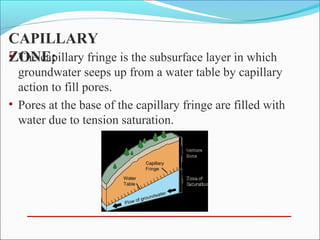
ZONE:• The capillary fringe is the subsurface layer in which
groundwater seeps up from a water table by capillary
action to fill pores.
• Pores at the base of the capillary fringe are filled with
water due to tension saturation.
• This saturated portion of the capillary fringe is less than total
capillary rise because of the presence of a mix in pore size.
• If pore size is small and relatively uniform, it is possible that
soils can be completely saturated with water for several feet
above the water table.
• Alternately, the saturated portion will extend only a few
inches
above the water table when pore size is large.

Sub surface water

  • 1.
    SUB SURFACE WATER • Waterin a soil mantle is called as sub surface water. • Water beneath the surface can essentially be divided into two zones • the unsaturated zone (also known as the "zone of aeration") which includes soil water zone, • The zone of saturation which includes ground water.
  • 2.
    • Sometimes, especiallyduring times of high rainfall, these pore spaces are filled with water. • The water table divides the zone of aeration from the zone of saturation. • In the saturation zone, all the pores of soil are filled with water. • In the aeration zone, soil pores are partially saturated with water.
  • 3.
    • The aerationzone has 3 sub-zones. i) Soil water zone ii)Intermediate zone Iii) Capillary fringe SOIL WATER ZONE: • Soil water is held in the pore spaces between particles of soil. • Soil water is the water that is immediately available to plants. • This water can be removed by air drying or by plant absorption, but cannot be removed by gravity.
  • 4.
    • Plants extractthis water through their roots until the soil capillary force (force holding water to the particle) is equal to the extractive force of the plant root. • At this point the plant cannot pull water from the plant- rooting zone and it wilts (called the wilting point). • The amount of water held in the soil after excess water has drained is called the field capacity of the soil.
  • 5.
    INTERMEDIATE ZONE: •This isthe layer that is available next to the soil water zone. •It lies in between the soil water zone and the capillary zone.
  • 6.
    CAPILLARY ZONE:• The capillaryfringe is the subsurface layer in which groundwater seeps up from a water table by capillary action to fill pores. • Pores at the base of the capillary fringe are filled with water due to tension saturation.
  • 7.
    • This saturatedportion of the capillary fringe is less than total capillary rise because of the presence of a mix in pore size. • If pore size is small and relatively uniform, it is possible that soils can be completely saturated with water for several feet above the water table. • Alternately, the saturated portion will extend only a few inches above the water table when pore size is large.