02/21/2025
1
WALLAGA UNIVERSITY
GIMBI CAMPUS
Improving Students’ Classroom Participation
through Cooperative Learning: The case of 3rd
and 4th
year soil resource and watershed
management Students
Requirements in Partial Fulfillment of HDP
By:
Terefa Adugna
Yadesa Wakena
Submitted to: HDP Coordinator
June, 2024
02/21/2025
2
LIST OF PRESENTATION
1. Introduction
2. Action plan
3. Data collection method
4. Procedure
5. Data analysis
6. Finding and presentation
7. Reflection and discussion
8. Conclusion
02/21/2025
3
1. INTRODUCTION
1.1. Back ground
 Teaching and learning have evolved over the years, although the use of
lectures remains the dominant mode of instruction in educational
institutions (Felder & Brent, 2005).
 Cooperative learning is one of the important teaching and learning
strategies to meet the requirement of active learning (Loh & Teo, 2017).
 Cooperative learning is a set of methods in which students work
together in small groups and help one another to achieve learning
objectives.
 The purpose of this Action research is to improve the active classroom
participation of students & teachers towards cooperative learning, and
the implementation of cooperative learning in Wollega University
particularly in soil resource and watershed management class.
02/21/2025
4
CONT…
1.2. Statement of the problem
 A contemporary teaching approach confirms the effectiveness of
cooperative learning in higher education.
 Recently implementing cooperative learning strategies started in
Ethiopian education system from lower grade level to higher
institution to enhance student learning.
 Wollega University also is implementing harmonized approaches
that encourage cooperative learning.
 However, the implementation is not successful compared to the
desired objectives.
 Therefore, the major purpose of this action research is to improve
student’s classroom participation through cooperative learning
02/21/2025
5
CONT….
1.3. Objective of the Study
General objective
 The general objective was to improve students’ classroom
participation through cooperative learning.
Specific objective
 Implementing cooperative learning strategy to enhance student
participation compared to traditional teacher centered learning
 To apply possible cooperative learning structure that help to
enhance students’ classroom participation
02/21/2025
6
CONT…
1.4. Research question
 How does implementing cooperative learning strategy affect the
level and equity of student participation compared to traditional
teacher centered question?
 How does cooperative learning structures are most effective in
promoting active participation from all students in class room?
02/21/2025
7
2. ACTION PLAN
 Based on the major findings of the study, action plan designed
for implementation and it was implemented in cooperation
with the instructors and the research team.
 The researchers developed strategies that identify the role of
teachers and the role of the student
 The researchers used qualitative case study research design.
 Qualitative research method is applied for this study.
 The major methodological concerns of the research were
Interview and FGD in reference with the theoretical and
practical framework of cooperative learning.
 The analysis and interpretation mainly emphasize on the role
of cooperative learning to improve student classroom
participation.
02/21/2025
8
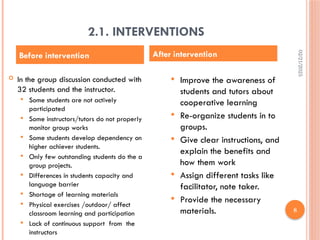
2.1. INTERVENTIONS
 In the group discussion conducted with
32 students and the instructor.
 Some students are not actively
participated
 Some instructors/tutors do not properly
monitor group works
 Some students develop dependency on
higher achiever students.
 Only few outstanding students do the a
group projects.
 Differences in students capacity and
language barrier
 Shortage of learning materials
 Physical exercises /outdoor/ affect
classroom learning and participation
 Lack of continuous support from the
instructors
 Improve the awareness of
students and tutors about
cooperative learning
 Re-organize students in to
groups.
 Give clear instructions, and
explain the benefits and
how them work
 Assign different tasks like
facilitator, note taker.
 Provide the necessary
materials.
Before intervention After intervention
02/21/2025
9
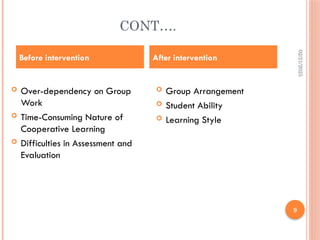
CONT….
 Over-dependency on Group
Work
 Time-Consuming Nature of
Cooperative Learning
 Difficulties in Assessment and
Evaluation
 Group Arrangement
 Student Ability
 Learning Style
Before intervention After intervention
02/21/2025
10
3. DATA COLLECTION METHOD
 Required data collected from both the instructors of the course
and from the students through interview and FGD respectively.
 In-depth interview conducted with the instructor and focus group
discussion conducted with 32 students in 2 class.
 There were 4 focus group discussions which has 8 group members.
 The instruments used to assess teachers and students perception
towards cooperative learning, the role to improve students’
classroom participation and social interaction.
 When the participants take part in a group interview, they can
demonstrate interest in the discussion topic.
02/21/2025
11
4. PROCEDURES
 The study took place during the first four weeks grading period of the
year.
 The students received instruction about working in cooperative groups
and practiced before the study began.
 For each block of material, one class used the cooperative learning
structures and the other did not receive instructions in this manner.
 The group not receiving cooperative learning structures as a teaching
method was involved in the traditional lecture/demonstration method
with individual assignments.
 Student achievement was measured through curriculum based assessment
instruments designed by the teacher.
 The assessments were quantitatively compared.
 Step-by-step procedures are used to present, practice, and review
material.
 Some regulate interaction between pairs, some are best for teamwork,
02/21/2025
12
5. DATA ANALYSIS
 The data obtained through in-depth interview and FGD
analyzed qualitatively.
 This part of the paper deals with the respondents’ background
of overall result of the issue under investigation (view of
respondents about cooperative learning).
02/21/2025
13
6. FINDING AND INTERPRETATION
6.1. Cooperative learning strategy
 The students worked together towards reaching a common learning task and
understanding in advance the main message of the text (Gimbi campus).
 We applied the cooperative learning script for first time for Soil Resource and
Watershed Management for 3 &4 year students of Wollega University Gimbi
campus.
 As result, the students find chances to think in their own ways to communicate in
group cooperatively and to present their ideas in a whole class discussion as
well as to have self-reflection on their own understanding and opinions.
 Analysis of a questionnaire surveys before and after delivering cooperative
learning in the University also shows that to insert cooperative learning
approach had an impact on students skills of progressing active learning such
‟
as ask questions, transparency of their own opinions, respect to other opinions,
participate to create a enjoyable learning environment and develop
communicational abilities.
 Comparing the scores of the “with cooperative learning” (before) and “after ”
the average scores are significantly higher than the “with cooperative
learning”.
02/21/2025
14
CONT….
 The result shows that cooperative learning is fundamentally different
from that in a more traditional model.
 It is vital that the teacher first provides the supportive classroom to
encourage cooperative learning and opportunities for team building.
 The role of the student’s in cooperative learning is different from
traditional classrooms that are the inclusion of cooperative student-to-
student interaction over subject matter as an integral part of the
learning process.
 After intervention had taken place, the research team was evaluate
what change occurred.
 In contrast, the traditional classroom consists primarily of teacher-
fronted lessons, in dependent work, and competition.
 In addition, there is often a competitive component to the traditional
classroom as when students vie for the teacher’s attention by
answering teacher review questions.
02/21/2025
15
CONT…
6.2. Cooperative learning structure
 The researchers developed cooperative learning structure that clearly
identified the role of teacher and the role of the students.
 The teacher’s role in cooperative learning is fundamentally different
from that in a more traditional model.
 It is vital that the teacher first provides the supportive class room
method to encourage cooperative learning and opportunities for
teambuilding.
 Alongside this is the necessity for developing interpersonal skills as part
of a planned program.
 The result of the study show that the students who studied by
cooperative learning obtained higher average overall discussion skills
indicates that the skills are able to be improved by a lot of experiences
with effective discussion and cooperative learning structure through
group learning. .
 By understanding mutual differences in opinions, students awareness of
‟
themselves is deepened.
02/21/2025
16
7. REFLECTION AND DISCUSSION
 We learnt that learning objectives need to be specific.
 Questions during the guided practice and independent practice were
driven by the learning objectives which made assessment genuine.
 It also ensured that remedial was not just for below average students but
were for any student who failed to answer any of the independent
practice questions.
 The plan had qualitative goals along with the rules and consequences,
and the workshop helped in creating a cooperative learning environment
within the class.
 This environment helped in maximizing students’ learning.
 Pair work was also a good activity as it helped students to not only
remember the concepts, but to listen to the lecture carefully during the
class.
 Students, however, did struggle in remembering the content after the
lesson was delivered.
02/21/2025
17
8. CONCLUSION
 Effective learning is collaborative, participatory and social, not
competitive and isolated.
 Working with others often increases involvement in learning.
 Sharing one’s own ideas and responding to others’ reactions sharpens
thinking and deepens understanding and participation.’
 To this end the research team, propose actions presented above.
 The research team strongly believes that there will be participation and
academic improvement on students due to the application of cooperative
learning, student teacher interaction can be improved.
 Along with it, research finds that cooperative learning has a very
important role in improving learning outcomes as well as developing
skills and motivating learners.
 We believe that this result plays a significant role in building and
developing a new learning method to meet the requirements of modern
education.
02/21/2025
18
CONT…
Thanks for attention!!!!!

PPT Action research.pptxhhhhhhhhhhhhhhhhh

  • 1.
    02/21/2025 1 WALLAGA UNIVERSITY GIMBI CAMPUS ImprovingStudents’ Classroom Participation through Cooperative Learning: The case of 3rd and 4th year soil resource and watershed management Students Requirements in Partial Fulfillment of HDP By: Terefa Adugna Yadesa Wakena Submitted to: HDP Coordinator June, 2024
  • 2.
    02/21/2025 2 LIST OF PRESENTATION 1.Introduction 2. Action plan 3. Data collection method 4. Procedure 5. Data analysis 6. Finding and presentation 7. Reflection and discussion 8. Conclusion
  • 3.
    02/21/2025 3 1. INTRODUCTION 1.1. Background  Teaching and learning have evolved over the years, although the use of lectures remains the dominant mode of instruction in educational institutions (Felder & Brent, 2005).  Cooperative learning is one of the important teaching and learning strategies to meet the requirement of active learning (Loh & Teo, 2017).  Cooperative learning is a set of methods in which students work together in small groups and help one another to achieve learning objectives.  The purpose of this Action research is to improve the active classroom participation of students & teachers towards cooperative learning, and the implementation of cooperative learning in Wollega University particularly in soil resource and watershed management class.
  • 4.
    02/21/2025 4 CONT… 1.2. Statement ofthe problem  A contemporary teaching approach confirms the effectiveness of cooperative learning in higher education.  Recently implementing cooperative learning strategies started in Ethiopian education system from lower grade level to higher institution to enhance student learning.  Wollega University also is implementing harmonized approaches that encourage cooperative learning.  However, the implementation is not successful compared to the desired objectives.  Therefore, the major purpose of this action research is to improve student’s classroom participation through cooperative learning
  • 5.
    02/21/2025 5 CONT…. 1.3. Objective ofthe Study General objective  The general objective was to improve students’ classroom participation through cooperative learning. Specific objective  Implementing cooperative learning strategy to enhance student participation compared to traditional teacher centered learning  To apply possible cooperative learning structure that help to enhance students’ classroom participation
  • 6.
    02/21/2025 6 CONT… 1.4. Research question How does implementing cooperative learning strategy affect the level and equity of student participation compared to traditional teacher centered question?  How does cooperative learning structures are most effective in promoting active participation from all students in class room?
  • 7.
    02/21/2025 7 2. ACTION PLAN Based on the major findings of the study, action plan designed for implementation and it was implemented in cooperation with the instructors and the research team.  The researchers developed strategies that identify the role of teachers and the role of the student  The researchers used qualitative case study research design.  Qualitative research method is applied for this study.  The major methodological concerns of the research were Interview and FGD in reference with the theoretical and practical framework of cooperative learning.  The analysis and interpretation mainly emphasize on the role of cooperative learning to improve student classroom participation.
  • 8.
    02/21/2025 8 2.1. INTERVENTIONS  Inthe group discussion conducted with 32 students and the instructor.  Some students are not actively participated  Some instructors/tutors do not properly monitor group works  Some students develop dependency on higher achiever students.  Only few outstanding students do the a group projects.  Differences in students capacity and language barrier  Shortage of learning materials  Physical exercises /outdoor/ affect classroom learning and participation  Lack of continuous support from the instructors  Improve the awareness of students and tutors about cooperative learning  Re-organize students in to groups.  Give clear instructions, and explain the benefits and how them work  Assign different tasks like facilitator, note taker.  Provide the necessary materials. Before intervention After intervention
  • 9.
    02/21/2025 9 CONT….  Over-dependency onGroup Work  Time-Consuming Nature of Cooperative Learning  Difficulties in Assessment and Evaluation  Group Arrangement  Student Ability  Learning Style Before intervention After intervention
  • 10.
    02/21/2025 10 3. DATA COLLECTIONMETHOD  Required data collected from both the instructors of the course and from the students through interview and FGD respectively.  In-depth interview conducted with the instructor and focus group discussion conducted with 32 students in 2 class.  There were 4 focus group discussions which has 8 group members.  The instruments used to assess teachers and students perception towards cooperative learning, the role to improve students’ classroom participation and social interaction.  When the participants take part in a group interview, they can demonstrate interest in the discussion topic.
  • 11.
    02/21/2025 11 4. PROCEDURES  Thestudy took place during the first four weeks grading period of the year.  The students received instruction about working in cooperative groups and practiced before the study began.  For each block of material, one class used the cooperative learning structures and the other did not receive instructions in this manner.  The group not receiving cooperative learning structures as a teaching method was involved in the traditional lecture/demonstration method with individual assignments.  Student achievement was measured through curriculum based assessment instruments designed by the teacher.  The assessments were quantitatively compared.  Step-by-step procedures are used to present, practice, and review material.  Some regulate interaction between pairs, some are best for teamwork,
  • 12.
    02/21/2025 12 5. DATA ANALYSIS The data obtained through in-depth interview and FGD analyzed qualitatively.  This part of the paper deals with the respondents’ background of overall result of the issue under investigation (view of respondents about cooperative learning).
  • 13.
    02/21/2025 13 6. FINDING ANDINTERPRETATION 6.1. Cooperative learning strategy  The students worked together towards reaching a common learning task and understanding in advance the main message of the text (Gimbi campus).  We applied the cooperative learning script for first time for Soil Resource and Watershed Management for 3 &4 year students of Wollega University Gimbi campus.  As result, the students find chances to think in their own ways to communicate in group cooperatively and to present their ideas in a whole class discussion as well as to have self-reflection on their own understanding and opinions.  Analysis of a questionnaire surveys before and after delivering cooperative learning in the University also shows that to insert cooperative learning approach had an impact on students skills of progressing active learning such ‟ as ask questions, transparency of their own opinions, respect to other opinions, participate to create a enjoyable learning environment and develop communicational abilities.  Comparing the scores of the “with cooperative learning” (before) and “after ” the average scores are significantly higher than the “with cooperative learning”.
  • 14.
    02/21/2025 14 CONT….  The resultshows that cooperative learning is fundamentally different from that in a more traditional model.  It is vital that the teacher first provides the supportive classroom to encourage cooperative learning and opportunities for team building.  The role of the student’s in cooperative learning is different from traditional classrooms that are the inclusion of cooperative student-to- student interaction over subject matter as an integral part of the learning process.  After intervention had taken place, the research team was evaluate what change occurred.  In contrast, the traditional classroom consists primarily of teacher- fronted lessons, in dependent work, and competition.  In addition, there is often a competitive component to the traditional classroom as when students vie for the teacher’s attention by answering teacher review questions.
  • 15.
    02/21/2025 15 CONT… 6.2. Cooperative learningstructure  The researchers developed cooperative learning structure that clearly identified the role of teacher and the role of the students.  The teacher’s role in cooperative learning is fundamentally different from that in a more traditional model.  It is vital that the teacher first provides the supportive class room method to encourage cooperative learning and opportunities for teambuilding.  Alongside this is the necessity for developing interpersonal skills as part of a planned program.  The result of the study show that the students who studied by cooperative learning obtained higher average overall discussion skills indicates that the skills are able to be improved by a lot of experiences with effective discussion and cooperative learning structure through group learning. .  By understanding mutual differences in opinions, students awareness of ‟ themselves is deepened.
  • 16.
    02/21/2025 16 7. REFLECTION ANDDISCUSSION  We learnt that learning objectives need to be specific.  Questions during the guided practice and independent practice were driven by the learning objectives which made assessment genuine.  It also ensured that remedial was not just for below average students but were for any student who failed to answer any of the independent practice questions.  The plan had qualitative goals along with the rules and consequences, and the workshop helped in creating a cooperative learning environment within the class.  This environment helped in maximizing students’ learning.  Pair work was also a good activity as it helped students to not only remember the concepts, but to listen to the lecture carefully during the class.  Students, however, did struggle in remembering the content after the lesson was delivered.
  • 17.
    02/21/2025 17 8. CONCLUSION  Effectivelearning is collaborative, participatory and social, not competitive and isolated.  Working with others often increases involvement in learning.  Sharing one’s own ideas and responding to others’ reactions sharpens thinking and deepens understanding and participation.’  To this end the research team, propose actions presented above.  The research team strongly believes that there will be participation and academic improvement on students due to the application of cooperative learning, student teacher interaction can be improved.  Along with it, research finds that cooperative learning has a very important role in improving learning outcomes as well as developing skills and motivating learners.  We believe that this result plays a significant role in building and developing a new learning method to meet the requirements of modern education.
  • 18.