PROJECT MANAGEMENT
QUESTION 1 is based on Section 2.5 of the textbook – Topic 3 in the study guide
thus The feasibility study and project proposal
Topic objectives:
• Differentiate between different types of feasibility and detail the process of
conducting a feasibility study
• Apply the best practice guidelines to create the components of the proposal ;
and
• Apply your knowledge of project initiation process to both fictional and real-life
cases and scenarios
3.1) Feasibility study and benefits of performing a feasibility study
A feasibility study is a collection of all elements that need to be considered inorder
to determine whether it is possible for a particular project to be executed. It requires
a methodical approach as there are a range of issues that it must cover. The study
analyzes the project’s relevant factors such as technical, economic and legal
considerations, to assess whether the project is worth an investment.
Benefits of conducting a feasibility study include:
a) Risk Assessment: Feasibility studies help identify potential risks and challenges
associated with a project . By thoroughly examining technical , financial ,
operational and market-related aspects , stakeholders can pinpoint areas of
concern and develop strategies to mitigate or manage these risks effectively
.With these anticipated risks at hand, it is convenient to find methods of
concerning or putting a stoppage on them before anything big arises
b) Resource Allocation: By assessing th feasibility of a project, stakeholders can
allocate resources more efficiently . They can avoid overinvesting in projects with
limited potential and allocate resources to those with a higher likelihood of
success.
c) Decision Making: feasibility studies provide critical information to decision-
makers , helping them make informed choices about whether to proceed with a
project . These studies offer a basis for go or no-go decisions, preventing
resources from being wasted on unviable endeavors. . With a good systematic
study , decision-making on issues like lack of resources , technological support,
financial resources or insufficient time can be dealt with better
d) Financial Planning: Feasibility studies include detailed financial projections and
cost estimates . This financial information is invaluable for securing funding
funding from investors, lenders, or other sources. It helps in creating a solid
business case.
e) Market Insight: Market feasibility studies provide insights into customer
demand, market trends, and competitive dynamics. This information is crucial
for designing products or services that meet market needs and for formulating
effective marketing strategies.
f) Optimized Design: Technical feasibility studies ensure that a project's technical
requirements and design are viable. They help in avoiding costly design flaws
and ensuring that the project can be implemented as planned.
g) Legal and Regulatory Compliance: Feasibility studies can identify potential
legal and regulatory challenges. This allows for the development of strategies to
navigate and comply with relevant laws and regulations, reducing the risk of
legal complications later on.
h) Enhanced Project Viability: Feasibility studies may lead to adjustments and
improvements in the project plan, making it more viable and likely to succeed.
This iterative process ensures that potential issues are addressed proactively.
i) Investor and Stakeholder Confidence: When potential investors and
stakeholders see that a comprehensive feasibility study has been conducted,
they are more likely to have confidence in the project. This can make it easier to
secure funding and support.
j) Long-Term Planning: Feasibility studies not only assess the viability of a project
in the short term but also help in long-term planning. They provide insights into
the sustainability and growth potential of a business or initiative.
3.2) Types of feasibility studies:
1.Technical Feasibility: Technical Feasibility study of a project analyzes and
evaluates its present resources, including equipment, programming, and
necessary innovation. This technical feasibility analysis provides information
about whether the technologies and resources needed to build the project are
available. Additionally, a feasibility study examines the engineering team's
expertise, the viability of using open systems, the ease of maintaining and
upgrading the technology of choice, and other factors.
3. Operational Feasibility: Operational Feasibility study examines how well a
product will satisfy needs and how simply it will be used and maintained after
implementation. Along with this, additional operational responsibilities
include evaluating the product's usefulness and the suitability of an
application development teams offered to fix
4. Economic Feasibility: The economic market feasibility study examines the
project's expense and value. This implies that a thorough analysis is done
to determine the program's development costs, including the cost of the
design process and operating costs. After that, it is determined if the
venture will be profitable. After that it is analyzed whether project will be
beneficial in terms of finance for organization or not.
4. Legal Feasibility: The project is examined from a legal standpoint in
examining Legal Feasibility. It evaluates project implementation legal
obstacles such as privacy laws or social networking regulations, business
certificates, licenses, trademarks, etc. Ultimately, it can be argued that a
legal feasibility study is an investigation to determine whether a project
proposal complies with the law and ethical guidelines. Overall it can be
said that Legal Feasibility Study is study to know if proposed project
conform legal and ethical requirements.
6. Schedule Feasibility: A scheduling feasibility study's primary focus is the
project proposal's schedules and due dates. This assessment involves how
long it will take team members to finish the project, which significantly
affects the company as the program's intended outcome may not be
achieved if it cannot be completed on time.
7. Cultural and Political Feasibility: This section assesses how the software
project will affect the political environment and organizational culture. This
analysis takes into account the organization’s culture and how the
suggested changes could be received there, as well as any potential
political obstacles or internal opposition to the project. It is essential that
cultural and political factors be taken into account in order to execute
projects successfully.
7. Market Feasibility: This refers to evaluating the market’s willingness and
ability to accept the suggested commodity . Analyzing the target market,
understanding consumer wants and assessing possible rivals are all part of
this study. It assists in identifying whether the project is in line with market
expectations and whether there is a feasible market for the good or service
being offered.
8. Resource Feasibility: This method evaluates if the resources needed to
complete the project successfully are adequate and readily available.
Financial, technological and human resources are all taken into account in
this study. It guarantees that sufficient hardware, software, trained
labor and funding are available to complete the project successfully.
3.3) Outline the process of conducting a feasibility study:
Step One: Conduct a Preliminary Analysis
The primary purpose of the preliminary analysis is to screen project ideas before
extensive time, effort, and money are invested. Two sets of activities are involved.
1. Describe or outline as specifically as possible the planned services, target
markets, and unique characteristics of the services( by answering these
questions:)
This process assess the practicality and viability of the entity’s goals and
objectives before starting the project will help keep everyone aligned and
working towards the same goals .
o Does the practice serve a currently unserved need? (e.g., multicultural
populations or age groups who are not currently being served)
o Does the practice serve an existing market in which demand exceeds
supply?
o Can the practice successfully compete with existing practices because of
an "advantageous situation," such as better design, price, location, or
availability (e.g., balance assessment and rehabilitation, programmable
devices)?
2. Determine whether there are any insurmountable obstacles. A "yes" response to
the following indicates that the idea has little chance for success:
o Are capital requirements for entry or continuing operations unavailable or
unaffordable?
o Do any factors prevent effective marketing to any or all referral sources?
If the information gathered so far indicates that the idea has potential, then continue
with a detailed feasibility study.
Step Two: Prepare a Projected Income Statement
Anticipated income must cover direct and indirect costs, taking into account the
expected income growth curve. Working backward from the anticipated income, the
revenue necessary to generate that income can be derived in order to build a projected
income statement.
Factors that determine this statement are services provided, fees for services, volume
of services, and adjust-ments to revenues (e.g., actual reimbursement levels).
Step Three: Conduct a Market Survey
A good market survey is crucial. If the planner cannot perform this survey, an outside
firm should be hired. The primary objective of a market survey is a realistic projection of
revenues. The major steps include:
• Define the geographic influence on the market.
• Review population trends, demographic features, cultural factors, and
purchasing power in the community.
• Analyze competing services in the community to determine their major strengths
and weaknesses. Factors to consider include pricing, product lines, sources of
referral, location, promotional activities, quality of service, consumer loyalty and
satisfaction, and sales.
• Determine total volume in the market area and estimate expected market share.
• Estimate market expansion opportunities (e.g., responsiveness to
new/enhanced services).
Step Four: Plan Business Organization and Operations
At this point, the organization and operations of the business should be planned in
sufficient depth to determine the technical feasibility and costs involved in start-up,
fixed investment, and operations. Extensive effort is necessary to develop detailed
plans for:
• Equipment
• Merchandising methods
• Facility location and design (or layout)
• Availability and cost of personnel
• Supply availability (e.g., vendors, pricing schedules. exclusive or franchised
products)
• Overhead (e.g., utilities, taxes, insurance)
Step Five: Prepare an Opening Day Balance Sheet
The Opening Day Balance Sheet should reflect the practice's assets and liabilities as
accurately as possible at the time the practice begins, before the practice generates
income.
Prepare a list of assets required for practice operations. The list should include item,
source, cost, and available financing methods. Necessary assets include everything
from cash necessary for working capital to buildings and land. Although the resulting
list is rather simple, the amount of effort required may be extensive.
Liabilities to be incurred and the investment required by the practice must also be
clarified. These items need to be considered:
• Whether to lease or buy land, buildings, and equipment
• How to finance asset purchases
• How to finance accounts receivable
Step Six: Review and Analyze All Data
This review is crucial. The planner should determine if any data or analysis performed
should change any of the preceding analyses. Basically, taking this step means "Step
back and reflect one more time."
• Reexamine the Projected Income Statement and compare with the list of desired
assets and the Opening Day Balance Sheet. Given all expenses and liabilities,
does the Income Statement reflect realistic expectations?
• Analyze risk and contingencies. Consider the likelihood of significant changes in
the current market that could alter projections.
Step Seven: Make "Go/No Go" Decision
All the preceding steps have been aimed at providing data and analysis for the "go/no
go" decision. If the analysis indicates that the business should yield at least the desired
minimum income and has growth potential, a "go" decision is appropriate. Anything
less mandates a "no go" decision. Additional considerations include:
• Is there a commitment to make the necessary sacrifices in time, effort and
money?
• Will the activity satisfy long-term aspirations?
3.4) What is a Project Proposal and what are the steps taken in
outlining it:
A project proposal is a written document outlining everything stakeholders should
know about a project, including the timeline, budget, objectives, and goals. Your
project proposal should summarize your project details and sell your idea so
stakeholders buy in to the initiative. In this guide, we’ll teach you how to write a
project proposal so you can win approval and succeed at work.
Please revert to page 29 of the study guide ******
Steps in drafting a project proposal include:
1. Write an executive summary
The executive summary serves as the introduction to your project proposal. Similar
to a report abstract or an essay introduction, this section should summarize what’s
coming and persuade the stakeholder to continue reading. Depending on the
complexity of your project, your executive summary may be one paragraph or a few
paragraphs.
Your executive summary should include:
• The problem your project plans to solve
• The solution your project provides for that problem
• The impact your project will have
You should only address these items briefly in your executive summary because
you’ll discuss these topics in more detail later in your proposal.
2. Explain the project background
In this section, you’ll go into the background of the project. Use references and
statistics to convince your reader that the problem you’re addressing is worthwhile.
Some questions to include are:
• What is the problem your project addresses?
• What is already known about this problem?
• Who has addressed this problem before/what research is there?
• Why is past research insufficient at addressing this problem?
You can also use this section to explain how the problem you hope to solve directly
relates to your organization.
3. Present a solution
You just presented a problem in the project background section, so the next logical
step in proposal writing is to present a solution. This section is your opportunity to
outline your project approach in greater detail.
Some items to include are:
• Your vision statement for the project
• Your project schedule, including important milestones
• Project team roles and responsibilities
• A risk register showing how you’ll mitigate risk
• The project deliverables
• Reporting tools you’ll use throughout the project
You may not have all these items in your proposal format, but you can decide what
to include based on the project scope. This section will likely be the longest and
most detailed section of your proposal, as you’ll discuss everything involved in
achieving your proposed solution.
4. Define project deliverables and goals
Defining your project deliverables is a crucial step in writing your project proposal.
Stakeholders want to know what you’re going to produce at the end of your project,
whether that’s a product, a program, an upgrade in technology, or something else.
As the stakeholder reads through your vision, this will be the section where they
say, “Aha, this is what they’ll use my resources for.”
When defining your deliverables, you should include:
• The end product or final objective of your project
• A project timeline for when deliverables will be ready
• SMART goals that align with the deliverables you’re producing
While it’s important to show the problem and solution to your project, it’s often
easier for stakeholders to visualize the project when you can define the
deliverables.
5. List what resources youneed
Now that you’ve outlined your problem, approach, solution, and deliverables, you
can go into detail about what resources you need to accomplish your initiative.
In this section, you’ll include:
• Project budget: The project budget involves everything from the supplies
you’ll need to create a product to ad pricing and team salaries. You should
include any budget items you need to deliver the project here.
• Breakdown of costs: This section should include research on why you need
specific resources for your project; that way, stakeholders can understand
what their buy-in is being used for. This breakdown can also help you
mitigate unexpected costs.
• Resource allocation plan: You should include an overview of your resource
allocation plan outlining where you plan to use the specific resources you
need. For example, if you determine you need $50,000 to complete the
project, do you plan to allocate this money to salaries, technology,
materials, etc.
Hopefully, by this point in the proposal, you’ve convinced the stakeholders to get
on board with your proposed project, which is why saving the required resources for
the end of the document is a smart strategic move.
Read: Budget proposal templates: 5 steps to secure funding
6. State your conclusion
Finally, wrap up your project proposal with a persuasive and confident conclusion.
Like the executive summary, the conclusion should briefly summarize the problem
your project addresses and your solution for solving that problem. You can
emphasize the impact of your project in the conclusion but keep this section
relevant, just like you would in a traditional essay.
3.4) Components of a feasibility study :
** Revert to page 27 in the study guide
TOPIC 4 : Project stakeholders and scope
After studying this topic, you should be able to:
• Explain the role and importance of project stakeholders
• Identify potential stakeholders in a project and the key characteristics of each
• Create a project charter
• Define a project’s scope and highlight its purpose
• Compose a work breakdown structure (WBS)
• Discuss important considerations for composing a project team
• Explain the process of reviewing the project initiation phase ; and
• Apply your knowledge of project initiation processes to both fictional and real-
life cases and scenarios
4.1) Explain the role and importance of project stakeholders
4.1.1) Project stakeholders include parties or individuals directly or indirectly
impacted by the success or failure of a project . They also include parties that affect
the project or have vested interests. Examples include customers, managers,
suppliers and investors. The central role of project stakeholders is to execute a
project’s objectives . Investors , for example , implement a project’s goals by
financing the project . Managers work on the purposes by drafting and executing a
stakeholder management plan and managing a project team .
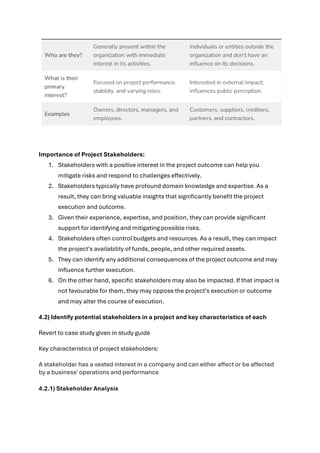
4.1.2) Types of stakeholders include:
Below are internal stakeholders (on the left) and external stakeholders (on the right)
Importance of Project Stakeholders:
1. Stakeholders with a positive interest in the project outcome can help you
mitigate risks and respond to challenges effectively.
2. Stakeholders typically have profound domain knowledge and expertise. As a
result, they can bring valuable insights that significantly benefit the project
execution and outcome.
3. Given their experience, expertise, and position, they can provide significant
support for identifying and mitigating possible risks.
4. Stakeholders often control budgets and resources. As a result, they can impact
the project's availability of funds, people, and other required assets.
5. They can identify any additional consequences of the project outcome and may
influence further execution.
6. On the other hand, specific stakeholders may also be impacted. If that impact is
not favourable for them, they may oppose the project's execution or outcome
and may alter the course of execution.
4.2) Identify potential stakeholders in a project and key characteristics of each
Revert to case study given in study guide
Key characteristics of project stakeholders:
A stakeholder has a vested interest in a company and can either affect or be affected
by a business' operations and performance
4.2.1) Stakeholder Analysis
Stakeholder Analysis is a process that involves collecting information about people
who will be impacted by a project. These individuals will be grouped according to their
levels of participation, interest and influence in the project; and determining how best
to involve and communicate each of these stakeholder groups throughout.
Importance of stakeholder analysis:
1. To enlist the help of key organizational players.
By approaching company influencers, executives, or valuable stakeholders for help
early in your project, you can leverage the knowledge and wisdom of these key players
to help guide the project to a successful outcome. Enlisting these players early on will
also increase the chances you will earn their support for your project.
But before you can determine which influencers and other key stakeholders to
approach, you’ll need to conduct a stakeholder analysis.
2. To gain early alignment among all stakeholders on goals and plans.
Because your stakeholder analysis will help you determine which people to involve in
the project, you will then be able to bring these people together for a kickoff and early-
stage meetings to communicate the project’s strategic objectives and plans.
3.Being inclusive
By identifying and analysing your stakeholders, you obtain a clear picture of who they
are and ensure all those who are impacted by your project are considered.
4.Engaging effectively
Grouping your stakeholders based on your analysis allows you to plan targeted
communications for each group, increasing your chances of positive engagement.
5.Promoting understanding and alignment
Creating communication channels facilitates for your stakeholders to understand the
project goal and its benefits, building trust and helping the project get support.
6.Anticipating issues
Knowing your stakeholders helps you plan actions in advance, avoiding potential
problems that could hurt the project underway.
7.Gaining insights
Your key stakeholders may share relevant opinions and views with you, which you can
use to improve the project (and as an additional benefit, gain more of their support)
How to conduct a stakeholder analysis:
Step 1: Identify your stakeholders
Brainstorm who your stakeholders are. List all of the people who are affected by your
work or who have a vested interest in its success or failure. Some of these relationships
may include investors, advisors, teammates, or even family.
There are two main groups of stakeholders: internal stakeholders and external
stakeholders.
Internal stakeholders are individuals or groups within your business, such as team
members or leadership.
External stakeholders are individuals or groups outside the business, including end
users, customers, and investors.
You will need to identify and assess both types of stakeholders in your analysis.
Step 2: Prioritize your stakeholders
Next, prioritize your stakeholders by assessing their level of influence and level of
interest. The stakeholder grid is the leading tool in visually assessing key stakeholders.
The position that you allocate to a stakeholder on the grid shows you the actions to take
with them:
•High power, highly interested people: Fully engage these people, and make the
greatest efforts to satisfy them.
•High power, less interested people: Keep these stakeholders satisfied, but not so
much that they become bored with your message.
•Low power, highly interested people: Adequately inform these people, and talk to
them to ensure that no major issues arise. People in this category can often be
very helpful with the details of your project in a supportive role.
•Low power, less interested people: Again, monitor these people, but don’t bore
them with excessive communication.
Step 3: Understand your key stakeholders
Now that stakeholders have been identified and prioritized, you need to understand
how they feel about your project. Some good questions to ask include:
•Do they have a financial or emotional interest in the outcome of your work? Is it
positive or negative?
•What motivates them the most?
•Which of your project information is relevant to them, and what is the best way to
relay that information?
•What is their current opinion of your work? Is that opinion based on accurate
information?
•Who influences their opinion, and are those influencers also your stakeholders?
•If they’re not likely to be supportive of your project, what can you do to win their
support?
•If you can’t win their support, what can you do to manage their opposition?
Once you've prioritized your stakeholders and consider their attitude toward your
project, you should also consider creating a project management communication plan.
A communication matrix will let everyone involved know how often they need to loop
stakeholders in.
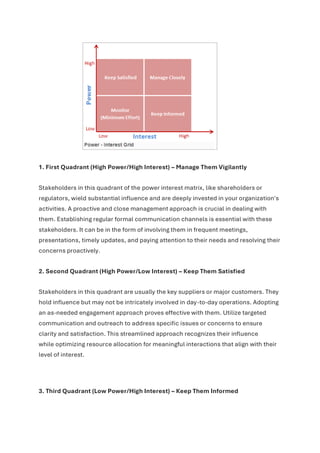
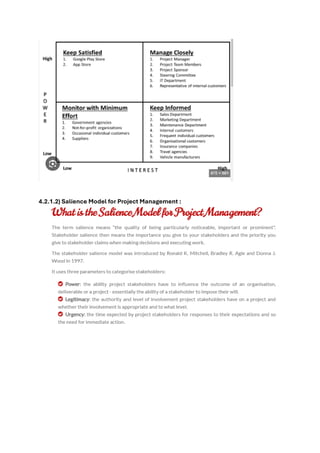
4.2.1.1) Power-interest grid
1. First Quadrant (High Power/High Interest) – Manage Them Vigilantly
Stakeholders in this quadrant of the power interest matrix, like shareholders or
regulators, wield substantial influence and are deeply invested in your organization's
activities. A proactive and close management approach is crucial in dealing with
them. Establishing regular formal communication channels is essential with these
stakeholders. It can be in the form of involving them in frequent meetings,
presentations, timely updates, and paying attention to their needs and resolving their
concerns proactively.
2. Second Quadrant (High Power/Low Interest) – Keep Them Satisfied
Stakeholders in this quadrant are usually the key suppliers or major customers. They
hold influence but may not be intricately involved in day-to-day operations. Adopting
an as-needed engagement approach proves effective with them. Utilize targeted
communication and outreach to address specific issues or concerns to ensure
clarity and satisfaction. This streamlined approach recognizes their influence
while optimizing resource allocation for meaningful interactions that align with their
level of interest.
3. Third Quadrant (Low Power/High Interest) – Keep Them Informed
Stakeholders in this quadrant like community groups or advocacy
organizations possess less direct influence but maintain a strong interest in your
organization. Transparency and responsiveness are key when managing these
stakeholders. Consider their needs and concerns in decision-making and involve
them through regular updates, informative dialogue, and feedback gathering. By
fostering an open channel of communication, you acknowledge their interest and
contribute to a collaborative decision-making process that respects their
perspectives.
4. Fourth Quadrant (Low Power/Low Interest) – Monitor These stakeholders
Stakeholders in this interest power grid quadrant are generally the casual customers
or employees with minimal influence. They hold limited impact on your organization
and are less involved in day-to-day operations. An occasional update and responsive
approach may keep these stakeholders satisfied. By being attentive to their needs as
they arise, you maintain a level of engagement that aligns with their lower influence
compared to the rest.
Benefits of Using Power Interest Grid for Stakeholder Management
Leveraging the power interest grid is invaluable for project managers. It offers crucial
insight into the stakeholder interests and motivations and paves the way for effective
engagement and management strategies. The power and interest grid of
stakeholders yields a multitude of advantages in project stakeholder management.
Key benefits encompass:
1. Identification and Prioritization of Stakeholders
Utilizing the power interest grid facilitates a swift assessment of stakeholder
influence and their vested interest in the project. This visual categorization enables
you to identify key stakeholders who wield significant influence and have a
substantial stake in project outcomes. Armed with this insight, you can strategically
allocate resources and direct time and energy toward engaging and managing these
pivotal stakeholders.
2. Understanding Stakeholder Motivations
The power interest grid offers you a complete picture of stakeholders' motivations. It
delves into why each stakeholder is invested in the project and gauges the impact of
their power and influence on project success. This insight proves particularly
valuable when navigating stakeholders with high power and low interest or those with
low power and high interest. It ultimately allows you to come up with tailored
strategies to effectively manage diverse motivations of different stakeholders.
3. Development of Effective Stakeholder Engagement Strategies
The power interest grid enables you to craft precise communication and engagement
approaches for every stakeholder by deciphering their power and interest levels
individually. The goal is targeted interaction with each stakeholder on their vested
interest. Therefore, the interest grid for stakeholders helps you customize
communication to meet their unique expectations.
4. Anticipation and Management of Stakeholder Conflict
It is often the case that the interest between stakeholders comes into a state of
conflict. The power interest grid in such instances serves as a proactive tool
by identifying stakeholders with conflicting interests and power dynamics. The
foresight you gain enables early recognition of potential conflicts, allowing swift
intervention and resolution before they escalate into significant issues.
4.2.1.2) Salience Model for Project Management :
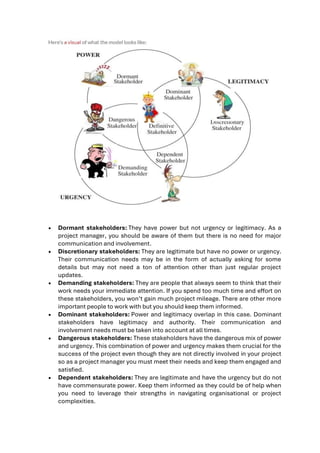
• Dormant stakeholders: They have power but not urgency or legitimacy. As a
project manager, you should be aware of them but there is no need for major
communication and involvement.
• Discretionary stakeholders: They are legitimate but have no power or urgency.
Their communication needs may be in the form of actually asking for some
details but may not need a ton of attention other than just regular project
updates.
• Demanding stakeholders: They are people that always seem to think that their
work needs your immediate attention. If you spend too much time and effort on
these stakeholders, you won’t gain much project mileage. There are other more
important people to work with but you should keep them informed.
• Dominant stakeholders: Power and legitimacy overlap in this case. Dominant
stakeholders have legitimacy and authority. Their communication and
involvement needs must be taken into account at all times.
• Dangerous stakeholders: These stakeholders have the dangerous mix of power
and urgency. This combination of power and urgency makes them crucial for the
success of the project even though they are not directly involved in your project
so as a project manager you must meet their needs and keep them engaged and
satisfied.
• Dependent stakeholders: They are legitimate and have the urgency but do not
have commensurate power. Keep them informed as they could be of help when
you need to leverage their strengths in navigating organisational or project
complexities.
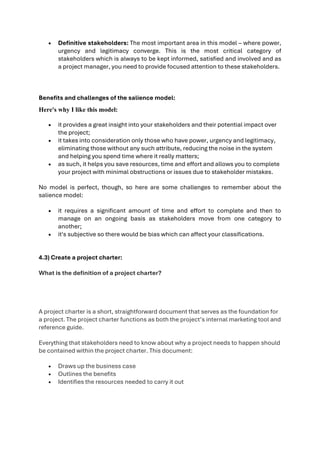
• Definitive stakeholders: The most important area in this model – where power,
urgency and legitimacy converge. This is the most critical category of
stakeholders which is always to be kept informed, satisfied and involved and as
a project manager, you need to provide focused attention to these stakeholders.
Benefits and challenges of the salience model:
Here's why I like this model:
• it provides a great insight into your stakeholders and their potential impact over
the project;
• it takes into consideration only those who have power, urgency and legitimacy,
eliminating those without any such attribute, reducing the noise in the system
and helping you spend time where it really matters;
• as such, it helps you save resources, time and effort and allows you to complete
your project with minimal obstructions or issues due to stakeholder mistakes.
No model is perfect, though, so here are some challenges to remember about the
salience model:
• it requires a significant amount of time and effort to complete and then to
manage on an ongoing basis as stakeholders move from one category to
another;
• it's subjective so there would be bias which can affect your classifications.
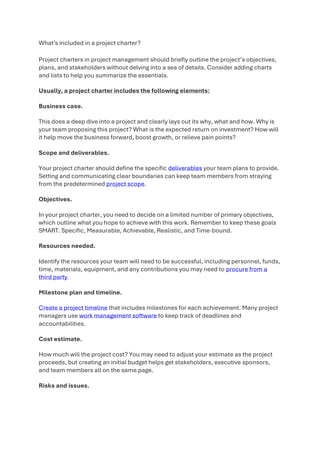
4.3) Create a project charter:
What is the definition of a project charter?
A project charter is a short, straightforward document that serves as the foundation for
a project. The project charter functions as both the project’s internal marketing tool and
reference guide.
Everything that stakeholders need to know about why a project needs to happen should
be contained within the project charter. This document:
• Draws up the business case
• Outlines the benefits
• Identifies the resources needed to carry it out
What’s included in a project charter?
Project charters in project management should briefly outline the project’s objectives,
plans, and stakeholders without delving into a sea of details. Consider adding charts
and lists to help you summarize the essentials.
Usually, a project charter includes the following elements:
Business case.
This does a deep dive into a project and clearly lays out its why, what and how. Why is
your team proposing this project? What is the expected return on investment? How will
it help move the business forward, boost growth, or relieve pain points?
Scope and deliverables.
Your project charter should define the specific deliverables your team plans to provide.
Setting and communicating clear boundaries can keep team members from straying
from the predetermined project scope.
Objectives.
In your project charter, you need to decide on a limited number of primary objectives,
which outline what you hope to achieve with this work. Remember to keep these goals
SMART. Specific, Measurable, Achievable, Realistic, and Time-bound.
Resources needed.
Identify the resources your team will need to be successful, including personnel, funds,
time, materials, equipment, and any contributions you may need to procure from a
third party.
Milestone plan and timeline.
Create a project timeline that includes milestones for each achievement. Many project
managers use work management software to keep track of deadlines and
accountabilities.
Cost estimate.
How much will the project cost? You may need to adjust your estimate as the project
proceeds, but creating an initial budget helps get stakeholders, executive sponsors,
and team members all on the same page.
Risks and issues.
Think about what could go wrong and the consequences of it. Focusing on the negative
may sound counterproductive, but taking the time to identify potential pitfalls can
prepare your team for unforeseen challenges down the line.
Dependencies.
When one piece of a project can’t start until a previous step has reached a certain
stage, that’s known as a dependency. It’s important to outline the optimal sequence of
tasks, including all dependencies, within the project plan.
This helps you identify the necessary resources and highlight potential scheduling
issues, especially when the scope of your project requires certain tasks to be
completed in order.
Benefits of a project charter.
Creating a project charter means giving stakeholders across your business a fuller
understanding to why it’s being undertaken. As the clearest line of communication
throughout, there are several benefits to having a project charter in place before you
execute your project.
• Creates a project roadmap. One of the main purposes of your project charter is
to establish expectations and vision for the project. Whenever the team has
doubts about the project’s direction, they can look to the project charter for
guidance.
• Markets the project to stakeholders. A well-drafted project charter serves as
your project’s principal internal marketing document, which you can show to
stakeholders, managers, executives, and clients to help justify the cost, secure
resources, and gain buy-in.
• Prevents scope creep. Project charters give clear definitions to the scope of a
project. They help minimize the risk of needing to move working boundaries at
any stage, which could otherwise result in scope creep, wasted resources and
time, and even risk project failure.
• Authorizes project kickoff. Project managers will use the project charter as the
authorization they need to begin adjusting workflows, redirecting resources and
spending budget. Without the green light, these moves will cause confusion and
delay within the project teams.
• Provides company continuity. When projects change hands, or new workers
are replaced or recruited, the project charter acts as a vital part of keeping your
timelines and objectives on track without the need to adjust too dramatically.
How to create a project charter:
1) Identify the project vision
2) Identify the stakeholders and the customers
3) Create an organizational chart
4) Define project milestones
5) Create a resource plan
6) Set the budget for the project
7) List down dependencies , constraints and risks
8) Lay out the implementation plan
4.4) Define a project’s scope and highlight its purpose:
Project scope is part of project planning that involves determining and documenting a
list of specific project goals, deliverables, tasks, costs and deadlines .
The benefits a project scope statement provides to any organization undertaking a new
initiative include the following :
a) Articulates what the project entails so that all stakeholders can understand
what’s involved
b) Provides a roadmap that managers can use to assign tasks, schedule work and
budget appropriately
c) Helps focus team members on common objectives
d) Prevents projects particularly complex ones, from expanding beyond the
established vision
4.5) Compose a Work Breakdown Structure
The WBS is a tool that is used to indicate how a project will be organized in terms of the
work that must be carried out. Its aim is to identify tasks and break them down into
smaller units of work. This process is repeated up to a certain point , which depends on
the project . There are three models or charts available to project managers when
presenting the WBS. These include the outlines, organisational charts and concept
maps.
Please revert back to the notes
How to create a work breakdown structure :
1) Define the scope and objectives : Record the overarching objectives you
are trying to accomplish. This objective could be anything from
developing a new software feature to building a missile. Document these
details in your project charter .
2) Break it down into key phases and deliverable : Depending on the nature
of your project , start dividing by project phases , specific large
deliverables , or sub-tasks
3) Organize deliverables into work packages: Break down each deliverable
into all the tasks and sub-tasks required to complete them. Organize the
tasks into work packages. Work packages are the lowest level of
breakdown and should define the work, duration, and the costs of each
tasks.

PROJECT MANAGEMENT 1 STADIO SECOND YEAR.pdf

  • 1.
    PROJECT MANAGEMENT QUESTION 1is based on Section 2.5 of the textbook – Topic 3 in the study guide thus The feasibility study and project proposal Topic objectives: • Differentiate between different types of feasibility and detail the process of conducting a feasibility study • Apply the best practice guidelines to create the components of the proposal ; and • Apply your knowledge of project initiation process to both fictional and real-life cases and scenarios 3.1) Feasibility study and benefits of performing a feasibility study A feasibility study is a collection of all elements that need to be considered inorder to determine whether it is possible for a particular project to be executed. It requires a methodical approach as there are a range of issues that it must cover. The study analyzes the project’s relevant factors such as technical, economic and legal considerations, to assess whether the project is worth an investment. Benefits of conducting a feasibility study include: a) Risk Assessment: Feasibility studies help identify potential risks and challenges associated with a project . By thoroughly examining technical , financial , operational and market-related aspects , stakeholders can pinpoint areas of concern and develop strategies to mitigate or manage these risks effectively .With these anticipated risks at hand, it is convenient to find methods of concerning or putting a stoppage on them before anything big arises b) Resource Allocation: By assessing th feasibility of a project, stakeholders can allocate resources more efficiently . They can avoid overinvesting in projects with limited potential and allocate resources to those with a higher likelihood of success. c) Decision Making: feasibility studies provide critical information to decision- makers , helping them make informed choices about whether to proceed with a project . These studies offer a basis for go or no-go decisions, preventing resources from being wasted on unviable endeavors. . With a good systematic study , decision-making on issues like lack of resources , technological support, financial resources or insufficient time can be dealt with better
  • 2.
    d) Financial Planning:Feasibility studies include detailed financial projections and cost estimates . This financial information is invaluable for securing funding funding from investors, lenders, or other sources. It helps in creating a solid business case. e) Market Insight: Market feasibility studies provide insights into customer demand, market trends, and competitive dynamics. This information is crucial for designing products or services that meet market needs and for formulating effective marketing strategies. f) Optimized Design: Technical feasibility studies ensure that a project's technical requirements and design are viable. They help in avoiding costly design flaws and ensuring that the project can be implemented as planned. g) Legal and Regulatory Compliance: Feasibility studies can identify potential legal and regulatory challenges. This allows for the development of strategies to navigate and comply with relevant laws and regulations, reducing the risk of legal complications later on. h) Enhanced Project Viability: Feasibility studies may lead to adjustments and improvements in the project plan, making it more viable and likely to succeed. This iterative process ensures that potential issues are addressed proactively. i) Investor and Stakeholder Confidence: When potential investors and stakeholders see that a comprehensive feasibility study has been conducted, they are more likely to have confidence in the project. This can make it easier to secure funding and support. j) Long-Term Planning: Feasibility studies not only assess the viability of a project in the short term but also help in long-term planning. They provide insights into the sustainability and growth potential of a business or initiative. 3.2) Types of feasibility studies: 1.Technical Feasibility: Technical Feasibility study of a project analyzes and evaluates its present resources, including equipment, programming, and necessary innovation. This technical feasibility analysis provides information about whether the technologies and resources needed to build the project are available. Additionally, a feasibility study examines the engineering team's expertise, the viability of using open systems, the ease of maintaining and upgrading the technology of choice, and other factors. 3. Operational Feasibility: Operational Feasibility study examines how well a product will satisfy needs and how simply it will be used and maintained after implementation. Along with this, additional operational responsibilities include evaluating the product's usefulness and the suitability of an application development teams offered to fix 4. Economic Feasibility: The economic market feasibility study examines the project's expense and value. This implies that a thorough analysis is done to determine the program's development costs, including the cost of the
  • 3.
    design process andoperating costs. After that, it is determined if the venture will be profitable. After that it is analyzed whether project will be beneficial in terms of finance for organization or not. 4. Legal Feasibility: The project is examined from a legal standpoint in examining Legal Feasibility. It evaluates project implementation legal obstacles such as privacy laws or social networking regulations, business certificates, licenses, trademarks, etc. Ultimately, it can be argued that a legal feasibility study is an investigation to determine whether a project proposal complies with the law and ethical guidelines. Overall it can be said that Legal Feasibility Study is study to know if proposed project conform legal and ethical requirements. 6. Schedule Feasibility: A scheduling feasibility study's primary focus is the project proposal's schedules and due dates. This assessment involves how long it will take team members to finish the project, which significantly affects the company as the program's intended outcome may not be achieved if it cannot be completed on time. 7. Cultural and Political Feasibility: This section assesses how the software project will affect the political environment and organizational culture. This analysis takes into account the organization’s culture and how the suggested changes could be received there, as well as any potential political obstacles or internal opposition to the project. It is essential that cultural and political factors be taken into account in order to execute projects successfully. 7. Market Feasibility: This refers to evaluating the market’s willingness and ability to accept the suggested commodity . Analyzing the target market, understanding consumer wants and assessing possible rivals are all part of this study. It assists in identifying whether the project is in line with market expectations and whether there is a feasible market for the good or service being offered. 8. Resource Feasibility: This method evaluates if the resources needed to complete the project successfully are adequate and readily available. Financial, technological and human resources are all taken into account in this study. It guarantees that sufficient hardware, software, trained labor and funding are available to complete the project successfully. 3.3) Outline the process of conducting a feasibility study: Step One: Conduct a Preliminary Analysis The primary purpose of the preliminary analysis is to screen project ideas before extensive time, effort, and money are invested. Two sets of activities are involved. 1. Describe or outline as specifically as possible the planned services, target markets, and unique characteristics of the services( by answering these questions:)
  • 4.
    This process assessthe practicality and viability of the entity’s goals and objectives before starting the project will help keep everyone aligned and working towards the same goals . o Does the practice serve a currently unserved need? (e.g., multicultural populations or age groups who are not currently being served) o Does the practice serve an existing market in which demand exceeds supply? o Can the practice successfully compete with existing practices because of an "advantageous situation," such as better design, price, location, or availability (e.g., balance assessment and rehabilitation, programmable devices)? 2. Determine whether there are any insurmountable obstacles. A "yes" response to the following indicates that the idea has little chance for success: o Are capital requirements for entry or continuing operations unavailable or unaffordable? o Do any factors prevent effective marketing to any or all referral sources? If the information gathered so far indicates that the idea has potential, then continue with a detailed feasibility study. Step Two: Prepare a Projected Income Statement Anticipated income must cover direct and indirect costs, taking into account the expected income growth curve. Working backward from the anticipated income, the revenue necessary to generate that income can be derived in order to build a projected income statement. Factors that determine this statement are services provided, fees for services, volume of services, and adjust-ments to revenues (e.g., actual reimbursement levels). Step Three: Conduct a Market Survey A good market survey is crucial. If the planner cannot perform this survey, an outside firm should be hired. The primary objective of a market survey is a realistic projection of revenues. The major steps include: • Define the geographic influence on the market. • Review population trends, demographic features, cultural factors, and purchasing power in the community. • Analyze competing services in the community to determine their major strengths and weaknesses. Factors to consider include pricing, product lines, sources of referral, location, promotional activities, quality of service, consumer loyalty and satisfaction, and sales. • Determine total volume in the market area and estimate expected market share.
  • 5.
    • Estimate marketexpansion opportunities (e.g., responsiveness to new/enhanced services). Step Four: Plan Business Organization and Operations At this point, the organization and operations of the business should be planned in sufficient depth to determine the technical feasibility and costs involved in start-up, fixed investment, and operations. Extensive effort is necessary to develop detailed plans for: • Equipment • Merchandising methods • Facility location and design (or layout) • Availability and cost of personnel • Supply availability (e.g., vendors, pricing schedules. exclusive or franchised products) • Overhead (e.g., utilities, taxes, insurance) Step Five: Prepare an Opening Day Balance Sheet The Opening Day Balance Sheet should reflect the practice's assets and liabilities as accurately as possible at the time the practice begins, before the practice generates income. Prepare a list of assets required for practice operations. The list should include item, source, cost, and available financing methods. Necessary assets include everything from cash necessary for working capital to buildings and land. Although the resulting list is rather simple, the amount of effort required may be extensive. Liabilities to be incurred and the investment required by the practice must also be clarified. These items need to be considered: • Whether to lease or buy land, buildings, and equipment • How to finance asset purchases • How to finance accounts receivable Step Six: Review and Analyze All Data This review is crucial. The planner should determine if any data or analysis performed should change any of the preceding analyses. Basically, taking this step means "Step back and reflect one more time." • Reexamine the Projected Income Statement and compare with the list of desired assets and the Opening Day Balance Sheet. Given all expenses and liabilities, does the Income Statement reflect realistic expectations? • Analyze risk and contingencies. Consider the likelihood of significant changes in the current market that could alter projections. Step Seven: Make "Go/No Go" Decision
  • 6.
    All the precedingsteps have been aimed at providing data and analysis for the "go/no go" decision. If the analysis indicates that the business should yield at least the desired minimum income and has growth potential, a "go" decision is appropriate. Anything less mandates a "no go" decision. Additional considerations include: • Is there a commitment to make the necessary sacrifices in time, effort and money? • Will the activity satisfy long-term aspirations? 3.4) What is a Project Proposal and what are the steps taken in outlining it: A project proposal is a written document outlining everything stakeholders should know about a project, including the timeline, budget, objectives, and goals. Your project proposal should summarize your project details and sell your idea so stakeholders buy in to the initiative. In this guide, we’ll teach you how to write a project proposal so you can win approval and succeed at work. Please revert to page 29 of the study guide ****** Steps in drafting a project proposal include: 1. Write an executive summary The executive summary serves as the introduction to your project proposal. Similar to a report abstract or an essay introduction, this section should summarize what’s coming and persuade the stakeholder to continue reading. Depending on the complexity of your project, your executive summary may be one paragraph or a few paragraphs. Your executive summary should include: • The problem your project plans to solve • The solution your project provides for that problem • The impact your project will have You should only address these items briefly in your executive summary because you’ll discuss these topics in more detail later in your proposal. 2. Explain the project background
  • 7.
    In this section,you’ll go into the background of the project. Use references and statistics to convince your reader that the problem you’re addressing is worthwhile. Some questions to include are: • What is the problem your project addresses? • What is already known about this problem? • Who has addressed this problem before/what research is there? • Why is past research insufficient at addressing this problem? You can also use this section to explain how the problem you hope to solve directly relates to your organization. 3. Present a solution You just presented a problem in the project background section, so the next logical step in proposal writing is to present a solution. This section is your opportunity to outline your project approach in greater detail. Some items to include are: • Your vision statement for the project • Your project schedule, including important milestones • Project team roles and responsibilities • A risk register showing how you’ll mitigate risk • The project deliverables • Reporting tools you’ll use throughout the project You may not have all these items in your proposal format, but you can decide what to include based on the project scope. This section will likely be the longest and most detailed section of your proposal, as you’ll discuss everything involved in achieving your proposed solution. 4. Define project deliverables and goals Defining your project deliverables is a crucial step in writing your project proposal. Stakeholders want to know what you’re going to produce at the end of your project, whether that’s a product, a program, an upgrade in technology, or something else. As the stakeholder reads through your vision, this will be the section where they say, “Aha, this is what they’ll use my resources for.” When defining your deliverables, you should include: • The end product or final objective of your project • A project timeline for when deliverables will be ready
  • 8.
    • SMART goalsthat align with the deliverables you’re producing While it’s important to show the problem and solution to your project, it’s often easier for stakeholders to visualize the project when you can define the deliverables. 5. List what resources youneed Now that you’ve outlined your problem, approach, solution, and deliverables, you can go into detail about what resources you need to accomplish your initiative. In this section, you’ll include: • Project budget: The project budget involves everything from the supplies you’ll need to create a product to ad pricing and team salaries. You should include any budget items you need to deliver the project here. • Breakdown of costs: This section should include research on why you need specific resources for your project; that way, stakeholders can understand what their buy-in is being used for. This breakdown can also help you mitigate unexpected costs. • Resource allocation plan: You should include an overview of your resource allocation plan outlining where you plan to use the specific resources you need. For example, if you determine you need $50,000 to complete the project, do you plan to allocate this money to salaries, technology, materials, etc. Hopefully, by this point in the proposal, you’ve convinced the stakeholders to get on board with your proposed project, which is why saving the required resources for the end of the document is a smart strategic move. Read: Budget proposal templates: 5 steps to secure funding 6. State your conclusion Finally, wrap up your project proposal with a persuasive and confident conclusion. Like the executive summary, the conclusion should briefly summarize the problem your project addresses and your solution for solving that problem. You can emphasize the impact of your project in the conclusion but keep this section relevant, just like you would in a traditional essay. 3.4) Components of a feasibility study : ** Revert to page 27 in the study guide
  • 9.
    TOPIC 4 :Project stakeholders and scope After studying this topic, you should be able to: • Explain the role and importance of project stakeholders • Identify potential stakeholders in a project and the key characteristics of each • Create a project charter • Define a project’s scope and highlight its purpose • Compose a work breakdown structure (WBS) • Discuss important considerations for composing a project team • Explain the process of reviewing the project initiation phase ; and • Apply your knowledge of project initiation processes to both fictional and real- life cases and scenarios 4.1) Explain the role and importance of project stakeholders 4.1.1) Project stakeholders include parties or individuals directly or indirectly impacted by the success or failure of a project . They also include parties that affect the project or have vested interests. Examples include customers, managers, suppliers and investors. The central role of project stakeholders is to execute a project’s objectives . Investors , for example , implement a project’s goals by financing the project . Managers work on the purposes by drafting and executing a stakeholder management plan and managing a project team . 4.1.2) Types of stakeholders include: Below are internal stakeholders (on the left) and external stakeholders (on the right)
  • 10.
    Importance of ProjectStakeholders: 1. Stakeholders with a positive interest in the project outcome can help you mitigate risks and respond to challenges effectively. 2. Stakeholders typically have profound domain knowledge and expertise. As a result, they can bring valuable insights that significantly benefit the project execution and outcome. 3. Given their experience, expertise, and position, they can provide significant support for identifying and mitigating possible risks. 4. Stakeholders often control budgets and resources. As a result, they can impact the project's availability of funds, people, and other required assets. 5. They can identify any additional consequences of the project outcome and may influence further execution. 6. On the other hand, specific stakeholders may also be impacted. If that impact is not favourable for them, they may oppose the project's execution or outcome and may alter the course of execution. 4.2) Identify potential stakeholders in a project and key characteristics of each Revert to case study given in study guide Key characteristics of project stakeholders: A stakeholder has a vested interest in a company and can either affect or be affected by a business' operations and performance 4.2.1) Stakeholder Analysis
  • 11.
    Stakeholder Analysis isa process that involves collecting information about people who will be impacted by a project. These individuals will be grouped according to their levels of participation, interest and influence in the project; and determining how best to involve and communicate each of these stakeholder groups throughout. Importance of stakeholder analysis: 1. To enlist the help of key organizational players. By approaching company influencers, executives, or valuable stakeholders for help early in your project, you can leverage the knowledge and wisdom of these key players to help guide the project to a successful outcome. Enlisting these players early on will also increase the chances you will earn their support for your project. But before you can determine which influencers and other key stakeholders to approach, you’ll need to conduct a stakeholder analysis. 2. To gain early alignment among all stakeholders on goals and plans. Because your stakeholder analysis will help you determine which people to involve in the project, you will then be able to bring these people together for a kickoff and early- stage meetings to communicate the project’s strategic objectives and plans. 3.Being inclusive By identifying and analysing your stakeholders, you obtain a clear picture of who they are and ensure all those who are impacted by your project are considered. 4.Engaging effectively Grouping your stakeholders based on your analysis allows you to plan targeted communications for each group, increasing your chances of positive engagement. 5.Promoting understanding and alignment Creating communication channels facilitates for your stakeholders to understand the project goal and its benefits, building trust and helping the project get support. 6.Anticipating issues Knowing your stakeholders helps you plan actions in advance, avoiding potential problems that could hurt the project underway. 7.Gaining insights Your key stakeholders may share relevant opinions and views with you, which you can use to improve the project (and as an additional benefit, gain more of their support) How to conduct a stakeholder analysis:
  • 12.
    Step 1: Identifyyour stakeholders Brainstorm who your stakeholders are. List all of the people who are affected by your work or who have a vested interest in its success or failure. Some of these relationships may include investors, advisors, teammates, or even family. There are two main groups of stakeholders: internal stakeholders and external stakeholders. Internal stakeholders are individuals or groups within your business, such as team members or leadership. External stakeholders are individuals or groups outside the business, including end users, customers, and investors. You will need to identify and assess both types of stakeholders in your analysis. Step 2: Prioritize your stakeholders Next, prioritize your stakeholders by assessing their level of influence and level of interest. The stakeholder grid is the leading tool in visually assessing key stakeholders. The position that you allocate to a stakeholder on the grid shows you the actions to take with them: •High power, highly interested people: Fully engage these people, and make the greatest efforts to satisfy them. •High power, less interested people: Keep these stakeholders satisfied, but not so much that they become bored with your message. •Low power, highly interested people: Adequately inform these people, and talk to them to ensure that no major issues arise. People in this category can often be very helpful with the details of your project in a supportive role. •Low power, less interested people: Again, monitor these people, but don’t bore them with excessive communication. Step 3: Understand your key stakeholders Now that stakeholders have been identified and prioritized, you need to understand how they feel about your project. Some good questions to ask include: •Do they have a financial or emotional interest in the outcome of your work? Is it positive or negative? •What motivates them the most?
  • 13.
    •Which of yourproject information is relevant to them, and what is the best way to relay that information? •What is their current opinion of your work? Is that opinion based on accurate information? •Who influences their opinion, and are those influencers also your stakeholders? •If they’re not likely to be supportive of your project, what can you do to win their support? •If you can’t win their support, what can you do to manage their opposition? Once you've prioritized your stakeholders and consider their attitude toward your project, you should also consider creating a project management communication plan. A communication matrix will let everyone involved know how often they need to loop stakeholders in. 4.2.1.1) Power-interest grid
  • 14.
    1. First Quadrant(High Power/High Interest) – Manage Them Vigilantly Stakeholders in this quadrant of the power interest matrix, like shareholders or regulators, wield substantial influence and are deeply invested in your organization's activities. A proactive and close management approach is crucial in dealing with them. Establishing regular formal communication channels is essential with these stakeholders. It can be in the form of involving them in frequent meetings, presentations, timely updates, and paying attention to their needs and resolving their concerns proactively. 2. Second Quadrant (High Power/Low Interest) – Keep Them Satisfied Stakeholders in this quadrant are usually the key suppliers or major customers. They hold influence but may not be intricately involved in day-to-day operations. Adopting an as-needed engagement approach proves effective with them. Utilize targeted communication and outreach to address specific issues or concerns to ensure clarity and satisfaction. This streamlined approach recognizes their influence while optimizing resource allocation for meaningful interactions that align with their level of interest. 3. Third Quadrant (Low Power/High Interest) – Keep Them Informed
  • 15.
    Stakeholders in thisquadrant like community groups or advocacy organizations possess less direct influence but maintain a strong interest in your organization. Transparency and responsiveness are key when managing these stakeholders. Consider their needs and concerns in decision-making and involve them through regular updates, informative dialogue, and feedback gathering. By fostering an open channel of communication, you acknowledge their interest and contribute to a collaborative decision-making process that respects their perspectives. 4. Fourth Quadrant (Low Power/Low Interest) – Monitor These stakeholders Stakeholders in this interest power grid quadrant are generally the casual customers or employees with minimal influence. They hold limited impact on your organization and are less involved in day-to-day operations. An occasional update and responsive approach may keep these stakeholders satisfied. By being attentive to their needs as they arise, you maintain a level of engagement that aligns with their lower influence compared to the rest. Benefits of Using Power Interest Grid for Stakeholder Management Leveraging the power interest grid is invaluable for project managers. It offers crucial insight into the stakeholder interests and motivations and paves the way for effective engagement and management strategies. The power and interest grid of stakeholders yields a multitude of advantages in project stakeholder management. Key benefits encompass: 1. Identification and Prioritization of Stakeholders Utilizing the power interest grid facilitates a swift assessment of stakeholder influence and their vested interest in the project. This visual categorization enables you to identify key stakeholders who wield significant influence and have a substantial stake in project outcomes. Armed with this insight, you can strategically allocate resources and direct time and energy toward engaging and managing these pivotal stakeholders.
  • 16.
    2. Understanding StakeholderMotivations The power interest grid offers you a complete picture of stakeholders' motivations. It delves into why each stakeholder is invested in the project and gauges the impact of their power and influence on project success. This insight proves particularly valuable when navigating stakeholders with high power and low interest or those with low power and high interest. It ultimately allows you to come up with tailored strategies to effectively manage diverse motivations of different stakeholders. 3. Development of Effective Stakeholder Engagement Strategies The power interest grid enables you to craft precise communication and engagement approaches for every stakeholder by deciphering their power and interest levels individually. The goal is targeted interaction with each stakeholder on their vested interest. Therefore, the interest grid for stakeholders helps you customize communication to meet their unique expectations. 4. Anticipation and Management of Stakeholder Conflict It is often the case that the interest between stakeholders comes into a state of conflict. The power interest grid in such instances serves as a proactive tool by identifying stakeholders with conflicting interests and power dynamics. The foresight you gain enables early recognition of potential conflicts, allowing swift intervention and resolution before they escalate into significant issues.
  • 17.
    4.2.1.2) Salience Modelfor Project Management :
  • 18.
    • Dormant stakeholders:They have power but not urgency or legitimacy. As a project manager, you should be aware of them but there is no need for major communication and involvement. • Discretionary stakeholders: They are legitimate but have no power or urgency. Their communication needs may be in the form of actually asking for some details but may not need a ton of attention other than just regular project updates. • Demanding stakeholders: They are people that always seem to think that their work needs your immediate attention. If you spend too much time and effort on these stakeholders, you won’t gain much project mileage. There are other more important people to work with but you should keep them informed. • Dominant stakeholders: Power and legitimacy overlap in this case. Dominant stakeholders have legitimacy and authority. Their communication and involvement needs must be taken into account at all times. • Dangerous stakeholders: These stakeholders have the dangerous mix of power and urgency. This combination of power and urgency makes them crucial for the success of the project even though they are not directly involved in your project so as a project manager you must meet their needs and keep them engaged and satisfied. • Dependent stakeholders: They are legitimate and have the urgency but do not have commensurate power. Keep them informed as they could be of help when you need to leverage their strengths in navigating organisational or project complexities.
  • 19.
    • Definitive stakeholders:The most important area in this model – where power, urgency and legitimacy converge. This is the most critical category of stakeholders which is always to be kept informed, satisfied and involved and as a project manager, you need to provide focused attention to these stakeholders. Benefits and challenges of the salience model: Here's why I like this model: • it provides a great insight into your stakeholders and their potential impact over the project; • it takes into consideration only those who have power, urgency and legitimacy, eliminating those without any such attribute, reducing the noise in the system and helping you spend time where it really matters; • as such, it helps you save resources, time and effort and allows you to complete your project with minimal obstructions or issues due to stakeholder mistakes. No model is perfect, though, so here are some challenges to remember about the salience model: • it requires a significant amount of time and effort to complete and then to manage on an ongoing basis as stakeholders move from one category to another; • it's subjective so there would be bias which can affect your classifications. 4.3) Create a project charter: What is the definition of a project charter? A project charter is a short, straightforward document that serves as the foundation for a project. The project charter functions as both the project’s internal marketing tool and reference guide. Everything that stakeholders need to know about why a project needs to happen should be contained within the project charter. This document: • Draws up the business case • Outlines the benefits • Identifies the resources needed to carry it out
  • 20.
    What’s included ina project charter? Project charters in project management should briefly outline the project’s objectives, plans, and stakeholders without delving into a sea of details. Consider adding charts and lists to help you summarize the essentials. Usually, a project charter includes the following elements: Business case. This does a deep dive into a project and clearly lays out its why, what and how. Why is your team proposing this project? What is the expected return on investment? How will it help move the business forward, boost growth, or relieve pain points? Scope and deliverables. Your project charter should define the specific deliverables your team plans to provide. Setting and communicating clear boundaries can keep team members from straying from the predetermined project scope. Objectives. In your project charter, you need to decide on a limited number of primary objectives, which outline what you hope to achieve with this work. Remember to keep these goals SMART. Specific, Measurable, Achievable, Realistic, and Time-bound. Resources needed. Identify the resources your team will need to be successful, including personnel, funds, time, materials, equipment, and any contributions you may need to procure from a third party. Milestone plan and timeline. Create a project timeline that includes milestones for each achievement. Many project managers use work management software to keep track of deadlines and accountabilities. Cost estimate. How much will the project cost? You may need to adjust your estimate as the project proceeds, but creating an initial budget helps get stakeholders, executive sponsors, and team members all on the same page. Risks and issues.
  • 21.
    Think about whatcould go wrong and the consequences of it. Focusing on the negative may sound counterproductive, but taking the time to identify potential pitfalls can prepare your team for unforeseen challenges down the line. Dependencies. When one piece of a project can’t start until a previous step has reached a certain stage, that’s known as a dependency. It’s important to outline the optimal sequence of tasks, including all dependencies, within the project plan. This helps you identify the necessary resources and highlight potential scheduling issues, especially when the scope of your project requires certain tasks to be completed in order. Benefits of a project charter. Creating a project charter means giving stakeholders across your business a fuller understanding to why it’s being undertaken. As the clearest line of communication throughout, there are several benefits to having a project charter in place before you execute your project. • Creates a project roadmap. One of the main purposes of your project charter is to establish expectations and vision for the project. Whenever the team has doubts about the project’s direction, they can look to the project charter for guidance. • Markets the project to stakeholders. A well-drafted project charter serves as your project’s principal internal marketing document, which you can show to stakeholders, managers, executives, and clients to help justify the cost, secure resources, and gain buy-in. • Prevents scope creep. Project charters give clear definitions to the scope of a project. They help minimize the risk of needing to move working boundaries at any stage, which could otherwise result in scope creep, wasted resources and time, and even risk project failure. • Authorizes project kickoff. Project managers will use the project charter as the authorization they need to begin adjusting workflows, redirecting resources and spending budget. Without the green light, these moves will cause confusion and delay within the project teams. • Provides company continuity. When projects change hands, or new workers are replaced or recruited, the project charter acts as a vital part of keeping your timelines and objectives on track without the need to adjust too dramatically. How to create a project charter:
  • 22.
    1) Identify theproject vision 2) Identify the stakeholders and the customers 3) Create an organizational chart 4) Define project milestones 5) Create a resource plan 6) Set the budget for the project 7) List down dependencies , constraints and risks 8) Lay out the implementation plan 4.4) Define a project’s scope and highlight its purpose: Project scope is part of project planning that involves determining and documenting a list of specific project goals, deliverables, tasks, costs and deadlines . The benefits a project scope statement provides to any organization undertaking a new initiative include the following : a) Articulates what the project entails so that all stakeholders can understand what’s involved b) Provides a roadmap that managers can use to assign tasks, schedule work and budget appropriately c) Helps focus team members on common objectives d) Prevents projects particularly complex ones, from expanding beyond the established vision 4.5) Compose a Work Breakdown Structure The WBS is a tool that is used to indicate how a project will be organized in terms of the work that must be carried out. Its aim is to identify tasks and break them down into smaller units of work. This process is repeated up to a certain point , which depends on the project . There are three models or charts available to project managers when presenting the WBS. These include the outlines, organisational charts and concept maps.
  • 23.
    Please revert backto the notes How to create a work breakdown structure : 1) Define the scope and objectives : Record the overarching objectives you are trying to accomplish. This objective could be anything from developing a new software feature to building a missile. Document these details in your project charter . 2) Break it down into key phases and deliverable : Depending on the nature of your project , start dividing by project phases , specific large deliverables , or sub-tasks 3) Organize deliverables into work packages: Break down each deliverable into all the tasks and sub-tasks required to complete them. Organize the tasks into work packages. Work packages are the lowest level of breakdown and should define the work, duration, and the costs of each tasks.