Feasibility Study
1
What is a Feasibility Study??
Definition: Feasibility study is the initial design stage of any project,
which brings together the elements of knowledge that indicate if a project is
possible or not.
A feasibility study is an analysis that takes all of a project's relevant factors
into account—including economic, technical, legal, and scheduling
considerations—to ascertain the likelihood of completing the project
successfully.
2
What Does Feasibility Study Mean?
 A feasibility study includes an estimate of the level of expertise
required for a project and who can provide it, quantitative and
qualitative assessments of other essential resources, identification of
critical points, a general timetable, and a general cost estimate.
 Whether a project is viable or not, i.e. whether it can generate an
equal or a higher rate of return during its lifetime requires a thorough
investigation of the investment per se as well as the level of current
expenditure. The preliminary design is the simple description of the
conceived idea with an indication of the main factors to be considered
in the study.
3
Types of feasibility studies??
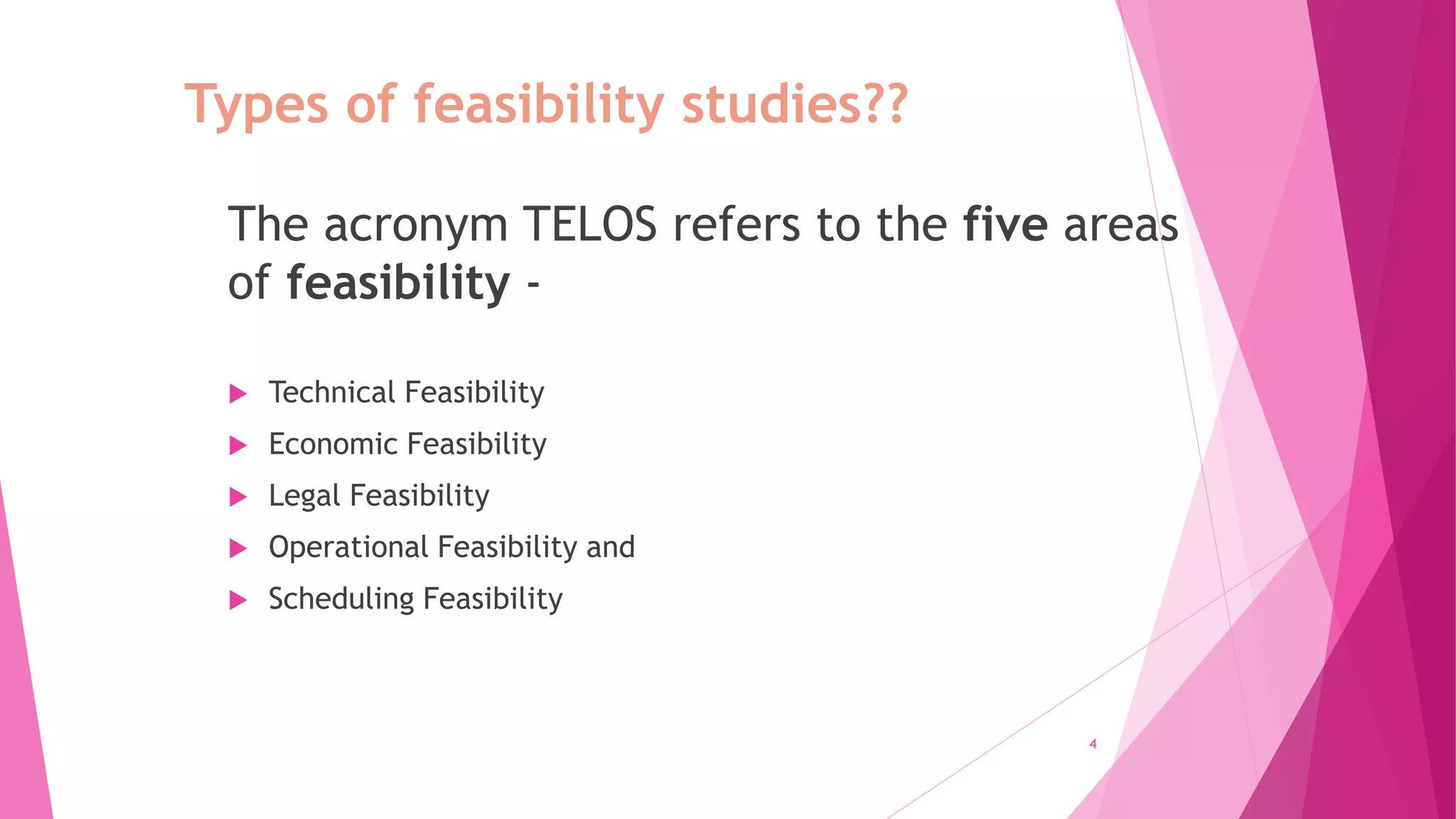
The acronym TELOS refers to the five areas
of feasibility -
 Technical Feasibility
 Economic Feasibility
 Legal Feasibility
 Operational Feasibility and
 Scheduling Feasibility
4
5
Technical feasibility
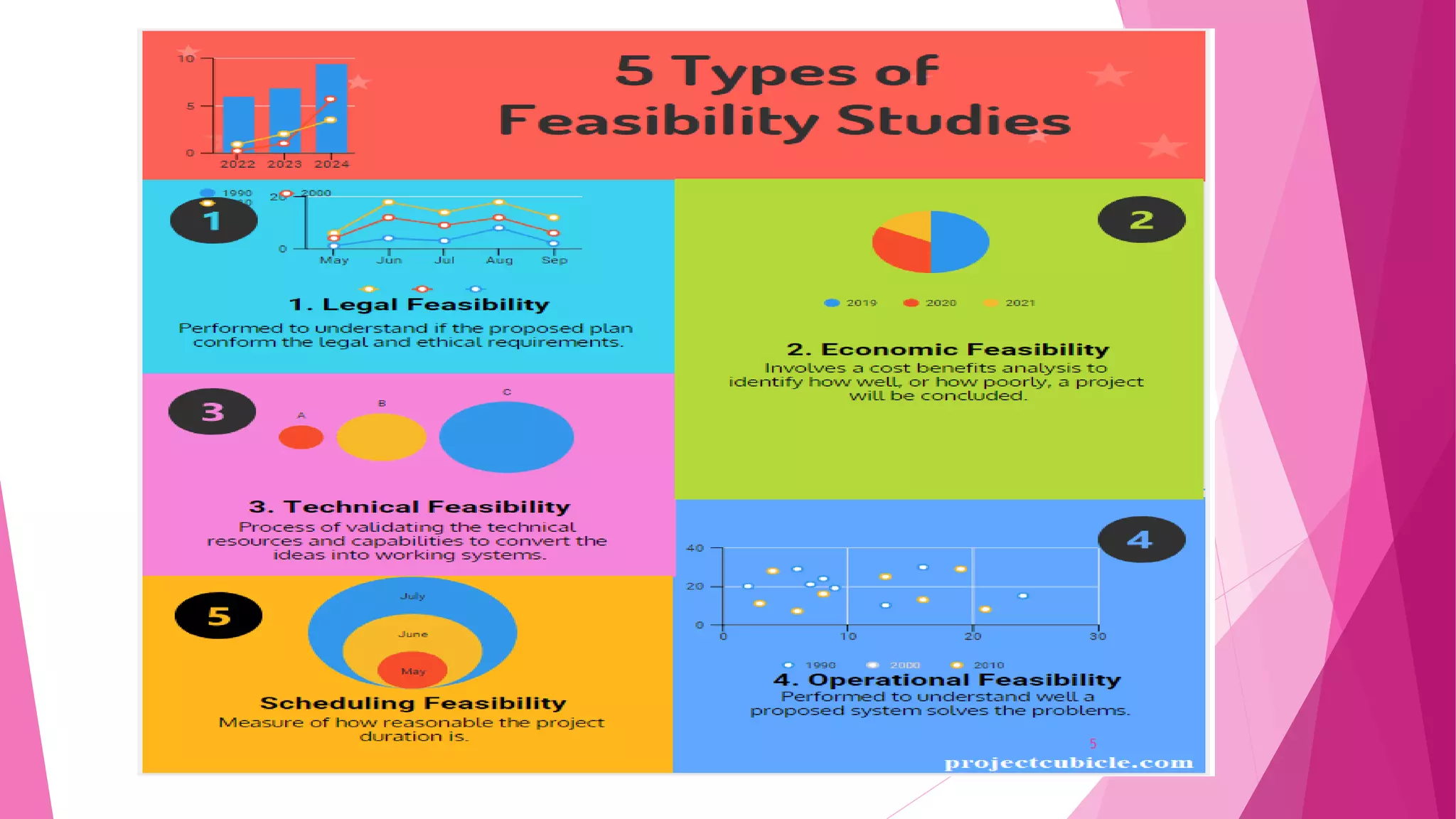
 Technical feasibility is the assessment of the technical requirements
of a project or product to find out what technical resources a project
requires.
 Technical feasibility is not complete until the same technical
assessment is done on the company to establish that it has the
technical capabilities to carry out the implementation of the project
to completion within the required time. It is focused on the available
hardware and software to be used for a project.
6
2. Economic feasibility
 It is used to determine the financial resource of the project.
 It measures all costs incurred in development of new system.
 It is cost benefit analysis because it determines the total cost for
development of new system and benefits derived from the new system.
 Benefits of new system should be more than cost incurred to achieve profit
from a new system or for any organization.
7
3. Legal feasibility Study
This is an assessment of whether the project meets the legal
requirements that exist for implementation. An example is
whether a new building meets the requirements of the law,
whether the location was suitably chosen and construction is
approved by the authorities. Legal feasibility also encompasses
the ethical aspects of a project, for example does a new plant
dump its waste in a manner that is environmentally friendly. The
project may also be a new undertaking that is not covered under
any law and so this must also be checked.
8
4. Operational feasibility
Operational feasibility ascertains how well the implementation of a
project fits in with the current organizational business structure. The
solutions to a current problem must come as close as possible to a
perfect fit with the organizational structure and be able to be applied to
solve other arising problems. The opportunities that come along the way
during the solution implementation must be able to be harnessed for
even easier implementation.
9
5. Schedule feasibility
Before you start a project, you have to ask the following questions:
 When is the project due??
 Are there legal obligations related to the schedule??
 Within what time is the project or product viable??
 Are the deadlines attainable??
This is an assessment of the time frame for the delivery of the product and whether or not the
product will still be needed after that time.
10
Components of a Feasibility Study
 Description of the Business: Describes the product or services you plan to offer.
 Market Feasibility: Describes the industry, the current market, anticipated future market
potential, competition, sales projections, and potential buyers.
 Technical Feasibility: Details how you will deliver your product or service, including issues of
materials, labor, transportation, where your business will be located, and the technology
needed.
 Financial Feasibility: Projects how much startup capital you'll need and examines potential
sources of capital and returns on investment.
 Organizational Feasibility: Examines the legal and corporate structure of the business. You
can also include professional background information about the founders of the business and
what skills they can contribute to the business.
 Conclusions: Discusses how you envision the business succeeding. You need to be honest in
your assessment because investors won't look at your conclusions and take that as proof. They
will look at the data and question your conclusions if they appear unrealistic.
11
Purpose of a feasibility study
The purpose of this study is to determine the factors that will
make the business opportunity that was presented in the
business case a success. Included in the project feasibility
study will be the exploration of the main focus of the business
opportunity along with the alternative paths it could follow.
12
The feasibility study could be incorporated into the initial stages of a
project's design as it may lead to significantly altering the project's
estimated resources, reshaping its aims and overall scope and
perhaps adjusting any identified objectives. There are several
suggested procedures and step-by-step approaches that support
the way a feasibility study can be conducted. It is quite frequent for
a feasibility study to take the form of a requirements analysis
exercise. We could identify the following stages on such an
exercise:
-identifying project stakeholders
- capturing stakeholder needs
- performing a needs assessment
- performing a reality check
- establishing an agreement.
The Importance of Conducting a Feasibility
Study
Identifying project stakeholders
The project stakeholders are the key people who
may have an impact on the project with their
decisions or may be in a position or role that
may be affected by the project's outcomes. Key
people may be classified as internal or external
to the organisation that is in charge of the
project.
Capturing stakeholder needs
There are several ways of identifying stakeholder
needs. It is quite common for stakeholders to be
interviewed, participate in focus groups or even take
part in surveys. All three techniques provide
opportunities for stakeholders to communicate their
views and for project managers to understand what
the stakeholder needs are. The different techniques
provide alternative routes for collecting information,
depending on whether it is important for
two-way communication to be established as well
as the detail of information required.
Performing a needs assessment
Once requirements are captured it is essential to use a
classification scheme. This will allow us to group together needs of
similar nature while establishing a prioritisation for the project's
objectives. The requirements identified may be functional or
operational, meaning that they may affect the way the project's
functions are performed or they may be operations that must be
present to support the project's output. Requirements may also be
classified as technical if they relate to technological aspects of the
project, or transitional when they relate to the changeover from the
existing situation to the one following the project's completion.
Requirements can be classified according to their severity and it is
not uncommon for some of them to be referred to as desirable,
being implemented only when certain criteria are met (e.g. time
availability, budget).
The reality check stage is critical for all parties involved as it helps
towards a common understanding of the needs identified so far. It is
important not only for project managers to understand the stakeholder
requirements, but also for each stakeholder to realise how their role and
perceived needs may affect the project. The definition of each
requirement is a key matter for this stage as the clarification and level of
detail must be such to ensure that a project deliverable can be
associated with it. The various requirements can be prioritised in terms
of their importance and each project may use a different weighing
system to establish how these range from critical to non-essential. It is
expected that clashes between requirements originating from different
stakeholders will exist and it is necessary to establish how such conflicts
are resolved. Finally the impact of each requirement being met, as well
as the awareness of change and the appreciation of the new
environment created, are three issues that must be addressed.
Performing a reality check
The final stage finds the involved parties in agreement as to
the stakeholder requirements and how the project will work
towards satisfying them to an extent which is predefined.
Establishing an agreement
So what is offered by a feasibility study?
The main elements can be identified as:
- assessing demand – allowing an understanding of what
the actual demand is for the new service or product
and therefore justifying the cost and investment
- assessing resources – estimating whether the project is
likely to succeed with existing resources and identifying
whether additional resources may become available
and at what cost
- assessing impact – identifying the changes introduced
with the deployment of the project
- assessing timeline – calculating the duration of the
project
Four steps of a feasibility study
1. An examination of the current situation with the aid of
scenarios, to establish an understanding of the background
and the environment, and how the project will be affected
by any external factors.
2. Assess the project requirements and perform a reality
check to establish that these requirements are realistic and
that the plan provides a reasonable way to address them.
3. Then the method followed to implement the project is put to
the test to establish whether it is proven and stable and
with a significant chance to succeed against predefined
quality criteria.
4. Provide possible contingency plans and alternative routes
for a number of scenarios relevant to identified risks.

L2 PM Project Feasibility study.pptx

  • 1.
  • 2.
    What is aFeasibility Study?? Definition: Feasibility study is the initial design stage of any project, which brings together the elements of knowledge that indicate if a project is possible or not. A feasibility study is an analysis that takes all of a project's relevant factors into account—including economic, technical, legal, and scheduling considerations—to ascertain the likelihood of completing the project successfully. 2
  • 3.
    What Does FeasibilityStudy Mean?  A feasibility study includes an estimate of the level of expertise required for a project and who can provide it, quantitative and qualitative assessments of other essential resources, identification of critical points, a general timetable, and a general cost estimate.  Whether a project is viable or not, i.e. whether it can generate an equal or a higher rate of return during its lifetime requires a thorough investigation of the investment per se as well as the level of current expenditure. The preliminary design is the simple description of the conceived idea with an indication of the main factors to be considered in the study. 3
  • 4.
    Types of feasibilitystudies?? The acronym TELOS refers to the five areas of feasibility -  Technical Feasibility  Economic Feasibility  Legal Feasibility  Operational Feasibility and  Scheduling Feasibility 4
  • 5.
  • 6.
    Technical feasibility  Technicalfeasibility is the assessment of the technical requirements of a project or product to find out what technical resources a project requires.  Technical feasibility is not complete until the same technical assessment is done on the company to establish that it has the technical capabilities to carry out the implementation of the project to completion within the required time. It is focused on the available hardware and software to be used for a project. 6
  • 7.
    2. Economic feasibility It is used to determine the financial resource of the project.  It measures all costs incurred in development of new system.  It is cost benefit analysis because it determines the total cost for development of new system and benefits derived from the new system.  Benefits of new system should be more than cost incurred to achieve profit from a new system or for any organization. 7
  • 8.
    3. Legal feasibilityStudy This is an assessment of whether the project meets the legal requirements that exist for implementation. An example is whether a new building meets the requirements of the law, whether the location was suitably chosen and construction is approved by the authorities. Legal feasibility also encompasses the ethical aspects of a project, for example does a new plant dump its waste in a manner that is environmentally friendly. The project may also be a new undertaking that is not covered under any law and so this must also be checked. 8
  • 9.
    4. Operational feasibility Operationalfeasibility ascertains how well the implementation of a project fits in with the current organizational business structure. The solutions to a current problem must come as close as possible to a perfect fit with the organizational structure and be able to be applied to solve other arising problems. The opportunities that come along the way during the solution implementation must be able to be harnessed for even easier implementation. 9
  • 10.
    5. Schedule feasibility Beforeyou start a project, you have to ask the following questions:  When is the project due??  Are there legal obligations related to the schedule??  Within what time is the project or product viable??  Are the deadlines attainable?? This is an assessment of the time frame for the delivery of the product and whether or not the product will still be needed after that time. 10
  • 11.
    Components of aFeasibility Study  Description of the Business: Describes the product or services you plan to offer.  Market Feasibility: Describes the industry, the current market, anticipated future market potential, competition, sales projections, and potential buyers.  Technical Feasibility: Details how you will deliver your product or service, including issues of materials, labor, transportation, where your business will be located, and the technology needed.  Financial Feasibility: Projects how much startup capital you'll need and examines potential sources of capital and returns on investment.  Organizational Feasibility: Examines the legal and corporate structure of the business. You can also include professional background information about the founders of the business and what skills they can contribute to the business.  Conclusions: Discusses how you envision the business succeeding. You need to be honest in your assessment because investors won't look at your conclusions and take that as proof. They will look at the data and question your conclusions if they appear unrealistic. 11
  • 12.
    Purpose of afeasibility study The purpose of this study is to determine the factors that will make the business opportunity that was presented in the business case a success. Included in the project feasibility study will be the exploration of the main focus of the business opportunity along with the alternative paths it could follow. 12
  • 13.
    The feasibility studycould be incorporated into the initial stages of a project's design as it may lead to significantly altering the project's estimated resources, reshaping its aims and overall scope and perhaps adjusting any identified objectives. There are several suggested procedures and step-by-step approaches that support the way a feasibility study can be conducted. It is quite frequent for a feasibility study to take the form of a requirements analysis exercise. We could identify the following stages on such an exercise: -identifying project stakeholders - capturing stakeholder needs - performing a needs assessment - performing a reality check - establishing an agreement. The Importance of Conducting a Feasibility Study
  • 14.
    Identifying project stakeholders Theproject stakeholders are the key people who may have an impact on the project with their decisions or may be in a position or role that may be affected by the project's outcomes. Key people may be classified as internal or external to the organisation that is in charge of the project.
  • 15.
    Capturing stakeholder needs Thereare several ways of identifying stakeholder needs. It is quite common for stakeholders to be interviewed, participate in focus groups or even take part in surveys. All three techniques provide opportunities for stakeholders to communicate their views and for project managers to understand what the stakeholder needs are. The different techniques provide alternative routes for collecting information, depending on whether it is important for two-way communication to be established as well as the detail of information required.
  • 16.
    Performing a needsassessment Once requirements are captured it is essential to use a classification scheme. This will allow us to group together needs of similar nature while establishing a prioritisation for the project's objectives. The requirements identified may be functional or operational, meaning that they may affect the way the project's functions are performed or they may be operations that must be present to support the project's output. Requirements may also be classified as technical if they relate to technological aspects of the project, or transitional when they relate to the changeover from the existing situation to the one following the project's completion. Requirements can be classified according to their severity and it is not uncommon for some of them to be referred to as desirable, being implemented only when certain criteria are met (e.g. time availability, budget).
  • 17.
    The reality checkstage is critical for all parties involved as it helps towards a common understanding of the needs identified so far. It is important not only for project managers to understand the stakeholder requirements, but also for each stakeholder to realise how their role and perceived needs may affect the project. The definition of each requirement is a key matter for this stage as the clarification and level of detail must be such to ensure that a project deliverable can be associated with it. The various requirements can be prioritised in terms of their importance and each project may use a different weighing system to establish how these range from critical to non-essential. It is expected that clashes between requirements originating from different stakeholders will exist and it is necessary to establish how such conflicts are resolved. Finally the impact of each requirement being met, as well as the awareness of change and the appreciation of the new environment created, are three issues that must be addressed. Performing a reality check
  • 18.
    The final stagefinds the involved parties in agreement as to the stakeholder requirements and how the project will work towards satisfying them to an extent which is predefined. Establishing an agreement
  • 19.
    So what isoffered by a feasibility study? The main elements can be identified as: - assessing demand – allowing an understanding of what the actual demand is for the new service or product and therefore justifying the cost and investment - assessing resources – estimating whether the project is likely to succeed with existing resources and identifying whether additional resources may become available and at what cost - assessing impact – identifying the changes introduced with the deployment of the project - assessing timeline – calculating the duration of the project
  • 20.
    Four steps ofa feasibility study 1. An examination of the current situation with the aid of scenarios, to establish an understanding of the background and the environment, and how the project will be affected by any external factors. 2. Assess the project requirements and perform a reality check to establish that these requirements are realistic and that the plan provides a reasonable way to address them. 3. Then the method followed to implement the project is put to the test to establish whether it is proven and stable and with a significant chance to succeed against predefined quality criteria. 4. Provide possible contingency plans and alternative routes for a number of scenarios relevant to identified risks.