Phases of
Management
By: Franco, Ernesto
1. Project Identification, Definition
and Selection
• PROJECT IDENTIFICATION –
discussions toward the concepts essential for
thorough search process and specially for a
meaningful evaluation of opportunities
THE VIEWING PROCESS
(forecasting- an equally important tool in environmental
scanning)
a. whether the viewer perceives an issue to be relevant or not
b. whether more information is needed or not
c. whether the consequences are great or the matter is
current.
WAYS OF THE VIEWING
PROCESS
• undirected viewing
• conditioned viewing
• informal search
• formal search
KEY ELEMENTS:
1. beneficiary of the viewing process
2. the location and level of the unit or
person performing the viewing function
3. the geographical scope
4. the relative formality of the procedure
5. the opportunity orientation
6. the inherent bias of the viewing process
7. the problems related to the credibility
that arise when viewing the environment
The Screening Process
(processes the output of Phase 1 the
viewing process)
Four Steps:
1. Determination of requirements
or needs in the fields of
education and training
2: Determination of
growth objectives and
contribution to nation
building
3: Evaluation of Barriers to entry:
* Technology available from
various sources.
* Project cost on the high scale
* Manpower resources
4: Consideration of subjective
preferences
* Addresses appropriate needs
* Based on some key advantage
* Follows thrust consistent with
perceived trends
* Provides desirable side-effects
- within the institution
- for the country
- for the students
*The output of the screening process is the
profile of opportunities that the educational
institution can address itself to. It will show
the requirements of success in that particular
opportunity. It will show conditions or factors
which bring about the opportunity and which
if removed will correspondingly make the
option disappear.
PROJECT DEFINITION
– (dictionary, CONCEPT is ‘an idea, especially a
generalized idea of a class of objectives; a
thought; general action”.
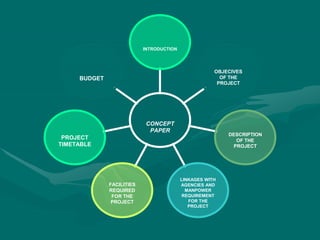
-ONCE A PROJECT OR PROGRAM HAS
BEEN IDENTIFIED, A PAPER
DESCRIBING THE PROJECT SHOULD BE
MADE. THIS IS THE CONCEPT PAPER
BUDGET
PROJECT
TIMETABLE
FACILITIES
REQUIRED
FOR THE
PROJECT
LINKAGES WITH
AGENCIES AND
MANPOWER
REQUIREMENT
FOR THE
PROJECT
DESCRIPTION
OF THE
PROJECT
OBJECIVES
OF THE
PROJECT
INTRODUCTION
CONCEPT
PAPER
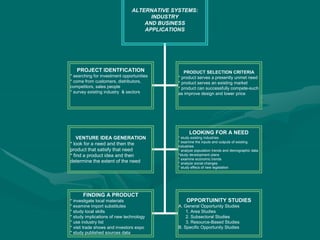
ALTERNATIVE SYSTEMS:
INDUSTRY
AND BUSINESS
APPLICATIONS
PROJECT IDENTFICATION
* searching for investment opportunities
* come from customers, distributors,
competitors, sales people
* survey existing industry & sectors
PRODUCT SELECTION CRITERIA
* product serves a presently unmet need
* product serves an existing market
* product can successfully compete-such
as improve design and lower price
VENTURE IDEA GENERATION
* look for a need and then the
product that satisfy that need
* find a product idea and then
determine the extent of the need
LOOKING FOR A NEED
* study existing industries
* examine the inputs and outputs of existing
industries
* analyze population trends and demographic data
*study development plans
* examine economic trends
* analyze social changes
* study effecs of new legislation
FINDING A PRODUCT
* investigate local materials
* examine import substitutes
* study local skills
* study implications of new technology
* use industry list
* visit trade shows and investors expo
* study published sources data
OPPORTUINITY STUDIES
A. General Opportunity Studies
1. Area Studies
2. Subsectoral Studies
3. Resource-Based Studies
B. Specific Opportunity Studies
PROJECT SELECTION
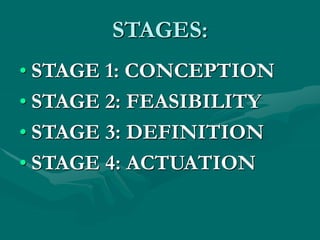
STAGES:
• STAGE 1: CONCEPTION
• STAGE 2: FEASIBILITY
• STAGE 3: DEFINITION
• STAGE 4: ACTUATION
APPLYING TO INDUSTRIES:
1. Study imports
* domestic production
* imports existing market
* suggest opportunities for new projects
2. Investigate Local Materials
* quality or price of raw materials
3. Study Available Skills
* labor and management skills which have already been developed in the area
4. Make Industry Studies
* thorough analysis of existing industries may lead to identifying new project
5.Originate or Apply Technology
re-examining local raw materials and existing products in the light of current
scientific and technical advances
6. Examine Inter-Industry Relationship
* analyzing how the input of industries fit together
7. Evaluate Development Plans
* plans should be studied to discover how they will change the
matter
8. Review Old Projects
* projects previously developed but not implemented often
become feasible as market change
* possible to find opportunities in old ideas
9. Observe Experience Elsewhere
* familiarity with current industrial development in other
countries for suggestion
10. Use Industry List
* are useful for suggesting ideas for making sure nothing is
overlooked
2. Project Feasibility Studies
Project Feasibility Studies, is an integral part of the total
project management cycle
ROLE: to enable top management to make a
decision as to whether or not a project should
be implemented on the basis of the project’s
viability and other factors
Inter-locking Task of Project
Feasibility Study
a. begins with Project Plan
b. then into its execution,
c. termination
d. evaluation
e. and recycling
USES:
1. For Project Proponent or Sponsors
- basis for selecting a viable venture and
exploiting an opportunity
2. For Creditor and Investors
- basis for deciding whether
or not to grant financing to a
proposed opportunity
3. For Project Manager
- basis for implementing the
project and organizing the
different inputs and
4. For Project Team and Staff
- basis for interrelationship
and coordinating their
different functional activities
5. For the Beneficiaries
- basis for examining the
delivery capability of a
project against other
alternatives
6. For National Economy
- it minimizes risks of failure
as well as eliminates poor
ventures
Steps Towards Feasibility Study
1. The Concept Paper– also known as position or
working paper or aide memoire
*The objective is to get top management interest
and support for the idea without diverting
attention on practical points as yet.
2. The Pre-Feasibility Study
– stage wherein it puts together materials or facts
already published or available form various
sources
- reports on the potential project with sufficient
detail to indicate the general promise
- the objective is to get enough facts or data’s that
includes :
a. market study on demand and supply
b. estimated market share of the project
c. marketing program
d. production aspects with emphasis on raw
materials
3. Feasibility Study – referred to as the project
development stage
- this point management makes decision to go
or not to go with the project
- tackles details relating to economic, technical,
organizational and personnel, financial, legal,
and socio-economic aspect of the project
Sub Details of Feasibility Study:
1. The Market Study
Items covered: annual quantity of the product
the selling price of the product
the marketing program
2. The Technical Study
Items covered: product identification/description
manufacturing process/system
machinery and equipments
facilities requirements and specifications
3. The Organizational, Managerial, and Personal
Studies
Items covered: management control
attraction of financing
alternative organizational forms
internal organizational structure
job design analysis
manpower training and
development
4. The Financial Study
Items covered: preparation of financial analysis/ratios
determination of financing scheme and
effective cost of financing
preparation of financial statements
5. The Socio-Economic Study
Items covered: project’s social contributions
foreign exchange reserves
employment
increased business opportunities
increased satisfaction of convenience
by costumer social rate of return
The Linkage of
Feasibility Study
to Project Management
Cycle
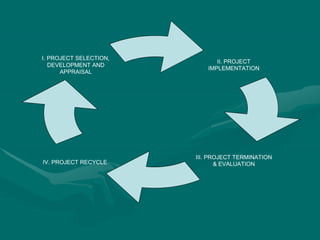
II. PROJECT
IMPLEMENTATION
IV. PROJECT RECYCLE
III. PROJECT TERMINATION
& EVALUATION
I. PROJECT SELECTION,
DEVELOPMENT AND
APPRAISAL
According to PES
4 Indices:
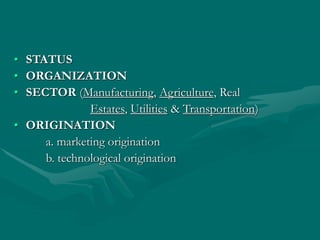
• STATUS
• ORGANIZATION
• SECTOR (Manufacturing, Agriculture, Real
Estates, Utilities & Transportation)
• ORIGINATION
a. marketing origination
b. technological origination
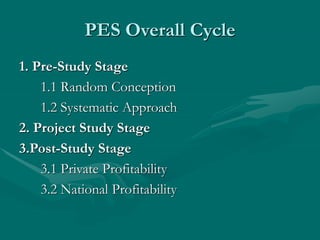
PES Overall Cycle
1. Pre-Study Stage
1.1 Random Conception
1.2 Systematic Approach
2. Project Study Stage
3.Post-Study Stage
3.1 Private Profitability
3.2 National Profitability
PROJECT BUDGETING
AND FUND RAISING
BUDGETING
Purposes:
*to attain certain objectives
*review the institution’s resources or income
*provides analysis for expenditures of the
institution
*limits the program according to its resources
STEPS
1. THE PREPARATION OF THE BUDGET
2. ADOPTION OF THE BUDGET
a. BUDGET PRESENTATION
b. APPROVAL
3. EXECUTION AND CONTROL
CAPITAL EXPENDITURES
EXAMPLES:
1. ADDITIONAL SCHOOL BUILDINGS
2. AIR CONDITIONER SETS
3. FIXTURES
4. EQUIPMENTS
5. OR SCHOOL BUSES
THE BUDGET COMMITTEE
Basic Duties:
* establishes the guiding principle,
* the direction,
* execution of all budget
procedures
ADVANCES OF BUDGETING
it is one of the most important
areas of management decision
among administrators
FUND RAISING
PACKAGING PROPOSALS
there is no single format for wiring
project proposals
SAMPLE PROCEDURES:
1. INTRODUCTION AND SUMMARY
2. THE NEED
3. THE OBJECTIVES
4. THE METHODS
5. THE BUDGET
6. THE ORGANIZATION (QUALIFICATIONS)
7. THE EVALUATION
8. THE ADDENDUM OR EXHIBITS
NOTE:
The Objectives should be a direct
outgrowth of the “need”
The Methods shall be directly
dependent upon the “objectives”
The Budget shall, in turn, be
determined by the “methods”
MECHANICS OF CAMPAIGN
1. THE GOAL SET IN THE FUND
CAMPAIGN
2. A CASE STATEMENT
3. THE MASTERPLAN OF THE FUND
CAMPAIGN
4. LEADERSHIP
QUALITIES OF A LEADER
• SALESMANSHIP
• COMMUNICATION SKILLS
• INGENUITY AND FLEXIBILITY
• RESEARCH SKILLS
• ADMINISTRATIVE SKILLS
• GOOD HUMAN RELATIONS
• PERSISTENCE AND DEDICATION
THANK YOU
VERY MUCH
END OF PRESENTATION
BY
KENN NORWAY B. MARZADO

Phases of Management.ppt

  • 1.
  • 2.
    1. Project Identification,Definition and Selection • PROJECT IDENTIFICATION – discussions toward the concepts essential for thorough search process and specially for a meaningful evaluation of opportunities
  • 3.
    THE VIEWING PROCESS (forecasting-an equally important tool in environmental scanning) a. whether the viewer perceives an issue to be relevant or not b. whether more information is needed or not c. whether the consequences are great or the matter is current.
  • 4.
    WAYS OF THEVIEWING PROCESS • undirected viewing • conditioned viewing • informal search • formal search
  • 5.
    KEY ELEMENTS: 1. beneficiaryof the viewing process 2. the location and level of the unit or person performing the viewing function 3. the geographical scope 4. the relative formality of the procedure 5. the opportunity orientation 6. the inherent bias of the viewing process 7. the problems related to the credibility that arise when viewing the environment
  • 6.
    The Screening Process (processesthe output of Phase 1 the viewing process)
  • 7.
    Four Steps: 1. Determinationof requirements or needs in the fields of education and training
  • 8.
    2: Determination of growthobjectives and contribution to nation building
  • 9.
    3: Evaluation ofBarriers to entry: * Technology available from various sources. * Project cost on the high scale * Manpower resources
  • 10.
    4: Consideration ofsubjective preferences * Addresses appropriate needs * Based on some key advantage * Follows thrust consistent with perceived trends * Provides desirable side-effects - within the institution - for the country - for the students
  • 11.
    *The output ofthe screening process is the profile of opportunities that the educational institution can address itself to. It will show the requirements of success in that particular opportunity. It will show conditions or factors which bring about the opportunity and which if removed will correspondingly make the option disappear.
  • 12.
    PROJECT DEFINITION – (dictionary,CONCEPT is ‘an idea, especially a generalized idea of a class of objectives; a thought; general action”. -ONCE A PROJECT OR PROGRAM HAS BEEN IDENTIFIED, A PAPER DESCRIBING THE PROJECT SHOULD BE MADE. THIS IS THE CONCEPT PAPER
  • 13.
    BUDGET PROJECT TIMETABLE FACILITIES REQUIRED FOR THE PROJECT LINKAGES WITH AGENCIESAND MANPOWER REQUIREMENT FOR THE PROJECT DESCRIPTION OF THE PROJECT OBJECIVES OF THE PROJECT INTRODUCTION CONCEPT PAPER
  • 14.
    ALTERNATIVE SYSTEMS: INDUSTRY AND BUSINESS APPLICATIONS PROJECTIDENTFICATION * searching for investment opportunities * come from customers, distributors, competitors, sales people * survey existing industry & sectors PRODUCT SELECTION CRITERIA * product serves a presently unmet need * product serves an existing market * product can successfully compete-such as improve design and lower price VENTURE IDEA GENERATION * look for a need and then the product that satisfy that need * find a product idea and then determine the extent of the need LOOKING FOR A NEED * study existing industries * examine the inputs and outputs of existing industries * analyze population trends and demographic data *study development plans * examine economic trends * analyze social changes * study effecs of new legislation FINDING A PRODUCT * investigate local materials * examine import substitutes * study local skills * study implications of new technology * use industry list * visit trade shows and investors expo * study published sources data OPPORTUINITY STUDIES A. General Opportunity Studies 1. Area Studies 2. Subsectoral Studies 3. Resource-Based Studies B. Specific Opportunity Studies
  • 15.
  • 16.
    STAGES: • STAGE 1:CONCEPTION • STAGE 2: FEASIBILITY • STAGE 3: DEFINITION • STAGE 4: ACTUATION
  • 17.
    APPLYING TO INDUSTRIES: 1.Study imports * domestic production * imports existing market * suggest opportunities for new projects 2. Investigate Local Materials * quality or price of raw materials 3. Study Available Skills * labor and management skills which have already been developed in the area 4. Make Industry Studies * thorough analysis of existing industries may lead to identifying new project 5.Originate or Apply Technology re-examining local raw materials and existing products in the light of current scientific and technical advances
  • 18.
    6. Examine Inter-IndustryRelationship * analyzing how the input of industries fit together 7. Evaluate Development Plans * plans should be studied to discover how they will change the matter 8. Review Old Projects * projects previously developed but not implemented often become feasible as market change * possible to find opportunities in old ideas 9. Observe Experience Elsewhere * familiarity with current industrial development in other countries for suggestion 10. Use Industry List * are useful for suggesting ideas for making sure nothing is overlooked
  • 19.
    2. Project FeasibilityStudies Project Feasibility Studies, is an integral part of the total project management cycle ROLE: to enable top management to make a decision as to whether or not a project should be implemented on the basis of the project’s viability and other factors
  • 20.
    Inter-locking Task ofProject Feasibility Study a. begins with Project Plan b. then into its execution, c. termination d. evaluation e. and recycling
  • 21.
    USES: 1. For ProjectProponent or Sponsors - basis for selecting a viable venture and exploiting an opportunity
  • 22.
    2. For Creditorand Investors - basis for deciding whether or not to grant financing to a proposed opportunity
  • 23.
    3. For ProjectManager - basis for implementing the project and organizing the different inputs and
  • 24.
    4. For ProjectTeam and Staff - basis for interrelationship and coordinating their different functional activities
  • 25.
    5. For theBeneficiaries - basis for examining the delivery capability of a project against other alternatives
  • 26.
    6. For NationalEconomy - it minimizes risks of failure as well as eliminates poor ventures
  • 27.
    Steps Towards FeasibilityStudy 1. The Concept Paper– also known as position or working paper or aide memoire *The objective is to get top management interest and support for the idea without diverting attention on practical points as yet.
  • 28.
    2. The Pre-FeasibilityStudy – stage wherein it puts together materials or facts already published or available form various sources - reports on the potential project with sufficient detail to indicate the general promise - the objective is to get enough facts or data’s that includes :
  • 29.
    a. market studyon demand and supply b. estimated market share of the project c. marketing program d. production aspects with emphasis on raw materials
  • 30.
    3. Feasibility Study– referred to as the project development stage - this point management makes decision to go or not to go with the project - tackles details relating to economic, technical, organizational and personnel, financial, legal, and socio-economic aspect of the project
  • 31.
    Sub Details ofFeasibility Study: 1. The Market Study Items covered: annual quantity of the product the selling price of the product the marketing program 2. The Technical Study Items covered: product identification/description manufacturing process/system machinery and equipments facilities requirements and specifications
  • 32.
    3. The Organizational,Managerial, and Personal Studies Items covered: management control attraction of financing alternative organizational forms internal organizational structure job design analysis manpower training and development
  • 33.
    4. The FinancialStudy Items covered: preparation of financial analysis/ratios determination of financing scheme and effective cost of financing preparation of financial statements 5. The Socio-Economic Study Items covered: project’s social contributions foreign exchange reserves employment increased business opportunities increased satisfaction of convenience by costumer social rate of return
  • 34.
    The Linkage of FeasibilityStudy to Project Management Cycle
  • 35.
    II. PROJECT IMPLEMENTATION IV. PROJECTRECYCLE III. PROJECT TERMINATION & EVALUATION I. PROJECT SELECTION, DEVELOPMENT AND APPRAISAL
  • 36.
  • 37.
    • STATUS • ORGANIZATION •SECTOR (Manufacturing, Agriculture, Real Estates, Utilities & Transportation) • ORIGINATION a. marketing origination b. technological origination
  • 38.
    PES Overall Cycle 1.Pre-Study Stage 1.1 Random Conception 1.2 Systematic Approach 2. Project Study Stage 3.Post-Study Stage 3.1 Private Profitability 3.2 National Profitability
  • 39.
  • 40.
    BUDGETING Purposes: *to attain certainobjectives *review the institution’s resources or income *provides analysis for expenditures of the institution *limits the program according to its resources
  • 41.
    STEPS 1. THE PREPARATIONOF THE BUDGET 2. ADOPTION OF THE BUDGET a. BUDGET PRESENTATION b. APPROVAL 3. EXECUTION AND CONTROL
  • 42.
    CAPITAL EXPENDITURES EXAMPLES: 1. ADDITIONALSCHOOL BUILDINGS 2. AIR CONDITIONER SETS 3. FIXTURES 4. EQUIPMENTS 5. OR SCHOOL BUSES
  • 43.
    THE BUDGET COMMITTEE BasicDuties: * establishes the guiding principle, * the direction, * execution of all budget procedures
  • 44.
    ADVANCES OF BUDGETING itis one of the most important areas of management decision among administrators
  • 45.
  • 46.
    PACKAGING PROPOSALS there isno single format for wiring project proposals SAMPLE PROCEDURES: 1. INTRODUCTION AND SUMMARY 2. THE NEED 3. THE OBJECTIVES 4. THE METHODS 5. THE BUDGET 6. THE ORGANIZATION (QUALIFICATIONS) 7. THE EVALUATION 8. THE ADDENDUM OR EXHIBITS
  • 47.
    NOTE: The Objectives shouldbe a direct outgrowth of the “need”
  • 48.
    The Methods shallbe directly dependent upon the “objectives”
  • 49.
    The Budget shall,in turn, be determined by the “methods”
  • 50.
    MECHANICS OF CAMPAIGN 1.THE GOAL SET IN THE FUND CAMPAIGN 2. A CASE STATEMENT 3. THE MASTERPLAN OF THE FUND CAMPAIGN 4. LEADERSHIP
  • 51.
    QUALITIES OF ALEADER • SALESMANSHIP • COMMUNICATION SKILLS • INGENUITY AND FLEXIBILITY • RESEARCH SKILLS • ADMINISTRATIVE SKILLS • GOOD HUMAN RELATIONS • PERSISTENCE AND DEDICATION
  • 52.
    THANK YOU VERY MUCH ENDOF PRESENTATION BY KENN NORWAY B. MARZADO