By
SHRINIVAS B. KOREWAR (ROLL NO:5)
ABHIJEET B. BHOSALE(ROLL NO:14)
Feasibility Report
What is feasibility study?
• A feasibility study is an analysis of the viability of an idea through a
disciplined and documented process of thinking through the idea from
its logical beginning to its logical end.
• Feasibility study is carried out in order to assess the viability of a new
project
• It is primary and most important thing in development of a project
Reasons to Do a Study
• Gives focus to the project.
• Narrows the business alternatives.
• Identifies new opportunities.
• Identifies reasons not to proceed.
• Provides valuable information for “go/no go” decision.
• Increases probability of business success by identifying weaknesses
early.
• Provides documentation that the idea was thoroughly investigated.
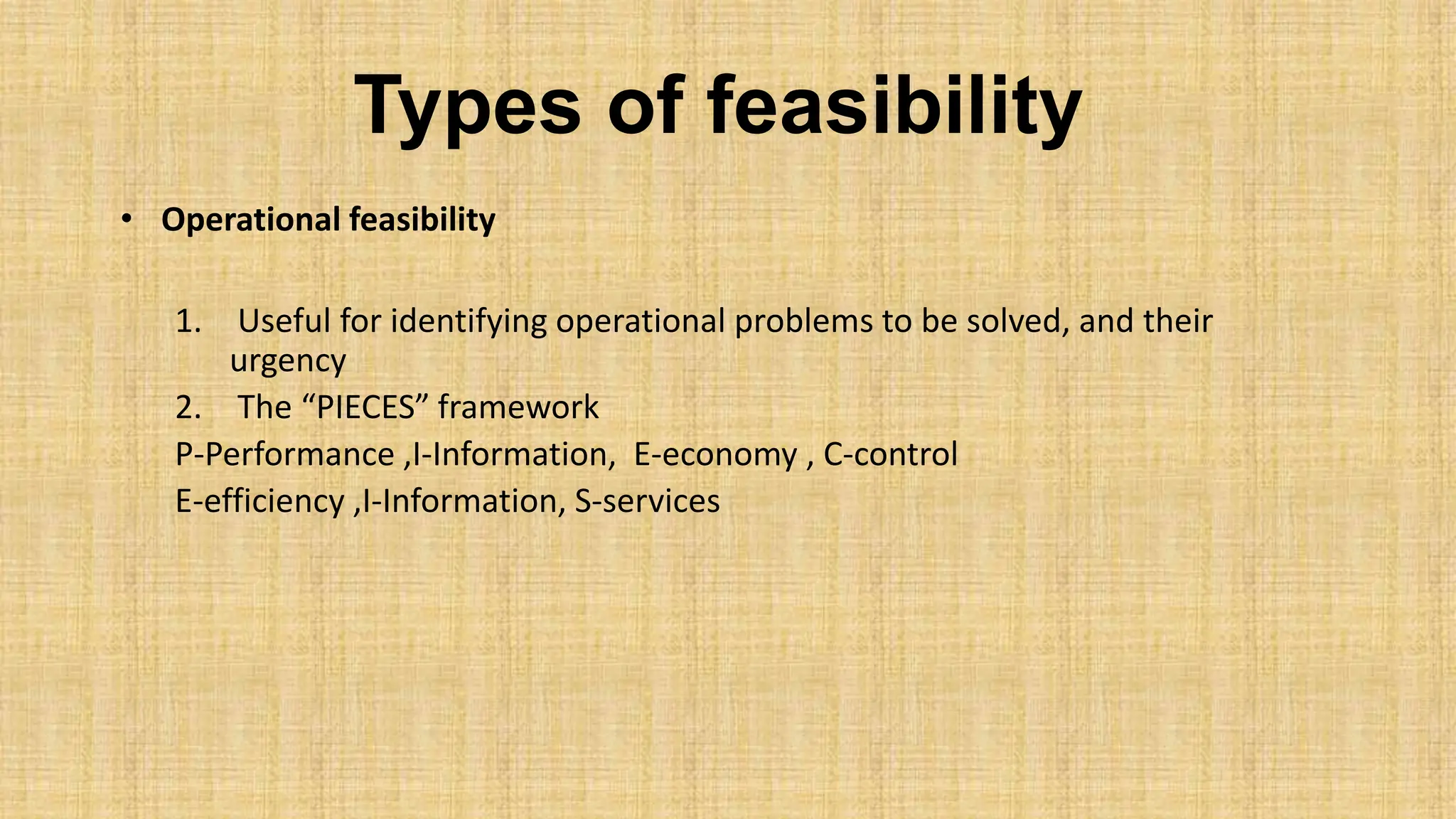
Types of feasibility
• Operational feasibility
1. Useful for identifying operational problems to be solved, and their
urgency
2. The “PIECES” framework
P-Performance ,I-Information, E-economy , C-control
E-efficiency ,I-Information, S-services
Types of feasibility
• Market Feasibility
1. Determine facility needs.
2. Suitability of production technology.
3. Availability and suitable of site.
4. Raw materials.
5. Other inputs
Types of feasibility
• Financial/Economic Feasibility
1. Estimate the total capital requirements.
2. Estimate equity and credit needs.
3. Budget expected costs and returns
• Organizational/Managerial Feasibility
1. Business Structure
2. Business Founders
• Environmental feasibility
Environmental impact and their assessment
Types of feasibility
• Legal feasibility
1. Is the project legally feasible?
2. Legal requirements.
Feasibility report
• A feasibility report is the results of a feasibility study. This report
details whether or not a project should be undertaken and the reasons
for that decision.
• Report Content
1. Introduction/Executive Summary
2. Background
3. outline of project
4. Methodology/method of analysis
5. Overview of alternatives
6. Conclusion
7. Recommendation
Introduction/Executive
summary
1. It state objective of the report and of the project
2. It should refer terms of references
3. Also it should state the constraints within which it has been
conducted
4. Executive summary:
This should concise summary of the major recommendations of
the report within 6 pages so that it quickly understood by senior
executive
Background
• Some feasibility reports may require some background discussion
in order to make the rest of the report meaningful to readers.
• Describe your proposed plan in sufficient detail state if it worked
elsewhere and how it was implemented
• Background on the Situation. For many feasibility reports, you'll
need to discuss the problem, need, or opportunity that has
brought about this report.
Outline of system
• Outline of system involves description of project
• List type and quality of product(s) or service(s) to be marketed.
• Outline the general business model (ie. how the business will make
money).
• Include the technical processes, size, location, and kind of inputs.
• Specify the time horizon from the time the project is initiated until it is
up and running at capacity.
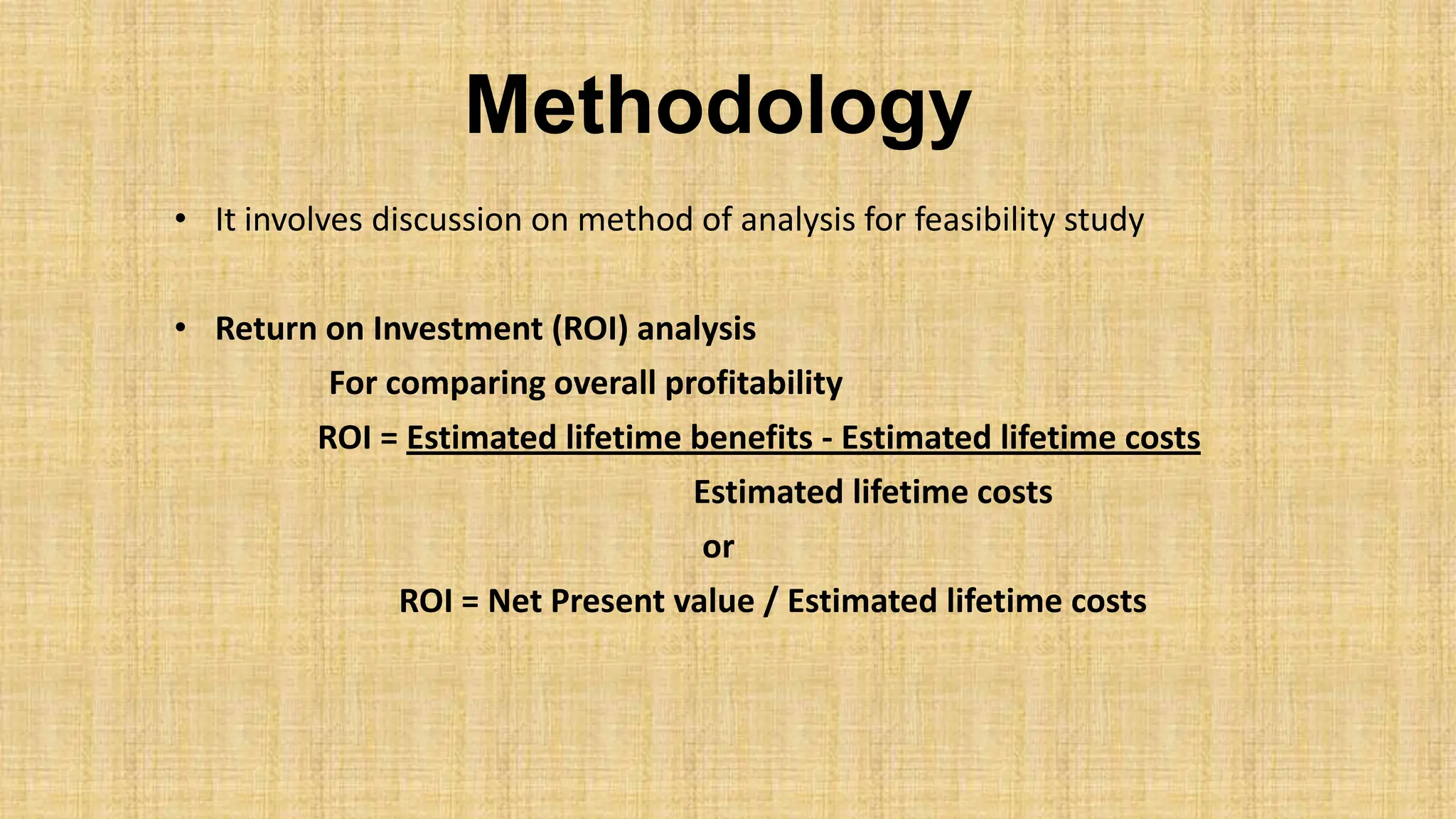
Methodology
• It involves discussion on method of analysis for feasibility study
• Return on Investment (ROI) analysis
For comparing overall profitability
ROI = Estimated lifetime benefits - Estimated lifetime costs
Estimated lifetime costs
or
ROI = Net Present value / Estimated lifetime costs
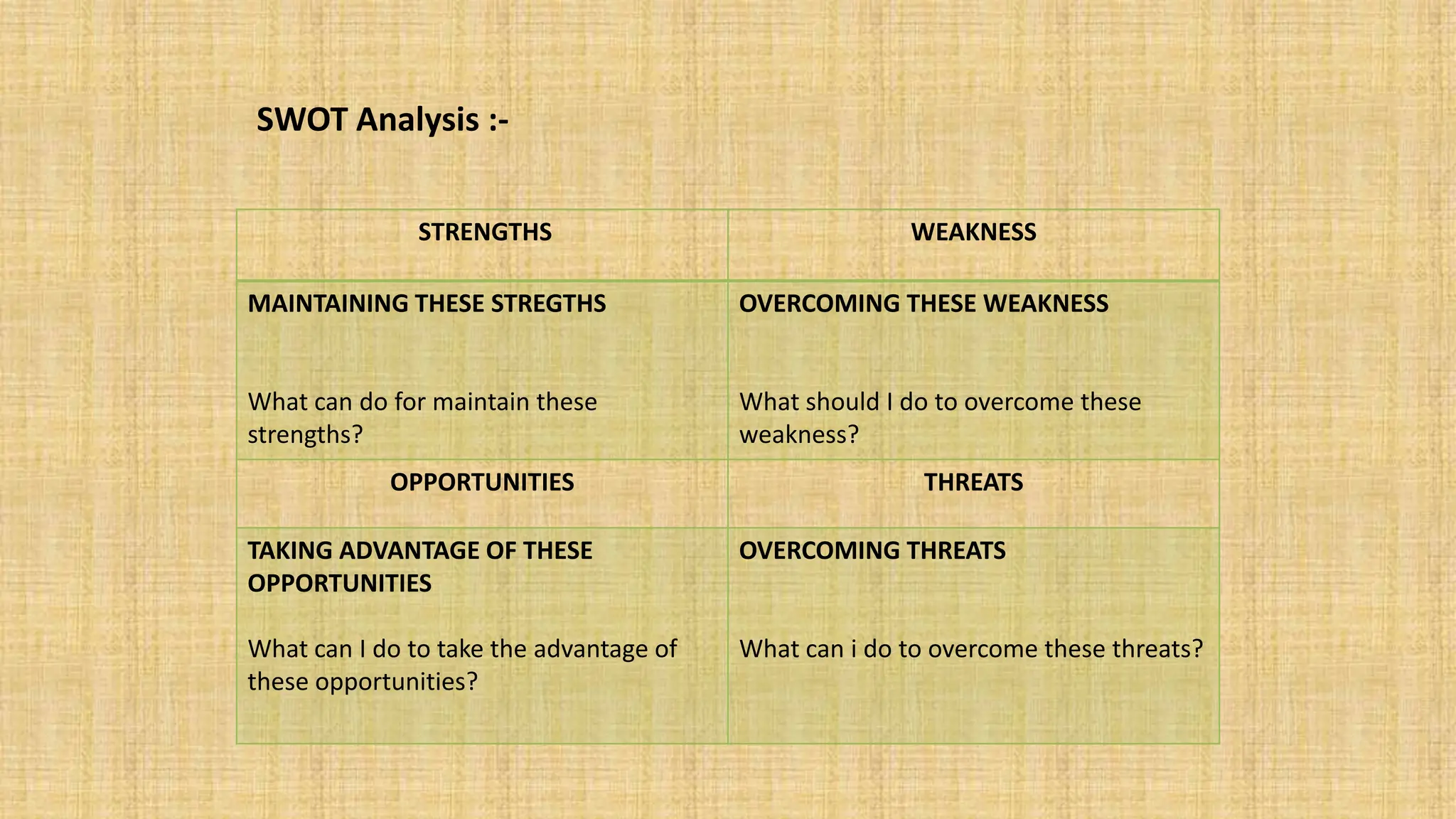
STRENGTHS WEAKNESS
MAINTAINING THESE STREGTHS
What can do for maintain these
strengths?
OVERCOMING THESE WEAKNESS
What should I do to overcome these
weakness?
OPPORTUNITIES THREATS
TAKING ADVANTAGE OF THESE
OPPORTUNITIES
What can I do to take the advantage of
these opportunities?
OVERCOMING THREATS
What can i do to overcome these threats?
SWOT Analysis :-
Overview of alternatives
• Possible alternatives
• “Sticking with the current system” should always be studied as one
alternative
• Different business processes for solving the problems
• Different levels/types of computerization for the solutions
• Advantages and disadvantages of the alternatives
• The major possible alternatives should be discussed and compared
using clearly defined criteria.
1. Estimate Equity and Credit Needs
• Identify alternative equity sources and capital availability
 Producers, Local Investors, Angel Investors, Venture Capitalists
• Identify and assess alternative credit sources.
 Banks, Government (direct loans or loan guarantees), Grants,
 Local and State Economic Development Incentives.
• Assess expected financing needs and alternative sources.
 Interest Rates, Terms, Conditions, Etc.
2. Cost and benefits evaluation
• It demonstrate how this proposal is feasible
• It involves discussion technological feasibility, economic
practicality, social desirability, and ecological soundness
• Examples of benefits
1. cost reductions
2. error reductions
3. increased throughput
4. increased flexibility of operation
5. improved operation
6. better (e.g., more accurate) and more timely information.
• Types of costs
Development costs purchasing cost, Installation cost, operational
cost
Conclusion
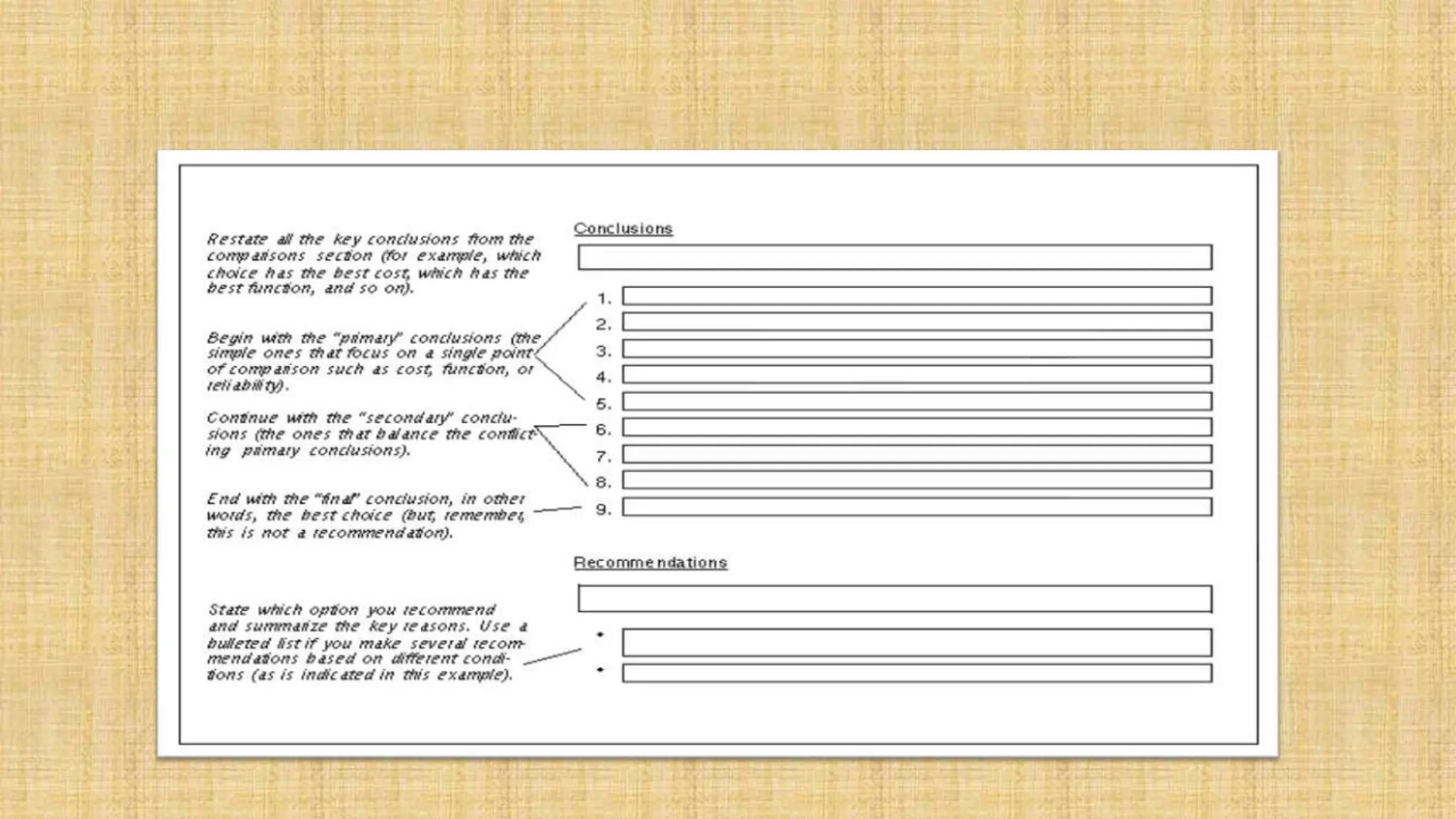
• The conclusions section of a feasibility is the restatement of the
conclusions you have already reached in the comparison sections. In
this section, you restate the individual conclusions, for example, which
model had the best price, which had the best battery function, and so
on.
• It must untangle all the conflicting conclusions and somehow reach
the final conclusion, which is the one that states which is the best
choice
Recommendation
• The final section of feasibility reports states the recommendation.
• The recommendation section should echo the most important
conclusions leading to the recommendation and then state the
recommendation emphatically.
• the basis for that judgment has to be stated somewhere in the
requirements section.
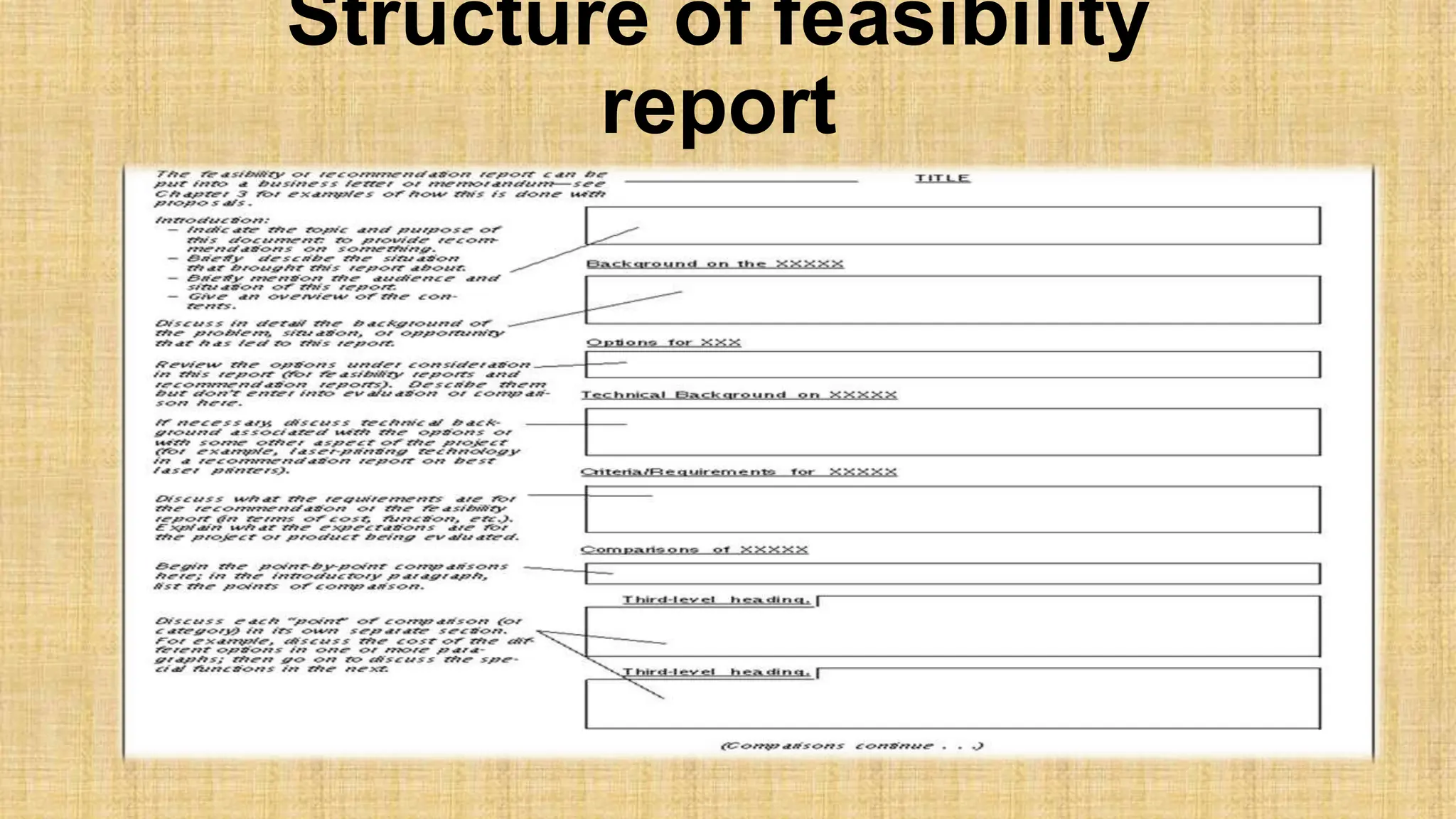
Structure of feasibility
report
Example of feasibility report on Waste
water system
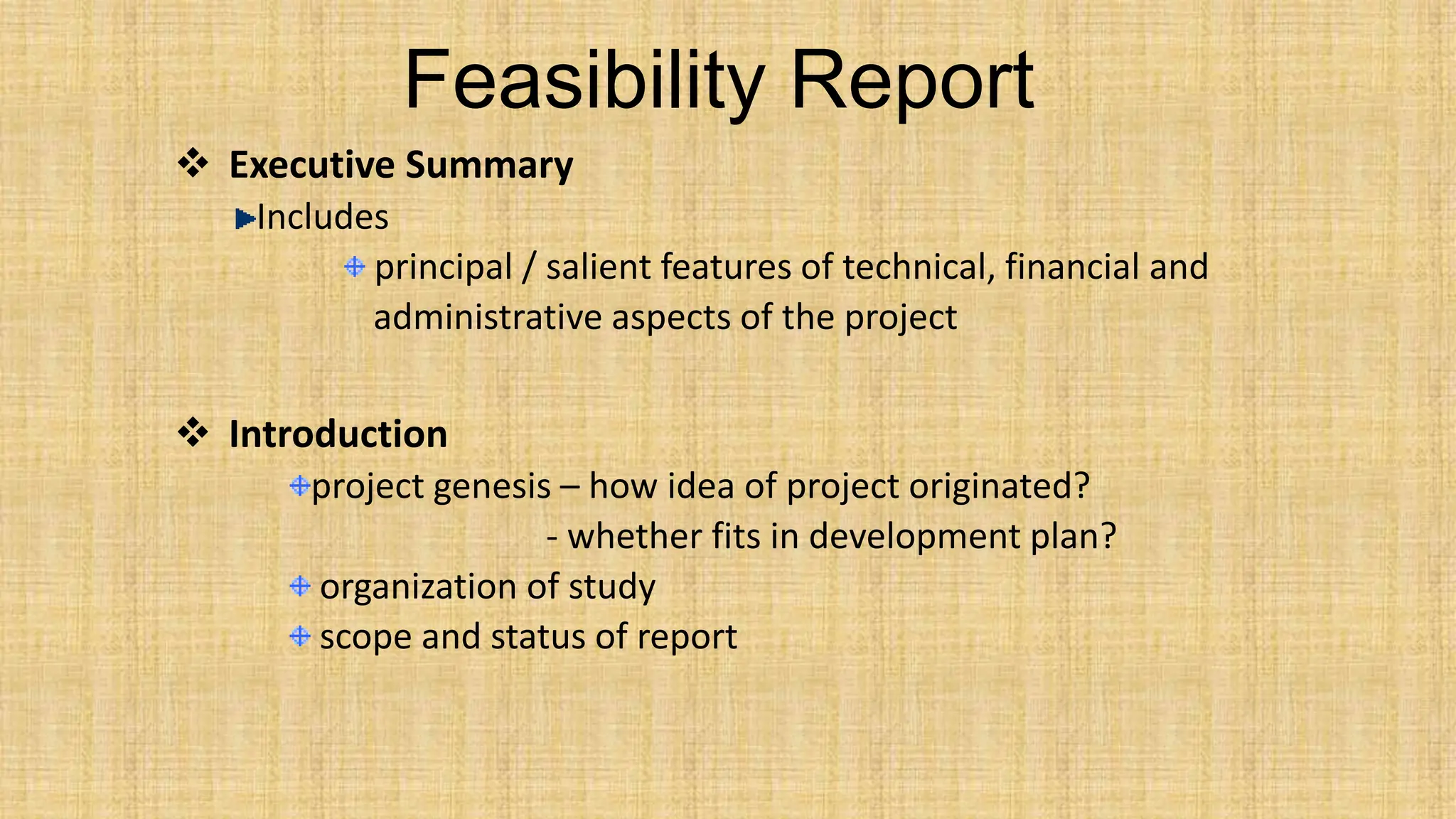
Feasibility Report
 Executive Summary
Includes
principal / salient features of technical, financial and
administrative aspects of the project
 Introduction
project genesis – how idea of project originated?
- whether fits in development plan?
organization of study
scope and status of report
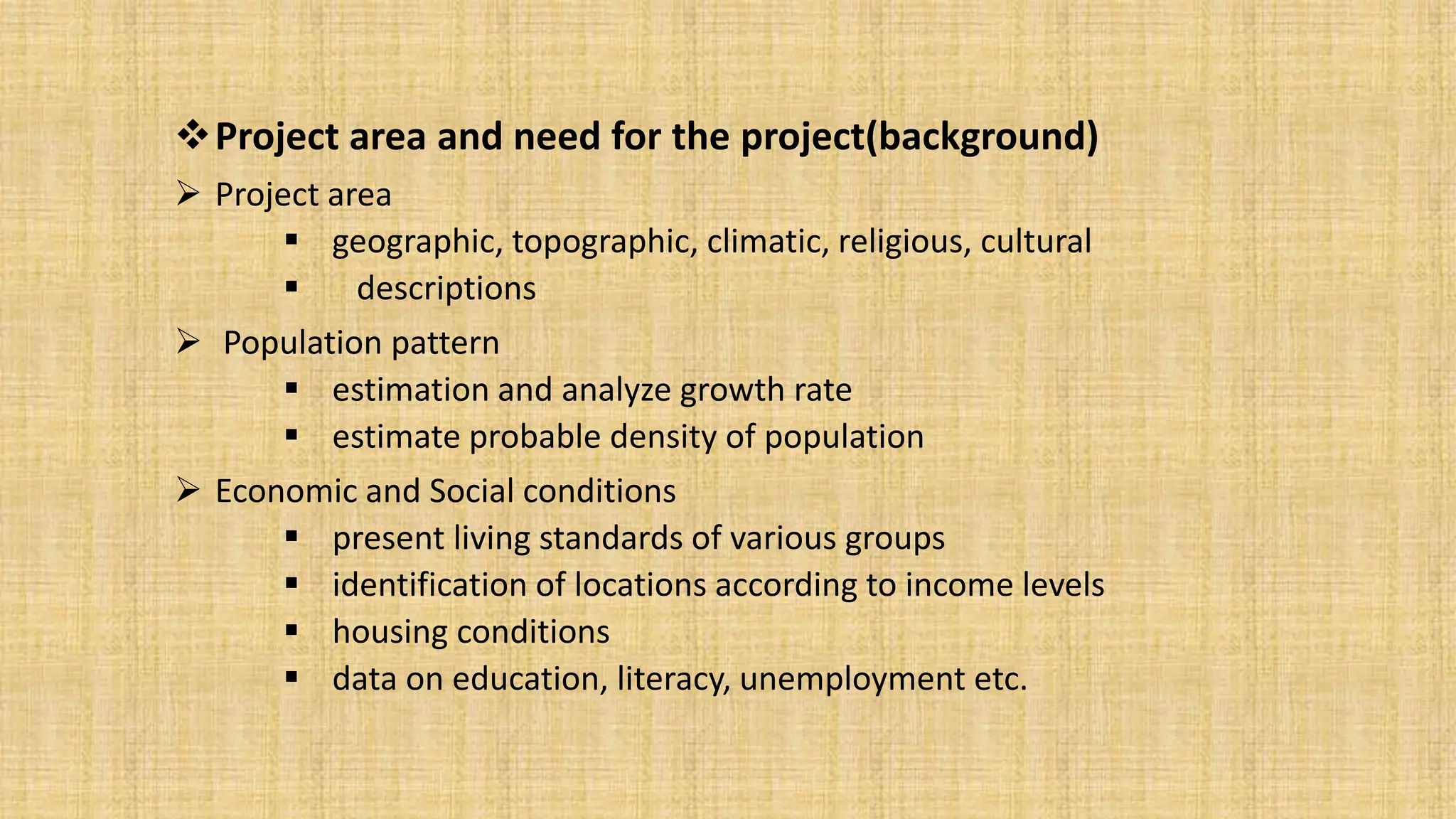
Project area and need for the project(background)
 Project area
 geographic, topographic, climatic, religious, cultural
 descriptions
 Population pattern
 estimation and analyze growth rate
 estimate probable density of population
 Economic and Social conditions
 present living standards of various groups
 identification of locations according to income levels
 housing conditions
 data on education, literacy, unemployment etc.
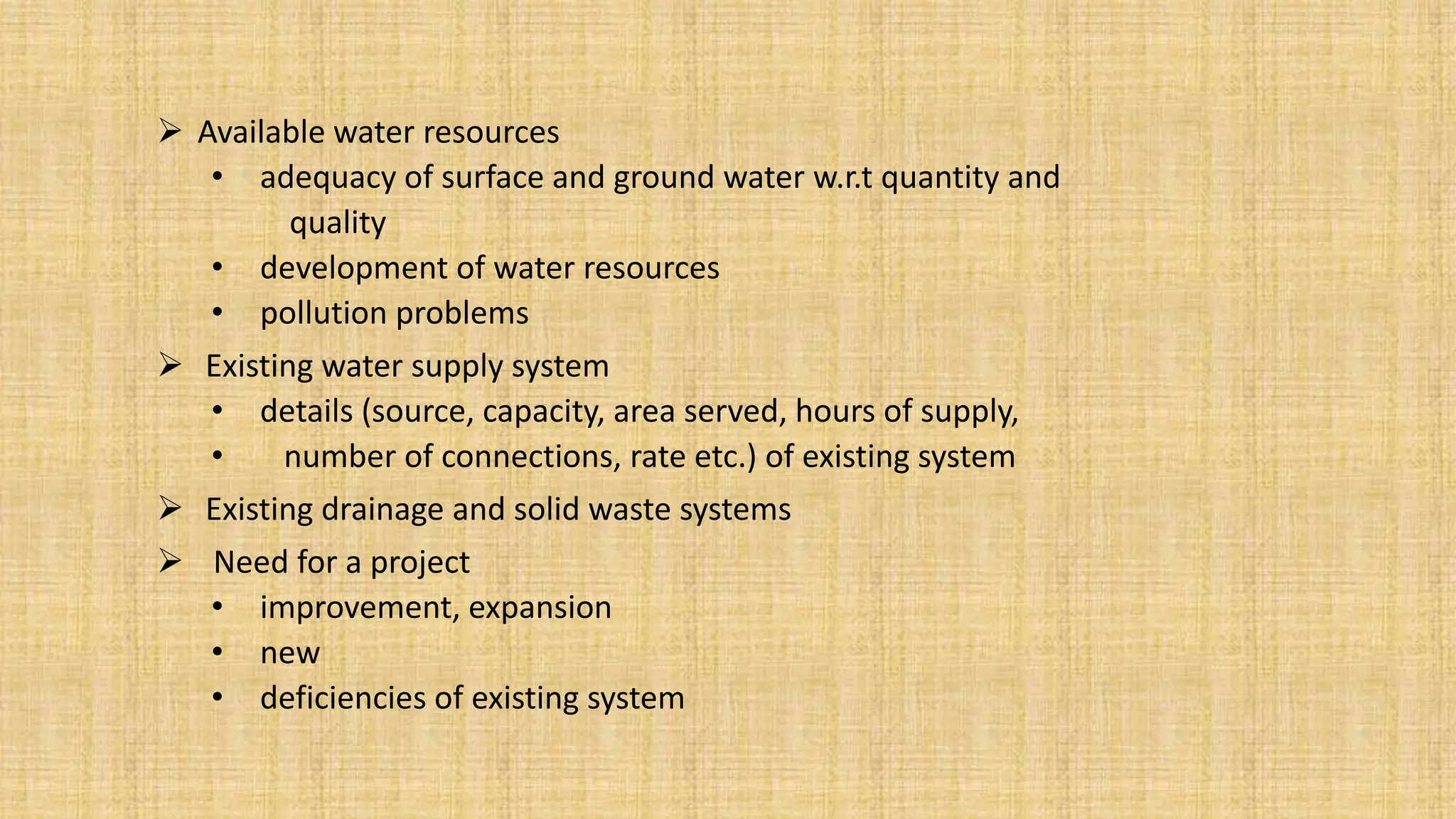
 Available water resources
• adequacy of surface and ground water w.r.t quantity and
quality
• development of water resources
• pollution problems
 Existing water supply system
• details (source, capacity, area served, hours of supply,
• number of connections, rate etc.) of existing system
 Existing drainage and solid waste systems
 Need for a project
• improvement, expansion
• new
• deficiencies of existing system
Proposed project (water supply scheme outline)
 Details of the project
 rehabilitation of the existing facility
 construction of new facility
 alternative designs
 selection of sources
 alternative layouts of rising mains
 alternative sites of WTP & ESRs
 training schemes for O & M
 consultancy services needed
 Components of project
 thoroughly described with necessary topo- maps
 location maps
 technical information
 engg. design & drawings
 Implementation schedule (CPM/PERT)
 Cost Estimates
 capital investment (for all components)
 recurring cost (annual)
 Impact on the environment
 Institutional responsibilities (Identification of organizations)
 approval
 funding
 implementation
 O & M
Financial plan
Source of fund
Interest on loan
Recurring expenses
Annual burden
Conclusion
Summary of findings and results of FR
Review of need
Recommended alternative scope, coverage and components
Capital cost and tentative financing plan
Urgency for implementation
Recommendation
Specify all action for completion
Mention of detailed investigation, data collection and operational studies
feasibilityreport-131027121529-phpapp01 (1).pdf

feasibilityreport-131027121529-phpapp01 (1).pdf

  • 1.
    By SHRINIVAS B. KOREWAR(ROLL NO:5) ABHIJEET B. BHOSALE(ROLL NO:14) Feasibility Report
  • 2.
    What is feasibilitystudy? • A feasibility study is an analysis of the viability of an idea through a disciplined and documented process of thinking through the idea from its logical beginning to its logical end. • Feasibility study is carried out in order to assess the viability of a new project • It is primary and most important thing in development of a project
  • 3.
    Reasons to Doa Study • Gives focus to the project. • Narrows the business alternatives. • Identifies new opportunities. • Identifies reasons not to proceed. • Provides valuable information for “go/no go” decision. • Increases probability of business success by identifying weaknesses early. • Provides documentation that the idea was thoroughly investigated.
  • 4.
    Types of feasibility •Operational feasibility 1. Useful for identifying operational problems to be solved, and their urgency 2. The “PIECES” framework P-Performance ,I-Information, E-economy , C-control E-efficiency ,I-Information, S-services
  • 5.
    Types of feasibility •Market Feasibility 1. Determine facility needs. 2. Suitability of production technology. 3. Availability and suitable of site. 4. Raw materials. 5. Other inputs
  • 6.
    Types of feasibility •Financial/Economic Feasibility 1. Estimate the total capital requirements. 2. Estimate equity and credit needs. 3. Budget expected costs and returns • Organizational/Managerial Feasibility 1. Business Structure 2. Business Founders • Environmental feasibility Environmental impact and their assessment
  • 7.
    Types of feasibility •Legal feasibility 1. Is the project legally feasible? 2. Legal requirements.
  • 8.
    Feasibility report • Afeasibility report is the results of a feasibility study. This report details whether or not a project should be undertaken and the reasons for that decision. • Report Content 1. Introduction/Executive Summary 2. Background 3. outline of project 4. Methodology/method of analysis 5. Overview of alternatives 6. Conclusion 7. Recommendation
  • 9.
    Introduction/Executive summary 1. It stateobjective of the report and of the project 2. It should refer terms of references 3. Also it should state the constraints within which it has been conducted 4. Executive summary: This should concise summary of the major recommendations of the report within 6 pages so that it quickly understood by senior executive
  • 10.
    Background • Some feasibilityreports may require some background discussion in order to make the rest of the report meaningful to readers. • Describe your proposed plan in sufficient detail state if it worked elsewhere and how it was implemented • Background on the Situation. For many feasibility reports, you'll need to discuss the problem, need, or opportunity that has brought about this report.
  • 11.
    Outline of system •Outline of system involves description of project • List type and quality of product(s) or service(s) to be marketed. • Outline the general business model (ie. how the business will make money). • Include the technical processes, size, location, and kind of inputs. • Specify the time horizon from the time the project is initiated until it is up and running at capacity.
  • 12.
    Methodology • It involvesdiscussion on method of analysis for feasibility study • Return on Investment (ROI) analysis For comparing overall profitability ROI = Estimated lifetime benefits - Estimated lifetime costs Estimated lifetime costs or ROI = Net Present value / Estimated lifetime costs
  • 13.
    STRENGTHS WEAKNESS MAINTAINING THESESTREGTHS What can do for maintain these strengths? OVERCOMING THESE WEAKNESS What should I do to overcome these weakness? OPPORTUNITIES THREATS TAKING ADVANTAGE OF THESE OPPORTUNITIES What can I do to take the advantage of these opportunities? OVERCOMING THREATS What can i do to overcome these threats? SWOT Analysis :-
  • 14.
    Overview of alternatives •Possible alternatives • “Sticking with the current system” should always be studied as one alternative • Different business processes for solving the problems • Different levels/types of computerization for the solutions • Advantages and disadvantages of the alternatives • The major possible alternatives should be discussed and compared using clearly defined criteria.
  • 15.
    1. Estimate Equityand Credit Needs • Identify alternative equity sources and capital availability  Producers, Local Investors, Angel Investors, Venture Capitalists • Identify and assess alternative credit sources.  Banks, Government (direct loans or loan guarantees), Grants,  Local and State Economic Development Incentives. • Assess expected financing needs and alternative sources.  Interest Rates, Terms, Conditions, Etc.
  • 16.
    2. Cost andbenefits evaluation • It demonstrate how this proposal is feasible • It involves discussion technological feasibility, economic practicality, social desirability, and ecological soundness • Examples of benefits 1. cost reductions 2. error reductions 3. increased throughput 4. increased flexibility of operation 5. improved operation 6. better (e.g., more accurate) and more timely information.
  • 17.
    • Types ofcosts Development costs purchasing cost, Installation cost, operational cost
  • 18.
    Conclusion • The conclusionssection of a feasibility is the restatement of the conclusions you have already reached in the comparison sections. In this section, you restate the individual conclusions, for example, which model had the best price, which had the best battery function, and so on. • It must untangle all the conflicting conclusions and somehow reach the final conclusion, which is the one that states which is the best choice
  • 19.
    Recommendation • The finalsection of feasibility reports states the recommendation. • The recommendation section should echo the most important conclusions leading to the recommendation and then state the recommendation emphatically. • the basis for that judgment has to be stated somewhere in the requirements section.
  • 20.
  • 22.
    Example of feasibilityreport on Waste water system
  • 23.
    Feasibility Report  ExecutiveSummary Includes principal / salient features of technical, financial and administrative aspects of the project  Introduction project genesis – how idea of project originated? - whether fits in development plan? organization of study scope and status of report
  • 24.
    Project area andneed for the project(background)  Project area  geographic, topographic, climatic, religious, cultural  descriptions  Population pattern  estimation and analyze growth rate  estimate probable density of population  Economic and Social conditions  present living standards of various groups  identification of locations according to income levels  housing conditions  data on education, literacy, unemployment etc.
  • 25.
     Available waterresources • adequacy of surface and ground water w.r.t quantity and quality • development of water resources • pollution problems  Existing water supply system • details (source, capacity, area served, hours of supply, • number of connections, rate etc.) of existing system  Existing drainage and solid waste systems  Need for a project • improvement, expansion • new • deficiencies of existing system
  • 26.
    Proposed project (watersupply scheme outline)  Details of the project  rehabilitation of the existing facility  construction of new facility  alternative designs  selection of sources  alternative layouts of rising mains  alternative sites of WTP & ESRs  training schemes for O & M  consultancy services needed  Components of project  thoroughly described with necessary topo- maps  location maps  technical information  engg. design & drawings
  • 27.
     Implementation schedule(CPM/PERT)  Cost Estimates  capital investment (for all components)  recurring cost (annual)  Impact on the environment  Institutional responsibilities (Identification of organizations)  approval  funding  implementation  O & M
  • 28.
    Financial plan Source offund Interest on loan Recurring expenses Annual burden
  • 29.
    Conclusion Summary of findingsand results of FR Review of need Recommended alternative scope, coverage and components Capital cost and tentative financing plan Urgency for implementation
  • 30.
    Recommendation Specify all actionfor completion Mention of detailed investigation, data collection and operational studies