WAREHOUSE MANAGEMENT
SYSTEM
ECE361, INDUSTRIAL AUTOMATION
CA-3
Made by:
Nimish Arora
11405752
E1408 A05
Introduction
 A warehouse management system (WMS) is a software and
hardware application that supports the day-to-day
operations in a warehouse.
 Early warehouse management systems could only provide
simple storage location functionality.
 But now WMS programs enable centralized management of
tasks such as tracking inventory levels and stock locations
by using high-end systems which may include tracking and
routing technologies such as Radio Frequency Identification
(RFID) and voice recognition.
 The goal of a warehouse management system is to provide
management with the information it needs to efficiently
control the movement of materials within a warehouse.
Problems in
Warehouse industry
End-Customer Satisfaction
Discrepancies in Shipping Cost
Managing the Scale Error-free
Seasonal Demand Surge
Varied Payload Types
Effective Space Utilization
Role of Automation
Benefits of automation in warehouse management:
 Increased pick accuracy
 Increased pick productivity
 Increased stock accuracy
 Reduction of administration
 Reduced warehouse footprint.
 Lower building costs
 Maximum possible usage of available floor space
and building height.
 Increase storage capacity by up to 400%
 Safer operations
 Increased reliability
 Reduced running costs
 Better return on investment (ROI)
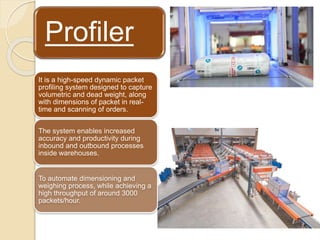
Profiler
It is a high-speed dynamic packet
profiling system designed to capture
volumetric and dead weight, along
with dimensions of packet in real-
time and scanning of orders.
The system enables increased
accuracy and productivity during
inbound and outbound processes
inside warehouses.
To automate dimensioning and
weighing process, while achieving a
high throughput of around 3000
packets/hour.
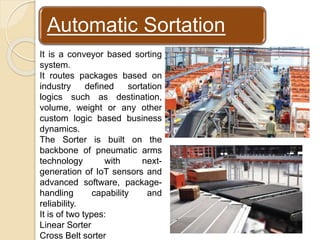
Automatic Sortation
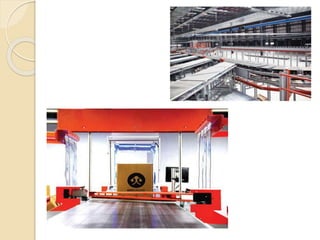
It is a conveyor based sorting
system.
It routes packages based on
industry defined sortation
logics such as destination,
volume, weight or any other
custom logic based business
dynamics.
The Sorter is built on the
backbone of pneumatic arms
technology with next-
generation of IoT sensors and
advanced software, package-
handling capability and
reliability.
It is of two types:
Linear Sorter
Cross Belt sorter
Its features are:
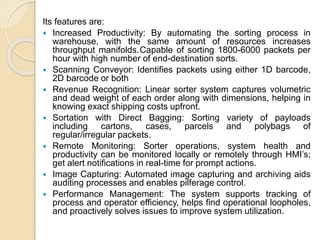
 Increased Productivity: By automating the sorting process in
warehouse, with the same amount of resources increases
throughput manifolds.Capable of sorting 1800-6000 packets per
hour with high number of end-destination sorts.
 Scanning Conveyor: Identifies packets using either 1D barcode,
2D barcode or both
 Revenue Recognition: Linear sorter system captures volumetric
and dead weight of each order along with dimensions, helping in
knowing exact shipping costs upfront.
 Sortation with Direct Bagging: Sorting variety of payloads
including cartons, cases, parcels and polybags of
regular/irregular packets.
 Remote Monitoring: Sorter operations, system health and
productivity can be monitored locally or remotely through HMI’s;
get alert notifications in real-time for prompt actions.
 Image Capturing: Automated image capturing and archiving aids
auditing processes and enables pilferage control.
 Performance Management: The system supports tracking of
process and operator efficiency, helps find operational loopholes,
and proactively solves issues to improve system utilization.
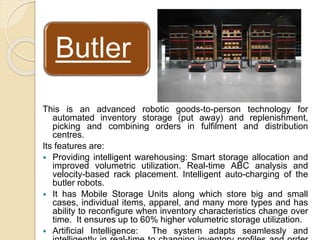
Butler
This is an advanced robotic goods-to-person technology for
automated inventory storage (put away) and replenishment,
picking and combining orders in fulfilment and distribution
centres.
Its features are:
 Providing intelligent warehousing: Smart storage allocation and
improved volumetric utilization. Real-time ABC analysis and
velocity-based rack placement. Intelligent auto-charging of the
butler robots.
 It has Mobile Storage Units along which store big and small
cases, individual items, apparel, and many more types and has
ability to reconfigure when inventory characteristics change over
time. It ensures up to 60% higher volumetric storage utilization.
 Artificial Intelligence: The system adapts seamlessly and
Warehouse management system presentation

Warehouse management system presentation

  • 1.
    WAREHOUSE MANAGEMENT SYSTEM ECE361, INDUSTRIALAUTOMATION CA-3 Made by: Nimish Arora 11405752 E1408 A05
  • 2.
    Introduction  A warehousemanagement system (WMS) is a software and hardware application that supports the day-to-day operations in a warehouse.  Early warehouse management systems could only provide simple storage location functionality.  But now WMS programs enable centralized management of tasks such as tracking inventory levels and stock locations by using high-end systems which may include tracking and routing technologies such as Radio Frequency Identification (RFID) and voice recognition.  The goal of a warehouse management system is to provide management with the information it needs to efficiently control the movement of materials within a warehouse.
  • 3.
    Problems in Warehouse industry End-CustomerSatisfaction Discrepancies in Shipping Cost Managing the Scale Error-free Seasonal Demand Surge Varied Payload Types Effective Space Utilization
  • 4.
    Role of Automation Benefitsof automation in warehouse management:  Increased pick accuracy  Increased pick productivity  Increased stock accuracy  Reduction of administration  Reduced warehouse footprint.  Lower building costs  Maximum possible usage of available floor space and building height.  Increase storage capacity by up to 400%  Safer operations  Increased reliability  Reduced running costs  Better return on investment (ROI)
  • 5.
    Profiler It is ahigh-speed dynamic packet profiling system designed to capture volumetric and dead weight, along with dimensions of packet in real- time and scanning of orders. The system enables increased accuracy and productivity during inbound and outbound processes inside warehouses. To automate dimensioning and weighing process, while achieving a high throughput of around 3000 packets/hour.
  • 6.
    Automatic Sortation It isa conveyor based sorting system. It routes packages based on industry defined sortation logics such as destination, volume, weight or any other custom logic based business dynamics. The Sorter is built on the backbone of pneumatic arms technology with next- generation of IoT sensors and advanced software, package- handling capability and reliability. It is of two types: Linear Sorter Cross Belt sorter
  • 7.
    Its features are: Increased Productivity: By automating the sorting process in warehouse, with the same amount of resources increases throughput manifolds.Capable of sorting 1800-6000 packets per hour with high number of end-destination sorts.  Scanning Conveyor: Identifies packets using either 1D barcode, 2D barcode or both  Revenue Recognition: Linear sorter system captures volumetric and dead weight of each order along with dimensions, helping in knowing exact shipping costs upfront.  Sortation with Direct Bagging: Sorting variety of payloads including cartons, cases, parcels and polybags of regular/irregular packets.  Remote Monitoring: Sorter operations, system health and productivity can be monitored locally or remotely through HMI’s; get alert notifications in real-time for prompt actions.  Image Capturing: Automated image capturing and archiving aids auditing processes and enables pilferage control.  Performance Management: The system supports tracking of process and operator efficiency, helps find operational loopholes, and proactively solves issues to improve system utilization.
  • 9.
    Butler This is anadvanced robotic goods-to-person technology for automated inventory storage (put away) and replenishment, picking and combining orders in fulfilment and distribution centres. Its features are:  Providing intelligent warehousing: Smart storage allocation and improved volumetric utilization. Real-time ABC analysis and velocity-based rack placement. Intelligent auto-charging of the butler robots.  It has Mobile Storage Units along which store big and small cases, individual items, apparel, and many more types and has ability to reconfigure when inventory characteristics change over time. It ensures up to 60% higher volumetric storage utilization.  Artificial Intelligence: The system adapts seamlessly and