Waste :- Any material which is not needed by
 the owner, producer or processor.

Classification:-
   Domestic waste
   Factory waste
   Waste from oil factory
   E-waste
   Construction waste
   Agricultural waste
   Food processing waste
   Bio-medical waste
   Nuclear waste
   E-waste- discarded electronic devices like computer,
    TV, music systems etc.

   Plastic waste- plastic bags, bottles, buckets etc.

   Metal waste- unused metal sheet, metal scraps etc.

   Nuclear waste- unused materials from nuclear power
    plants

   Domestic waste- vegetable waste, kitchen waste,
    household waste
   Waste generation.

   Waste handling and sorting.

   Storage and processing at the source.

   Collection of wate.

   Sorting, processing and transformation(Recycling)

   Transfer and transport.

   Disposal.
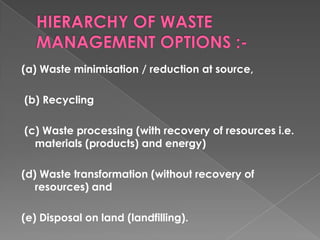
(a) Waste minimisation / reduction at source,

(b) Recycling

(c) Waste processing (with recovery of resources i.e.
  materials (products) and energy)

(d) Waste transformation (without recovery of
   resources) and

(e) Disposal on land (landfilling).
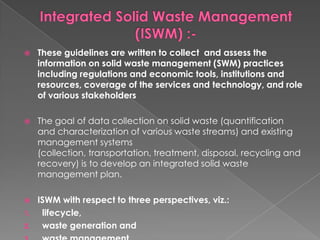
    These guidelines are written to collect and assess the
     information on solid waste management (SWM) practices
     including regulations and economic tools, institutions and
     resources, coverage of the services and technology, and role
     of various stakeholders

    The goal of data collection on solid waste (quantification
     and characterization of various waste streams) and existing
     management systems
     (collection, transportation, treatment, disposal, recycling and
     recovery) is to develop an integrated solid waste
     management plan.

    ISWM with respect to three perspectives, viz.:
1.    lifecycle,
2.    waste generation and
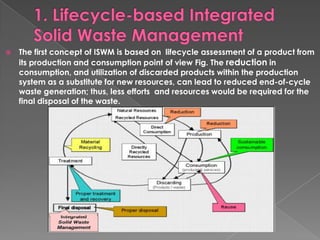
   The first concept of ISWM is based on lifecycle assessment of a product from
    its production and consumption point of view Fig. The reduction in
    consumption, and utilization of discarded products within the production
    system as a substitute for new resources, can lead to reduced end-of-cycle
    waste generation; thus, less efforts and resources would be required for the
    final disposal of the waste.
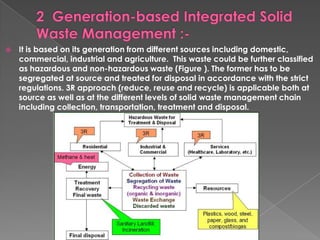
   It is based on its generation from different sources including domestic,
    commercial, industrial and agriculture. This waste could be further classified
    as hazardous and non-hazardous waste (Figure ). The former has to be
    segregated at source and treated for disposal in accordance with the strict
    regulations. 3R approach (reduce, reuse and recycle) is applicable both at
    source as well as at the different levels of solid waste management chain
    including collection, transportation, treatment and disposal.
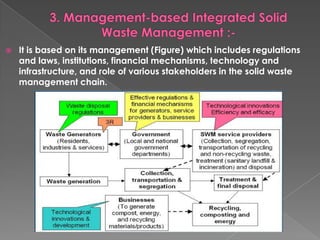
   It is based on its management (Figure) which includes regulations
    and laws, institutions, financial mechanisms, technology and
    infrastructure, and role of various stakeholders in the solid waste
    management chain.
   If there is more than one management system to handle solid
    waste, either from different generators or different types of solid
    waste (hazardous and non-hazardous), then the individual
    systems should be analyzed separately and the data so
    obtained could be compared to see their similarities and
    differences. For general purpose, the guidelines classify solid
    waste management in three systems, viz.: municipal solid
    waste, industrial solid waste, and hazardous solid waste.
    However, there might be fewer or more systems available in a
    particular city or country. To analyze solid waste management
    systems, the data and information is required to be collected on
    the following aspects:

o   Policies
o   Institutions
o   Financing mechanisms
o   Technology
o   Stakeholder participation
1.Laws and Acts
2.Regulations
3.Economic Instruments
4.Enforcement

1.Laws and Acts:-

I. Environmental Protection Law/Act
II. Hazardous Waste Management Law/Act
III. Recycling or Resource Recovery Law/Act
IV. Clean Air Act – Incineration, Landfill gases
V. Public Services Act – Solid Waste Management .
2     Regulations
2 Regulations :-


I. Regulations on production and consumption – upstream
     measures
II. Regulations on segregation of recyclable and non-
     recyclable waste
III. Regulations on electronics waste
IV. Regulations pertaining to extended producer’s
     responsibility
V. Regulations on handling of hazardous waste
VI. Regulations on collection and transportation of industrial
     waste
VII. Regulations on construction and operation of landfills
VIII. Regulations on construction and operation of
     incinerators
IX. Regulations on construction and operation of composting
     plant
3.Economic Instruments :-

I. Levy on use of fresh resources in industrial production
II. Subsidies for recycling in industrial production
III. Volume-based solid waste fee on non-recyclable waste
IV. Penalties on hazardous waste
V.    Subsidies for resource recovery, including power-
      generation at landfill

4.Enforcement :-

Enforcement becomes the most crucial aspect of policies for
    SWM as they could only make a difference if these are
    properly enforced at all levels. Therefore, an assessment
    of the level of enforcement is vital. But it can become a
    challenging task as the criteria or benchmarks to
    ascertain the level of enforcement may not be available
    and the opinion on the enforcement levels may differ
    within the different stakeholders2. Hence, the opinions
    from all the major stakeholders should be sought to get a
    comparatively appropriate assessment.
Traditionally solid waste management was the
   responsibility of local governments. However, with the
   increasing rate of solid waste from
   diversified, unconventional sources (like industries
   and laboratories respectively), and awareness and
   regulations (for recycling and recovery, hazardous
   waste management and source reduction by
   intervening at production and consumption
   level), various institutions got involved into one or
   more aspects of solid waste management chain. This
   transition from public to private institutions for
   undertaking various public utilities and services
   demanded governments to establish strong
   regulatory institutions to make sure that the service
   providers deliver effective and efficient services.
   There may be more than one institution involved at
   the same level or for the same type of activity, for
   example, informal and formal sector for recycling or
   public and private sector for collection and
   transportation of municipal waste.
 User charges
 Penalty, fine and levy
 Environmental Bonds
 Environmental Fund
 Direct Loans
 International Cooperation
 National subsidies
 Annual budget
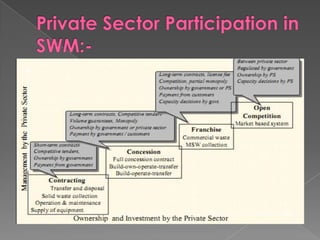
 Private Sector Participation (PSP)
i.     Primary collection and transfer stations

ii.    Transportation

iii.   Treatment

iv.    Final Disposal

v.     Recycling and Recovery
   Appropriate method of on- site storage.
   Appropriate method of bulk storage of
    waste.
   Approprate method of primary collection
    of waste.
   Appropriate method of transportation of
    waste using Geographical Information
    System (GIS).
   Appropriate method of waste disposal.
   Financial expenditure on whole solid waste
    management plan.
Stakeholder participation is becoming an essential part of
   SWM. Major stakeholders include waste
   generators, regulators, service providers such as
   organizations involved in waste collection and
   disposal, and organizations involved in recycling and
   recovery. Each stakeholder has a specific, clear and
   active role to improve the efficacy and efficiency of SWM
   by active participation and continuous interaction. Waste
   generators - traditionally considered as passive partners -
   have a major responsibility to reduce, segregate, and
   properly discard the waste as per the regulations. A close
   cooperation would be required between waste
   generators and waste collectors to increase the coverage
   and effectiveness of the waste collection system, proper
   disposal of waste, and recycling and recovery of
   materials. Furthermore, with rapid changes in quantity and
   composition of solid waste, regulatory organizations or
   governments have to be in continuous dialogue with the
   stakeholders to introduce appropriate regulations which
   can help bring the required improvements in SWM system.
1. Refuse - Instead of buying new containers from the market, use the ones that are
in the house. Refuse to buy new items though you may think they are prettier than
the ones you already have.

2. Reuse - Do not throw away the soft drink cans or the bottles; cover them with
homemade paper or paint on them and use them as pencil stands or small vases.
Alternately, you can store them and sell it to the kabariwalla who takes these for
recycling. Reuse the plastic bags for shopping again and again. It is better if you use
shopping bags made of cloth or jute, which can be used over and over again.

3. Recycle - Segregate your wastes so that non-perishable wastes are easily
collected and taken for recycling. Dig a small pit to compost your organic wastes
    like
kitchen wastes at your home.

4. Reduce - Reduce the generation of unnecessary waste, e.g. carry your own
shopping bag when you go to the market and put all your purchases directly into it.
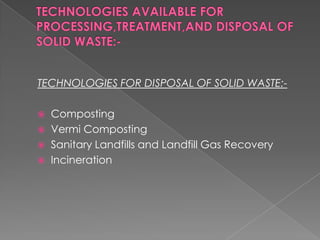
TECHNOLOGIES FOR DISPOSAL OF SOLID WASTE:-

   Composting
   Vermi Composting
   Sanitary Landfills and Landfill Gas Recovery
   Incineration
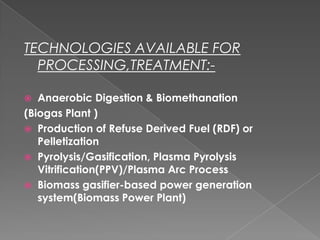
TECHNOLOGIES AVAILABLE FOR
  PROCESSING,TREATMENT:-

  Anaerobic Digestion & Biomethanation
(Biogas Plant )
 Production of Refuse Derived Fuel (RDF) or
   Pelletization
 Pyrolysis/Gasification, Plasma Pyrolysis
   Vitrification(PPV)/Plasma Arc Process
 Biomass gasifier-based power generation
   system(Biomass Power Plant)
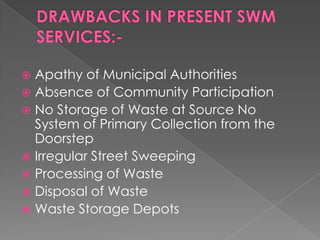
 Apathy of Municipal Authorities
 Absence of Community Participation
 No Storage of Waste at Source No
  System of Primary Collection from the
  Doorstep
 Irregular Street Sweeping
 Processing of Waste
 Disposal of Waste
 Waste Storage Depots
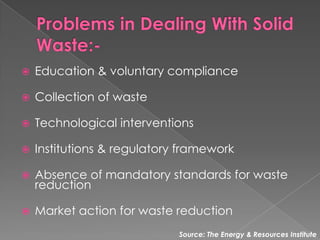
   Education & voluntary compliance

   Collection of waste

   Technological interventions

   Institutions & regulatory framework

   Absence of mandatory standards for waste
    reduction

   Market action for waste reduction
                             Source: The Energy & Resources Institute
“ There are two things certain in life – one is
   death and the other is waste” as said by a
   waste plant operator, accurately sums up
   the waste scenario in urban India. The
   findings of the project indicate that
   sustainability of a decentralized waste
   treatment option can be achieved with
   adequate municipal and residential
   support and the dedicated efforts of those
   people involved in the actual running of the
   operation.
   Teri
   ISWM plan For UN vol.2
   http://www.teriin.org/
   http://www.mnre.gov.in
   http://en.wikipedia.org/wiki/
   India Infrastructure magzine 2008
   GIS from Asansol municipality
   Chapter-2 PRINCIPLES OF MUNICIPAL SOLID
    WASTE MANAGEMENT
   SWM Prakriti, Centre for Management
    Studies, Dibrugarh University
Solid waste management model

Solid waste management model

  • 2.
    Waste :- Anymaterial which is not needed by the owner, producer or processor. Classification:-  Domestic waste  Factory waste  Waste from oil factory  E-waste  Construction waste  Agricultural waste  Food processing waste  Bio-medical waste  Nuclear waste
  • 3.
    E-waste- discarded electronic devices like computer, TV, music systems etc.  Plastic waste- plastic bags, bottles, buckets etc.  Metal waste- unused metal sheet, metal scraps etc.  Nuclear waste- unused materials from nuclear power plants  Domestic waste- vegetable waste, kitchen waste, household waste
  • 4.
    Waste generation.  Waste handling and sorting.  Storage and processing at the source.  Collection of wate.  Sorting, processing and transformation(Recycling)  Transfer and transport.  Disposal.
  • 5.
    (a) Waste minimisation/ reduction at source, (b) Recycling (c) Waste processing (with recovery of resources i.e. materials (products) and energy) (d) Waste transformation (without recovery of resources) and (e) Disposal on land (landfilling).
  • 6.
    These guidelines are written to collect and assess the information on solid waste management (SWM) practices including regulations and economic tools, institutions and resources, coverage of the services and technology, and role of various stakeholders  The goal of data collection on solid waste (quantification and characterization of various waste streams) and existing management systems (collection, transportation, treatment, disposal, recycling and recovery) is to develop an integrated solid waste management plan.  ISWM with respect to three perspectives, viz.: 1. lifecycle, 2. waste generation and
  • 7.
    The first concept of ISWM is based on lifecycle assessment of a product from its production and consumption point of view Fig. The reduction in consumption, and utilization of discarded products within the production system as a substitute for new resources, can lead to reduced end-of-cycle waste generation; thus, less efforts and resources would be required for the final disposal of the waste.
  • 8.
    It is based on its generation from different sources including domestic, commercial, industrial and agriculture. This waste could be further classified as hazardous and non-hazardous waste (Figure ). The former has to be segregated at source and treated for disposal in accordance with the strict regulations. 3R approach (reduce, reuse and recycle) is applicable both at source as well as at the different levels of solid waste management chain including collection, transportation, treatment and disposal.
  • 9.
    It is based on its management (Figure) which includes regulations and laws, institutions, financial mechanisms, technology and infrastructure, and role of various stakeholders in the solid waste management chain.
  • 10.
    If there is more than one management system to handle solid waste, either from different generators or different types of solid waste (hazardous and non-hazardous), then the individual systems should be analyzed separately and the data so obtained could be compared to see their similarities and differences. For general purpose, the guidelines classify solid waste management in three systems, viz.: municipal solid waste, industrial solid waste, and hazardous solid waste. However, there might be fewer or more systems available in a particular city or country. To analyze solid waste management systems, the data and information is required to be collected on the following aspects: o Policies o Institutions o Financing mechanisms o Technology o Stakeholder participation
  • 11.
    1.Laws and Acts 2.Regulations 3.EconomicInstruments 4.Enforcement 1.Laws and Acts:- I. Environmental Protection Law/Act II. Hazardous Waste Management Law/Act III. Recycling or Resource Recovery Law/Act IV. Clean Air Act – Incineration, Landfill gases V. Public Services Act – Solid Waste Management . 2 Regulations
  • 12.
    2 Regulations :- I.Regulations on production and consumption – upstream measures II. Regulations on segregation of recyclable and non- recyclable waste III. Regulations on electronics waste IV. Regulations pertaining to extended producer’s responsibility V. Regulations on handling of hazardous waste VI. Regulations on collection and transportation of industrial waste VII. Regulations on construction and operation of landfills VIII. Regulations on construction and operation of incinerators IX. Regulations on construction and operation of composting plant
  • 13.
    3.Economic Instruments :- I.Levy on use of fresh resources in industrial production II. Subsidies for recycling in industrial production III. Volume-based solid waste fee on non-recyclable waste IV. Penalties on hazardous waste V. Subsidies for resource recovery, including power- generation at landfill 4.Enforcement :- Enforcement becomes the most crucial aspect of policies for SWM as they could only make a difference if these are properly enforced at all levels. Therefore, an assessment of the level of enforcement is vital. But it can become a challenging task as the criteria or benchmarks to ascertain the level of enforcement may not be available and the opinion on the enforcement levels may differ within the different stakeholders2. Hence, the opinions from all the major stakeholders should be sought to get a comparatively appropriate assessment.
  • 14.
    Traditionally solid wastemanagement was the responsibility of local governments. However, with the increasing rate of solid waste from diversified, unconventional sources (like industries and laboratories respectively), and awareness and regulations (for recycling and recovery, hazardous waste management and source reduction by intervening at production and consumption level), various institutions got involved into one or more aspects of solid waste management chain. This transition from public to private institutions for undertaking various public utilities and services demanded governments to establish strong regulatory institutions to make sure that the service providers deliver effective and efficient services. There may be more than one institution involved at the same level or for the same type of activity, for example, informal and formal sector for recycling or public and private sector for collection and transportation of municipal waste.
  • 15.
     User charges Penalty, fine and levy  Environmental Bonds  Environmental Fund  Direct Loans  International Cooperation  National subsidies  Annual budget  Private Sector Participation (PSP)
  • 17.
    i. Primary collection and transfer stations ii. Transportation iii. Treatment iv. Final Disposal v. Recycling and Recovery
  • 18.
    Appropriate method of on- site storage.  Appropriate method of bulk storage of waste.  Approprate method of primary collection of waste.  Appropriate method of transportation of waste using Geographical Information System (GIS).  Appropriate method of waste disposal.  Financial expenditure on whole solid waste management plan.
  • 19.
    Stakeholder participation isbecoming an essential part of SWM. Major stakeholders include waste generators, regulators, service providers such as organizations involved in waste collection and disposal, and organizations involved in recycling and recovery. Each stakeholder has a specific, clear and active role to improve the efficacy and efficiency of SWM by active participation and continuous interaction. Waste generators - traditionally considered as passive partners - have a major responsibility to reduce, segregate, and properly discard the waste as per the regulations. A close cooperation would be required between waste generators and waste collectors to increase the coverage and effectiveness of the waste collection system, proper disposal of waste, and recycling and recovery of materials. Furthermore, with rapid changes in quantity and composition of solid waste, regulatory organizations or governments have to be in continuous dialogue with the stakeholders to introduce appropriate regulations which can help bring the required improvements in SWM system.
  • 20.
    1. Refuse -Instead of buying new containers from the market, use the ones that are in the house. Refuse to buy new items though you may think they are prettier than the ones you already have. 2. Reuse - Do not throw away the soft drink cans or the bottles; cover them with homemade paper or paint on them and use them as pencil stands or small vases. Alternately, you can store them and sell it to the kabariwalla who takes these for recycling. Reuse the plastic bags for shopping again and again. It is better if you use shopping bags made of cloth or jute, which can be used over and over again. 3. Recycle - Segregate your wastes so that non-perishable wastes are easily collected and taken for recycling. Dig a small pit to compost your organic wastes like kitchen wastes at your home. 4. Reduce - Reduce the generation of unnecessary waste, e.g. carry your own shopping bag when you go to the market and put all your purchases directly into it.
  • 21.
    TECHNOLOGIES FOR DISPOSALOF SOLID WASTE:-  Composting  Vermi Composting  Sanitary Landfills and Landfill Gas Recovery  Incineration
  • 22.
    TECHNOLOGIES AVAILABLE FOR PROCESSING,TREATMENT:-  Anaerobic Digestion & Biomethanation (Biogas Plant )  Production of Refuse Derived Fuel (RDF) or Pelletization  Pyrolysis/Gasification, Plasma Pyrolysis Vitrification(PPV)/Plasma Arc Process  Biomass gasifier-based power generation system(Biomass Power Plant)
  • 23.
     Apathy ofMunicipal Authorities  Absence of Community Participation  No Storage of Waste at Source No System of Primary Collection from the Doorstep  Irregular Street Sweeping  Processing of Waste  Disposal of Waste  Waste Storage Depots
  • 24.
    Education & voluntary compliance  Collection of waste  Technological interventions  Institutions & regulatory framework  Absence of mandatory standards for waste reduction  Market action for waste reduction Source: The Energy & Resources Institute
  • 25.
    “ There aretwo things certain in life – one is death and the other is waste” as said by a waste plant operator, accurately sums up the waste scenario in urban India. The findings of the project indicate that sustainability of a decentralized waste treatment option can be achieved with adequate municipal and residential support and the dedicated efforts of those people involved in the actual running of the operation.
  • 26.
    Teri  ISWM plan For UN vol.2  http://www.teriin.org/  http://www.mnre.gov.in  http://en.wikipedia.org/wiki/  India Infrastructure magzine 2008  GIS from Asansol municipality  Chapter-2 PRINCIPLES OF MUNICIPAL SOLID WASTE MANAGEMENT  SWM Prakriti, Centre for Management Studies, Dibrugarh University