
Volatile oil
Presented by:
Arun Agarwal
MPharm (pharmaceutics)
Inertis institute of pharmacy, invertis
university, Bareilly, UP, India
Content
• Introduction
• Extraction process
• Types of volatile oils
• Chemical tests for volatile oils
• Storage of volatile oils
• uses
Introduction
• The odorous, volatile principles of plant and animals are known as
volatile oils.
• Evaporate when exposed to air at ordinary temperatures.
• They are also called as essential oils.
• Chemically derived from terpenes and their oxygenated compounds.
• They are made up of isoprene unit(C5H8) and are usually mono,
sesqui and diterpenes.
Cont..
• They are soluble in alcohol, ether and other lipid solvents and
practically insoluble in water.
• They are usually lighter than water.
• They posses characteristic odour and they have high refractive indices.
Most of them are optically active.
• They are secreted in special structures such as duct, cell,
schizogenous or lysigenous glands, trichomes.
Extraction process
• Hydro-distillation
• Enfleurage
• Eucelle
• Liquid carbon dioxide
Hydro-distillation
• This method comprising of water distillation, water and steam distillation, and
steam distillation is used for extraction of volatile oil from herbal drugs.
• The fresh material is subjected to hydro-distillation in case of the leaf drugs.
• Air-dried subterranean parts are extracted by steam distillation.
Enfleurage
• This method is use for extraction of delicate perfume.
• The fresh flower petals are mechanically spread on layer fatty
material, allow to imbibe and the exhausted petals are replace by
fresh material.
• The process is continued till the fatty layer is saturated with
volatile principles which are then extracted with lipid solvent.
Ecuelle
• This method is use for extraction of citrus oils, wherein oil cells in
rind are ruptured mechanically using pointed projection by twisting
raw material over them in clockwise direction either mechanically
or manually.
Liquid carbon dioxide
• It is also used to extract essential oil.
• Liquefied under pressure, it act as a solvent reserving back to
gaseous nature when pressure is reduced leaving no residue of
solvent.
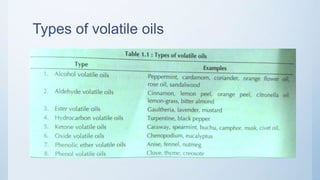
Types of volatile oils
Chemical tests for volatile oils
• To the thin section of the drug, and alcoholic solutions of sudan III. Red
colour obtained by globule indicate the presence of volatile oil.
• To the thin section of the drug, add a drop of tincture alkane.
• Red colour indicate the presence of volatile oil.
Storage of volatile oil
• Certain volatile oil are liable to deteriorate on keeping. The
deterioration is accompanied by change in colour, or increase in
viscosity of the oil, or change in odour of the oil.
• Therefore, volatile oil should be preserved properly in well closed, well
filled containers away from light and in cool place.
Uses
• Volatile oils are used as flavouring and perfuming agents in
pharmaceutical formulation, foods, beverages and cosmetics.
• Beside, they are also used as medicinal agents such as, carminative
(umbelliferous fruits, cinnamon), anthelmentics(cinnapodium), diuretics
(juniper), antiseptic (eucalyptus), counter irritant (oil of wintergreen),
local anesthetic (clove), sedative (jatamansi), insect repellant, for
synthesis of vitamin A.
Terpeneless oils
• It is fected more price in perfumery industry because of their specificity
and stability.
• They are processed by removing hydrocarbons and undesired
components by fractional distillation and other techniques witch are
usually kept as guarded secrets by manufacturer.
• They are used in manufacture of high price cosmetics and perfumes.
THANK YOU!!

Volatile oils

  • 1.
    Volatile oil Presented by: ArunAgarwal MPharm (pharmaceutics) Inertis institute of pharmacy, invertis university, Bareilly, UP, India
  • 2.
    Content • Introduction • Extractionprocess • Types of volatile oils • Chemical tests for volatile oils • Storage of volatile oils • uses
  • 3.
    Introduction • The odorous,volatile principles of plant and animals are known as volatile oils. • Evaporate when exposed to air at ordinary temperatures. • They are also called as essential oils. • Chemically derived from terpenes and their oxygenated compounds. • They are made up of isoprene unit(C5H8) and are usually mono, sesqui and diterpenes.
  • 4.
    Cont.. • They aresoluble in alcohol, ether and other lipid solvents and practically insoluble in water. • They are usually lighter than water. • They posses characteristic odour and they have high refractive indices. Most of them are optically active. • They are secreted in special structures such as duct, cell, schizogenous or lysigenous glands, trichomes.
  • 5.
    Extraction process • Hydro-distillation •Enfleurage • Eucelle • Liquid carbon dioxide
  • 6.
    Hydro-distillation • This methodcomprising of water distillation, water and steam distillation, and steam distillation is used for extraction of volatile oil from herbal drugs. • The fresh material is subjected to hydro-distillation in case of the leaf drugs. • Air-dried subterranean parts are extracted by steam distillation.
  • 7.
    Enfleurage • This methodis use for extraction of delicate perfume. • The fresh flower petals are mechanically spread on layer fatty material, allow to imbibe and the exhausted petals are replace by fresh material. • The process is continued till the fatty layer is saturated with volatile principles which are then extracted with lipid solvent.
  • 8.
    Ecuelle • This methodis use for extraction of citrus oils, wherein oil cells in rind are ruptured mechanically using pointed projection by twisting raw material over them in clockwise direction either mechanically or manually.
  • 9.
    Liquid carbon dioxide •It is also used to extract essential oil. • Liquefied under pressure, it act as a solvent reserving back to gaseous nature when pressure is reduced leaving no residue of solvent.
  • 10.
  • 11.
    Chemical tests forvolatile oils • To the thin section of the drug, and alcoholic solutions of sudan III. Red colour obtained by globule indicate the presence of volatile oil. • To the thin section of the drug, add a drop of tincture alkane. • Red colour indicate the presence of volatile oil.
  • 12.
    Storage of volatileoil • Certain volatile oil are liable to deteriorate on keeping. The deterioration is accompanied by change in colour, or increase in viscosity of the oil, or change in odour of the oil. • Therefore, volatile oil should be preserved properly in well closed, well filled containers away from light and in cool place.
  • 13.
    Uses • Volatile oilsare used as flavouring and perfuming agents in pharmaceutical formulation, foods, beverages and cosmetics. • Beside, they are also used as medicinal agents such as, carminative (umbelliferous fruits, cinnamon), anthelmentics(cinnapodium), diuretics (juniper), antiseptic (eucalyptus), counter irritant (oil of wintergreen), local anesthetic (clove), sedative (jatamansi), insect repellant, for synthesis of vitamin A.
  • 14.
    Terpeneless oils • Itis fected more price in perfumery industry because of their specificity and stability. • They are processed by removing hydrocarbons and undesired components by fractional distillation and other techniques witch are usually kept as guarded secrets by manufacturer. • They are used in manufacture of high price cosmetics and perfumes.
  • 15.