
Vaccine Delivery System
Presented by: Arun Agarwal
(CSIR-JRF)
ID: 53253
Supervisor: Dr. Wahajuddin
(Principal scientist)
Division: Pharmaceutics and
pharmacokinetics
Vaccine
• Vaccine is a material that induces an immunologically mediated
resistance to a disease but not necessarily an infection.
• Vaccines are generally composed of killed or attenuated organisms or
subunits of organisms or DNA encoding antigenic proteins of
pathogens.
• In order to induce an effective protective immunity, these vaccines
require boosting with agents called “adjuvants.” Adjuvants are
believed to act by forming complexes with the agent to be delivered
from which immunogens are slowly released.
• Adjuvants potentiate the immunostimulatory property of the antigen
while being non-immunogenic, nontoxic, and biodegradable by
themselves.
Delivery systems of vaccine
• Delivery of antigens from oil-based adjuvants such as Freunds
adjuvant lead to a reduction in the number of doses of vaccine to be
administered but due to toxicity concerns like inductions of
granulomas at the injection site, such adjuvants are not widely used.
• FDA approved adjuvants for human uses are aluminium hydroxide
and aluminium phosphate in the form of alum.
Solid particulate vaccine delivery
• Solid particulate systems such as microspheres and lipospheres are being
exploited for vaccine delivery based on the fact that intestine is an
imperfect barrier to small particulates. Antigens entrapped in such
particulates when taken up by M-cells can generate immunity.
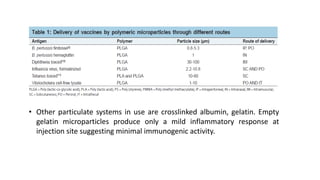
• Biodegradable polymers such as PLGA, previously used as surgical implant
and suture material is now being exploited for matrix antigen delivery.
• PLGA microspheres are rapidly taken up by M-cells and translocated
towards the underlying lymphatic tissue within 1 h.
• Other particulate systems in use are crosslinked albumin, gelatin. Empty
gelatin microparticles produce only a mild inflammatory response at
injection site suggesting minimal immunogenic activity.
Liposomal delivery system
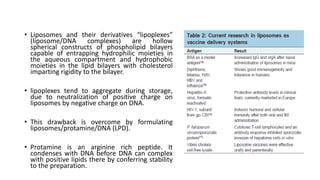
• Liposomes and their derivatives “lipoplexes”
(liposome/DNA complexes) are hollow
spherical constructs of phospholipid bilayers
capable of entrapping hydrophilic moieties in
the aqueous compartment and hydrophobic
moieties in the lipid bilayers with cholesterol
imparting rigidity to the bilayer.
• lipoplexes tend to aggregate during storage,
due to neutralization of positive charge on
liposomes by negative charge on DNA.
• This drawback is overcome by formulating
liposomes/protamine/DNA (LPD).
• Protamine is an arginine rich peptide. It
condenses with DNA before DNA can complex
with positive lipids there by conferring stability
to the preparation.
Virosomes
• Virosomes are small spherical unilamellar lipid membranes vesicles
(150 nm) embedded with viral membrane proteins such as
hemagglutin and neuraminidase of influenza virus but devoid of
nucleocapsid including the genetic material of the source virus.
• These proteins enable the virosome membranes to fuse with cells of
the immune system and thus deliver their contents—the specific
antigens—directly to their target cells, eliciting a specific immune
response even with weak-immunogenic antigens.
Emulsion delivery system
• Emulsions are heterogeneous liquid systems may be water-in-oil
emulsions, oil-in-water emulsions, or more complex systems such as
water-in-oil-in-water multiple emulsions, micro emulsions, or nano-
emulsions.
• Antigens are dissolved in a water phase and emulsified in the oil in
the presence of an appropriate emulsifier.
• The controlled release characteristics of an emulsion are determined
by factors such as viscosity of oil phase, oil-towater phase ratio and
emulsion droplet size.
• For example, high oil content can cause unnecessary injection site irritation
and too large a droplet size can result in a physically unstable product there
by reducing its shelf life.
Polymeric nanoparticle delivery
system
• Polymeric nanoparticles because of their size are preferentially taken up by
the mucosa associated lymphoid tissue.
• They are extensively reviewed for nasal and oral delivery of vaccines.
Limited doses of antigen are sufficient to induce effective immunization.
• Hence, the use of nanoparticles for oral delivery of antigens is suitable
because of their ability to release proteins and to protect them from
enzymatic degradation in the GIT.
• Nanoparticles labeled with MAb specific to M-cells increase the level of
absorption of nanoparticulate vaccines and hence immune response.
• Other nan carrier types that have been used as multivalent vaccine
constructs include:
• Metallic oxide particles
• Polysaccharide-based spermine
• Alginate capsules (which are natural polymers) and synthetic biocompatible
and biodegradable poly (d,l-lactide-co-glycolide) copolymer.
Micellar delivery system
• Micelles have been well investigated as potential antigen carriers.
• These are self-aggregated clusters of amphiphilic surfactant
molecules.
• The invention, Moyer describes methods and systems for generating
a safe and effective oral smallpox vaccine for humans using a
genetically defective strain of vaccinia virus to confer immunity
following oral delivery of the vaccine.
• Formulations and methods for transmucosal delivery of a beneficial
agent use a combination of a pH-responsive component and a
temperature-responsive component.
• The temperature-responsive component in aqueous solutions is capable of
undergoing a temperature-dependent sol to gel phase transition.
• The temperature-responsive compound is an alkylene oxide copolymer
capable of forming micelles in aqueous solutions.
• These formulations were found to have bioadhesive properties and
hence are suitable for delivering wide variety of beneficial agents.
Dendrimer based delivery system
• Dendrimers are branched, synthetic polymers with layered architectures.
• By combining the multifunctional polymeric material with a biologically
active substance in an aqueous loading environment, the carrier system
can be administered as a drug delivery vehicle to a human subject.
• Invention by Wright, features an Influenza vaccine having a dendrimer as
an adjuvant. Vaccine contains an influenza antigen and a dendrimer in a
physiologically compatible carrier.
• The use of the dendrimer makes it possible to adjuvant Influenza without
producing a toxic complex since even a small amount of the dendrimer acts
as an effective adjuvant.
Immunostimulatory complexes-
ISCOMs
• ISCOMs are spontaneously formed spherical open cage-like
complexes when saponin, cholesterol, phospholipid, and immunogen,
usually protein are mixed together and have typically a diameter of
30-80 nm.
• ISCOMs combine certain aspects of virus particles such as their size
and orientation of surface proteins, with the powerful
immunostimulatory activity of saponins.
• Brunham and Murdin describe a two-step immunization procedure
against chlamydia infection by initial administration of Chlamydia
protein followed by administration of a chlamydia protein in ISCOMs.
• Such Immunogenic compositions have utility as chlamydial vaccines
and in diagnostic applications.
• Other ISCOM based vaccines are invented for infections by Moraxella,
Helicobacter infections, Campylobacter infections.
• ISCOM-based veterinary vaccine against equine influenza is
commercially available.
DNA vaccine
• DNA vaccines consist of bacterial plasmids into which specific
sequences are incorporated.
• Gene expression is promoted by the cytomegalovirus promoter and
its adjacent intron A sequence (ensures high transcription efficiency)
and elements like a transcription termination signal and a prokaryotic
antibiotic resistance gene.
DNA vaccine delivery strategies
Physical methods
• Techniques such as:
• Tattooing
• Gene gun
• Electroporation
• Ultrasound
• Laser
These techniques provide energy (electrical, ultrasonic, laser beam) that
brings about a transient change in permeability of cell membrane thereby
promoting the entry of immunogenic DNA into the cells.
• The cell permeability is restored on the removal of applied energy after a
short time period.
Mucosal delivery of vaccine
• Mucosal vaccination offers protection against microorganisms which
gain access to body via mucosal membranes.
• Patient compliance, ease of administration, reduction in possibility of
needle-borne injections, stimulation of both systemic and mucosal
immunity are some of the advantages.
Nasal Mucosa delivery
• Intranasal vaccines include:
• Influenza A and B virus
• Proteosoma-influenza
• Adenovirus-vectored influenza
• Group B meningococcal native
• Attenuated respiratory syncytial virus
• Parainfluenza 3virus.
Needle Free delivery of vaccine
• Needle-free vaccine delivery is gaining popularity these days due to
the following reasons:
• Reduce pain associated with injection.
• Differentiate their product form existing product as the pharmaceutical
industry faces massive losses.
• Search for alternative ways to deliver growing list of new biopharmaceutical
and molecular entities like vaccines, DNA, peptides and proteins that cannot
be delivered orally.
• Urge to evolve into specialty pharmaceutical companies developing their own
branded pharmaceutical products, based on off-patented drugs.
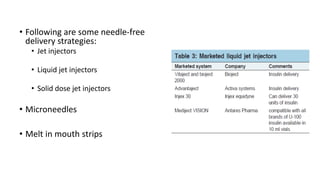
• Following are some needle-free
delivery strategies:
• Jet injectors
• Liquid jet injectors
• Solid dose jet injectors
• Microneedles
• Melt in mouth strips
References
• Saroja, C., et al. (2011). "Recent trends in vaccine delivery systems: a
review." International journal of pharmaceutical investigation 1(2):
64.
Thank you!!

Vaccine delivery system

  • 1.
    Vaccine Delivery System Presentedby: Arun Agarwal (CSIR-JRF) ID: 53253 Supervisor: Dr. Wahajuddin (Principal scientist) Division: Pharmaceutics and pharmacokinetics
  • 2.
    Vaccine • Vaccine isa material that induces an immunologically mediated resistance to a disease but not necessarily an infection. • Vaccines are generally composed of killed or attenuated organisms or subunits of organisms or DNA encoding antigenic proteins of pathogens.
  • 3.
    • In orderto induce an effective protective immunity, these vaccines require boosting with agents called “adjuvants.” Adjuvants are believed to act by forming complexes with the agent to be delivered from which immunogens are slowly released. • Adjuvants potentiate the immunostimulatory property of the antigen while being non-immunogenic, nontoxic, and biodegradable by themselves.
  • 4.
  • 5.
    • Delivery ofantigens from oil-based adjuvants such as Freunds adjuvant lead to a reduction in the number of doses of vaccine to be administered but due to toxicity concerns like inductions of granulomas at the injection site, such adjuvants are not widely used. • FDA approved adjuvants for human uses are aluminium hydroxide and aluminium phosphate in the form of alum.
  • 6.
    Solid particulate vaccinedelivery • Solid particulate systems such as microspheres and lipospheres are being exploited for vaccine delivery based on the fact that intestine is an imperfect barrier to small particulates. Antigens entrapped in such particulates when taken up by M-cells can generate immunity. • Biodegradable polymers such as PLGA, previously used as surgical implant and suture material is now being exploited for matrix antigen delivery. • PLGA microspheres are rapidly taken up by M-cells and translocated towards the underlying lymphatic tissue within 1 h.
  • 7.
    • Other particulatesystems in use are crosslinked albumin, gelatin. Empty gelatin microparticles produce only a mild inflammatory response at injection site suggesting minimal immunogenic activity.
  • 8.
  • 9.
    • Liposomes andtheir derivatives “lipoplexes” (liposome/DNA complexes) are hollow spherical constructs of phospholipid bilayers capable of entrapping hydrophilic moieties in the aqueous compartment and hydrophobic moieties in the lipid bilayers with cholesterol imparting rigidity to the bilayer. • lipoplexes tend to aggregate during storage, due to neutralization of positive charge on liposomes by negative charge on DNA. • This drawback is overcome by formulating liposomes/protamine/DNA (LPD). • Protamine is an arginine rich peptide. It condenses with DNA before DNA can complex with positive lipids there by conferring stability to the preparation.
  • 10.
  • 11.
    • Virosomes aresmall spherical unilamellar lipid membranes vesicles (150 nm) embedded with viral membrane proteins such as hemagglutin and neuraminidase of influenza virus but devoid of nucleocapsid including the genetic material of the source virus. • These proteins enable the virosome membranes to fuse with cells of the immune system and thus deliver their contents—the specific antigens—directly to their target cells, eliciting a specific immune response even with weak-immunogenic antigens.
  • 12.
  • 13.
    • Emulsions areheterogeneous liquid systems may be water-in-oil emulsions, oil-in-water emulsions, or more complex systems such as water-in-oil-in-water multiple emulsions, micro emulsions, or nano- emulsions. • Antigens are dissolved in a water phase and emulsified in the oil in the presence of an appropriate emulsifier. • The controlled release characteristics of an emulsion are determined by factors such as viscosity of oil phase, oil-towater phase ratio and emulsion droplet size. • For example, high oil content can cause unnecessary injection site irritation and too large a droplet size can result in a physically unstable product there by reducing its shelf life.
  • 14.
  • 15.
    • Polymeric nanoparticlesbecause of their size are preferentially taken up by the mucosa associated lymphoid tissue. • They are extensively reviewed for nasal and oral delivery of vaccines. Limited doses of antigen are sufficient to induce effective immunization. • Hence, the use of nanoparticles for oral delivery of antigens is suitable because of their ability to release proteins and to protect them from enzymatic degradation in the GIT. • Nanoparticles labeled with MAb specific to M-cells increase the level of absorption of nanoparticulate vaccines and hence immune response.
  • 16.
    • Other nancarrier types that have been used as multivalent vaccine constructs include: • Metallic oxide particles • Polysaccharide-based spermine • Alginate capsules (which are natural polymers) and synthetic biocompatible and biodegradable poly (d,l-lactide-co-glycolide) copolymer.
  • 17.
  • 18.
    • Micelles havebeen well investigated as potential antigen carriers. • These are self-aggregated clusters of amphiphilic surfactant molecules. • The invention, Moyer describes methods and systems for generating a safe and effective oral smallpox vaccine for humans using a genetically defective strain of vaccinia virus to confer immunity following oral delivery of the vaccine.
  • 19.
    • Formulations andmethods for transmucosal delivery of a beneficial agent use a combination of a pH-responsive component and a temperature-responsive component. • The temperature-responsive component in aqueous solutions is capable of undergoing a temperature-dependent sol to gel phase transition. • The temperature-responsive compound is an alkylene oxide copolymer capable of forming micelles in aqueous solutions. • These formulations were found to have bioadhesive properties and hence are suitable for delivering wide variety of beneficial agents.
  • 20.
  • 21.
    • Dendrimers arebranched, synthetic polymers with layered architectures. • By combining the multifunctional polymeric material with a biologically active substance in an aqueous loading environment, the carrier system can be administered as a drug delivery vehicle to a human subject. • Invention by Wright, features an Influenza vaccine having a dendrimer as an adjuvant. Vaccine contains an influenza antigen and a dendrimer in a physiologically compatible carrier. • The use of the dendrimer makes it possible to adjuvant Influenza without producing a toxic complex since even a small amount of the dendrimer acts as an effective adjuvant.
  • 22.
  • 23.
    • ISCOMs arespontaneously formed spherical open cage-like complexes when saponin, cholesterol, phospholipid, and immunogen, usually protein are mixed together and have typically a diameter of 30-80 nm. • ISCOMs combine certain aspects of virus particles such as their size and orientation of surface proteins, with the powerful immunostimulatory activity of saponins.
  • 24.
    • Brunham andMurdin describe a two-step immunization procedure against chlamydia infection by initial administration of Chlamydia protein followed by administration of a chlamydia protein in ISCOMs. • Such Immunogenic compositions have utility as chlamydial vaccines and in diagnostic applications. • Other ISCOM based vaccines are invented for infections by Moraxella, Helicobacter infections, Campylobacter infections. • ISCOM-based veterinary vaccine against equine influenza is commercially available.
  • 25.
  • 26.
    • DNA vaccinesconsist of bacterial plasmids into which specific sequences are incorporated. • Gene expression is promoted by the cytomegalovirus promoter and its adjacent intron A sequence (ensures high transcription efficiency) and elements like a transcription termination signal and a prokaryotic antibiotic resistance gene.
  • 27.
  • 28.
    Physical methods • Techniquessuch as: • Tattooing • Gene gun • Electroporation • Ultrasound • Laser These techniques provide energy (electrical, ultrasonic, laser beam) that brings about a transient change in permeability of cell membrane thereby promoting the entry of immunogenic DNA into the cells. • The cell permeability is restored on the removal of applied energy after a short time period.
  • 29.
    Mucosal delivery ofvaccine • Mucosal vaccination offers protection against microorganisms which gain access to body via mucosal membranes. • Patient compliance, ease of administration, reduction in possibility of needle-borne injections, stimulation of both systemic and mucosal immunity are some of the advantages.
  • 30.
    Nasal Mucosa delivery •Intranasal vaccines include: • Influenza A and B virus • Proteosoma-influenza • Adenovirus-vectored influenza • Group B meningococcal native • Attenuated respiratory syncytial virus • Parainfluenza 3virus.
  • 31.
  • 32.
    • Needle-free vaccinedelivery is gaining popularity these days due to the following reasons: • Reduce pain associated with injection. • Differentiate their product form existing product as the pharmaceutical industry faces massive losses. • Search for alternative ways to deliver growing list of new biopharmaceutical and molecular entities like vaccines, DNA, peptides and proteins that cannot be delivered orally. • Urge to evolve into specialty pharmaceutical companies developing their own branded pharmaceutical products, based on off-patented drugs.
  • 33.
    • Following aresome needle-free delivery strategies: • Jet injectors • Liquid jet injectors • Solid dose jet injectors • Microneedles • Melt in mouth strips
  • 34.
    References • Saroja, C.,et al. (2011). "Recent trends in vaccine delivery systems: a review." International journal of pharmaceutical investigation 1(2): 64.
  • 35.