VOLATILE OILS
Shivani-Rawat
B .Pharm[5-Semester]
[U.I.P.S] UTTARANCHAL UNIVERSITY
VOLATILE
OILS
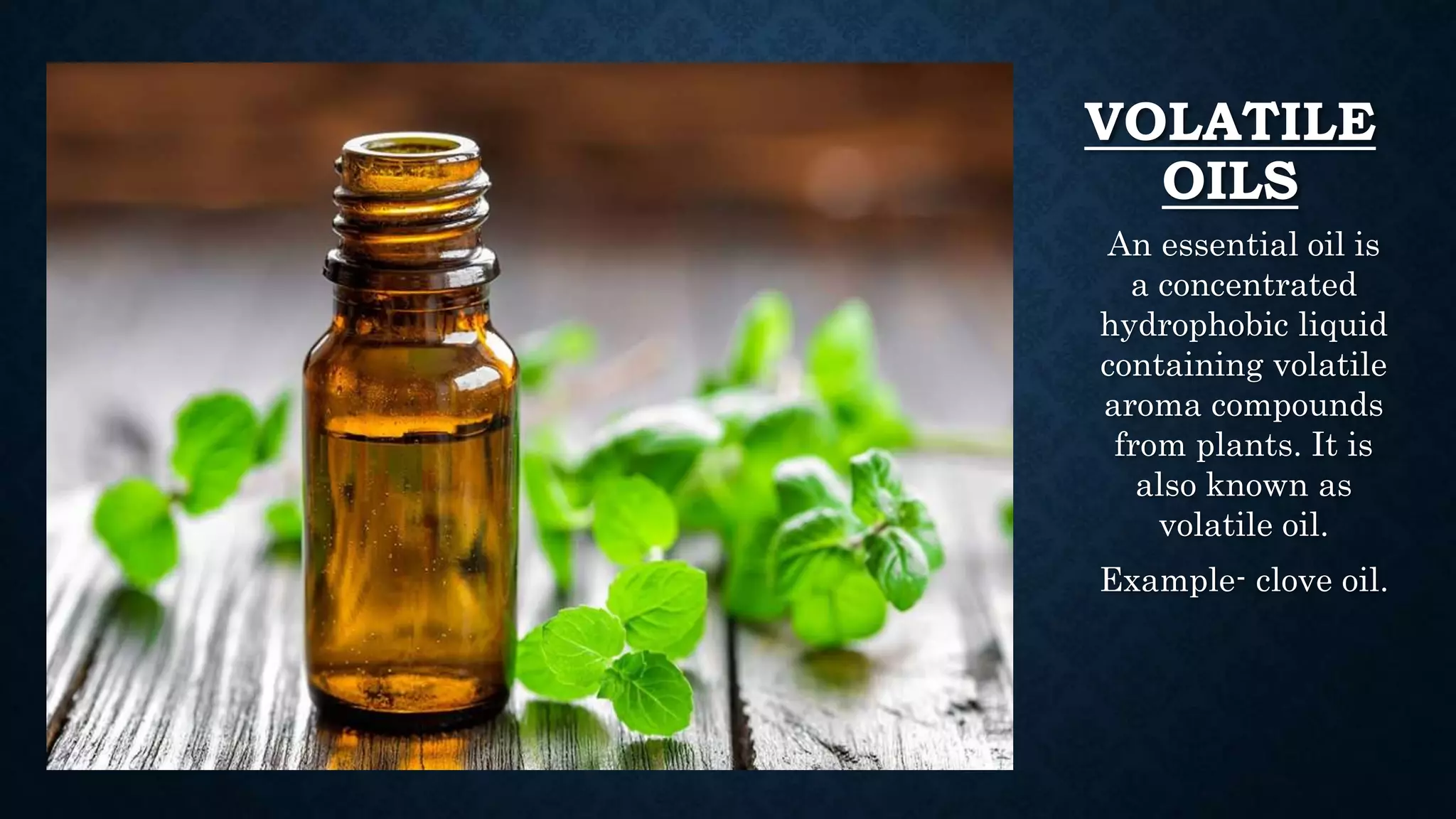
An essential oil is
a concentrated
hydrophobic liquid
containing volatile
aroma compounds
from plants. It is
also known as
volatile oil.
Example- clove oil.
PLANT PARTS HAVING VOLATILE OIL
CHEMISTRY OF VOLATILE OILS
• Many volatile oils consist largely of terpenes.
• Terpenes are defined as natural products whose
structures may be divided into isoprene units.
• These units arise from acetate via mevolonic acid
pathway.
• Isoprenes are 5 carbon compound having 2
unsaturated bond.
• They are joined in head to tail fashion.
• Isoprenes are also termed as hemi-terpenes.
PHYSICAL PROPERTIES OF VOLATILE
OILS
• Lighter than water.
• Optically active and high refractive index.
• Do not leave stains like fixed oils.
• Soluble in organic solvents like alcohol ,chloroform.
• Commonly found in the species
-Labiatae
-Rutaceae
THERAPEUTIC USES
• As a counter irritant.
• Improves local circulation
• In aroma therapy[e.g. lavender and rosemary]
• Eucalyptus oil administered as an inhalant.
• Antiseptic, antibacterial, antifungal.
• Thymol is used in mouth washes and gargles.
• Reduce secretion of lungs in cough and asthma.
EXTRACTION
METHOD
ECUELLE METHOD
Ecuelle method is used for the extraction of
citrus oils where oils cells in rind are
ruptured mechanically using pointed
projections by twisting raw material over
them in clockwise direction either
mechanically or manually.
ENFLEURAGE
It is used for extraction of delicate perfumes.
In this method a layer of fat is spread over a
glass plate and flower petal are placed over
fat layer which absorbs volume. The
exhausted petals are replaced by fresh
petals. This process continues till the fatty
layer is saturated volatile principle which is
then extracted with lipid solvent.
STEAM DISTILLATION
For substances which are usually injured by
direct heat for example clove, cinnamon.
Dried drug ground and covered with layer of
water. Steam is passes through mixture,
steam is generated by another chamber and
piped into container having drug. The
vapour contain oils are introduced in
condensing chamber cooled and collected.
MACERATION
The process in which properly communited
drug is placed or permitted to soak in a
solvent for specific period of time until the
cellular structure is softened and penetrated
by the solvent and soluble constituents are
dissolved and extracted out.
Example- tea bags.
SOLVENT EXTRACTION
It is used in perfume industry and is an
expensive method,. In this technique parts
containing parts containing volatile oils are
extracted directly by one of the organic solvent as
they are crushed and mixed in the solvent and
are mixed in the solvent and are separated by
distillation.
E.g.-oil of rose
CLASSIFICATION OF VOLATILE
OILS
Volatile oils
Volatile oils
Volatile oils
Volatile oils
Volatile oils
Volatile oils
Volatile oils
Volatile oils
Volatile oils

Volatile oils

  • 1.
  • 2.
    VOLATILE OILS An essential oilis a concentrated hydrophobic liquid containing volatile aroma compounds from plants. It is also known as volatile oil. Example- clove oil.
  • 3.
    PLANT PARTS HAVINGVOLATILE OIL
  • 4.
    CHEMISTRY OF VOLATILEOILS • Many volatile oils consist largely of terpenes. • Terpenes are defined as natural products whose structures may be divided into isoprene units. • These units arise from acetate via mevolonic acid pathway. • Isoprenes are 5 carbon compound having 2 unsaturated bond. • They are joined in head to tail fashion. • Isoprenes are also termed as hemi-terpenes.
  • 5.
    PHYSICAL PROPERTIES OFVOLATILE OILS • Lighter than water. • Optically active and high refractive index. • Do not leave stains like fixed oils. • Soluble in organic solvents like alcohol ,chloroform. • Commonly found in the species -Labiatae -Rutaceae
  • 6.
    THERAPEUTIC USES • Asa counter irritant. • Improves local circulation • In aroma therapy[e.g. lavender and rosemary] • Eucalyptus oil administered as an inhalant. • Antiseptic, antibacterial, antifungal. • Thymol is used in mouth washes and gargles. • Reduce secretion of lungs in cough and asthma.
  • 7.
    EXTRACTION METHOD ECUELLE METHOD Ecuelle methodis used for the extraction of citrus oils where oils cells in rind are ruptured mechanically using pointed projections by twisting raw material over them in clockwise direction either mechanically or manually.
  • 8.
    ENFLEURAGE It is usedfor extraction of delicate perfumes. In this method a layer of fat is spread over a glass plate and flower petal are placed over fat layer which absorbs volume. The exhausted petals are replaced by fresh petals. This process continues till the fatty layer is saturated volatile principle which is then extracted with lipid solvent.
  • 9.
    STEAM DISTILLATION For substanceswhich are usually injured by direct heat for example clove, cinnamon. Dried drug ground and covered with layer of water. Steam is passes through mixture, steam is generated by another chamber and piped into container having drug. The vapour contain oils are introduced in condensing chamber cooled and collected.
  • 10.
    MACERATION The process inwhich properly communited drug is placed or permitted to soak in a solvent for specific period of time until the cellular structure is softened and penetrated by the solvent and soluble constituents are dissolved and extracted out. Example- tea bags.
  • 11.
    SOLVENT EXTRACTION It isused in perfume industry and is an expensive method,. In this technique parts containing parts containing volatile oils are extracted directly by one of the organic solvent as they are crushed and mixed in the solvent and are mixed in the solvent and are separated by distillation. E.g.-oil of rose
  • 12.