Dispersive Transform Infrared
Spectroscopy
Presented by: Arun Agarwal
(CSIR-JRF)
ID: 53253
Supervisor: Dr. Wahajuddin
(Principal scientist)
Division: Pharmaceutics and
pharmacokinetics
Infrared Spectroscopy
• Infrared spectroscopy (IR spectroscopy or vibrational spectroscopy)
involves the interaction of infrared radiation with matter.
• It covers a range of techniques, mostly based on absorption
spectroscopy.
• As with all spectroscopic techniques, it can be used to identify and
study chemical substances.
• Samples may be solid, liquid, or gas.
Instrument
• Instrument called an infrared spectrometer (or spectrophotometer)
to produce an infrared spectrum.
• An IR spectrum can be visualized in a graph of infrared light
absorbance (or transmittance) on the vertical axis vs. frequency or
wavelength on the horizontal axis.
• Typical units of frequency used in IR spectra are reciprocal
centimeters (sometimes called wave numbers), with the symbol cm−1
Fourier transform infrared spectroscopy (FT-IR)
• It is a measurement technique that allows one to record infrared spectra.
Infrared light is guided through an interferometer and then through the
sample (or vice versa).
• A moving mirror inside the apparatus alters the distribution of infrared
light that passes through the interferometer.
• The signal directly recorded, called an "interferogram", represents light
output as a function of mirror position.
• A data-processing technique called Fourier transform turns this raw data
into the desired result (the sample's spectrum).
Dispersive Transform Infrared Spectroscopy
• An alternate method for acquiring spectra is the "dispersive" or
"scanning monochromator" method.
• In this approach, the sample is irradiated sequentially with various
single wavelengths.
• The dispersive method is more common in UV-Vis spectroscopy, but is
less practical in the infrared than the FTIR method.
Dispersive IR Spectrometer
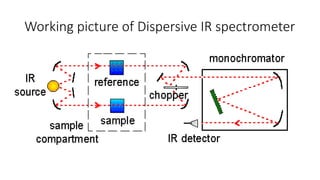
• The general set up of a dispersive IR instrument is similar to that of the
double beam UV-visible instrument.
• However there are two differences.
• Firstly, the radiation emerging out of the sample cell is dispersed with the help of a
suitable grating and not by diffraction grating as in UV-VIS spectrometers.
• Secondly, in IR, the sample is located between the source and the monochromator.
• This arrangement helps in getting rid of the scattered radiation from the
cell compartment.
Working picture of Dispersive IR spectrometer
Uses and applications
• Infrared spectroscopy is a simple and reliable technique widely used in both
organic and inorganic chemistry, in research and industry.
• It is used in quality control, dynamic measurement, and monitoring applications
such as the long-term unattended measurement of CO2 concentrations in
greenhouses and growth chambers by infrared gas analyzers.
• It is also used in forensic analysis in both criminal and civil cases, for example in
identifying polymer degradation. It can be used in determining the blood alcohol
content of a suspected drunk driver.
• IR-spectroscopy has been successfully used in analysis and identification of
pigments in paintings. And other art objects.. Such as illuminated manuscripts
References
• https://en.wikipedia.org/wiki/Infrared_spectroscopy. (accessed on 9th
October 2019).
• https://shodhganga.inflibnet.ac.in/bitstream/10603/134021/9/09_ch
apter%203.pdf. (Accessed on 9th October 2019).
Thank you!!

Dispersive transform infrared spectroscopy

  • 1.
    Dispersive Transform Infrared Spectroscopy Presentedby: Arun Agarwal (CSIR-JRF) ID: 53253 Supervisor: Dr. Wahajuddin (Principal scientist) Division: Pharmaceutics and pharmacokinetics
  • 2.
    Infrared Spectroscopy • Infraredspectroscopy (IR spectroscopy or vibrational spectroscopy) involves the interaction of infrared radiation with matter. • It covers a range of techniques, mostly based on absorption spectroscopy. • As with all spectroscopic techniques, it can be used to identify and study chemical substances. • Samples may be solid, liquid, or gas.
  • 3.
    Instrument • Instrument calledan infrared spectrometer (or spectrophotometer) to produce an infrared spectrum. • An IR spectrum can be visualized in a graph of infrared light absorbance (or transmittance) on the vertical axis vs. frequency or wavelength on the horizontal axis. • Typical units of frequency used in IR spectra are reciprocal centimeters (sometimes called wave numbers), with the symbol cm−1
  • 4.
    Fourier transform infraredspectroscopy (FT-IR) • It is a measurement technique that allows one to record infrared spectra. Infrared light is guided through an interferometer and then through the sample (or vice versa). • A moving mirror inside the apparatus alters the distribution of infrared light that passes through the interferometer. • The signal directly recorded, called an "interferogram", represents light output as a function of mirror position. • A data-processing technique called Fourier transform turns this raw data into the desired result (the sample's spectrum).
  • 5.
    Dispersive Transform InfraredSpectroscopy • An alternate method for acquiring spectra is the "dispersive" or "scanning monochromator" method. • In this approach, the sample is irradiated sequentially with various single wavelengths. • The dispersive method is more common in UV-Vis spectroscopy, but is less practical in the infrared than the FTIR method.
  • 6.
    Dispersive IR Spectrometer •The general set up of a dispersive IR instrument is similar to that of the double beam UV-visible instrument. • However there are two differences. • Firstly, the radiation emerging out of the sample cell is dispersed with the help of a suitable grating and not by diffraction grating as in UV-VIS spectrometers. • Secondly, in IR, the sample is located between the source and the monochromator. • This arrangement helps in getting rid of the scattered radiation from the cell compartment.
  • 7.
    Working picture ofDispersive IR spectrometer
  • 8.
    Uses and applications •Infrared spectroscopy is a simple and reliable technique widely used in both organic and inorganic chemistry, in research and industry. • It is used in quality control, dynamic measurement, and monitoring applications such as the long-term unattended measurement of CO2 concentrations in greenhouses and growth chambers by infrared gas analyzers. • It is also used in forensic analysis in both criminal and civil cases, for example in identifying polymer degradation. It can be used in determining the blood alcohol content of a suspected drunk driver. • IR-spectroscopy has been successfully used in analysis and identification of pigments in paintings. And other art objects.. Such as illuminated manuscripts
  • 9.
    References • https://en.wikipedia.org/wiki/Infrared_spectroscopy. (accessedon 9th October 2019). • https://shodhganga.inflibnet.ac.in/bitstream/10603/134021/9/09_ch apter%203.pdf. (Accessed on 9th October 2019).
  • 10.