Volatile oil
Definition, classification, properties and test for identification
PRESENTED BY:
MR. PRITAM VIJAY JUVATKAR
ASSISTANT PROFESSOR
pvjuvatkar@rediffmail.com, +91 9987779536
KONKAN GYANPEETH RAHUL DHARKAR COLLEGE OF PHARMACY AND RESEARCH INSTITUTE,
KARJAT
UNIVERSITY OF MUMBAI
Pritam Vijay Juvatkar 9987779536 Volatile oil 2
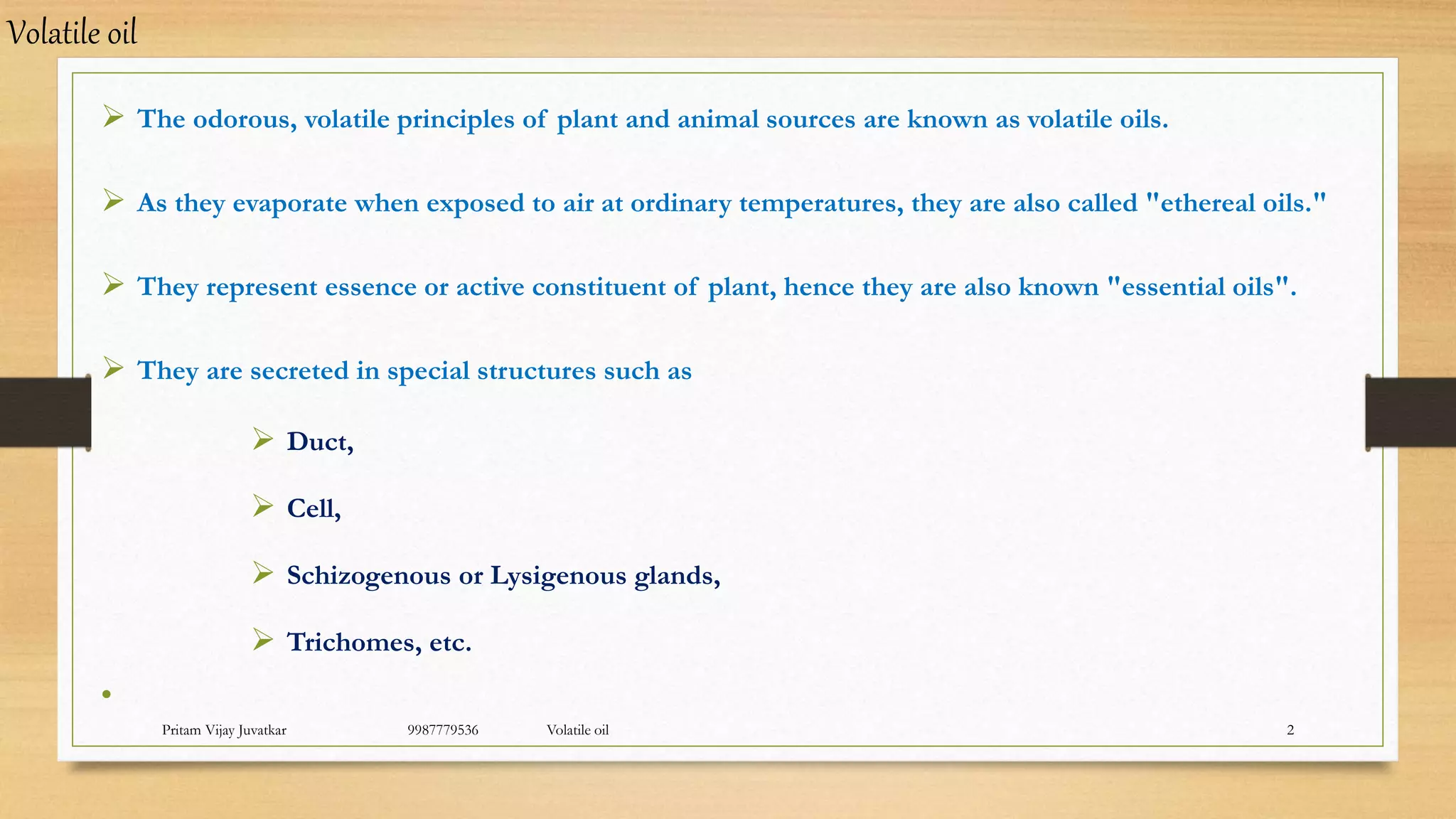
 The odorous, volatile principles of plant and animal sources are known as volatile oils.
 As they evaporate when exposed to air at ordinary temperatures, they are also called "ethereal oils."
 They represent essence or active constituent of plant, hence they are also known "essential oils".
 They are secreted in special structures such as
 Duct,
 Cell,
 Schizogenous or Lysigenous glands,
 Trichomes, etc.
•
Volatile oil
Pritam Vijay Juvatkar 9987779536 Volatile oil 3
• Physical & Chemical Properties of Volatile oil
 Chemically, they are derived from terpenes and their oxygenated compounds.
 They are made up of isoprene units (C5H8) and are usually mono-, sesqui- and diterpenes with
empirical formulae as C5H8, ClOH16 , C15H24 and C20H32 respectively.
 Volatile oils are soluble in alcohol, ether and other lipid solvents and practically insoluble in water.
 They are usually lighter than water.
 They possess characteristic odours and they have high refractive indices.
 Most of them are optically active.
Volatile oil
Pritam Vijay Juvatkar 9987779536 Volatile oil 4
• Hydro distillation
 This method comprising of distillation, water and steam distillation is used for extraction of
volatile oil from herbal drugs.
 The fresh material is subjected to hydrodistillation in case of the leaf drugs. Air-dried
subterranean parts are extracted by steam distillation.
• Enfleurage
 This method is used for extraction of delicate perfumes.
 The fresh flower petals are mechanically spread on layer of fatty material, allowed to imbibe and
the exhausted petals are replaced by fresh material.
 The process is continued till the fatty layer is saturated with volatile principles which are then
extracted with lipid solvent.
•
Volatile oil Extraction methods
Pritam Vijay Juvatkar 9987779536 Volatile oil 5
• Ecuelle
 This method is used for extraction of citrus oils, wherein oil cells in rind are ruptured
mechanically using pointed projections by twisting raw material over them in clockwise direction
either mechanically or manually.
• Solvent extraction method
 Ethanol extraction is a type of solvent extraction used to extract fragrant compounds directly from
dry raw materials, as well as the impure oils or concrete resulting from organic solvent extraction,
expression, or enfluerage.
•
Volatile oil Extraction methods
Pritam Vijay Juvatkar 9987779536 Volatile oil 6
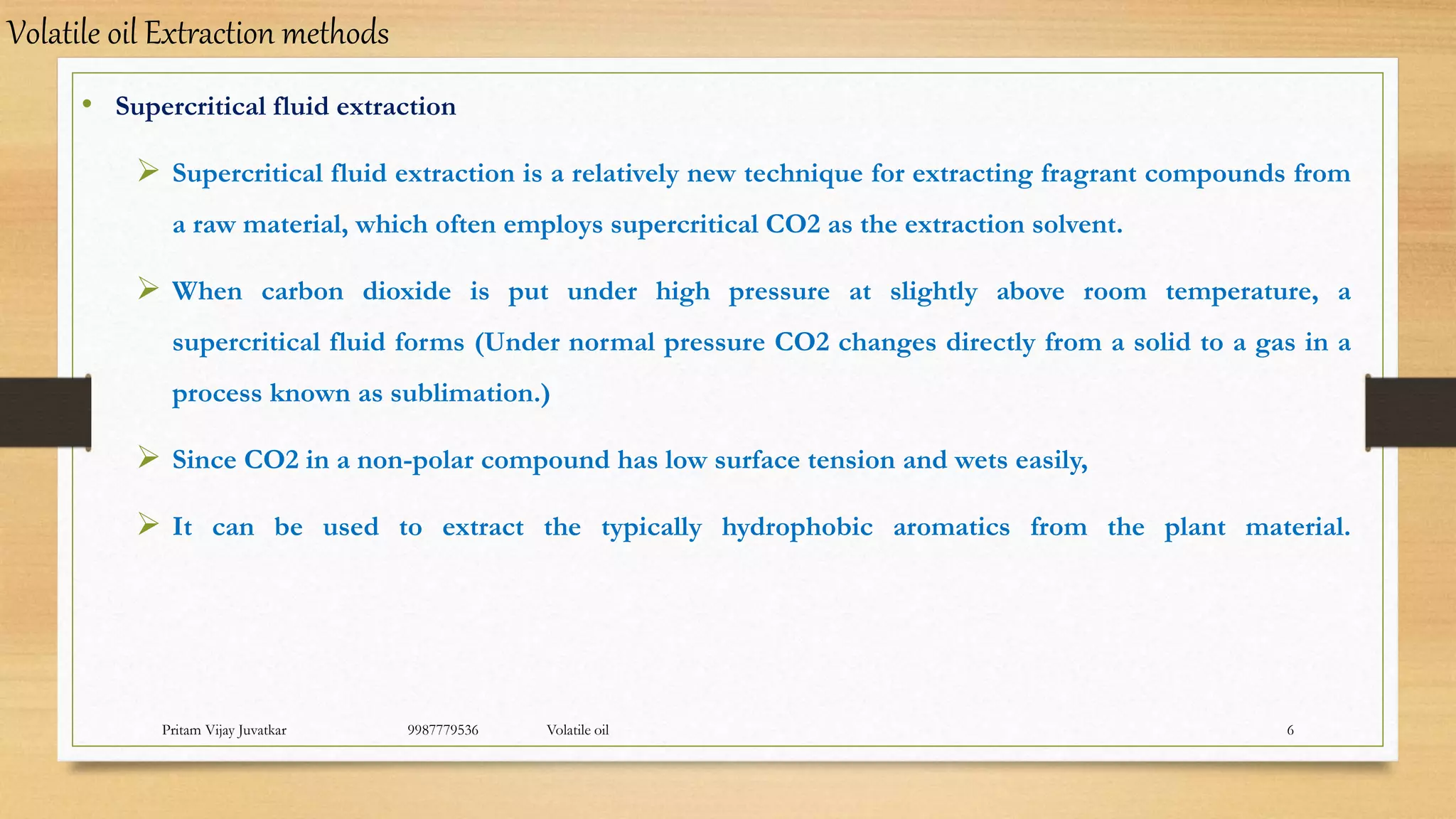
• Supercritical fluid extraction
 Supercritical fluid extraction is a relatively new technique for extracting fragrant compounds from
a raw material, which often employs supercritical CO2 as the extraction solvent.
 When carbon dioxide is put under high pressure at slightly above room temperature, a
supercritical fluid forms (Under normal pressure CO2 changes directly from a solid to a gas in a
process known as sublimation.)
 Since CO2 in a non-polar compound has low surface tension and wets easily,
 It can be used to extract the typically hydrophobic aromatics from the plant material.
Volatile oil Extraction methods
Pritam Vijay Juvatkar 9987779536 Volatile oil 7
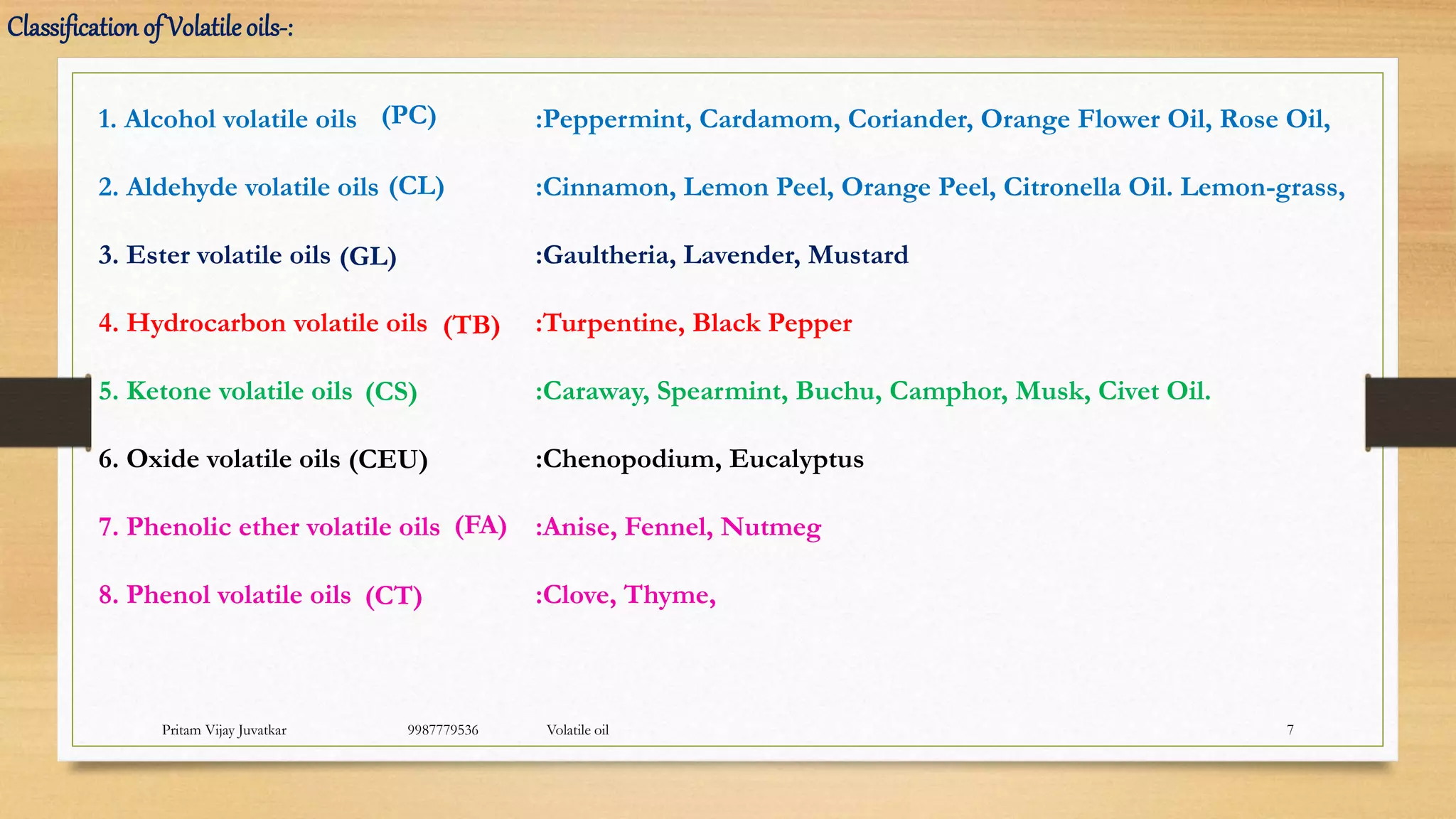
Classification of Volatileoils-:
1. Alcohol volatile oils :Peppermint, Cardamom, Coriander, Orange Flower Oil, Rose Oil,
2. Aldehyde volatile oils :Cinnamon, Lemon Peel, Orange Peel, Citronella Oil. Lemon-grass,
3. Ester volatile oils :Gaultheria, Lavender, Mustard
4. Hydrocarbon volatile oils :Turpentine, Black Pepper
5. Ketone volatile oils :Caraway, Spearmint, Buchu, Camphor, Musk, Civet Oil.
6. Oxide volatile oils :Chenopodium, Eucalyptus
7. Phenolic ether volatile oils :Anise, Fennel, Nutmeg
8. Phenol volatile oils :Clove, Thyme,
(PC)
(CL)
(GL)
(TB)
(CS)
(CEU)
(FA)
(CT)
Pritam Vijay Juvatkar 9987779536 Volatile oil 8
Classification of Volatileoils-:
 Volatile oils are used as flavouring and perfuming agents in pharmaceutical formulations, foods and
cosmetics.
 As carminatives (umbelliferous fruits, cinnamon, etc.),
 Anthelmintics (chenopodium),
 Diuretic (juniper),
 Antiseptic (eucalyptus),
 Counter-irritant (oil of wintergreen),
 Local anaesthetic (clove),
 Sedative (jatamansi),
 Local, irritant (turpentine),
 Terpeneless oils are valuable perfuming and flavouring agents.
Application of Volatile oil :
Pritam Vijay Juvatkar 9987779536 Volatile oil 9
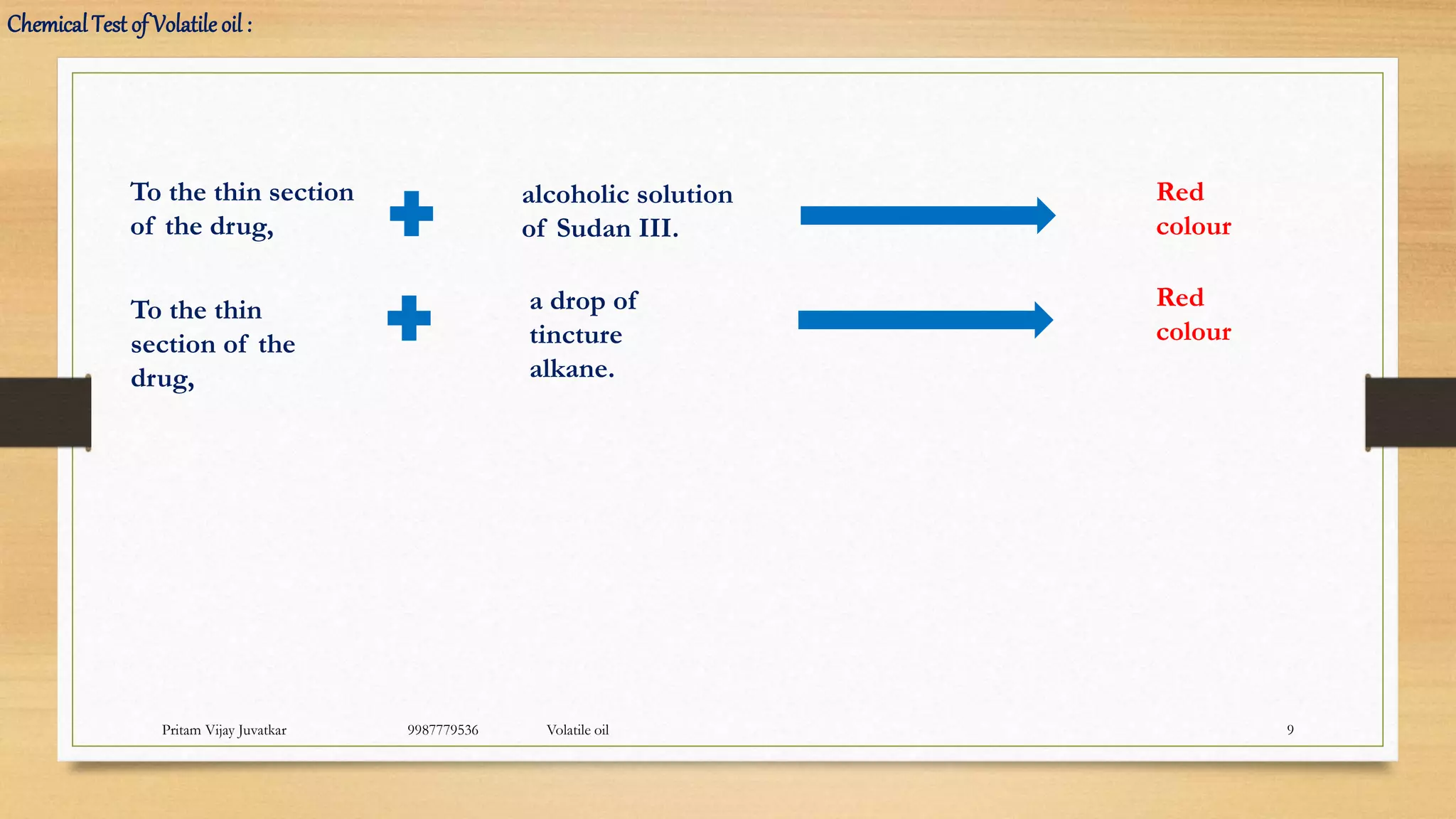
Chemical Test of Volatile oil :
To the thin section
of the drug,
alcoholic solution
of Sudan III.
Red
colour
To the thin
section of the
drug,
a drop of
tincture
alkane.
Red
colour
Thank You
PRESENTED BY:
MR. PRITAM VIJAY JUVATKAR
ASSISTANT PROFESSOR
pvjuvatkar@rediffmail.com, +91 9987779536
KONKAN GYANPEETH RAHUL DHARKAR COLLEGE OF PHARMACY AND RESEARCH INSTITUTE,
KARJAT
UNIVERSITY OF MUMBAI
Disclosure
PRESENTED BY:
MR. PRITAM VIJAY JUVATKAR
ASSISTANT PROFESSOR
pvjuvatkar@rediffmail.com, +91 9987779536
KONKAN GYANPEETH RAHUL DHARKAR COLLEGE OF PHARMACY AND RESEARCH INSTITUTE,
KARJAT
UNIVERSITY OF MUMBAI
This Presentation is meant for Study Notes for B.Pharm Students only. Please do
not take as a reference for treatment for an ailments or other usage

Volatile oil

  • 1.
    Volatile oil Definition, classification,properties and test for identification PRESENTED BY: MR. PRITAM VIJAY JUVATKAR ASSISTANT PROFESSOR pvjuvatkar@rediffmail.com, +91 9987779536 KONKAN GYANPEETH RAHUL DHARKAR COLLEGE OF PHARMACY AND RESEARCH INSTITUTE, KARJAT UNIVERSITY OF MUMBAI
  • 2.
    Pritam Vijay Juvatkar9987779536 Volatile oil 2  The odorous, volatile principles of plant and animal sources are known as volatile oils.  As they evaporate when exposed to air at ordinary temperatures, they are also called "ethereal oils."  They represent essence or active constituent of plant, hence they are also known "essential oils".  They are secreted in special structures such as  Duct,  Cell,  Schizogenous or Lysigenous glands,  Trichomes, etc. • Volatile oil
  • 3.
    Pritam Vijay Juvatkar9987779536 Volatile oil 3 • Physical & Chemical Properties of Volatile oil  Chemically, they are derived from terpenes and their oxygenated compounds.  They are made up of isoprene units (C5H8) and are usually mono-, sesqui- and diterpenes with empirical formulae as C5H8, ClOH16 , C15H24 and C20H32 respectively.  Volatile oils are soluble in alcohol, ether and other lipid solvents and practically insoluble in water.  They are usually lighter than water.  They possess characteristic odours and they have high refractive indices.  Most of them are optically active. Volatile oil
  • 4.
    Pritam Vijay Juvatkar9987779536 Volatile oil 4 • Hydro distillation  This method comprising of distillation, water and steam distillation is used for extraction of volatile oil from herbal drugs.  The fresh material is subjected to hydrodistillation in case of the leaf drugs. Air-dried subterranean parts are extracted by steam distillation. • Enfleurage  This method is used for extraction of delicate perfumes.  The fresh flower petals are mechanically spread on layer of fatty material, allowed to imbibe and the exhausted petals are replaced by fresh material.  The process is continued till the fatty layer is saturated with volatile principles which are then extracted with lipid solvent. • Volatile oil Extraction methods
  • 5.
    Pritam Vijay Juvatkar9987779536 Volatile oil 5 • Ecuelle  This method is used for extraction of citrus oils, wherein oil cells in rind are ruptured mechanically using pointed projections by twisting raw material over them in clockwise direction either mechanically or manually. • Solvent extraction method  Ethanol extraction is a type of solvent extraction used to extract fragrant compounds directly from dry raw materials, as well as the impure oils or concrete resulting from organic solvent extraction, expression, or enfluerage. • Volatile oil Extraction methods
  • 6.
    Pritam Vijay Juvatkar9987779536 Volatile oil 6 • Supercritical fluid extraction  Supercritical fluid extraction is a relatively new technique for extracting fragrant compounds from a raw material, which often employs supercritical CO2 as the extraction solvent.  When carbon dioxide is put under high pressure at slightly above room temperature, a supercritical fluid forms (Under normal pressure CO2 changes directly from a solid to a gas in a process known as sublimation.)  Since CO2 in a non-polar compound has low surface tension and wets easily,  It can be used to extract the typically hydrophobic aromatics from the plant material. Volatile oil Extraction methods
  • 7.
    Pritam Vijay Juvatkar9987779536 Volatile oil 7 Classification of Volatileoils-: 1. Alcohol volatile oils :Peppermint, Cardamom, Coriander, Orange Flower Oil, Rose Oil, 2. Aldehyde volatile oils :Cinnamon, Lemon Peel, Orange Peel, Citronella Oil. Lemon-grass, 3. Ester volatile oils :Gaultheria, Lavender, Mustard 4. Hydrocarbon volatile oils :Turpentine, Black Pepper 5. Ketone volatile oils :Caraway, Spearmint, Buchu, Camphor, Musk, Civet Oil. 6. Oxide volatile oils :Chenopodium, Eucalyptus 7. Phenolic ether volatile oils :Anise, Fennel, Nutmeg 8. Phenol volatile oils :Clove, Thyme, (PC) (CL) (GL) (TB) (CS) (CEU) (FA) (CT)
  • 8.
    Pritam Vijay Juvatkar9987779536 Volatile oil 8 Classification of Volatileoils-:  Volatile oils are used as flavouring and perfuming agents in pharmaceutical formulations, foods and cosmetics.  As carminatives (umbelliferous fruits, cinnamon, etc.),  Anthelmintics (chenopodium),  Diuretic (juniper),  Antiseptic (eucalyptus),  Counter-irritant (oil of wintergreen),  Local anaesthetic (clove),  Sedative (jatamansi),  Local, irritant (turpentine),  Terpeneless oils are valuable perfuming and flavouring agents. Application of Volatile oil :
  • 9.
    Pritam Vijay Juvatkar9987779536 Volatile oil 9 Chemical Test of Volatile oil : To the thin section of the drug, alcoholic solution of Sudan III. Red colour To the thin section of the drug, a drop of tincture alkane. Red colour
  • 10.
    Thank You PRESENTED BY: MR.PRITAM VIJAY JUVATKAR ASSISTANT PROFESSOR pvjuvatkar@rediffmail.com, +91 9987779536 KONKAN GYANPEETH RAHUL DHARKAR COLLEGE OF PHARMACY AND RESEARCH INSTITUTE, KARJAT UNIVERSITY OF MUMBAI
  • 11.
    Disclosure PRESENTED BY: MR. PRITAMVIJAY JUVATKAR ASSISTANT PROFESSOR pvjuvatkar@rediffmail.com, +91 9987779536 KONKAN GYANPEETH RAHUL DHARKAR COLLEGE OF PHARMACY AND RESEARCH INSTITUTE, KARJAT UNIVERSITY OF MUMBAI This Presentation is meant for Study Notes for B.Pharm Students only. Please do not take as a reference for treatment for an ailments or other usage