liquorice
harsh kumar baranwal
SYNONYMS
 Mulethi
Yastimadhu
Liquorice root
 Glycyrrhiza
radix
Biological Source
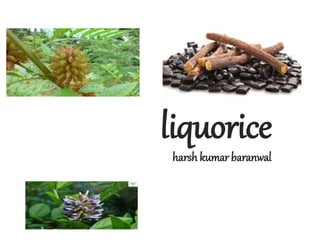
It is obtained from the dried, unpeeled
roots and stolons of the plant
Glycyrrhiza glabra.
FAMILY- LEGUMINOSAE
Macroscopic characters
Odour – Faint and
characteristic.
Colour – Yellowish brown
Taste – Sweet
Shape- Cylindrical
Size – 20-40cm in length
and 2cm in diameter
Microscopic Characters
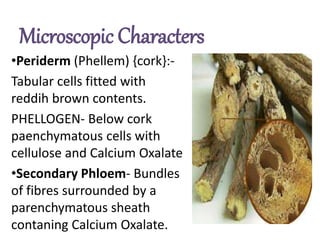
•Periderm (Phellem) {cork}:-
Tabular cells fitted with
reddih brown contents.
PHELLOGEN- Below cork
paenchymatous cells with
cellulose and Calcium Oxalate
•Secondary Phloem- Bundles
of fibres surrounded by a
parenchymatous sheath
contaning Calcium Oxalate.
• Medullary rays - multistearate
and parenchymatous.
Rays are narrow in xylem and
wide in phoem.
• Secondary Xylem - Xlem consist
of vessel, fibres, and lignified
wood parenchyma.
Starch is preent in wood
parenchyma.
• Pith – Consist of large
parenchyma with intercellular
spaces and few starch grain.
Pith is absent in root.
Collection and
Cultivation
• India and China are
the primary
producers of
liquorice.
• In India plant has
been grown in
Patiala, Hisar, Jhansi
and Lucknow.
• In India the plant is grown in he aresas with
the subtropical climate nd receiving annual
rainfall about 0cm or less.
• The plant is grown in the month of march i.e
in Spring season and harvested and collected
in the month of October i.e Autumn Season in
the third or fourth year of cultivation.
• There are several variations and species of the
liquorice root sold in World’s Market.
• Liquorice is to be grown around lakes and
semi-irrigated fields.
PREPARATION
• Roots are usually harvested in month of
October after 3 – 4 year of cultivation.
• The rootless and buds are removed manualy
and drug is washed with water.
• Maximum sweetness of sap is excreted out.
• The drug is first dried under the sun and shade
till it looses almost 50percent of its initila
weight.
• The extract ad water is filtered, evaported and
the concentration extract is molded eiher into
sticks or other suitable form.
Chemical Constituents
•It consist of the Saponins and
the Flavanoids.
SAPONINS – Gkycyrrhetinic
acid and Carbenoxolone.
FLAVANOIDS – Isoquiritigen
(R=H) and Isoquirtin (beta-D-
glucopyranosyl).
Substituents and Adulterants
• Mannchurian liquorice obtained from
Glycyrrhiza uralensis.
• Russian liquorice as it contains purplish
flowers appearance but have no stolons.
CHEMICAL TEST
• When sulphuric acid (80percent)
is added to a thick section ofvthe
drug or powder, it instantly
produce a deep colour.
USES
• Glycyrrhiza has
demulscent and
expectorant
properties.
• Liquid extract used
in treatment of
peptic ulcer.
• Added to beer to
form stable and
enhanced
foaminens.
• It is used as a masking agent for bitter drugs in
pharamceutical formulation such as quinine,
aloe, ammonium chloride etc.
• Ammoniated glycyrrhiza is employed as a
flavouring agent in bevearges,
pharmaceuticals and confectionary.
• The inherent surfactant activity due to the
presence of aponins helps to facilitate the
absorption of porly absorbed drug.
• Glycyrrhetic acid is employed in
dermatological formulations for its remarkable
anti-inflammatory properties.
Thank you

Liquorice

  • 1.
  • 2.
  • 3.
    Biological Source It isobtained from the dried, unpeeled roots and stolons of the plant Glycyrrhiza glabra. FAMILY- LEGUMINOSAE
  • 4.
    Macroscopic characters Odour –Faint and characteristic. Colour – Yellowish brown Taste – Sweet Shape- Cylindrical Size – 20-40cm in length and 2cm in diameter
  • 5.
    Microscopic Characters •Periderm (Phellem){cork}:- Tabular cells fitted with reddih brown contents. PHELLOGEN- Below cork paenchymatous cells with cellulose and Calcium Oxalate •Secondary Phloem- Bundles of fibres surrounded by a parenchymatous sheath contaning Calcium Oxalate.
  • 6.
    • Medullary rays- multistearate and parenchymatous. Rays are narrow in xylem and wide in phoem. • Secondary Xylem - Xlem consist of vessel, fibres, and lignified wood parenchyma. Starch is preent in wood parenchyma. • Pith – Consist of large parenchyma with intercellular spaces and few starch grain. Pith is absent in root.
  • 8.
    Collection and Cultivation • Indiaand China are the primary producers of liquorice. • In India plant has been grown in Patiala, Hisar, Jhansi and Lucknow.
  • 9.
    • In Indiathe plant is grown in he aresas with the subtropical climate nd receiving annual rainfall about 0cm or less. • The plant is grown in the month of march i.e in Spring season and harvested and collected in the month of October i.e Autumn Season in the third or fourth year of cultivation. • There are several variations and species of the liquorice root sold in World’s Market. • Liquorice is to be grown around lakes and semi-irrigated fields.
  • 10.
    PREPARATION • Roots areusually harvested in month of October after 3 – 4 year of cultivation. • The rootless and buds are removed manualy and drug is washed with water. • Maximum sweetness of sap is excreted out. • The drug is first dried under the sun and shade till it looses almost 50percent of its initila weight. • The extract ad water is filtered, evaported and the concentration extract is molded eiher into sticks or other suitable form.
  • 11.
    Chemical Constituents •It consistof the Saponins and the Flavanoids. SAPONINS – Gkycyrrhetinic acid and Carbenoxolone. FLAVANOIDS – Isoquiritigen (R=H) and Isoquirtin (beta-D- glucopyranosyl).
  • 13.
    Substituents and Adulterants •Mannchurian liquorice obtained from Glycyrrhiza uralensis. • Russian liquorice as it contains purplish flowers appearance but have no stolons.
  • 14.
    CHEMICAL TEST • Whensulphuric acid (80percent) is added to a thick section ofvthe drug or powder, it instantly produce a deep colour.
  • 15.
    USES • Glycyrrhiza has demulscentand expectorant properties. • Liquid extract used in treatment of peptic ulcer. • Added to beer to form stable and enhanced foaminens.
  • 16.
    • It isused as a masking agent for bitter drugs in pharamceutical formulation such as quinine, aloe, ammonium chloride etc. • Ammoniated glycyrrhiza is employed as a flavouring agent in bevearges, pharmaceuticals and confectionary. • The inherent surfactant activity due to the presence of aponins helps to facilitate the absorption of porly absorbed drug. • Glycyrrhetic acid is employed in dermatological formulations for its remarkable anti-inflammatory properties.
  • 19.