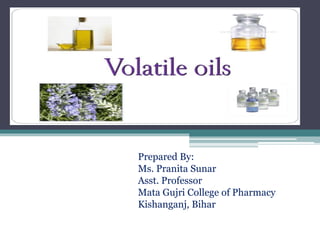
Prepared By:
Ms. Pranita Sunar
Asst. Professor
Mata Gujri College of Pharmacy
Kishanganj, Bihar
Volatile oils are odorous , volatile principle of plant and
animal source that evaporates easily when exposed to air
at ordinary room temperature. They represent essence of
active constituent of plant or animal , hence are also
known as essential oils.
They are present in any part or entire plant. They differ
entirely in both chemical and physical properties from
fixed oils. Volatile oils are chemically derived from
terpenes and their oxygenated compounds.
Properties of Volatile oils
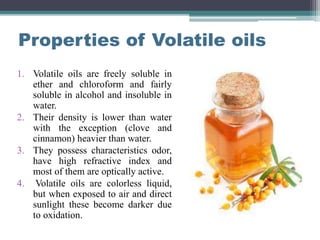
1. Volatile oils are freely soluble in
ether and chloroform and fairly
soluble in alcohol and insoluble in
water.
2. Their density is lower than water
with the exception (clove and
cinnamon) heavier than water.
3. They possess characteristics odor,
have high refractive index and
most of them are optically active.
4. Volatile oils are colorless liquid,
but when exposed to air and direct
sunlight these become darker due
to oxidation.
Occurrence and Distribution
Majority of volatile are preexist in the plants and is usually contained in
some special secretory tissues, for example- the oil ducts of
umbelliferous fruits, the oil cells or oil glands occurring in the sub-
epidermal tissue of the lemon and orange, leaves, trichomes of several
plants etc. And commonly found in
Labitae(tulsi),Rutaceae(orange,lemon),Piperaceae(blackpepper),Zingi
beraceae(cardamom) Umbelliferae(coriander, fennel) etc.
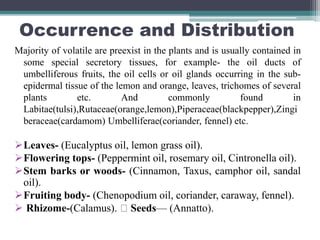
Leaves- (Eucalyptus oil, lemon grass oil).
Flowering tops- (Peppermint oil, rosemary oil, Cintronella oil).
Stem barks or woods- (Cinnamon, Taxus, camphor oil, sandal
oil).
Fruiting body- (Chenopodium oil, coriander, caraway, fennel).
 Rhizome-(Calamus). Seeds— (Annatto).
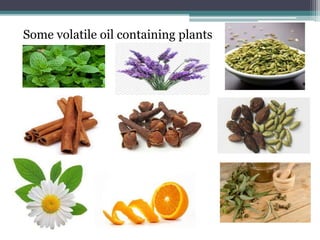
Some volatile oil containing plants
Isolation methods for volatile oils
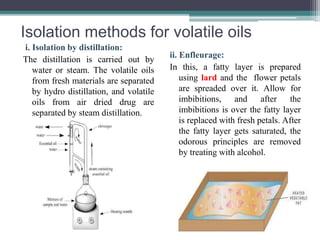
i. Isolation by distillation:
The distillation is carried out by
water or steam. The volatile oils
from fresh materials are separated
by hydro distillation, and volatile
oils from air dried drug are
separated by steam distillation.
ii. Enfleurage:
In this, a fatty layer is prepared
using lard and the flower petals
are spreaded over it. Allow for
imbibitions, and after the
imbibitions is over the fatty layer
is replaced with fresh petals. After
the fatty layer gets saturated, the
odorous principles are removed
by treating with alcohol.
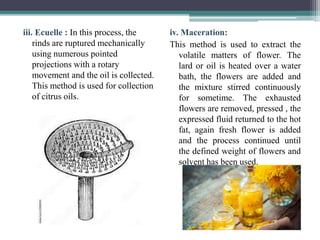
iii. Ecuelle : In this process, the
rinds are ruptured mechanically
using numerous pointed
projections with a rotary
movement and the oil is collected.
This method is used for collection
of citrus oils.
iv. Maceration:
This method is used to extract the
volatile matters of flower. The
lard or oil is heated over a water
bath, the flowers are added and
the mixture stirred continuously
for sometime. The exhausted
flowers are removed, pressed , the
expressed fluid returned to the hot
fat, again fresh flower is added
and the process continued until
the defined weight of flowers and
solvent has been used.
Chemical tests for volatile oils
When alcoholic solution of Sudan III is added to the thin
section of drug, it gives red color that indicates the presence of
volatile oil.
 When a drop of tincture alkane is added to the thin section of
drug, it gives red color that indicates the presence of volatile
oils.
Therapeutic/Pharmaceutical applications of volatile oil
Volatile oils are used as flavoring and perfuming agents
in pharmaceutical formulation, foods, beverages and
cosmetics.
They are also used as medicinal agent such as
carminative, anthelmintics, antiseptic, local anaesthetics,
sedative, insect repellant etc,.
THANK YOU
Best wishes

VOLATILE OILS.pptx

  • 1.
    Prepared By: Ms. PranitaSunar Asst. Professor Mata Gujri College of Pharmacy Kishanganj, Bihar
  • 2.
    Volatile oils areodorous , volatile principle of plant and animal source that evaporates easily when exposed to air at ordinary room temperature. They represent essence of active constituent of plant or animal , hence are also known as essential oils. They are present in any part or entire plant. They differ entirely in both chemical and physical properties from fixed oils. Volatile oils are chemically derived from terpenes and their oxygenated compounds.
  • 3.
    Properties of Volatileoils 1. Volatile oils are freely soluble in ether and chloroform and fairly soluble in alcohol and insoluble in water. 2. Their density is lower than water with the exception (clove and cinnamon) heavier than water. 3. They possess characteristics odor, have high refractive index and most of them are optically active. 4. Volatile oils are colorless liquid, but when exposed to air and direct sunlight these become darker due to oxidation.
  • 4.
    Occurrence and Distribution Majorityof volatile are preexist in the plants and is usually contained in some special secretory tissues, for example- the oil ducts of umbelliferous fruits, the oil cells or oil glands occurring in the sub- epidermal tissue of the lemon and orange, leaves, trichomes of several plants etc. And commonly found in Labitae(tulsi),Rutaceae(orange,lemon),Piperaceae(blackpepper),Zingi beraceae(cardamom) Umbelliferae(coriander, fennel) etc. Leaves- (Eucalyptus oil, lemon grass oil). Flowering tops- (Peppermint oil, rosemary oil, Cintronella oil). Stem barks or woods- (Cinnamon, Taxus, camphor oil, sandal oil). Fruiting body- (Chenopodium oil, coriander, caraway, fennel).  Rhizome-(Calamus). Seeds— (Annatto).
  • 5.
    Some volatile oilcontaining plants
  • 6.
    Isolation methods forvolatile oils i. Isolation by distillation: The distillation is carried out by water or steam. The volatile oils from fresh materials are separated by hydro distillation, and volatile oils from air dried drug are separated by steam distillation. ii. Enfleurage: In this, a fatty layer is prepared using lard and the flower petals are spreaded over it. Allow for imbibitions, and after the imbibitions is over the fatty layer is replaced with fresh petals. After the fatty layer gets saturated, the odorous principles are removed by treating with alcohol.
  • 7.
    iii. Ecuelle :In this process, the rinds are ruptured mechanically using numerous pointed projections with a rotary movement and the oil is collected. This method is used for collection of citrus oils. iv. Maceration: This method is used to extract the volatile matters of flower. The lard or oil is heated over a water bath, the flowers are added and the mixture stirred continuously for sometime. The exhausted flowers are removed, pressed , the expressed fluid returned to the hot fat, again fresh flower is added and the process continued until the defined weight of flowers and solvent has been used.
  • 8.
    Chemical tests forvolatile oils When alcoholic solution of Sudan III is added to the thin section of drug, it gives red color that indicates the presence of volatile oil.  When a drop of tincture alkane is added to the thin section of drug, it gives red color that indicates the presence of volatile oils. Therapeutic/Pharmaceutical applications of volatile oil Volatile oils are used as flavoring and perfuming agents in pharmaceutical formulation, foods, beverages and cosmetics. They are also used as medicinal agent such as carminative, anthelmintics, antiseptic, local anaesthetics, sedative, insect repellant etc,.
  • 9.