Silent Selling: Visual Merchandising for Small RetailersDebra Templar: Retail Check ups, Tune Ups & Makeovers....It’s in the bag!
VISUAL MERCHANDISINGSupports salesCommunicates with CustomersSupports Selling by:Communicating the latest trendsAssisting the customer in making a buying decision, andCreating an exciting environment within the shop/centre
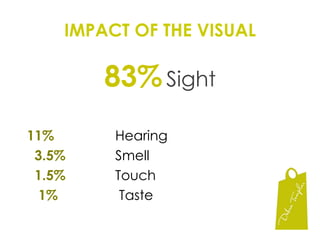
IMPACT OF THE VISUAL83%Sight11%	Hearing3.5%	Smell1.5%	Touch1%		 Taste
FIRST IMPRESSIONSFirst Impressions are formed within the first 10 seconds.Customers remember vividly the worst impression, not the best impression.
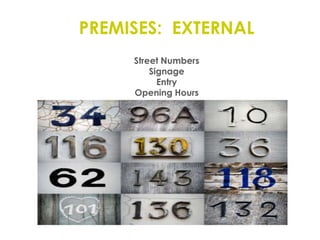
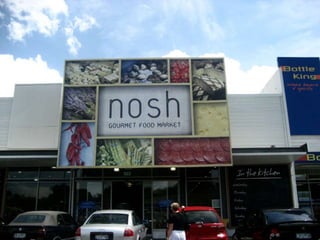
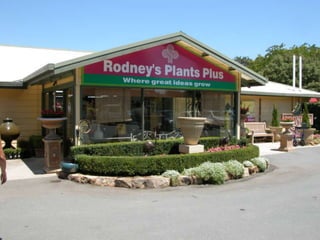
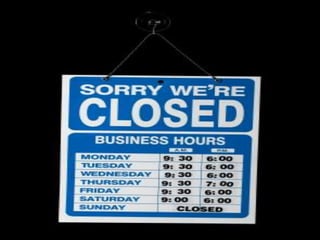
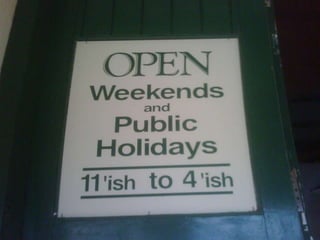
PREMISES:  EXTERNALStreet NumbersSignageEntryOpening Hours
CRABTREE & EVELYN
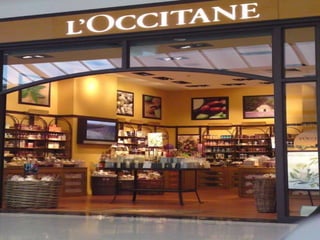
L’OCCITAINE Broadway
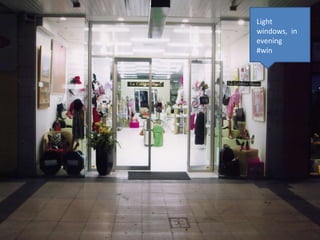
Light windows,  in evening#win
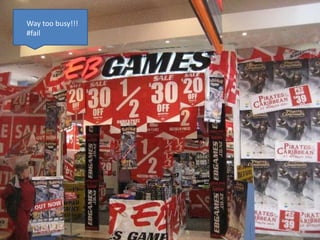
Way too busy!!!#fail
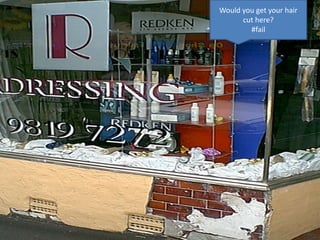
Would you get your hair cut here?#fail
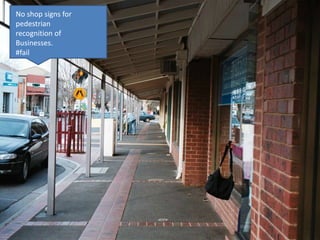
No shop signs forpedestrianrecognition ofBusinesses.#fail
WINDOWSIf eyes are the windows to the soulThen shop windows are just as revealing.They reveal the soul of the shop…
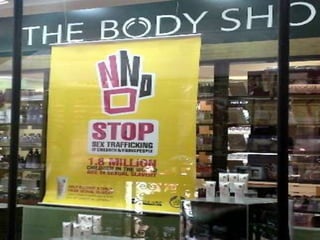
BODYSHOP Broadway
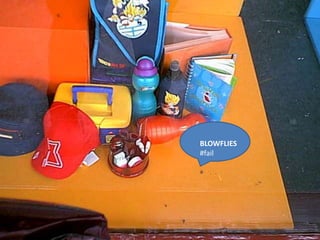
BLOWFLIES#fail
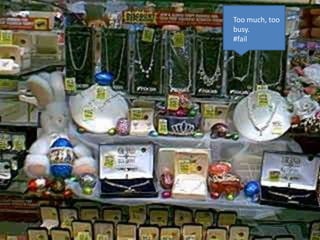
Too much, too busy.#fail
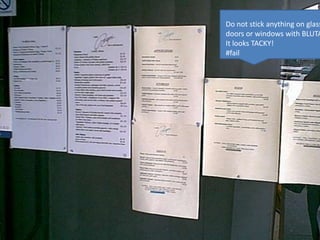
Do not stick anything on glass doors or windows with BLUTAK.It looks TACKY!#fail
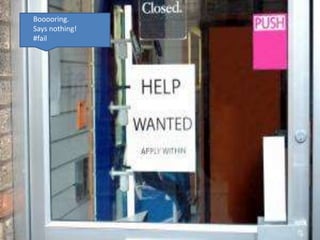
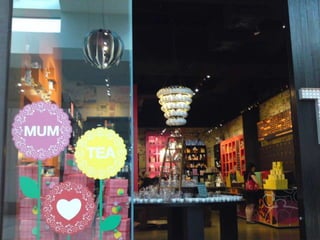
Booooring.Says nothing!#fail
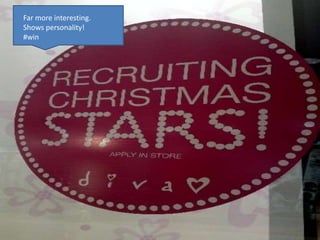
Far more interesting. Shows personality!#win
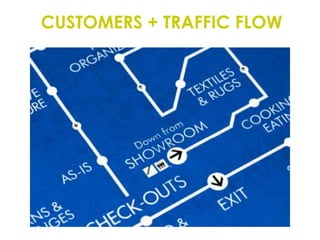
CUSTOMERS + TRAFFIC FLOW
Every square metre of space in a retail store costs money – all areas should pay their way.Useful points:On entering store, most customers skirt around the cash desk.Beware of what merchandise you place in an Adjustment Space.  Customers don’t see it.Most customers avoid badly lit, neglected or cluttered areas.
Open sight lines are important.Negative signs on displays about terms of sale deter customers from returning.Stock left in aisles and pathways can seriously damage your traffic flow.Friendly staff are important.
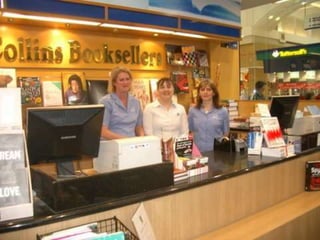
Remember, your people are part of your visual appeal.  A friendly face or a sourpuss... You choose.#win
“BUTT’’ BRUSHPaco Underhill
Some product categories require more space, as they are browse products.
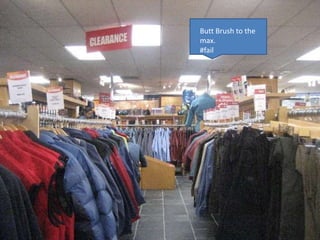
People will brush up against product three times before they get the “heebies” and leave.
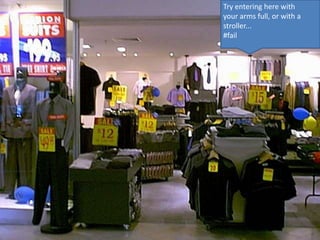
Ensure there is enough space for people to move around your store without bumping into product, fixtures etc.Try entering here with your arms full, or with a stroller...#fail
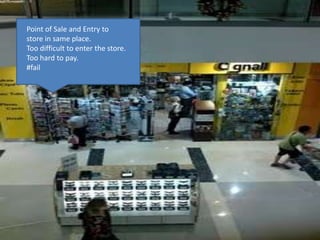
Point of Sale and Entry to store in same place.Too difficult to enter the store. Too hard to pay.  #fail
Butt Brush to the max.#fail
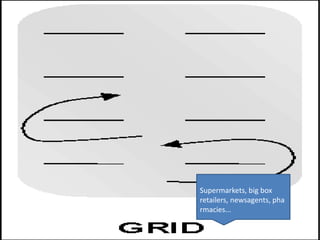
Supermarkets, big box retailers, newsagents, pharmacies...
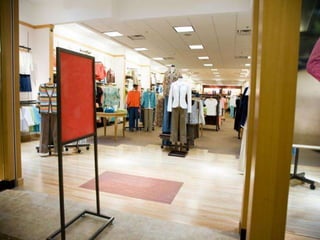
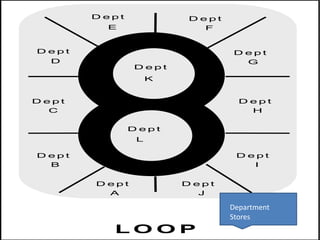
Department Stores
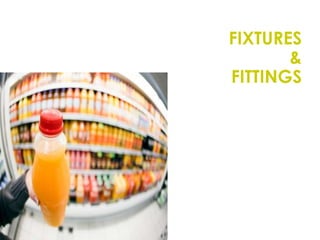
FIXTURES&             FITTINGS
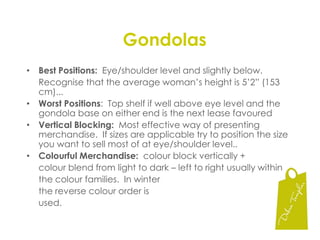
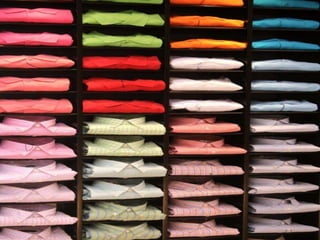
GondolasBest Positions:  Eye/shoulder level and slightly below.	Recognise that the average woman’s height is 5’2” (153 cm)... Worst Positions:  Top shelf if well above eye level and the gondola base on either end is the next lease favouredVertical Blocking:  Most effective way of presenting merchandise.  If sizes are applicable try to position the size you want to sell most of at eye/shoulder level..Colourful Merchandise:  colour block vertically + 	colour blend from light to dark – left to right usually within 	the colour families.  In winter 	the reverse colour order is 	used.
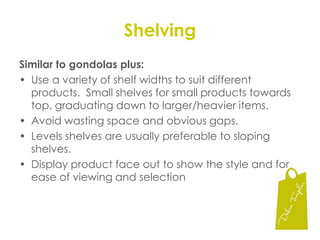
ShelvingSimilar to gondolas plus:Use a variety of shelf widths to suit different products.  Small shelves for small products towards top, graduating down to larger/heavier items.
Avoid wasting space and obvious gaps.
Levels shelves are usually preferable to sloping shelves.
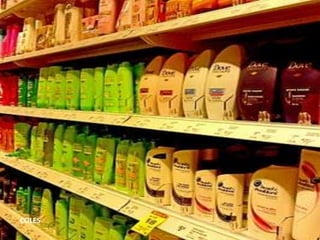
Display product face out to show the style and for ease of viewing and selection
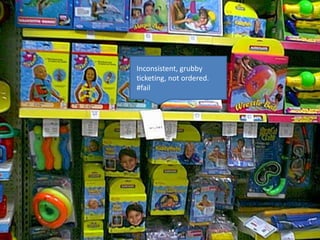
Inconsistent, grubby ticketing, not ordered.#fail
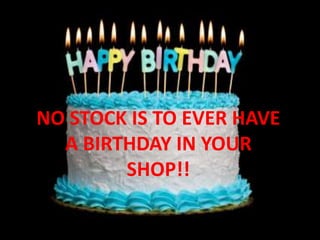
NO STOCK IS TO EVER HAVE A BIRTHDAY IN YOUR SHOP!!
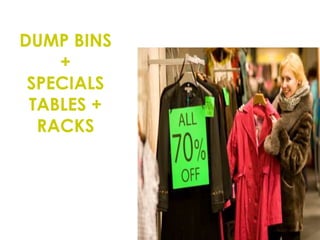
DUMP BINS + SPECIALS TABLES + RACKS
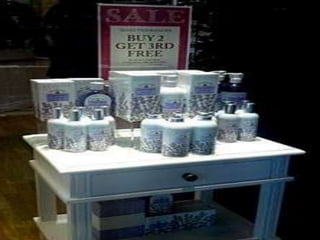
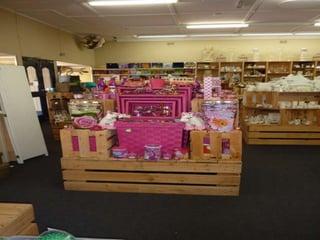
Don’t over-crowd.  But no less than half full.  Make everything in Dump Bin/Table/Rack the same price, wherever possible.
Locate in your racetrack and use it to give the impression that it is a price-motivated promotion.
Allocate one product type per bin and display the products as if it were just dumped into the bin.
Always have a price sign to highlight the special price.
Life of a dump bin:  Maximum of 1 month. Preferably, 1 week.
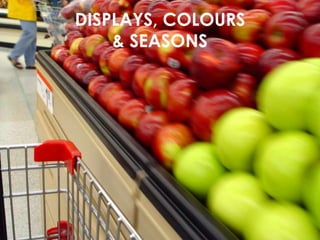
Sales will increase by 30% for that specified productDISPLAYS, COLOURS & SEASONS
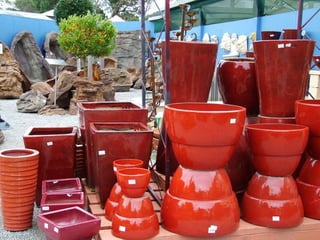
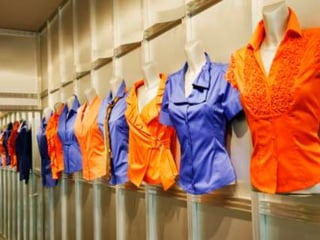
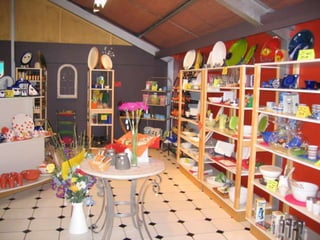
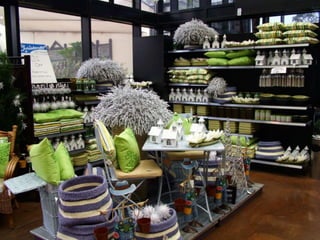
Colour SellsColour is what customers see first.  More than anything else, colour makes people stop and look.  For many customers colour is more important than the size or the style of the product.
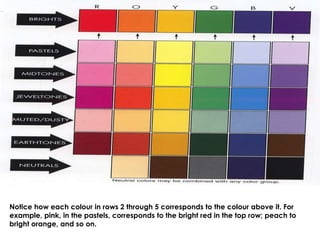
Notice how each colour in rows 2 through 5 corresponds to the colour above it. For example, pink, in the pastels, corresponds to the bright red in the top row; peach to bright orange, and so on.
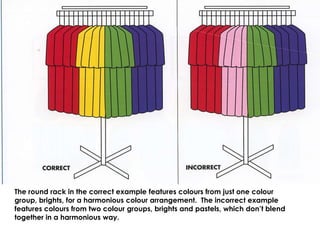
The round rack in the correct example features colours from just one colour group, brights, for a harmonious colour arrangement.  The incorrect example features colours from two colour groups, brights and pastels, which don’t blend together in a harmonious way.
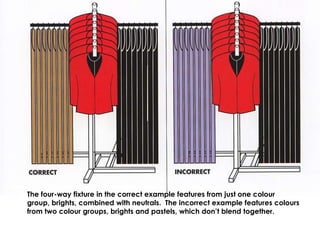
The four-way fixture in the correct example features from just one colour group, brights, combined with neutrals.  The incorrect example features colours from two colour groups, brights and pastels, which don’t blend together.
How to Maximise the Use of ColourAttract the eye of the customer
Create points of interest
Use contrasts of colour and form
Aim at variety
Create a buying mood
SIGNAGE AND TICKETING  Corporate Signs:  Branding signsProduct Category Signs:  Direct consumers to specific categoriesPromotional Signage:  Highlight specific promotions, have short life span, based on the stockturn of the promotionInformation Signage:  Identify service + service policies within your businessProduct Signs:  These educate customers about the specific product
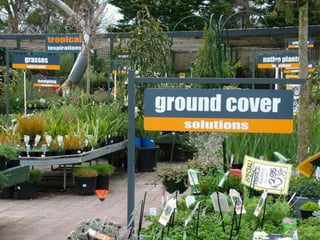
Product Category SignageThe bigger the shop, the greater the need for department signage.
The customer should be able to enter your shop and clearly see where the major departments are situated.
Keep the sign simple so it can be easily read.
Be consistent in the style used on all department signage.
Promotional SignageOnly use the signs in the key, relevant areas (do not promote roses in the herb department);
Give the promotion a lifespan and keep to it (customers don’t want to see dated, faded and ripped signs);
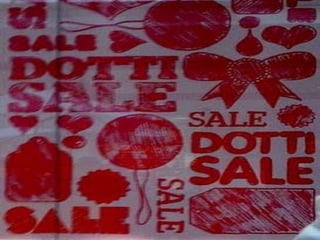
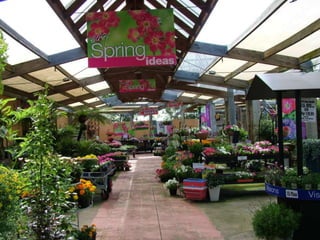
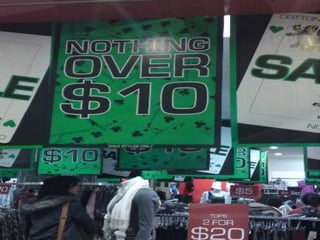
Use promotional material in an exciting way.  Rather than just hang up posters around your shop, 	group them to catch the customer’s eye.
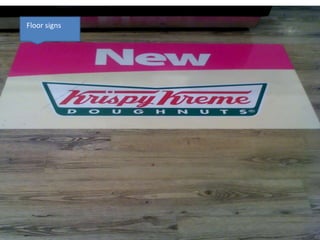
Floor signs
TICKETING
SIGNAGE AND TICKETINGHow well any sign works depends on how easy it is to read and understand.	Signs should look professional.  They must be clean & unblemished.Theme Tickets
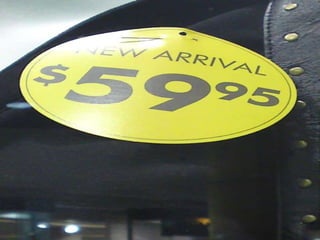
Price Tickets
Hard Sell/Soft Sell
Known Value
Unknown ValueSIGNAGE AND TICKETINGResearch in USA has revealed that during the same sale period if 100products were sold with no signage:Then 170were sold when handwritten signs were used 265products were sold when signs were professionally produced to sell the products.
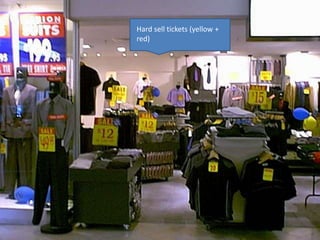
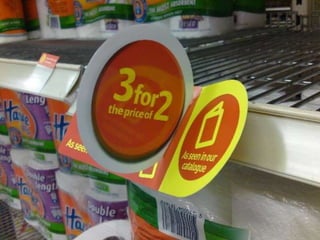
Hard sell tickets (yellow + red)
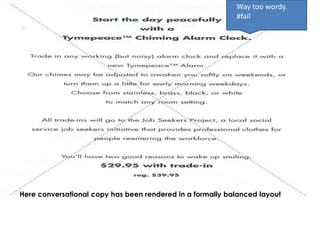
Way too wordy.#failHere conversational copy has been rendered in a formally balanced layout
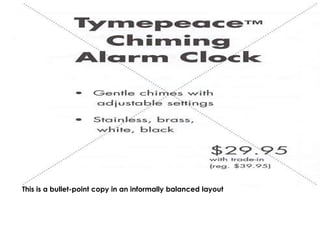
This is a bullet-point copy in an informally balanced layout
Known Value LinesProducts that are purchased on price rather than their benefits as the consumer perceives they know the exact price of these products.  Even a 5% increase in price is criticised by consumers but the reverse is that a 5% reduction in price an result in a buying frenzy, eg. cigarettes, petrol, milk, bread…
Don’t be cheaper than anyone else on KV Lines.  It will not help your bottom line.   You can match your competition, but don’t go cheaper.Consumers will judge your whole product price strategy based on a few KV lines.  Make sure you are aware of the price structure adopted by your competition on these lines.If you are more than 10% more expensive than the price leader, you will be perceived as being too expensive in your whole product.Placement of KV tickets is important.
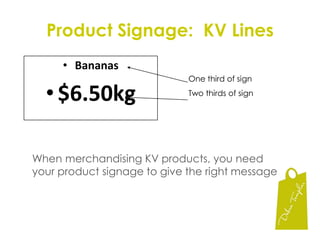
Product Signage:  KV LinesBananas$6.50kgOne third of signTwo thirds of signWhen merchandising KV products, you need your product signage to give the right message
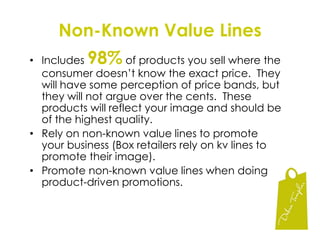
Non-Known Value LinesIncludes 98% of products you sell where the consumer doesn’t know the exact price.  They will have some perception of price bands, but they will not argue over the cents.  These products will reflect your image and should be of the highest quality.Rely on non-known value lines to promote your business (Box retailers rely on kv lines to promote their image).  Promote non-known value lines when doing product-driven promotions.
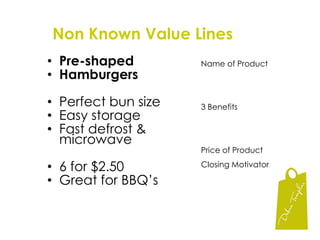
Non Known Value LinesPre-shapedHamburgersPerfect bun sizeEasy storageFast defrost & microwave6 for $2.50Great for BBQ’sName of Product3 BenefitsPrice of ProductClosing Motivator
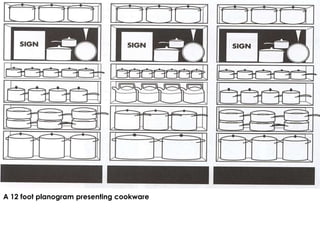
A 12 foot planogram presenting cookware
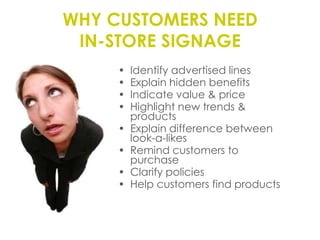
WHY CUSTOMERS NEED IN-STORE SIGNAGEIdentify advertised lines
Explain hidden benefits
Indicate value & price
Highlight new trends & products
Explain difference between look-a-likes
Remind customers to purchase
Clarify policies
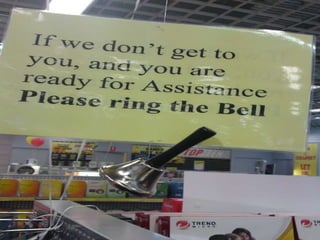
Help customers find products
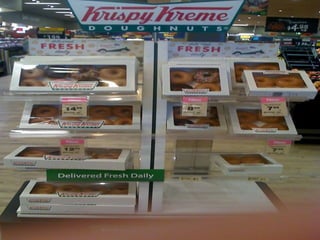
HOW TO CAPTURE CUSTOMER INTERESTCatch your customer’s eye through repetition.
Step your products to provide variation.
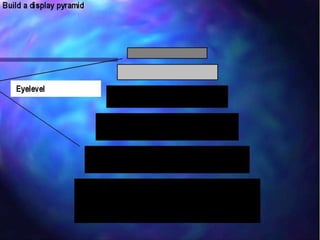
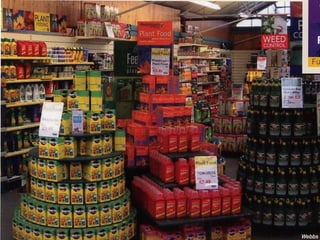
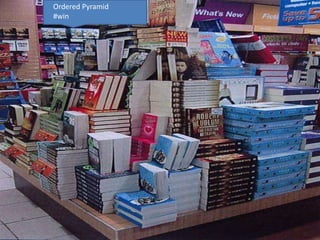
Use a pyramid to sell more product.
Try radiating displays.
Be on lookout for ideas from elsewhere.
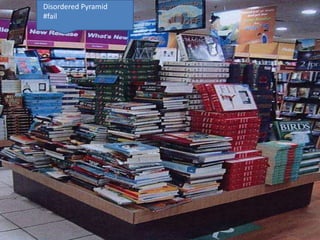
Disordered Pyramid#fail

Visual Merchandising for Small Retailers

  • 1.
    Silent Selling: VisualMerchandising for Small RetailersDebra Templar: Retail Check ups, Tune Ups & Makeovers....It’s in the bag!
  • 2.
    VISUAL MERCHANDISINGSupports salesCommunicateswith CustomersSupports Selling by:Communicating the latest trendsAssisting the customer in making a buying decision, andCreating an exciting environment within the shop/centre
  • 3.
    IMPACT OF THEVISUAL83%Sight11% Hearing3.5% Smell1.5% Touch1% Taste
  • 4.
    FIRST IMPRESSIONSFirst Impressionsare formed within the first 10 seconds.Customers remember vividly the worst impression, not the best impression.
  • 5.
    PREMISES: EXTERNALStreetNumbersSignageEntryOpening Hours
  • 6.
  • 9.
  • 11.
    Light windows, in evening#win
  • 12.
  • 13.
    Would you getyour hair cut here?#fail
  • 14.
    No shop signsforpedestrianrecognition ofBusinesses.#fail
  • 17.
    WINDOWSIf eyes arethe windows to the soulThen shop windows are just as revealing.They reveal the soul of the shop…
  • 19.
  • 20.
  • 21.
    Too much, toobusy.#fail
  • 22.
    Do not stickanything on glass doors or windows with BLUTAK.It looks TACKY!#fail
  • 23.
  • 24.
    Far more interesting.Shows personality!#win
  • 26.
  • 27.
    Every square metreof space in a retail store costs money – all areas should pay their way.Useful points:On entering store, most customers skirt around the cash desk.Beware of what merchandise you place in an Adjustment Space. Customers don’t see it.Most customers avoid badly lit, neglected or cluttered areas.
  • 28.
    Open sight linesare important.Negative signs on displays about terms of sale deter customers from returning.Stock left in aisles and pathways can seriously damage your traffic flow.Friendly staff are important.
  • 29.
    Remember, your peopleare part of your visual appeal. A friendly face or a sourpuss... You choose.#win
  • 30.
  • 31.
    Some product categoriesrequire more space, as they are browse products.
  • 32.
    People will brushup against product three times before they get the “heebies” and leave.
  • 33.
    Ensure there isenough space for people to move around your store without bumping into product, fixtures etc.Try entering here with your arms full, or with a stroller...#fail
  • 34.
    Point of Saleand Entry to store in same place.Too difficult to enter the store. Too hard to pay. #fail
  • 35.
    Butt Brush tothe max.#fail
  • 36.
    Supermarkets, big boxretailers, newsagents, pharmacies...
  • 41.
  • 43.
    FIXTURES& FITTINGS
  • 44.
    GondolasBest Positions: Eye/shoulder level and slightly below. Recognise that the average woman’s height is 5’2” (153 cm)... Worst Positions: Top shelf if well above eye level and the gondola base on either end is the next lease favouredVertical Blocking: Most effective way of presenting merchandise. If sizes are applicable try to position the size you want to sell most of at eye/shoulder level..Colourful Merchandise: colour block vertically + colour blend from light to dark – left to right usually within the colour families. In winter the reverse colour order is used.
  • 45.
    ShelvingSimilar to gondolasplus:Use a variety of shelf widths to suit different products. Small shelves for small products towards top, graduating down to larger/heavier items.
  • 46.
    Avoid wasting spaceand obvious gaps.
  • 47.
    Levels shelves areusually preferable to sloping shelves.
  • 48.
    Display product faceout to show the style and for ease of viewing and selection
  • 49.
  • 50.
    NO STOCK ISTO EVER HAVE A BIRTHDAY IN YOUR SHOP!!
  • 51.
    DUMP BINS +SPECIALS TABLES + RACKS
  • 52.
    Don’t over-crowd. But no less than half full. Make everything in Dump Bin/Table/Rack the same price, wherever possible.
  • 53.
    Locate in yourracetrack and use it to give the impression that it is a price-motivated promotion.
  • 54.
    Allocate one producttype per bin and display the products as if it were just dumped into the bin.
  • 55.
    Always have aprice sign to highlight the special price.
  • 56.
    Life of adump bin: Maximum of 1 month. Preferably, 1 week.
  • 57.
    Sales will increaseby 30% for that specified productDISPLAYS, COLOURS & SEASONS
  • 58.
    Colour SellsColour iswhat customers see first. More than anything else, colour makes people stop and look. For many customers colour is more important than the size or the style of the product.
  • 61.
    Notice how eachcolour in rows 2 through 5 corresponds to the colour above it. For example, pink, in the pastels, corresponds to the bright red in the top row; peach to bright orange, and so on.
  • 62.
    The round rackin the correct example features colours from just one colour group, brights, for a harmonious colour arrangement. The incorrect example features colours from two colour groups, brights and pastels, which don’t blend together in a harmonious way.
  • 63.
    The four-way fixturein the correct example features from just one colour group, brights, combined with neutrals. The incorrect example features colours from two colour groups, brights and pastels, which don’t blend together.
  • 64.
    How to Maximisethe Use of ColourAttract the eye of the customer
  • 65.
  • 66.
    Use contrasts ofcolour and form
  • 67.
  • 68.
  • 72.
    SIGNAGE AND TICKETING Corporate Signs: Branding signsProduct Category Signs: Direct consumers to specific categoriesPromotional Signage: Highlight specific promotions, have short life span, based on the stockturn of the promotionInformation Signage: Identify service + service policies within your businessProduct Signs: These educate customers about the specific product
  • 73.
    Product Category SignageThebigger the shop, the greater the need for department signage.
  • 74.
    The customer shouldbe able to enter your shop and clearly see where the major departments are situated.
  • 75.
    Keep the signsimple so it can be easily read.
  • 76.
    Be consistent inthe style used on all department signage.
  • 77.
    Promotional SignageOnly usethe signs in the key, relevant areas (do not promote roses in the herb department);
  • 78.
    Give the promotiona lifespan and keep to it (customers don’t want to see dated, faded and ripped signs);
  • 79.
    Use promotional materialin an exciting way. Rather than just hang up posters around your shop, group them to catch the customer’s eye.
  • 83.
  • 84.
  • 85.
    SIGNAGE AND TICKETINGHowwell any sign works depends on how easy it is to read and understand. Signs should look professional. They must be clean & unblemished.Theme Tickets
  • 86.
  • 87.
  • 88.
  • 89.
    Unknown ValueSIGNAGE ANDTICKETINGResearch in USA has revealed that during the same sale period if 100products were sold with no signage:Then 170were sold when handwritten signs were used 265products were sold when signs were professionally produced to sell the products.
  • 91.
    Hard sell tickets(yellow + red)
  • 93.
    Way too wordy.#failHereconversational copy has been rendered in a formally balanced layout
  • 94.
    This is abullet-point copy in an informally balanced layout
  • 96.
    Known Value LinesProductsthat are purchased on price rather than their benefits as the consumer perceives they know the exact price of these products. Even a 5% increase in price is criticised by consumers but the reverse is that a 5% reduction in price an result in a buying frenzy, eg. cigarettes, petrol, milk, bread…
  • 97.
    Don’t be cheaperthan anyone else on KV Lines. It will not help your bottom line. You can match your competition, but don’t go cheaper.Consumers will judge your whole product price strategy based on a few KV lines. Make sure you are aware of the price structure adopted by your competition on these lines.If you are more than 10% more expensive than the price leader, you will be perceived as being too expensive in your whole product.Placement of KV tickets is important.
  • 98.
    Product Signage: KV LinesBananas$6.50kgOne third of signTwo thirds of signWhen merchandising KV products, you need your product signage to give the right message
  • 99.
    Non-Known Value LinesIncludes98% of products you sell where the consumer doesn’t know the exact price. They will have some perception of price bands, but they will not argue over the cents. These products will reflect your image and should be of the highest quality.Rely on non-known value lines to promote your business (Box retailers rely on kv lines to promote their image). Promote non-known value lines when doing product-driven promotions.
  • 100.
    Non Known ValueLinesPre-shapedHamburgersPerfect bun sizeEasy storageFast defrost & microwave6 for $2.50Great for BBQ’sName of Product3 BenefitsPrice of ProductClosing Motivator
  • 101.
    A 12 footplanogram presenting cookware
  • 102.
    WHY CUSTOMERS NEEDIN-STORE SIGNAGEIdentify advertised lines
  • 103.
  • 104.
  • 105.
  • 106.
  • 107.
  • 108.
  • 109.
  • 111.
    HOW TO CAPTURECUSTOMER INTERESTCatch your customer’s eye through repetition.
  • 112.
    Step your productsto provide variation.
  • 113.
    Use a pyramidto sell more product.
  • 114.
  • 115.
    Be on lookoutfor ideas from elsewhere.
  • 119.