Merchandising, Point of
purchase, E-marketing and
customer service
Amity Global Business School
Prepared By:- Anusha Adhikar
DEFINATION OF
MERCHNDISING
According to the American Marketing Association
“Merchandising is the Planning involved in the Marketing
in the right merchandise in right Place at the right time in
the right quantities at the right prices. ”
“Planning and implementing of the acquisition, handling
and monitoring of merchandise categories for an
identified retail organization”
Merchandising
In 2005, marketing trends in retail environments will continue
to focus on point-of-purchase displays for attracting new and
expanding existing markets.
In this day & age of self service stores, displays are absolutely
essential as they serve as the “salesperson.” Your display
MUST sell the product or service. How do you sell - satisfy
the customer’s want or need & solve their problems
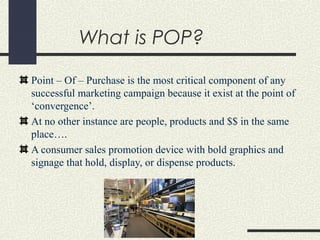
What is POP?
Point – Of – Purchase is the most critical component of any
successful marketing campaign because it exist at the point of
‘convergence’.
At no other instance are people, products and $$ in the same
place….
A consumer sales promotion device with bold graphics and
signage that hold, display, or dispense products.
The Big Three!
Retail stores have 3 distinct aspects:
 Design (meaning the premises)
 Merchandising (whatever you put in them)
 Operations (whatever employees do)
They are all connected…
Making a decision or change to one of these
aspects; you’ve automatically made a
change to the other two as well.
Example:
 Gap Stores trademark is intimate contact between
shopper and goods.
 That merchandising policy dictates that the displays
are wide, flat tabletops; not racks and shelves.
 The display policy dictates that significant staff
(operations) is needed on the floor to fold and keep
clothing areas neat.
Display Function
Reinforce the store’s image
Generate a promotional atmosphere
Speeding up a sales transaction
Protecting the store’s merchandise
Think Like Your Customer
Spend half an hour standing in one place…
observe!
How do people move?
How are people reacting to your displays?
Is it how you thought they would?
Shopping has become the museum of the
21st
century…it is a social, not business
phenomenon.
Start with the Front
Stand half a block away.
 You can see the building but can you identify
what’s inside?
 Does your signage reach people at that
distance?
 Is the lighting for window displays effective at
various times during the day?
 It takes time for people to acclimate to a retail
environment, so don’t try to achieve something
critical in the immediate area by the door. They
will blow right by, hence the term
“decompression zone”.
More On The Front End
Greet customers, don’t steer them! This will
start the seduction…
A simple hello will also reduce theft.
Create a “Power” display that will act as a
speed bump and also a billboard.
 It doesn’t have to say “shop me”, but rather
“take a look at what your walking in on”.
Don’t forget the sidewalk…clearance items
create excitement.
Shopping Baskets & Human Anatomy
Shoppers only have 2 hands – those who
use baskets buy more – period!
Shoppers don’t necessarily need a basket at
the front of the store.
They should be spread around, available
without stooping.
Consumers don’t seriously consider
purchasing until they have browsed a bit.
Make sure your baskets are appropriate for
the merchandise going in them.
Shelf Stalkers
Research has shown that allocating more
shelf space to memorable brands is not as
effective as better visual presence – even
for less noticeable brands.
Product placement on a shelf has shown to
be more effective sales tool than the actual
numbers of product packages.
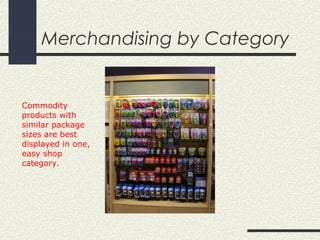
Merchandising by Category
Commodity
products with
similar package
sizes are best
displayed in one,
easy shop
category.
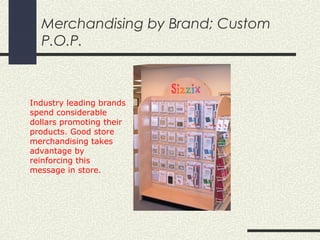
Merchandising by Brand; Custom
P.O.P.
Industry leading brands
spend considerable
dollars promoting their
products. Good store
merchandising takes
advantage by
reinforcing this
message in store.
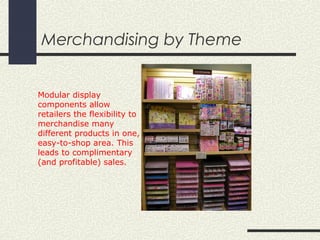
Merchandising by Theme
Modular display
components allow
retailers the flexibility to
merchandise many
different products in one,
easy-to-shop area. This
leads to complimentary
(and profitable) sales.
Men Are From Lowes…
Woman Are From Nordstrom
For men – have seating and food.
Women aren’t just shopping, they are searching for
authentic, emotional expression.
Women need to feel comfortable before they buy, so
be sure to give them enough room.
Women need to test, ponder, try, then buy.
Keep as much information available as possible.
So Now What?
Understand your POP needs, including look
and feel.
Take a fresh look at your store layout and
how it can change.
Decide on a level of functionality and
flexibility for your displays.
Reinvest in signage and shelf talkers – that
can update a section in minutes.
What Type of Displays Should I Invest In?
Review many merchandising systems in the market.
Initially, don’t let cost discourage you.
Find a look that compliments your store (and
products).
Feel comfortable communicating a preferred look to
prospective vendors.
Be clear about your store’s physical attributes
(limitations).
Use digital photography – picture tells a thousand
words.
Point-of-Purchase Options…
Create “focal points” with moveable, modular island
displays.
Use rotating displays to maximize product offerings in
tight spaces – against walls, corners.
Implement waterfall displays for SKU intensive product
categories.
Feature popular and new products with signage at the front
of the store. Reproduce similar signage within specific
departments to reinforce signage at the front.
What Have We Learned….
Customers want a relaxing and fun shopping experience – Good
POP design and layout allow them to enjoy the process.
Be thoughtful about your space and don’t be afraid to try
something new.
Variety may not be the spice of life.
Think modular, moveable.
Sign language; create visual attention with signs and shelf
talkers.
If at first you don’t succeed try, try again – Modular displays
will allow you the flexibility to move displays (product) is
customers don’t seem interested.
E- Marketing
Marketing:
 Use of 4 “P’s” to meet customer’s needs
E-Marketing:
 Use of technology to increase efficiency of
marketing
 Increases company profitability and adds
customer value
Continued……
E-marketing is the use of electronic data and
applications for planning and executing the
conception, distribution, promotion, and pricing of
ideas, goods, and services to create exchanges that
satisfy individual and organizational objectives. It
affects traditional marketing by increasing
efficiency in traditional marketing functions, and
the technology of e-marketing transforms many
marketing strategies.
E-Marketing Challenges and
Opportunities
Markets
Revenge of the Consumer
Businesses
Technology
Revenge of the Consumer
2000s:
 Consumers have control
What consumers want:
 Privacy
 To safeguard their children
 Permission before being sent commercial email
Businesses
Challenges:
 Quality customer service
 Information overload
Opportunities:
 Ways of generating revenue
 Greater interdependence in their value chain
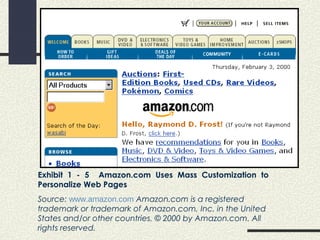
Exhibit 1 - 5 Amazon.com Uses Mass Customization to
Personalize Web Pages
Source: www.amazon.com Amazon.com is a registered
trademark or trademark of Amazon.com, Inc. in the United
States and/or other countries. © 2000 by Amazon.com. All
rights reserved.
E-Marketing Delivers
Value = Benefits – Costs
Value - customer perceptions of the product’s
benefits
Benefits - attributes, brand name, etc…
 Add benefits through mass customization and
personalization
Costs - time, money, energy
 Lower costs through 24/7 convenience and one-stop
shopping
Customer service
It is a interaction with a consumer while
conducting business
Key things of customer wants-
Quick results
Personal attention
simple – fast transaction
friendly – caring service
problem resolution
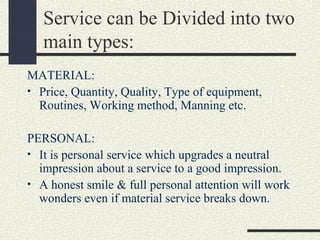
Service can be Divided into two
main types:
MATERIAL:
• Price, Quantity, Quality, Type of equipment,
Routines, Working method, Manning etc.
PERSONAL:
• It is personal service which upgrades a neutral
impression about a service to a good impression.
• A honest smile & full personal attention will work
wonders even if material service breaks down.
Queries ………..?

Merchandising and pop

  • 1.
    Merchandising, Point of purchase,E-marketing and customer service Amity Global Business School Prepared By:- Anusha Adhikar
  • 2.
    DEFINATION OF MERCHNDISING According tothe American Marketing Association “Merchandising is the Planning involved in the Marketing in the right merchandise in right Place at the right time in the right quantities at the right prices. ” “Planning and implementing of the acquisition, handling and monitoring of merchandise categories for an identified retail organization”
  • 3.
    Merchandising In 2005, marketingtrends in retail environments will continue to focus on point-of-purchase displays for attracting new and expanding existing markets. In this day & age of self service stores, displays are absolutely essential as they serve as the “salesperson.” Your display MUST sell the product or service. How do you sell - satisfy the customer’s want or need & solve their problems
  • 4.
    What is POP? Point– Of – Purchase is the most critical component of any successful marketing campaign because it exist at the point of ‘convergence’. At no other instance are people, products and $$ in the same place…. A consumer sales promotion device with bold graphics and signage that hold, display, or dispense products.
  • 5.
    The Big Three! Retailstores have 3 distinct aspects:  Design (meaning the premises)  Merchandising (whatever you put in them)  Operations (whatever employees do)
  • 6.
    They are allconnected… Making a decision or change to one of these aspects; you’ve automatically made a change to the other two as well. Example:  Gap Stores trademark is intimate contact between shopper and goods.  That merchandising policy dictates that the displays are wide, flat tabletops; not racks and shelves.  The display policy dictates that significant staff (operations) is needed on the floor to fold and keep clothing areas neat.
  • 7.
    Display Function Reinforce thestore’s image Generate a promotional atmosphere Speeding up a sales transaction Protecting the store’s merchandise
  • 8.
    Think Like YourCustomer Spend half an hour standing in one place… observe! How do people move? How are people reacting to your displays? Is it how you thought they would? Shopping has become the museum of the 21st century…it is a social, not business phenomenon.
  • 9.
    Start with theFront Stand half a block away.  You can see the building but can you identify what’s inside?  Does your signage reach people at that distance?  Is the lighting for window displays effective at various times during the day?  It takes time for people to acclimate to a retail environment, so don’t try to achieve something critical in the immediate area by the door. They will blow right by, hence the term “decompression zone”.
  • 10.
    More On TheFront End Greet customers, don’t steer them! This will start the seduction… A simple hello will also reduce theft. Create a “Power” display that will act as a speed bump and also a billboard.  It doesn’t have to say “shop me”, but rather “take a look at what your walking in on”. Don’t forget the sidewalk…clearance items create excitement.
  • 11.
    Shopping Baskets &Human Anatomy Shoppers only have 2 hands – those who use baskets buy more – period! Shoppers don’t necessarily need a basket at the front of the store. They should be spread around, available without stooping. Consumers don’t seriously consider purchasing until they have browsed a bit. Make sure your baskets are appropriate for the merchandise going in them.
  • 12.
    Shelf Stalkers Research hasshown that allocating more shelf space to memorable brands is not as effective as better visual presence – even for less noticeable brands. Product placement on a shelf has shown to be more effective sales tool than the actual numbers of product packages.
  • 13.
    Merchandising by Category Commodity productswith similar package sizes are best displayed in one, easy shop category.
  • 14.
    Merchandising by Brand;Custom P.O.P. Industry leading brands spend considerable dollars promoting their products. Good store merchandising takes advantage by reinforcing this message in store.
  • 15.
    Merchandising by Theme Modulardisplay components allow retailers the flexibility to merchandise many different products in one, easy-to-shop area. This leads to complimentary (and profitable) sales.
  • 16.
    Men Are FromLowes… Woman Are From Nordstrom For men – have seating and food. Women aren’t just shopping, they are searching for authentic, emotional expression. Women need to feel comfortable before they buy, so be sure to give them enough room. Women need to test, ponder, try, then buy. Keep as much information available as possible.
  • 17.
    So Now What? Understandyour POP needs, including look and feel. Take a fresh look at your store layout and how it can change. Decide on a level of functionality and flexibility for your displays. Reinvest in signage and shelf talkers – that can update a section in minutes.
  • 18.
    What Type ofDisplays Should I Invest In? Review many merchandising systems in the market. Initially, don’t let cost discourage you. Find a look that compliments your store (and products). Feel comfortable communicating a preferred look to prospective vendors. Be clear about your store’s physical attributes (limitations). Use digital photography – picture tells a thousand words.
  • 19.
    Point-of-Purchase Options… Create “focalpoints” with moveable, modular island displays. Use rotating displays to maximize product offerings in tight spaces – against walls, corners. Implement waterfall displays for SKU intensive product categories. Feature popular and new products with signage at the front of the store. Reproduce similar signage within specific departments to reinforce signage at the front.
  • 20.
    What Have WeLearned…. Customers want a relaxing and fun shopping experience – Good POP design and layout allow them to enjoy the process. Be thoughtful about your space and don’t be afraid to try something new. Variety may not be the spice of life. Think modular, moveable. Sign language; create visual attention with signs and shelf talkers. If at first you don’t succeed try, try again – Modular displays will allow you the flexibility to move displays (product) is customers don’t seem interested.
  • 21.
    E- Marketing Marketing:  Useof 4 “P’s” to meet customer’s needs E-Marketing:  Use of technology to increase efficiency of marketing  Increases company profitability and adds customer value
  • 22.
    Continued…… E-marketing is theuse of electronic data and applications for planning and executing the conception, distribution, promotion, and pricing of ideas, goods, and services to create exchanges that satisfy individual and organizational objectives. It affects traditional marketing by increasing efficiency in traditional marketing functions, and the technology of e-marketing transforms many marketing strategies.
  • 23.
    E-Marketing Challenges and Opportunities Markets Revengeof the Consumer Businesses Technology
  • 24.
    Revenge of theConsumer 2000s:  Consumers have control What consumers want:  Privacy  To safeguard their children  Permission before being sent commercial email
  • 25.
    Businesses Challenges:  Quality customerservice  Information overload Opportunities:  Ways of generating revenue  Greater interdependence in their value chain
  • 26.
    Exhibit 1 -5 Amazon.com Uses Mass Customization to Personalize Web Pages Source: www.amazon.com Amazon.com is a registered trademark or trademark of Amazon.com, Inc. in the United States and/or other countries. © 2000 by Amazon.com. All rights reserved.
  • 27.
    E-Marketing Delivers Value =Benefits – Costs Value - customer perceptions of the product’s benefits Benefits - attributes, brand name, etc…  Add benefits through mass customization and personalization Costs - time, money, energy  Lower costs through 24/7 convenience and one-stop shopping
  • 28.
    Customer service It isa interaction with a consumer while conducting business Key things of customer wants- Quick results Personal attention simple – fast transaction friendly – caring service problem resolution
  • 29.
    Service can beDivided into two main types: MATERIAL: • Price, Quantity, Quality, Type of equipment, Routines, Working method, Manning etc. PERSONAL: • It is personal service which upgrades a neutral impression about a service to a good impression. • A honest smile & full personal attention will work wonders even if material service breaks down.
  • 30.

Editor's Notes

  • #5 Designed to promote impulse purchases