Anchal Kumari
FD3
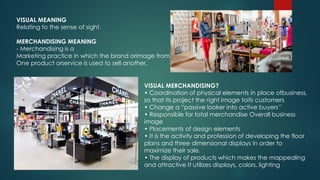
VISUAL MERCHANDISING?
• Coordination of physical elements in place ofbusiness,
so that its project the right image toits customers
• Change a “passive looker into active buyers’’
• Responsible for total merchandise Overall business
image
• Placements of design elements
• It is the activity and profession of developing the floor
plans and three dimensional displays in order to
maximize their sale.
• The display of products which makes the mappealing
and attractive It utilizes displays, colors, lighting
VISUAL MEANING
Relating to the sense of sight.
MERCHANDISING MEANING
- Merchandising is a
Marketing practice in which the brand orimage from
One product orservice is used to sell another.
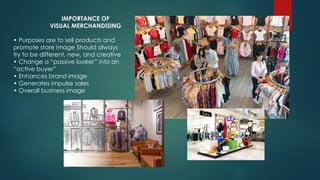
IMPORTANCE OF
VISUAL MERCHANDISING
• Purposes are to sell products and
promote store image Should always
try to be different, new, and creative
• Change a “passive looker” into an
“active buyer”
• Enhances brand image
• Generates impulse sales
• Overall business image
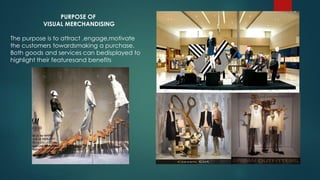
PURPOSE OF
VISUAL MERCHANDISING
The purpose is to attract ,engage,motivate
the customers towardsmaking a purchase.
Both goods and services can bedisplayed to
highlight their featuresand benefits
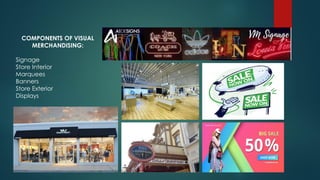
COMPONENTS OF VISUAL
MERCHANDISING:
Signage
Store Interior
Marquees
Banners
Store Exterior
Displays
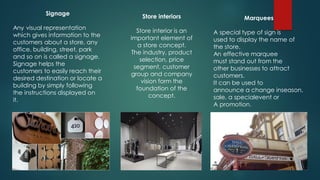
Signage
Any visual representation
which gives information to the
customers about a store, any
office, building, street, park
and so on is called a signage.
Signage helps the
customers to easily reach their
desired destination or locate a
building by simply following
the instructions displayed on
it.
Store interiors
Store interior is an
important element of
a store concept.
The industry, product
selection, price
segment, customer
group and company
vision form the
foundation of the
concept.
Marquees
A special type of sign is
used to display the name of
the store.
An effective marquee
must stand out from the
other businesses to attract
customers.
It can be used to
announce a change inseason,
sale, a specialevent or
A promotion.
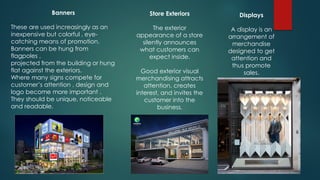
Banners
These are used increasingly as an
inexpensive but colorful , eye-
catching means of promotion.
Banners can be hung from
flagpoles ,
projected from the building or hung
flat against the exteriors.
Where many signs compete for
customer’s attention , design and
logo become more important .
They should be unique, noticeable
and readable.
Store Exteriors
The exterior
appearance of a store
silently announces
what customers can
expect inside.
Good exterior visual
merchandising attracts
attention, creates
interest, and invites the
customer into the
business.
Displays
A display is an
arrangement of
merchandise
designed to get
attention and
thus promote
sales.
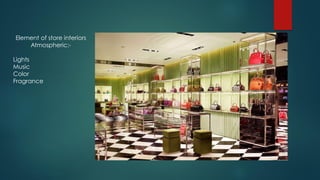
Element of store interiors
Atmospheric:-
Lights
Music
Color
Fragrance
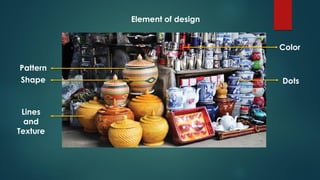
Element of design
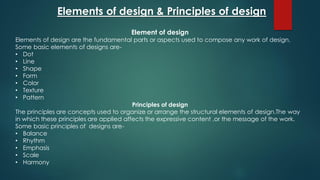
Elements of design are the fundamental parts or aspects used to compose any work of design.
Some basic elements of designs are-
• Dot
• Line
• Shape
• Form
• Color
• Texture
• Pattern
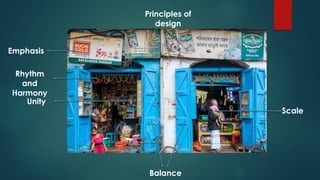
Principles of design
The principles are concepts used to organize or arrange the structural elements of design.The way
in which these principles are applied affects the expressive content ,or the message of the work.
Some basic principles of designs are-
• Balance
• Rhythm
• Emphasis
• Scale
• Harmony
Elements of design & Principles of design
Color
Pattern
Shape
Lines
and
Texture
Dots
Element of design
Principles of
design
Emphasis
Balance
Scale
Rhythm
and
Harmony
Unity
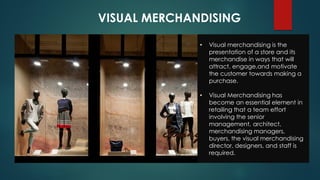
VISUAL MERCHANDISING
• Visual merchandising is the
presentation of a store and its
merchandise in ways that will
attract, engage,and motivate
the customer towards making a
purchase.
• Visual Merchandising has
become an essential element in
retailing that a team effort
involving the senior
management, architect,
merchandising managers,
buyers, the visual merchandising
director, designers, and staff is
required.
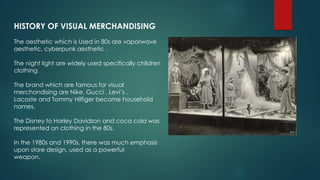
HISTORY OF VISUAL MERCHANDISING
The aesthetic which is Used in 80s are vaporwave
aesthetic, cyberpunk aesthetic .
The night light are widely used specifically children
clothing .
The brand which are famous for visual
merchandising are Nike, Gucci , Levi’s ,
Lacoste and Tommy Hilfiger become household
names.
The Disney to Harley Davidson and coca cola was
represented on clothing in the 80s.
In the 1980s and 1990s, there was much emphasis
upon store design, used as a powerful
weapon.
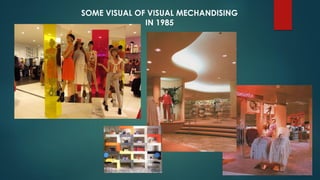
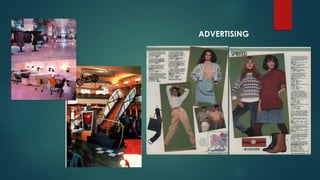
SOME VISUAL OF VISUAL MECHANDISING
IN 1985
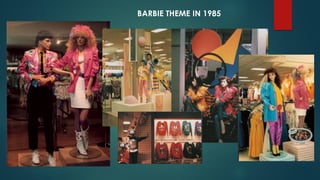
BARBIE THEME IN 1985
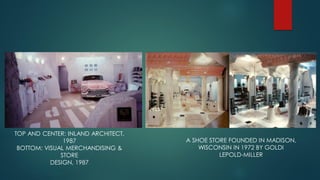
TOP AND CENTER: INLAND ARCHITECT,
1987
BOTTOM: VISUAL MERCHANDISING &
STORE
DESIGN, 1987
A SHOE STORE FOUNDED IN MADISON,
WISCONSIN IN 1972 BY GOLDI
LEPOLD-MILLER
ADVERTISING
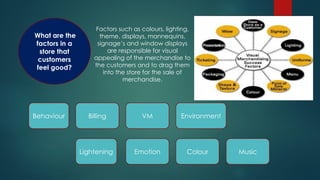
What are the
factors in a
store that
customers
feel good?
Behaviour Billing VM Environment
Lightening Emotion Colour Music
Factors such as colours, lighting,
theme, displays, mannequins,
signage’s and window displays
are responsible for visual
appealing of the merchandise to
the customers and to drag them
into the store for the sale of
merchandise.
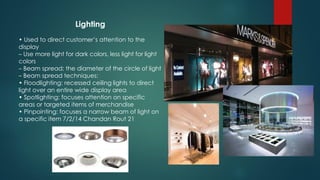
Lighting
• Used to direct customer’s attention to the
display
– Use more light for dark colors, less light for light
colors
– Beam spread; the diameter of the circle of light
– Beam spread techniques:
• Floodlighting: recessed ceiling lights to direct
light over an entire wide display area
• Spotlighting: focuses attention on specific
areas or targeted items of merchandise
• Pinpointing: focuses a narrow beam of light on
a specific item 7/2/14 Chandan Rout 21
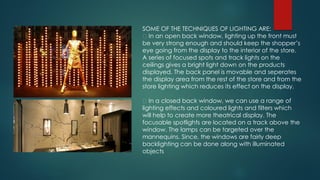
SOME OF THE TECHNIQUES OF LIGHTING ARE:
In an open back window, lighting up the front must
be very strong enough and should keep the shopper’s
eye going from the display to the interior of the store.
A series of focused spots and track lights on the
ceilings gives a bright light down on the products
displayed. The back panel is movable and seperates
the display area from the rest of the store and from the
store lighting which reduces its effect on the display.
In a closed back window, we can use a range of
lighting effects and coloured lights and filters which
will help to create more theatrical display. The
focusable spotlights are located on a track above the
window. The lamps can be targeted over the
mannequins. Since, the windows are fairly deep
backlighting can be done along with illuminated
objects
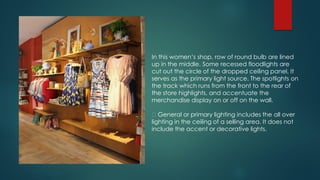
In this women’s shop, row of round bulb are lined
up in the middle. Some recessed floodlights are
cut out the circle of the dropped ceiling panel, It
serves as the primary light source. The spotlights on
the track which runs from the front to the rear of
the store highlights, and accentuate the
merchandise display on or off on the wall.
General or primary lighting includes the all over
lighting in the ceiling of a selling area. It does not
include the accent or decorative lights.
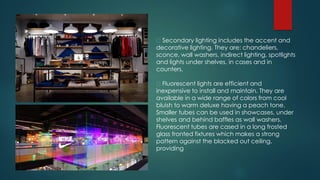
Secondary lighting includes the accent and
decorative lighting. They are: chandeliers,
sconce, wall washers, indirect lighting, spotlights
and lights under shelves, in cases and in
counters.
Fluorescent lights are efficient and
inexpensive to install and maintain. They are
available in a wide range of colors from cool
bluish to warm deluxe having a peach tone.
Smaller tubes can be used in showcases, under
shelves and behind baffles as wall washers.
Fluorescent tubes are cased in a long frosted
glass fronted fixtures which makes a strong
pattern against the blacked out ceiling,
providing
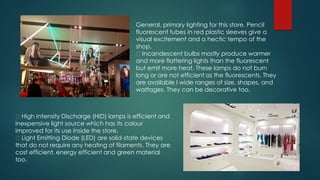
General, primary lighting for this store. Pencil
fluorescent tubes in red plastic sleeves give a
visual excitement and a hectic tempo of the
shop.
Incandescent bulbs mostly produce warmer
and more flattering lights than the fluorescent
but emit more heat. These lamps do not burn
long or are not efficient as the fluorescents. They
are available I wide ranges of size, shapes, and
wattages. They can be decorative too.
High Intensity Discharge (HID) lamps is efficient and
inexpensive light source which has its colour
improved for its use inside the store.
Light Emitting Diode (LED) are solid-state devices
that do not require any heating of filaments. They are
cost efficient, energy efficient and green material
too.
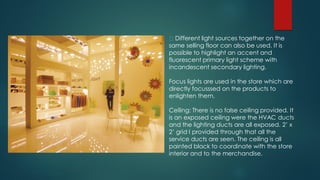
Different light sources together on the
same selling floor can also be used. It is
possible to highlight an accent and
fluorescent primary light scheme with
incandescent secondary lighting.
Focus lights are used in the store which are
directly focusssed on the products to
enlighten them.
Ceiling: There is no false ceiling provided. It
is an exposed ceiling were the HVAC ducts
and the lighting ducts are all exposed. 2’ x
2’ grid I provided through that all the
service ducts are seen. The ceiling is all
painted black to coordinate with the store
interior and to the merchandise.
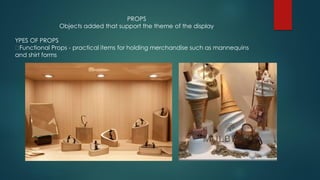
PROPS
Objects added that support the theme of the display
YPES OF PROPS
Functional Props - practical items for holding merchandise such as mannequins
and shirt forms
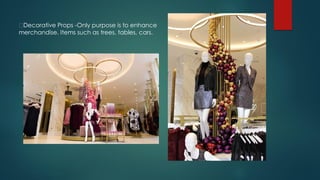
Decorative Props -Only purpose is to enhance
merchandise. Items such as trees, tables, cars.
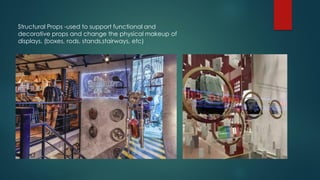
Structural Props -used to support functional and
decorative props and change the physical makeup of
displays. (boxes, rods, stands,stairways, etc)
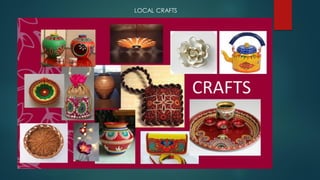
LOCAL CRAFTS
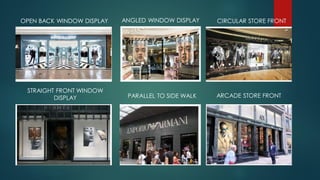
OPEN BACK WINDOW DISPLAY ANGLED WINDOW DISPLAY
STRAIGHT FRONT WINDOW
DISPLAY PARALLEL TO SIDE WALK
CIRCULAR STORE FRONT
ARCADE STORE FRONT
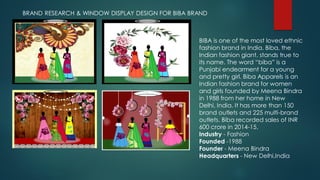
BRAND RESEARCH & WINDOW DISPLAY DESIGN FOR BIBA BRAND
BIBA is one of the most loved ethnic
fashion brand in India. Biba, the
Indian fashion giant, stands true to
its name. The word “biba” is a
Punjabi endearment for a young
and pretty girl. Biba Apparels is an
Indian fashion brand for women
and girls founded by Meena Bindra
in 1988 from her home in New
Delhi, India. It has more than 150
brand outlets and 225 multi-brand
outlets. Biba recorded sales of INR
600 crore in 2014-15.
Industry - Fashion
Founded -1988
Founder - Meena Bindra
Headquarters - New Delhi,India

Visual Merchandising

  • 1.
  • 2.
    VISUAL MERCHANDISING? • Coordinationof physical elements in place ofbusiness, so that its project the right image toits customers • Change a “passive looker into active buyers’’ • Responsible for total merchandise Overall business image • Placements of design elements • It is the activity and profession of developing the floor plans and three dimensional displays in order to maximize their sale. • The display of products which makes the mappealing and attractive It utilizes displays, colors, lighting VISUAL MEANING Relating to the sense of sight. MERCHANDISING MEANING - Merchandising is a Marketing practice in which the brand orimage from One product orservice is used to sell another.
  • 3.
    IMPORTANCE OF VISUAL MERCHANDISING •Purposes are to sell products and promote store image Should always try to be different, new, and creative • Change a “passive looker” into an “active buyer” • Enhances brand image • Generates impulse sales • Overall business image
  • 4.
    PURPOSE OF VISUAL MERCHANDISING Thepurpose is to attract ,engage,motivate the customers towardsmaking a purchase. Both goods and services can bedisplayed to highlight their featuresand benefits
  • 5.
    COMPONENTS OF VISUAL MERCHANDISING: Signage StoreInterior Marquees Banners Store Exterior Displays
  • 6.
    Signage Any visual representation whichgives information to the customers about a store, any office, building, street, park and so on is called a signage. Signage helps the customers to easily reach their desired destination or locate a building by simply following the instructions displayed on it. Store interiors Store interior is an important element of a store concept. The industry, product selection, price segment, customer group and company vision form the foundation of the concept. Marquees A special type of sign is used to display the name of the store. An effective marquee must stand out from the other businesses to attract customers. It can be used to announce a change inseason, sale, a specialevent or A promotion.
  • 7.
    Banners These are usedincreasingly as an inexpensive but colorful , eye- catching means of promotion. Banners can be hung from flagpoles , projected from the building or hung flat against the exteriors. Where many signs compete for customer’s attention , design and logo become more important . They should be unique, noticeable and readable. Store Exteriors The exterior appearance of a store silently announces what customers can expect inside. Good exterior visual merchandising attracts attention, creates interest, and invites the customer into the business. Displays A display is an arrangement of merchandise designed to get attention and thus promote sales.
  • 8.
    Element of storeinteriors Atmospheric:- Lights Music Color Fragrance
  • 9.
    Element of design Elementsof design are the fundamental parts or aspects used to compose any work of design. Some basic elements of designs are- • Dot • Line • Shape • Form • Color • Texture • Pattern Principles of design The principles are concepts used to organize or arrange the structural elements of design.The way in which these principles are applied affects the expressive content ,or the message of the work. Some basic principles of designs are- • Balance • Rhythm • Emphasis • Scale • Harmony Elements of design & Principles of design
  • 10.
  • 11.
  • 12.
    VISUAL MERCHANDISING • Visualmerchandising is the presentation of a store and its merchandise in ways that will attract, engage,and motivate the customer towards making a purchase. • Visual Merchandising has become an essential element in retailing that a team effort involving the senior management, architect, merchandising managers, buyers, the visual merchandising director, designers, and staff is required.
  • 13.
    HISTORY OF VISUALMERCHANDISING The aesthetic which is Used in 80s are vaporwave aesthetic, cyberpunk aesthetic . The night light are widely used specifically children clothing . The brand which are famous for visual merchandising are Nike, Gucci , Levi’s , Lacoste and Tommy Hilfiger become household names. The Disney to Harley Davidson and coca cola was represented on clothing in the 80s. In the 1980s and 1990s, there was much emphasis upon store design, used as a powerful weapon.
  • 14.
    SOME VISUAL OFVISUAL MECHANDISING IN 1985
  • 15.
  • 16.
    TOP AND CENTER:INLAND ARCHITECT, 1987 BOTTOM: VISUAL MERCHANDISING & STORE DESIGN, 1987 A SHOE STORE FOUNDED IN MADISON, WISCONSIN IN 1972 BY GOLDI LEPOLD-MILLER
  • 17.
  • 18.
    What are the factorsin a store that customers feel good? Behaviour Billing VM Environment Lightening Emotion Colour Music Factors such as colours, lighting, theme, displays, mannequins, signage’s and window displays are responsible for visual appealing of the merchandise to the customers and to drag them into the store for the sale of merchandise.
  • 19.
    Lighting • Used todirect customer’s attention to the display – Use more light for dark colors, less light for light colors – Beam spread; the diameter of the circle of light – Beam spread techniques: • Floodlighting: recessed ceiling lights to direct light over an entire wide display area • Spotlighting: focuses attention on specific areas or targeted items of merchandise • Pinpointing: focuses a narrow beam of light on a specific item 7/2/14 Chandan Rout 21
  • 20.
    SOME OF THETECHNIQUES OF LIGHTING ARE: In an open back window, lighting up the front must be very strong enough and should keep the shopper’s eye going from the display to the interior of the store. A series of focused spots and track lights on the ceilings gives a bright light down on the products displayed. The back panel is movable and seperates the display area from the rest of the store and from the store lighting which reduces its effect on the display. In a closed back window, we can use a range of lighting effects and coloured lights and filters which will help to create more theatrical display. The focusable spotlights are located on a track above the window. The lamps can be targeted over the mannequins. Since, the windows are fairly deep backlighting can be done along with illuminated objects
  • 21.
    In this women’sshop, row of round bulb are lined up in the middle. Some recessed floodlights are cut out the circle of the dropped ceiling panel, It serves as the primary light source. The spotlights on the track which runs from the front to the rear of the store highlights, and accentuate the merchandise display on or off on the wall. General or primary lighting includes the all over lighting in the ceiling of a selling area. It does not include the accent or decorative lights.
  • 22.
    Secondary lighting includesthe accent and decorative lighting. They are: chandeliers, sconce, wall washers, indirect lighting, spotlights and lights under shelves, in cases and in counters. Fluorescent lights are efficient and inexpensive to install and maintain. They are available in a wide range of colors from cool bluish to warm deluxe having a peach tone. Smaller tubes can be used in showcases, under shelves and behind baffles as wall washers. Fluorescent tubes are cased in a long frosted glass fronted fixtures which makes a strong pattern against the blacked out ceiling, providing
  • 23.
    General, primary lightingfor this store. Pencil fluorescent tubes in red plastic sleeves give a visual excitement and a hectic tempo of the shop. Incandescent bulbs mostly produce warmer and more flattering lights than the fluorescent but emit more heat. These lamps do not burn long or are not efficient as the fluorescents. They are available I wide ranges of size, shapes, and wattages. They can be decorative too. High Intensity Discharge (HID) lamps is efficient and inexpensive light source which has its colour improved for its use inside the store. Light Emitting Diode (LED) are solid-state devices that do not require any heating of filaments. They are cost efficient, energy efficient and green material too.
  • 24.
    Different light sourcestogether on the same selling floor can also be used. It is possible to highlight an accent and fluorescent primary light scheme with incandescent secondary lighting. Focus lights are used in the store which are directly focusssed on the products to enlighten them. Ceiling: There is no false ceiling provided. It is an exposed ceiling were the HVAC ducts and the lighting ducts are all exposed. 2’ x 2’ grid I provided through that all the service ducts are seen. The ceiling is all painted black to coordinate with the store interior and to the merchandise.
  • 25.
    PROPS Objects added thatsupport the theme of the display YPES OF PROPS Functional Props - practical items for holding merchandise such as mannequins and shirt forms
  • 26.
    Decorative Props -Onlypurpose is to enhance merchandise. Items such as trees, tables, cars.
  • 27.
    Structural Props -usedto support functional and decorative props and change the physical makeup of displays. (boxes, rods, stands,stairways, etc)
  • 28.
  • 29.
    OPEN BACK WINDOWDISPLAY ANGLED WINDOW DISPLAY STRAIGHT FRONT WINDOW DISPLAY PARALLEL TO SIDE WALK CIRCULAR STORE FRONT ARCADE STORE FRONT
  • 30.
    BRAND RESEARCH &WINDOW DISPLAY DESIGN FOR BIBA BRAND BIBA is one of the most loved ethnic fashion brand in India. Biba, the Indian fashion giant, stands true to its name. The word “biba” is a Punjabi endearment for a young and pretty girl. Biba Apparels is an Indian fashion brand for women and girls founded by Meena Bindra in 1988 from her home in New Delhi, India. It has more than 150 brand outlets and 225 multi-brand outlets. Biba recorded sales of INR 600 crore in 2014-15. Industry - Fashion Founded -1988 Founder - Meena Bindra Headquarters - New Delhi,India