STORE LAYOUT & DESIGN.
Akeeb Siddiqui.
A WELL DESIGNED STORE…
 Entrance: creates expectation and offers promises,
store front should entice ,a single message –
positive store image
 Clutter at the start- can create confusion and
disorientation, uncomfortable feeling
 Inside the store: leads the customer through the
store journey-using lighting, signage, display leads
customer – through path of discovery
 Checkout : store visit conclusion
OBJECTIVES
 Critical issues retailers consider in designing a
store
 Advantages/Disadvantages of alternative store
layout
 How is store floor space assigned to merchandise
and department
 Best techniques for merchandise presentation
STORE DESIGN OBJECTIVE
 Implement the retailers strategy
 Influence the customer buying behavior
 Provide flexibility
 control design and maintenance costs
 meet legal requirements
STORE DESIGN AND RETAIL STRATEGY
 Primary objective: to implement retailers strategy
 Design- consistent and reinforce the retailers
strategy by meeting the needs of the target market
and building a competitive advantage. Eg Sam`s-
price sensitive- floor design and racks – metal and
concrete to reinforce the brand image
 Flooring and shelving also affect retailers image:
glass-elegance
INFLUENCE CUSTOMER BUYING BEHAVIOR
 Store design- should attract customers, enable
them to locate merchandise, keep them in the store
for as long time, motivate them to make unplanned,
impulse purchase and provide them with a satisfied
customer experience.
 Buying behavior-influences store design: rise in
nuclear families-limited time
 e.g. P&G: “first moment of truth”- first 3-7 seconds,
customer notices an item on the store shelf . Mkt
research – customers do not walk down one aisle
and up the next. Park at the end of aisle-walk
partway to pick the product and return to the cart.
Hence puts its best selling brands at the middle of
the aisle
FLEXIBILITY
 Dynamic business- what may work today, may not
be applicable tomorrow- need to change the
merchandise mix- need to change layout
 attempt to design stores with max flexibility.
 Two forms: ability to physically move and store the
components, and the ease with which components
can be modified
 Book stores
COST
 Cost of implementing the store design and
maintain the store appearance
 Free form design – costly- can encourage the
customers to explore and increase sales
 More lighting- expensive jewelry and other
merchandise
 Good lighting- can make the merchandise look
better and increase sales
 Store design – affect labor costs- traditional dept
stores with diff depts – comfortable shopping, but
require one person constantly to provide service
LAYOUT
 Need to determine the basic layout of the store
 Use signage to guide customers through the store and assist
them in locating and finding info about merchandise
 variety of approaches used to feature specific products
 layouts- method of encouraging customer exploration –
present them with a layout which facilitates a specific traffic
pattern.
 Eg Toys R us uses a specific layout which forces customers
to move through a sections of inexpensive impulse purchase
products to larger more expensive goods
 3 types of layouts
- Grid
- Racetrack
- free form
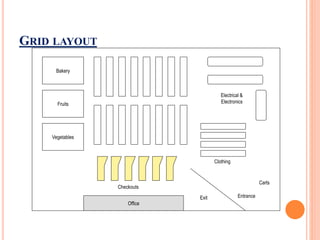
GRID LAYOUT
Bakery
Fruits
Vegetables
Clothing
Electrical &
Electronics
Office
EntranceExit
Checkouts
Carts
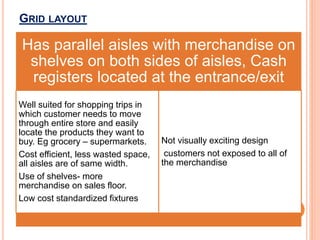
GRID LAYOUT
Has parallel aisles with merchandise on
shelves on both sides of aisles, Cash
registers located at the entrance/exit
Well suited for shopping trips in
which customer needs to move
through entire store and easily
locate the products they want to
buy. Eg grocery – supermarkets.
Cost efficient, less wasted space,
all aisles are of same width.
Use of shelves- more
merchandise on sales floor.
Low cost standardized fixtures
Not visually exciting design
customers not exposed to all of
the merchandise
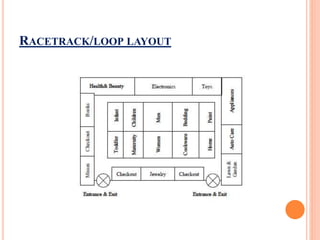
RACETRACK/LOOP LAYOUT
RACETRACK LAYOUT
Provides a major aisle that loops around the store to guide customer
traffic around various depts. To direct customers through the stores,
aisles must be defined by change in surface/color. cash register
stations are typically located in each dept bordering the racetrack
Facilitates the goal of
getting customers to
see the merchandise
available in multiple
depts and facilitate
impulse purchase.
Customers forced to
take diff viewing angles.
Customers forced to
take diff viewing angles.
FREE FORM LAYOUT
Display
Display
Checkout
Office
Changing
Rooms
WindowDisplay
FREE FORM LAYOUT
FREE FORM LAYOUT
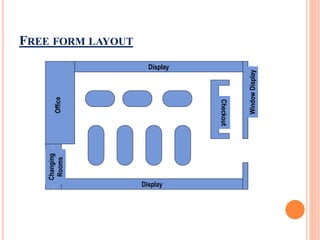
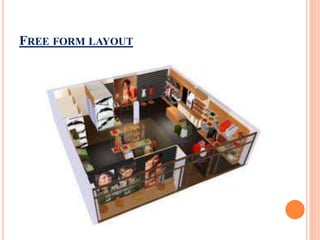
Boutique layout, arranges fixtures and aisles
in an asymmetric pattern. Use in small
specialty stores or within depts of large stores
Provides an intimate and
relaxing environment that
facilitates shopping and
browsing
No well defined traffic
pattern, customers are not
drawn towards the store
naturally. Personal selling
becomes more important .
Layout sacrifices some
retail storage and display
space to create a more
spacious environment
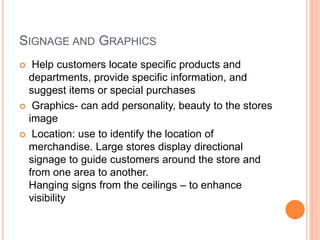
SIGNAGE AND GRAPHICS
 Help customers locate specific products and
departments, provide specific information, and
suggest items or special purchases
 Graphics- can add personality, beauty to the stores
image
 Location: use to identify the location of
merchandise. Large stores display directional
signage to guide customers around the store and
from one area to another.
Hanging signs from the ceilings – to enhance
visibility
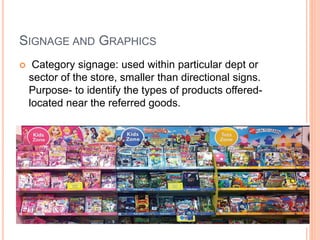
SIGNAGE AND GRAPHICS
 Category signage: used within particular dept or
sector of the store, smaller than directional signs.
Purpose- to identify the types of products offered-
located near the referred goods.
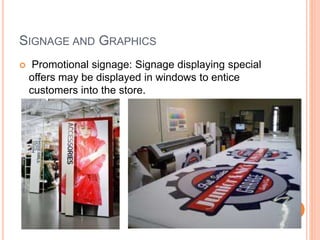
SIGNAGE AND GRAPHICS
 Promotional signage: Signage displaying special
offers may be displayed in windows to entice
customers into the store.
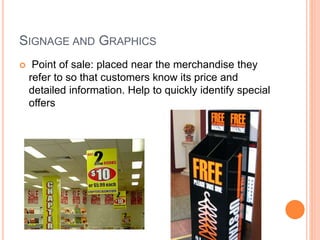
SIGNAGE AND GRAPHICS
 Point of sale: placed near the merchandise they
refer to so that customers know its price and
detailed information. Help to quickly identify special
offers
SIGNAGE AND GRAPHICS
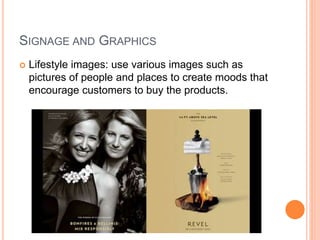
 Lifestyle images: use various images such as
pictures of people and places to create moods that
encourage customers to buy the products.
EFFECTIVE SIGNAGE
 Use signage and graphics
as props: using signs that
masquerade as props, is a
great way to unify a theme
or merchandise for an
appealing overall
presentation
EFFECTIVE SIGNAGE
 Keep signs and graphics fresh: should be relevant
to items displayed . New signs= new merchandise
 Limit text on signs: signs with too much copy wont
work.
 Use appropriate typefaces on signs
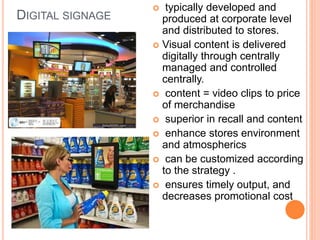
DIGITAL SIGNAGE
 typically developed and
produced at corporate level
and distributed to stores.
 Visual content is delivered
digitally through centrally
managed and controlled
centrally.
 content = video clips to price
of merchandise
 superior in recall and content
 enhance stores environment
and atmospherics
 can be customized according
to the strategy .
 ensures timely output, and
decreases promotional cost
FEATURE AREAS
 are those areas within a store designed to get
customers attention
 include freestanding displays, end caps,
promotional aisles, windows ,cash wraps or point of
sale areas and walls
CASH WRAPS
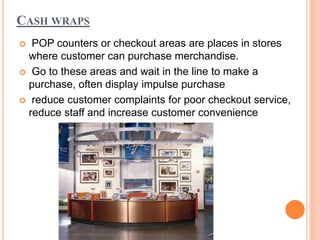
 POP counters or checkout areas are places in stores
where customer can purchase merchandise.
 Go to these areas and wait in the line to make a
purchase, often display impulse purchase
 reduce customer complaints for poor checkout service,
reduce staff and increase customer convenience
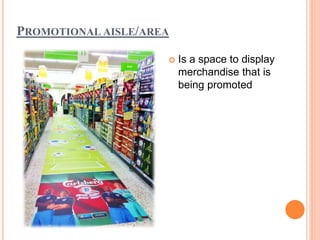
PROMOTIONAL AISLE/AREA
 Is a space to display
merchandise that is
being promoted
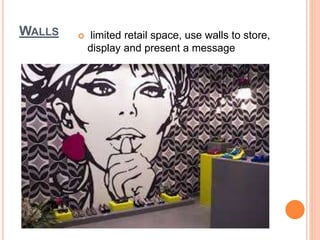
WALLS  limited retail space, use walls to store,
display and present a message
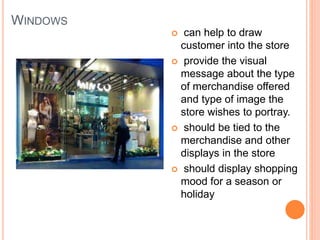
WINDOWS
 can help to draw
customer into the store
 provide the visual
message about the type
of merchandise offered
and type of image the
store wishes to portray.
 should be tied to the
merchandise and other
displays in the store
 should display shopping
mood for a season or
holiday
SPACE MANAGEMENT
 space within store- is a scarce resource
 allocation of store space to merchandise
 location of departments or merchandise categories
in the same area
 Thank you.

Store design and layout, Visual Merchandising

  • 1.
    STORE LAYOUT &DESIGN. Akeeb Siddiqui.
  • 2.
    A WELL DESIGNEDSTORE…  Entrance: creates expectation and offers promises, store front should entice ,a single message – positive store image  Clutter at the start- can create confusion and disorientation, uncomfortable feeling  Inside the store: leads the customer through the store journey-using lighting, signage, display leads customer – through path of discovery  Checkout : store visit conclusion
  • 3.
    OBJECTIVES  Critical issuesretailers consider in designing a store  Advantages/Disadvantages of alternative store layout  How is store floor space assigned to merchandise and department  Best techniques for merchandise presentation
  • 4.
    STORE DESIGN OBJECTIVE Implement the retailers strategy  Influence the customer buying behavior  Provide flexibility  control design and maintenance costs  meet legal requirements
  • 5.
    STORE DESIGN ANDRETAIL STRATEGY  Primary objective: to implement retailers strategy  Design- consistent and reinforce the retailers strategy by meeting the needs of the target market and building a competitive advantage. Eg Sam`s- price sensitive- floor design and racks – metal and concrete to reinforce the brand image  Flooring and shelving also affect retailers image: glass-elegance
  • 6.
    INFLUENCE CUSTOMER BUYINGBEHAVIOR  Store design- should attract customers, enable them to locate merchandise, keep them in the store for as long time, motivate them to make unplanned, impulse purchase and provide them with a satisfied customer experience.  Buying behavior-influences store design: rise in nuclear families-limited time  e.g. P&G: “first moment of truth”- first 3-7 seconds, customer notices an item on the store shelf . Mkt research – customers do not walk down one aisle and up the next. Park at the end of aisle-walk partway to pick the product and return to the cart. Hence puts its best selling brands at the middle of the aisle
  • 7.
    FLEXIBILITY  Dynamic business-what may work today, may not be applicable tomorrow- need to change the merchandise mix- need to change layout  attempt to design stores with max flexibility.  Two forms: ability to physically move and store the components, and the ease with which components can be modified  Book stores
  • 8.
    COST  Cost ofimplementing the store design and maintain the store appearance  Free form design – costly- can encourage the customers to explore and increase sales  More lighting- expensive jewelry and other merchandise  Good lighting- can make the merchandise look better and increase sales  Store design – affect labor costs- traditional dept stores with diff depts – comfortable shopping, but require one person constantly to provide service
  • 9.
    LAYOUT  Need todetermine the basic layout of the store  Use signage to guide customers through the store and assist them in locating and finding info about merchandise  variety of approaches used to feature specific products  layouts- method of encouraging customer exploration – present them with a layout which facilitates a specific traffic pattern.  Eg Toys R us uses a specific layout which forces customers to move through a sections of inexpensive impulse purchase products to larger more expensive goods  3 types of layouts - Grid - Racetrack - free form
  • 10.
  • 11.
    GRID LAYOUT Has parallelaisles with merchandise on shelves on both sides of aisles, Cash registers located at the entrance/exit Well suited for shopping trips in which customer needs to move through entire store and easily locate the products they want to buy. Eg grocery – supermarkets. Cost efficient, less wasted space, all aisles are of same width. Use of shelves- more merchandise on sales floor. Low cost standardized fixtures Not visually exciting design customers not exposed to all of the merchandise
  • 12.
  • 13.
    RACETRACK LAYOUT Provides amajor aisle that loops around the store to guide customer traffic around various depts. To direct customers through the stores, aisles must be defined by change in surface/color. cash register stations are typically located in each dept bordering the racetrack Facilitates the goal of getting customers to see the merchandise available in multiple depts and facilitate impulse purchase. Customers forced to take diff viewing angles. Customers forced to take diff viewing angles.
  • 14.
  • 15.
  • 16.
    FREE FORM LAYOUT Boutiquelayout, arranges fixtures and aisles in an asymmetric pattern. Use in small specialty stores or within depts of large stores Provides an intimate and relaxing environment that facilitates shopping and browsing No well defined traffic pattern, customers are not drawn towards the store naturally. Personal selling becomes more important . Layout sacrifices some retail storage and display space to create a more spacious environment
  • 17.
    SIGNAGE AND GRAPHICS Help customers locate specific products and departments, provide specific information, and suggest items or special purchases  Graphics- can add personality, beauty to the stores image  Location: use to identify the location of merchandise. Large stores display directional signage to guide customers around the store and from one area to another. Hanging signs from the ceilings – to enhance visibility
  • 18.
    SIGNAGE AND GRAPHICS Category signage: used within particular dept or sector of the store, smaller than directional signs. Purpose- to identify the types of products offered- located near the referred goods.
  • 19.
    SIGNAGE AND GRAPHICS Promotional signage: Signage displaying special offers may be displayed in windows to entice customers into the store.
  • 20.
    SIGNAGE AND GRAPHICS Point of sale: placed near the merchandise they refer to so that customers know its price and detailed information. Help to quickly identify special offers
  • 21.
    SIGNAGE AND GRAPHICS Lifestyle images: use various images such as pictures of people and places to create moods that encourage customers to buy the products.
  • 22.
    EFFECTIVE SIGNAGE  Usesignage and graphics as props: using signs that masquerade as props, is a great way to unify a theme or merchandise for an appealing overall presentation
  • 23.
    EFFECTIVE SIGNAGE  Keepsigns and graphics fresh: should be relevant to items displayed . New signs= new merchandise  Limit text on signs: signs with too much copy wont work.  Use appropriate typefaces on signs
  • 24.
    DIGITAL SIGNAGE  typicallydeveloped and produced at corporate level and distributed to stores.  Visual content is delivered digitally through centrally managed and controlled centrally.  content = video clips to price of merchandise  superior in recall and content  enhance stores environment and atmospherics  can be customized according to the strategy .  ensures timely output, and decreases promotional cost
  • 25.
    FEATURE AREAS  arethose areas within a store designed to get customers attention  include freestanding displays, end caps, promotional aisles, windows ,cash wraps or point of sale areas and walls
  • 26.
    CASH WRAPS  POPcounters or checkout areas are places in stores where customer can purchase merchandise.  Go to these areas and wait in the line to make a purchase, often display impulse purchase  reduce customer complaints for poor checkout service, reduce staff and increase customer convenience
  • 27.
    PROMOTIONAL AISLE/AREA  Isa space to display merchandise that is being promoted
  • 28.
    WALLS  limitedretail space, use walls to store, display and present a message
  • 29.
    WINDOWS  can helpto draw customer into the store  provide the visual message about the type of merchandise offered and type of image the store wishes to portray.  should be tied to the merchandise and other displays in the store  should display shopping mood for a season or holiday
  • 30.
    SPACE MANAGEMENT  spacewithin store- is a scarce resource  allocation of store space to merchandise  location of departments or merchandise categories in the same area
  • 31.