MKTG 1058:
DISTRIBUTION
  CHANNELS


               5-1
Distribution Channels MKTG 1058
              LECTURE FIVE
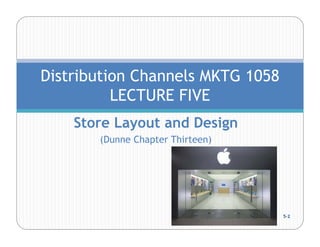
        Store Layout and Design
           (Dunne Chapter Thirteen)


                                      5-2
2
Learning Objectives of Chapter 13

 •List the elements of a store’s
  environment and define its two
  primary objectives.

 •Discuss the steps involved in
  planning the store.


                                    5-3
Learning Objectives of Chapter 13
• Describe how various types of fixtures,
  merchandise presentation methods and
  techniques, and the psychology of
  merchandise presentation are used to
  increase the productivity of the sales floor.
• Describe why store design is so important to
  a store’s success.
• Explain the role of visual communications in
  a retail store.


                                                  5-4
In Seconds…
 A shopper should be able to
 determine a store’s
  Name
  Line of trade
                       These are tests of
  Claim to fame        how effective a
                        store’s image is
  Price position
  Personality


                                            5-5
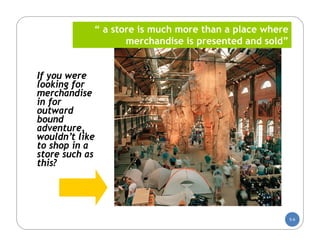
“ a store is much more than a place where
                   merchandise is presented and sold”


If you were
looking for
merchandise
in for
outward
bound
adventure,
wouldn’t like
to shop in a
store such as
this?


                                                        5-6
Store Design Objectives
 Implement retailer’s strategy
 Influence customer buying
  behavior
 Control design and maintenance
  costs
 Provide flexibility
 Meet legal requirements

                                   5-7
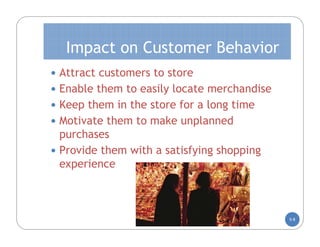
Impact on Customer Behavior
 Attract customers to store
 Enable them to easily locate merchandise
 Keep them in the store for a long time
 Motivate them to make unplanned
  purchases
 Provide them with a satisfying shopping
  experience


                                             5-8
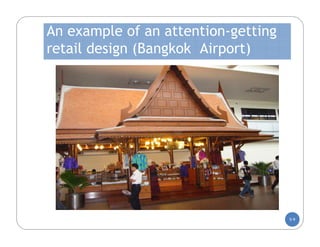
An example of an attention-getting
retail design (Bangkok Airport)


                                     5-9
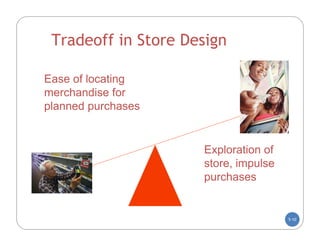
Tradeoff in Store Design

Ease of locating
merchandise for
planned purchases


                     Exploration of
                     store, impulse
                     purchases


                                      5-10
Importance of the Store Image
 In an economy of time-poverty, this is
  particularly important when customers enter
  the store with a negative attitude/emotion
  because they have other things they would
  rather be doing.
 In fact, no other variable in the retailing mix
  influences the consumer's initial perception
  of a brick & mortar retailer as much as the
  retailer's store itself.


                                                    5-11
Introduction to Store Layout
Management
  • Store Image is the overall perception
    the customer has of the store’s
    environment.
  • Space Productivity represents how
    effectively the retailer utilizes its
    space and is usually measured by sales
    per square foot of selling space or
    gross margin dollars per square foot of
    selling space.


                                              5-12
The importance of store image
 Linked to the differentiation and
  positioning of the retail store
 “Perception is reality”
 Retailer leverages on store image to
  create perceived differentiation away
  from rival retailers
 Customers visit the store to share
  experiences and not just buy
  merchandise

                                          5-13
Introduction to Store Layout
Management
    •Elements of the Store
          Environment

   •Objectives of the Store
          Environment


                               5-14
Introduction to Store Layout
Management
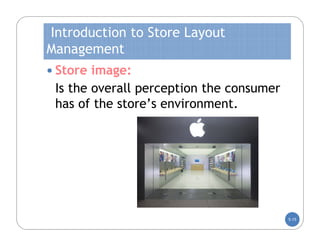
 Store image:
 Is the overall perception the consumer
 has of the store’s environment.


                                          5-15
Introduction to Store Layout
Management
 Space productivity:
 Represents how effectively the retailer
 utilizes its space and is usually
 measured by sales per square foot of
 selling space or gross margin dollars per
 square foot of selling space.


                                       LO 1
                                          5-16
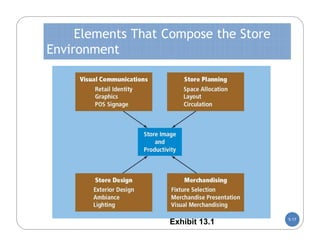
Elements That Compose the Store
Environment


                                       5-17
                   Exhibit 13.1
Objectives of the Store
Environment
• Tasks to create desired store image and
  increase space productivity:
• Get customers into the store (market
  image).
• Convert them into customers buying
  merchandise once inside the store
  (space productivity).
• Do this in the most efficient manner
  possible.
                                            5-18
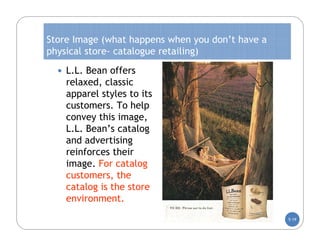
Store Image (what happens when you don’t have a
physical store- catalogue retailing)
   L.L. Bean offers
    relaxed, classic
    apparel styles to its
    customers. To help
    convey this image,
    L.L. Bean’s catalog
    and advertising
    reinforces their
    image. For catalog
    customers, the
    catalog is the store
    environment.
                                                  5-19
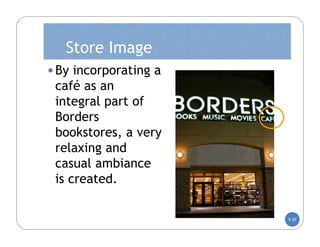
Store Image
• By incorporating a
 café as an
 integral part of
 Borders
 bookstores, a very
 relaxing and
 casual ambiance
 is created.

                       5-20
Store Image
 By incorporating a café as an integral
 part of Borders bookstores, a very
 relaxing and casual ambiance is
 created.


                                           5-21
Developing a Store Image
 The ability to create and
 change store image through the
 store environment-becomes
 more important every day for a
 retailer's survival.
 Two key words- create and change
 Implications?

                                    5-22
Elements of Retail Image


        (source: Berman)   5-23
Retailing Truism
•The more merchandise
  customers are exposed to, the
  more they tend to buy.

To what extent do you agree with this
statement? Are there other factors to
consider? Is there a direct correlation between
merchandise quantity and assortment and
actual purchase propensity?

                                                  5-24
Increasing Space Productivity:
 The more merchandise customers are
 exposed to, the more they tend to buy.
 Many retailers are focusing more attention
 on in-store marketing, based on the theory
 that it is easier to get a consumer who is
 already in a store to buy more
 merchandise than planned, than to get a
 new consumer to get in the car and make a
 trip to a store.

                                               5-25
Space Productivity
 To enhance space productivity,
 retailers must incorporate
 planning, merchandising, and
 design strategies that minimize
 shrinkage (the loss of
 merchandise through theft,
 loss, and damage).
                                   5-26
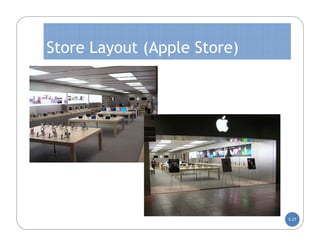
Store Layout (Apple Store)


                             5-27
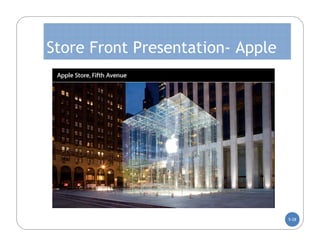
Store Front Presentation- Apple


                                  5-28
Store Planning
•Allocating Space
•Circulation
•Shrinkage Prevention


                        5-29
Store Planning
• Floor Plan is a schematic that shows
  where merchandise and customer
  service departments are located, how
  customers circulate through the store,
  and how much space is dedicated to
  each department.
• Stack-Outs are pallets of merchandise
  set out on the floor in front of the main
  shelves.
                                              5-30
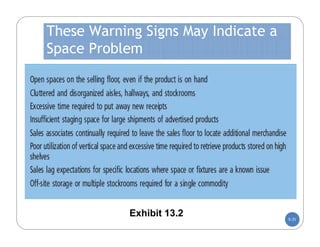
These Warning Signs May Indicate a
Space Problem


            Exhibit 13.2             5-31
Allocating Space
•Types of space needed:
 •Back room
 •Office and other functional spaces
 •Aisles, services areas, and other non-
  selling areas of the main sales floor
 •Wall merchandise space
 •Floor merchandise space

                                           5-32
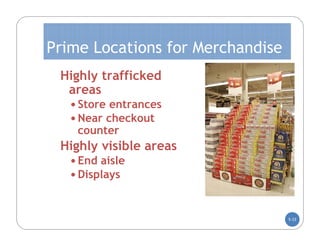
Prime Locations for Merchandise
 Highly trafficked
  areas
    Store entrances
    Near checkout
    counter
 Highly visible areas
    End aisle
    Displays


                                  5-33
Location of Merchandise
Categories
 Impulse merchandise – near heavily
  trafficked areas
 Demand merchandise – back left-hand
  corner of the store
 Special merchandise – lightly trafficked
  areas (glass pieces)
 Adjacencies – complimentary merchandise
  next to each other


                                             5-34
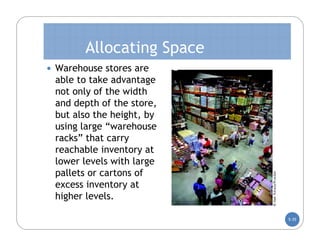
Allocating Space
 Warehouse stores are
 able to take advantage
 not only of the width
 and depth of the store,
 but also the height, by
 using large “warehouse
 racks” that carry
 reachable inventory at
 lower levels with large
 pallets or cartons of
 excess inventory at
 higher levels.

                           5-35
Store Planning
 Space Allocation Planning
 Improving Space Productivity
  in Existing Stores
 Space Allocations for a New
  Store


                                 5-36
Space Allocation Planning
 • Improving Space Productivity in
  Existing Stores
  • When a retailer has been in business for
   some time, it can develop a sales history
   on which to evaluate merchandise
   performance, refine space allocations,
   and enhance space productivity. Various
   quantitative measures, such as the
   space productivity index, can be used to
   develop a more productive space
   allocation.                                 5-37
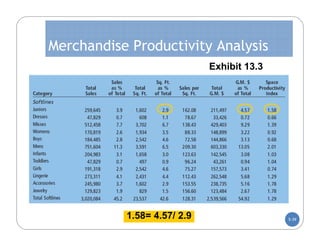
SPI : Space Productivity Index
• Space Productivity Index is a ratio that
 compares the percentage of the store’s
 total gross margin that a particular
 merchandise category generates to its
 percentage of total store selling space
 used.


                                             5-38
Merchandise Productivity Analysis
                             Exhibit 13.3


           1.58= 4.57/ 2.9                  5-39
Space Allocations for a New Store
 When a retailer is creating a new
 store format, it bases space
 allocation on industry standards,
 previous experience with similar
 formats, or more frequently, the
 space required to carry the number
 of items specified by the buyers

                                      5-40
Circulation
Free Flow
Grid
Loop
Spine

                 5-41
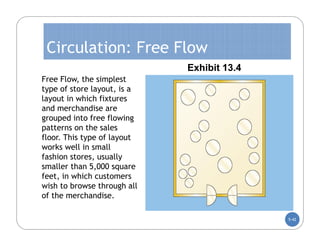
Circulation: Free Flow
                             Exhibit 13.4
Free Flow, the simplest
type of store layout, is a
layout in which fixtures
and merchandise are
grouped into free flowing
patterns on the sales
floor. This type of layout
works well in small
fashion stores, usually
smaller than 5,000 square
feet, in which customers
wish to browse through all
of the merchandise.

                                            5-42
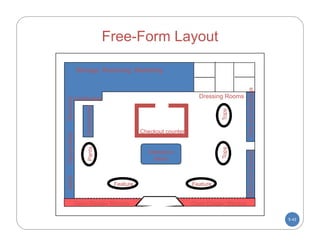
Free-Form Layout

              Storage, Receiving, Marketing


                                                                                    Hats and Handbags
              Underwear                                         Dressing Rooms
Stockings


                  Accessories


                                                                        Tops
                                           Checkout counter
Casual Wear


                    Pants


                                                                        Tops


                                                                                    Skirts and Dresses
                                             Clearance
                                               Items
Jeans


                                 Feature                      Feature


              Open Display Window                             Open Display Window

                                                                                                         5-43
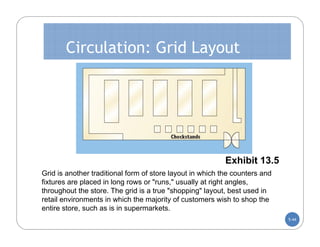
Circulation: Grid Layout


                                                           Exhibit 13.5
Grid is another traditional form of store layout in which the counters and
fixtures are placed in long rows or "runs," usually at right angles,
throughout the store. The grid is a true "shopping" layout, best used in
retail environments in which the majority of customers wish to shop the
entire store, such as is in supermarkets.
                                                                             5-44
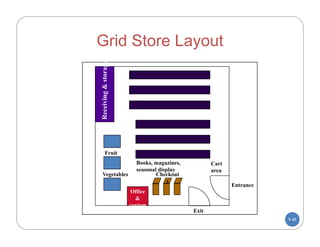
Grid Store Layout


Receiving & storage


        Fruit
                        Books, magazines,          Cart
                        seasonal display           area
 Vegetables                     Checkout
                                    s
                                                          Entrance
                       Office
                        &
                      custom
                        er                  Exit
                      service                                        5-45
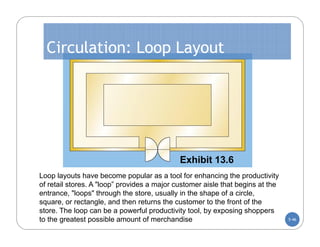
Circulation: Loop Layout


                                             Exhibit 13.6
Loop layouts have become popular as a tool for enhancing the productivity
of retail stores. A "loop” provides a major customer aisle that begins at the
entrance, "loops" through the store, usually in the shape of a circle,
square, or rectangle, and then returns the customer to the front of the
store. The loop can be a powerful productivity tool, by exposing shoppers
to the greatest possible amount of merchandise                                  5-46
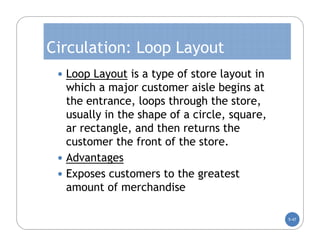
Circulation: Loop Layout
  Loop Layout is a type of store layout in
   which a major customer aisle begins at
   the entrance, loops through the store,
   usually in the shape of a circle, square,
   ar rectangle, and then returns the
   customer the front of the store.
  Advantages
  Exposes customers to the greatest
   amount of merchandise

                                               5-47
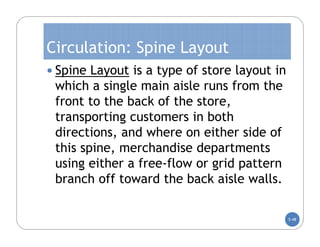
Circulation: Spine Layout
 Spine Layout is a type of store layout in
 which a single main aisle runs from the
 front to the back of the store,
 transporting customers in both
 directions, and where on either side of
 this spine, merchandise departments
 using either a free-flow or grid pattern
 branch off toward the back aisle walls.

                                              5-48
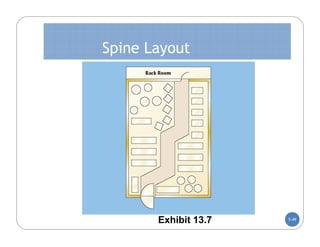
Spine Layout


       Exhibit 13.7   5-49
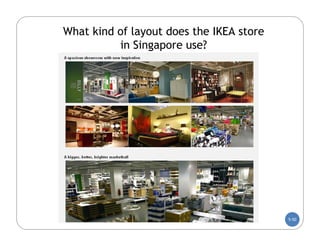
What kind of layout does the IKEA store
          in Singapore use?


                                          5-50
Shrinkage Prevention
 When planning stores, the
  prevention of shrinkage due to
  theft, damage, and loss must
  be considered.
 Some layouts will minimize
  vulnerability to shoplifters by
  increasing the visibility of the
  merchandise                        5-51
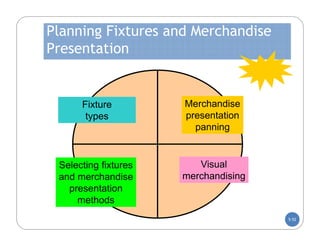
Planning Fixtures and Merchandise
Presentation


      Fixture         Merchandise
       types          presentation
                        panning


 Selecting fixtures      Visual
 and merchandise      merchandising
   presentation
     methods
                                      5-52
Planning Fixtures and Merchandise
Presentation
 On-Shelf Merchandising
 Is the display of merchandise
 on counters, racks, shelves,
 and fixtures throughout the
 store.


                                    5-53
Fixture Types
•Hardlines Fixtures
•Softlines Fixtures
•Wall Fixtures

              These are minor
              topics; just read
              briefly from text
                                  5-54
Fixture Types: Hardlines
 Hardlines Fixtures: The workhorse fixture in
 most hardlines department is known as the
 gondola. The gondola can hold a wide
 variety of merchandise -- in fact, virtually all
 hardlines -- by means of hardware hung from
 the vertical spine. Tables, large bins, and
 flat-base decks are used to display bulk
 quantities of merchandise when the retailer
 wants to make a high-value statement

                                                    5-55
Fixture Types: Softlines
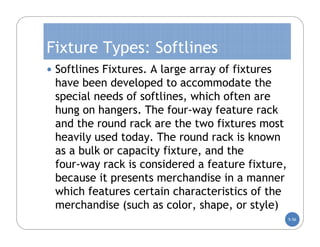
 Softlines Fixtures. A large array of fixtures
 have been developed to accommodate the
 special needs of softlines, which often are
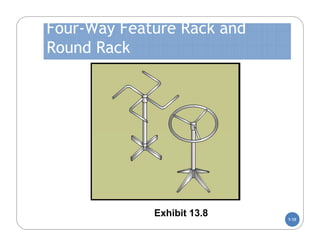
 hung on hangers. The four-way feature rack
 and the round rack are the two fixtures most
 heavily used today. The round rack is known
 as a bulk or capacity fixture, and the
 four-way rack is considered a feature fixture,
 because it presents merchandise in a manner
 which features certain characteristics of the
 merchandise (such as color, shape, or style)
                                                  5-56
Fixture Types: Wall
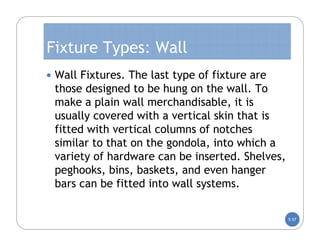
 Wall Fixtures. The last type of fixture are
 those designed to be hung on the wall. To
 make a plain wall merchandisable, it is
 usually covered with a vertical skin that is
 fitted with vertical columns of notches
 similar to that on the gondola, into which a
 variety of hardware can be inserted. Shelves,
 peghooks, bins, baskets, and even hanger
 bars can be fitted into wall systems.

                                                 5-57
Four-Way Feature Rack and
Round Rack


             Exhibit 13.8   5-58
Merchandise Presentation
Planning

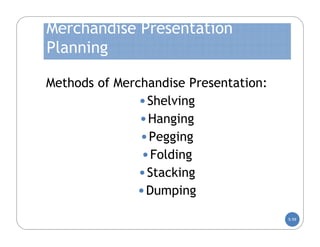
Methods of Merchandise Presentation:
               • Shelving
               • Hanging
               • Pegging
               • Folding
               • Stacking
              • Dumping
                                       5-59
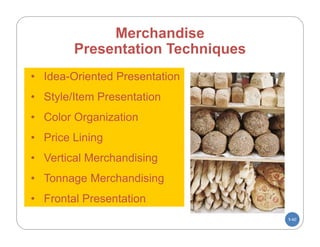
Merchandise
        Presentation Techniques
• Idea-Oriented Presentation
• Style/Item Presentation
• Color Organization
• Price Lining
• Vertical Merchandising
• Tonnage Merchandising
• Frontal Presentation
                                  5-60
Merchandise Presentation
Planning
 Psychological Factors to
 Consider When Merchandising
 Stores:
•Value/fashion image
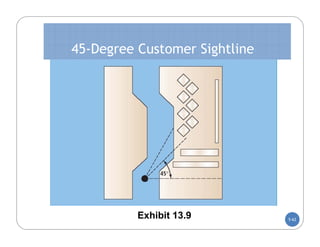
•Angles and sightlines
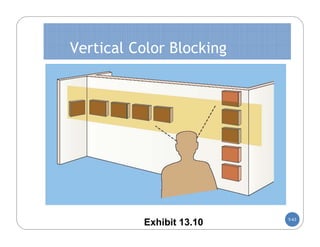
•Vertical color blocking
                               5-61
45-Degree Customer Sightline


          Exhibit 13.9         5-62
Vertical Color Blocking


                          5-63
          Exhibit 13.10
Visual Merchandising
• Visual Merchandising
 Is the artistic display of merchandise
 and theatrical props used as scene-
 setting decoration in the store.
 Berman: Proactive, integrated
 atmospherics approach to create a
 certain look, properly display products,
 stimulate shopping behavior, and
 enhance physical behavior
                                            5-64
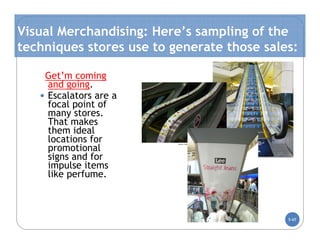
Visual Merchandising: Here’s sampling of the
techniques stores use to generate those sales:

    Get’m coming
     and going.
   • Escalators are a
     focal point of
     many stores.
     That makes
     them ideal
     locations for
     promotional
     signs and for
     impulse items
     like perfume.


                                            5-65
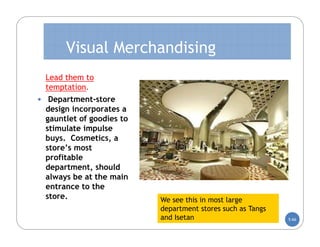
Visual Merchandising
 Lead them to
 temptation.
• Department-store
 design incorporates a
 gauntlet of goodies to
 stimulate impulse
 buys. Cosmetics, a
 store’s most
 profitable
 department, should
 always be at the main
 entrance to the
 store.                   We see this in most large
                          department stores such as Tangs
                          and Isetan                        5-66
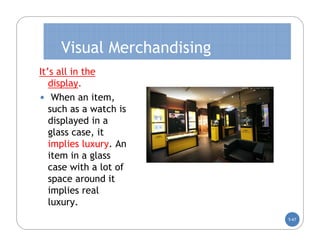
Visual Merchandising
It’s all in the
   display.
• When an item,
   such as a watch is
   displayed in a
   glass case, it
   implies luxury. An
   item in a glass
   case with a lot of
   space around it
   implies real
   luxury.
                            5-67
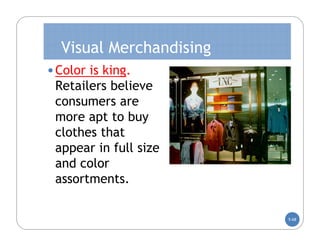
Visual Merchandising
• Color is king.
 Retailers believe
 consumers are
 more apt to buy
 clothes that
 appear in full size
 and color
 assortments.

                         5-68
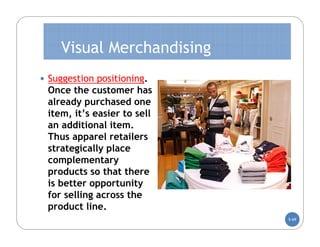
Visual Merchandising
• Suggestion positioning.
 Once the customer has
 already purchased one
 item, it’s easier to sell
 an additional item.
 Thus apparel retailers
 strategically place
 complementary
 products so that there
 is better opportunity
 for selling across the
 product line.
                             5-69
Question to Ponder
•How do fixtures and
 merchandise presentation
 interact to influence consumers
 in different types of retailers?
Do you have you own examples to add?
What about unique or creative
presentations of merchandise that you
have seen in Singapore or in your travels
to other retail cities in Asia?

                                            5-70
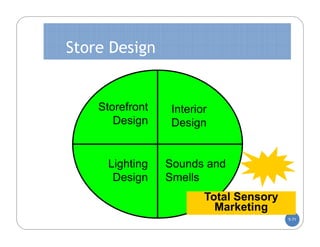
Store Design


    Storefront   Interior
       Design    Design


      Lighting   Sounds and
       Design    Smells
                        Total Sensory
                          Marketing
                                        5-71
Store Design
•Ambience
Is the overall feeling or mood
projected by a store through its
aesthetic appeal to human
senses.
Sometimes known as “store
atmosphere”
                                   5-72
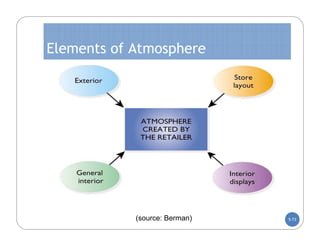
Elements of Atmosphere


            (source: Berman)   5-73
Atmosphere
The psychological feeling a customer
gets when visiting a retailer
  Store retailer: atmosphere refers to
   store’s physical characteristics that
   project an image and draw customers
  Nonstore retailer: atmosphere refers to
   the physical characteristics of catalogs,
   vending machines, Web sites, etc.


                                               5-74
Store Design (the “book analogy”)
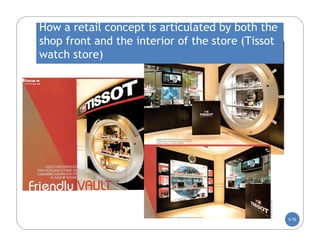
 Storefront Design. If the retail store can be
  compared to a book, then the storefront or store
  exterior is like the book cover. It must be
  noticeable, easily identified by passing motorists
  or mall shoppers, and memorable, and must
  clearly identify the name and general market
  positioning of the store and give some hint as to
  the merchandise inside.
 Interior Design can be broken into architectural
  elements and design finishes, and encompasses
  floor covering, walls, and ceilings.


                                                       5-75
How a retail concept is articulated by both the
shop front and the interior of the store (Tissot
watch store)


                                                   5-76
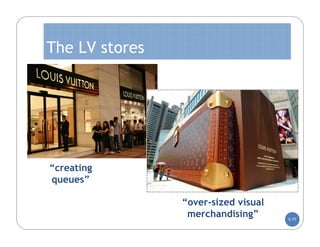
The LV stores


“creating
queues”

                “over-sized visual
                 merchandising”      5-77
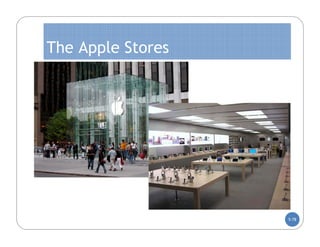
The Apple Stores


                   5-78
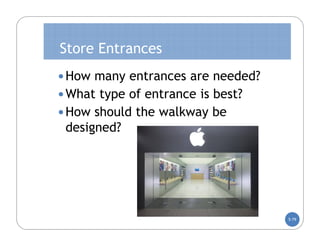
Store Entrances
 How many entrances are needed?
 What type of entrance is best?
 How should the walkway be
 designed?


                                   5-79
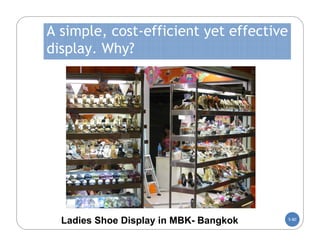
A simple, cost-efficient yet effective
display. Why?


  Ladies Shoe Display in MBK- Bangkok    5-80
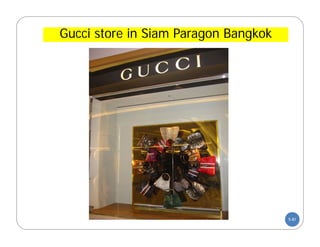
Gucci store in Siam Paragon Bangkok


                                      5-81
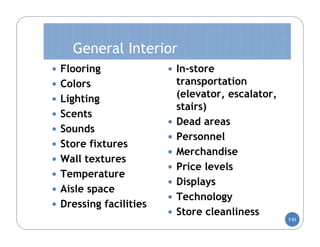
General Interior
 Flooring               In-store
 Colors                    transportation
 Lighting
                            (elevator, escalator,
                            stairs)
 Scents
                           Dead areas
 Sounds
                           Personnel
 Store fixtures
                           Merchandise
 Wall textures
                           Price levels
 Temperature
                           Displays
 Aisle space
                           Technology
 Dressing facilities
                           Store cleanliness
                                                    5-82
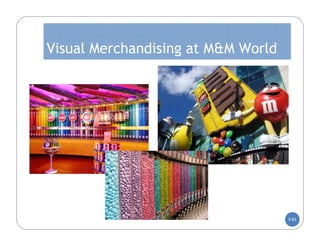
Visual Merchandising at M&M World


                                    5-83
Store Design (cont’d)
 Lighting is one of the most important-
  though often overlooked-elements in a
  successful store design. Retailers learned
  that different types and levels of lighting
  can have a significant impact on sales.
 Sounds and Smells: Total Sensory
  Marketing. Research has shown that senses
  other than sight can be very important,
  too, and many retailers are beginning to
  engineer the sounds and smells in their
  stores
                                                5-84
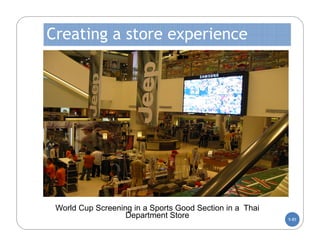
Creating a store experience


 World Cup Screening in a Sports Good Section in a Thai
                   Department Store                       5-85
Visual Communications
•Name, Logo, and Retail Identity
•Institutional Signage
•Directional, Departmental, and
 Category Signage
•Point-of-Sale (POS) Signage
•Lifestyle Graphics
                                   5-86
Directional, Departmental, and
Category Signage
• Directional and Departmental Signage
  are large signs that are usually placed
  fairly high, so they can be seen
  throughout the store.
• Category Signage are smaller than
  directional and departmental signage
  and are intended to be seen from a
  shorter distance; they are located on or
  close to the fixture itself where the
  merchandise is displayed.                  5-87
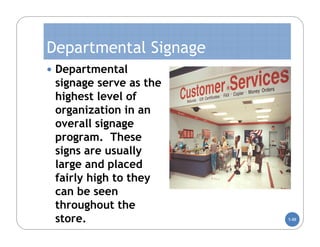
Departmental Signage
 Departmental
 signage serve as the
 highest level of
 organization in an
 overall signage
 program. These
 signs are usually
 large and placed
 fairly high to they
 can be seen
 throughout the
 store.                 5-88
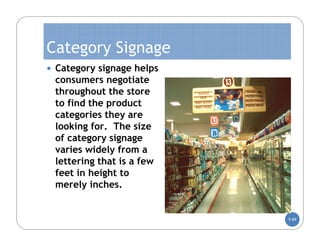
Category Signage
 Category signage helps
 consumers negotiate
 throughout the store
 to find the product
 categories they are
 looking for. The size
 of category signage
 varies widely from a
 lettering that is a few
 feet in height to
 merely inches.


                           5-89
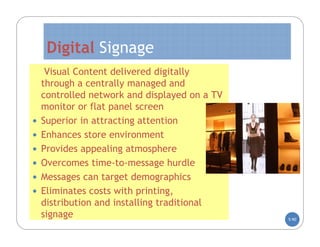
Digital Signage
     Visual Content delivered digitally
    through a centrally managed and
    controlled network and displayed on a TV
    monitor or flat panel screen
   Superior in attracting attention
   Enhances store environment
   Provides appealing atmosphere
   Overcomes time-to-message hurdle
   Messages can target demographics
   Eliminates costs with printing,
    distribution and installing traditional
    signage                                    5-90
Point-of-Sale (POS) Signage
•Point-of-Sale Signage
 Is relatively small signage
 that is placed very close
 to the merchandise and is
 intended to give details
 about specific items.
                               5-91
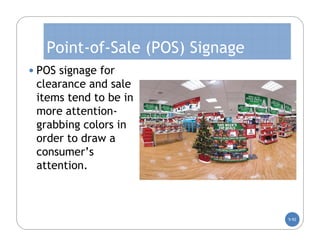
Point-of-Sale (POS) Signage
• POS signage for
 clearance and sale
 items tend to be in
 more attention-
 grabbing colors in
 order to draw a
 consumer’s
 attention.


                                 5-92
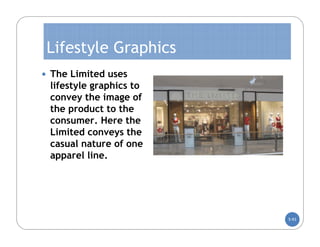
Lifestyle Graphics
 The Limited uses
 lifestyle graphics to
 convey the image of
 the product to the
 consumer. Here the
 Limited conveys the
 casual nature of one
 apparel line.


                         5-93
Summary: Usage of Signage and
 Graphics
1.   Locational – identifies location of
     merchandise and guides customers
2.   Category Signage – identifies types of
     products and located near the goods
3.   Promotional Signage – relates to specific
     offers – sometimes in windows
4.   Point of sale – near merchandise with prices
     and product information
5.   Lifestyle images – creates moods that
     encourage customers to shop
                                                    5-94
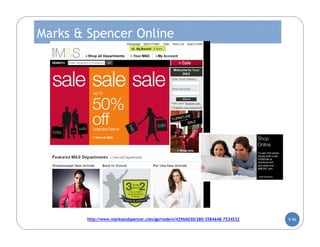
What happens if your store front
is in digital space?
    Retail marketing on the web
    The home page becomes your
            “store front”

                                   5-95
Marks & Spencer Online


        http://www.marksandspencer.com/gp/node/n/42966030/280-3584648-7534532   5-96
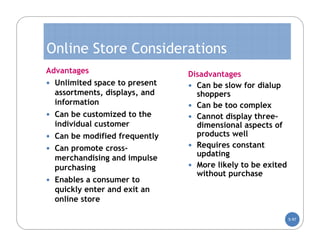
Online Store Considerations
Advantages                     Disadvantages
 Unlimited space to present    Can be slow for dialup
  assortments, displays, and     shoppers
  information                   Can be too complex
 Can be customized to the      Cannot display three-
  individual customer            dimensional aspects of
 Can be modified frequently     products well
 Can promote cross-            Requires constant
                                 updating
  merchandising and impulse
  purchasing                    More likely to be exited
                                 without purchase
 Enables a consumer to
  quickly enter and exit an
  online store

                                                            5-97
Past Year Examination Questions

 Chapter Thirteen: Store Layout
          and Design


                              5-98
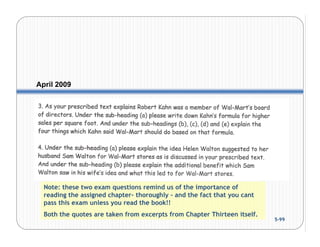
April 2009


  Note: these two exam questions remind us of the importance of
  reading the assigned chapter- thoroughly – and the fact that you cant
  pass this exam unless you read the book!!
  Both the quotes are taken from excerpts from Chapter Thirteen itself.
                                                                          5-99

DC Lecture Five :Store Layout and Design

  • 1.
  • 2.
    Distribution Channels MKTG1058 LECTURE FIVE Store Layout and Design (Dunne Chapter Thirteen) 5-2 2
  • 3.
    Learning Objectives ofChapter 13 •List the elements of a store’s environment and define its two primary objectives. •Discuss the steps involved in planning the store. 5-3
  • 4.
    Learning Objectives ofChapter 13 • Describe how various types of fixtures, merchandise presentation methods and techniques, and the psychology of merchandise presentation are used to increase the productivity of the sales floor. • Describe why store design is so important to a store’s success. • Explain the role of visual communications in a retail store. 5-4
  • 5.
    In Seconds…  Ashopper should be able to determine a store’s  Name  Line of trade These are tests of  Claim to fame how effective a store’s image is  Price position  Personality 5-5
  • 6.
    “ a storeis much more than a place where merchandise is presented and sold” If you were looking for merchandise in for outward bound adventure, wouldn’t like to shop in a store such as this? 5-6
  • 7.
    Store Design Objectives Implement retailer’s strategy  Influence customer buying behavior  Control design and maintenance costs  Provide flexibility  Meet legal requirements 5-7
  • 8.
    Impact on CustomerBehavior  Attract customers to store  Enable them to easily locate merchandise  Keep them in the store for a long time  Motivate them to make unplanned purchases  Provide them with a satisfying shopping experience 5-8
  • 9.
    An example ofan attention-getting retail design (Bangkok Airport) 5-9
  • 10.
    Tradeoff in StoreDesign Ease of locating merchandise for planned purchases Exploration of store, impulse purchases 5-10
  • 11.
    Importance of theStore Image  In an economy of time-poverty, this is particularly important when customers enter the store with a negative attitude/emotion because they have other things they would rather be doing.  In fact, no other variable in the retailing mix influences the consumer's initial perception of a brick & mortar retailer as much as the retailer's store itself. 5-11
  • 12.
    Introduction to StoreLayout Management • Store Image is the overall perception the customer has of the store’s environment. • Space Productivity represents how effectively the retailer utilizes its space and is usually measured by sales per square foot of selling space or gross margin dollars per square foot of selling space. 5-12
  • 13.
    The importance ofstore image  Linked to the differentiation and positioning of the retail store  “Perception is reality”  Retailer leverages on store image to create perceived differentiation away from rival retailers  Customers visit the store to share experiences and not just buy merchandise 5-13
  • 14.
    Introduction to StoreLayout Management •Elements of the Store Environment •Objectives of the Store Environment 5-14
  • 15.
    Introduction to StoreLayout Management  Store image: Is the overall perception the consumer has of the store’s environment. 5-15
  • 16.
    Introduction to StoreLayout Management  Space productivity: Represents how effectively the retailer utilizes its space and is usually measured by sales per square foot of selling space or gross margin dollars per square foot of selling space. LO 1 5-16
  • 17.
    Elements That Composethe Store Environment 5-17 Exhibit 13.1
  • 18.
    Objectives of theStore Environment • Tasks to create desired store image and increase space productivity: • Get customers into the store (market image). • Convert them into customers buying merchandise once inside the store (space productivity). • Do this in the most efficient manner possible. 5-18
  • 19.
    Store Image (whathappens when you don’t have a physical store- catalogue retailing)  L.L. Bean offers relaxed, classic apparel styles to its customers. To help convey this image, L.L. Bean’s catalog and advertising reinforces their image. For catalog customers, the catalog is the store environment. 5-19
  • 20.
    Store Image • Byincorporating a café as an integral part of Borders bookstores, a very relaxing and casual ambiance is created. 5-20
  • 21.
    Store Image  Byincorporating a café as an integral part of Borders bookstores, a very relaxing and casual ambiance is created. 5-21
  • 22.
    Developing a StoreImage  The ability to create and change store image through the store environment-becomes more important every day for a retailer's survival. Two key words- create and change Implications? 5-22
  • 23.
    Elements of RetailImage (source: Berman) 5-23
  • 24.
    Retailing Truism •The moremerchandise customers are exposed to, the more they tend to buy. To what extent do you agree with this statement? Are there other factors to consider? Is there a direct correlation between merchandise quantity and assortment and actual purchase propensity? 5-24
  • 25.
    Increasing Space Productivity: The more merchandise customers are exposed to, the more they tend to buy.  Many retailers are focusing more attention on in-store marketing, based on the theory that it is easier to get a consumer who is already in a store to buy more merchandise than planned, than to get a new consumer to get in the car and make a trip to a store. 5-25
  • 26.
    Space Productivity  Toenhance space productivity, retailers must incorporate planning, merchandising, and design strategies that minimize shrinkage (the loss of merchandise through theft, loss, and damage). 5-26
  • 27.
  • 28.
  • 29.
  • 30.
    Store Planning • FloorPlan is a schematic that shows where merchandise and customer service departments are located, how customers circulate through the store, and how much space is dedicated to each department. • Stack-Outs are pallets of merchandise set out on the floor in front of the main shelves. 5-30
  • 31.
    These Warning SignsMay Indicate a Space Problem Exhibit 13.2 5-31
  • 32.
    Allocating Space •Types ofspace needed: •Back room •Office and other functional spaces •Aisles, services areas, and other non- selling areas of the main sales floor •Wall merchandise space •Floor merchandise space 5-32
  • 33.
    Prime Locations forMerchandise Highly trafficked areas  Store entrances  Near checkout counter Highly visible areas  End aisle  Displays 5-33
  • 34.
    Location of Merchandise Categories Impulse merchandise – near heavily trafficked areas  Demand merchandise – back left-hand corner of the store  Special merchandise – lightly trafficked areas (glass pieces)  Adjacencies – complimentary merchandise next to each other 5-34
  • 35.
    Allocating Space  Warehousestores are able to take advantage not only of the width and depth of the store, but also the height, by using large “warehouse racks” that carry reachable inventory at lower levels with large pallets or cartons of excess inventory at higher levels. 5-35
  • 36.
    Store Planning  SpaceAllocation Planning Improving Space Productivity in Existing Stores Space Allocations for a New Store 5-36
  • 37.
    Space Allocation Planning • Improving Space Productivity in Existing Stores • When a retailer has been in business for some time, it can develop a sales history on which to evaluate merchandise performance, refine space allocations, and enhance space productivity. Various quantitative measures, such as the space productivity index, can be used to develop a more productive space allocation. 5-37
  • 38.
    SPI : SpaceProductivity Index • Space Productivity Index is a ratio that compares the percentage of the store’s total gross margin that a particular merchandise category generates to its percentage of total store selling space used. 5-38
  • 39.
    Merchandise Productivity Analysis Exhibit 13.3 1.58= 4.57/ 2.9 5-39
  • 40.
    Space Allocations fora New Store  When a retailer is creating a new store format, it bases space allocation on industry standards, previous experience with similar formats, or more frequently, the space required to carry the number of items specified by the buyers 5-40
  • 41.
  • 42.
    Circulation: Free Flow Exhibit 13.4 Free Flow, the simplest type of store layout, is a layout in which fixtures and merchandise are grouped into free flowing patterns on the sales floor. This type of layout works well in small fashion stores, usually smaller than 5,000 square feet, in which customers wish to browse through all of the merchandise. 5-42
  • 43.
    Free-Form Layout Storage, Receiving, Marketing Hats and Handbags Underwear Dressing Rooms Stockings Accessories Tops Checkout counter Casual Wear Pants Tops Skirts and Dresses Clearance Items Jeans Feature Feature Open Display Window Open Display Window 5-43
  • 44.
    Circulation: Grid Layout Exhibit 13.5 Grid is another traditional form of store layout in which the counters and fixtures are placed in long rows or "runs," usually at right angles, throughout the store. The grid is a true "shopping" layout, best used in retail environments in which the majority of customers wish to shop the entire store, such as is in supermarkets. 5-44
  • 45.
    Grid Store Layout Receiving& storage Fruit Books, magazines, Cart seasonal display area Vegetables Checkout s Entrance Office & custom er Exit service 5-45
  • 46.
    Circulation: Loop Layout Exhibit 13.6 Loop layouts have become popular as a tool for enhancing the productivity of retail stores. A "loop” provides a major customer aisle that begins at the entrance, "loops" through the store, usually in the shape of a circle, square, or rectangle, and then returns the customer to the front of the store. The loop can be a powerful productivity tool, by exposing shoppers to the greatest possible amount of merchandise 5-46
  • 47.
    Circulation: Loop Layout  Loop Layout is a type of store layout in which a major customer aisle begins at the entrance, loops through the store, usually in the shape of a circle, square, ar rectangle, and then returns the customer the front of the store.  Advantages  Exposes customers to the greatest amount of merchandise 5-47
  • 48.
    Circulation: Spine Layout Spine Layout is a type of store layout in which a single main aisle runs from the front to the back of the store, transporting customers in both directions, and where on either side of this spine, merchandise departments using either a free-flow or grid pattern branch off toward the back aisle walls. 5-48
  • 49.
    Spine Layout Exhibit 13.7 5-49
  • 50.
    What kind oflayout does the IKEA store in Singapore use? 5-50
  • 51.
    Shrinkage Prevention  Whenplanning stores, the prevention of shrinkage due to theft, damage, and loss must be considered.  Some layouts will minimize vulnerability to shoplifters by increasing the visibility of the merchandise 5-51
  • 52.
    Planning Fixtures andMerchandise Presentation Fixture Merchandise types presentation panning Selecting fixtures Visual and merchandise merchandising presentation methods 5-52
  • 53.
    Planning Fixtures andMerchandise Presentation  On-Shelf Merchandising Is the display of merchandise on counters, racks, shelves, and fixtures throughout the store. 5-53
  • 54.
    Fixture Types •Hardlines Fixtures •SoftlinesFixtures •Wall Fixtures These are minor topics; just read briefly from text 5-54
  • 55.
    Fixture Types: Hardlines Hardlines Fixtures: The workhorse fixture in most hardlines department is known as the gondola. The gondola can hold a wide variety of merchandise -- in fact, virtually all hardlines -- by means of hardware hung from the vertical spine. Tables, large bins, and flat-base decks are used to display bulk quantities of merchandise when the retailer wants to make a high-value statement 5-55
  • 56.
    Fixture Types: Softlines Softlines Fixtures. A large array of fixtures have been developed to accommodate the special needs of softlines, which often are hung on hangers. The four-way feature rack and the round rack are the two fixtures most heavily used today. The round rack is known as a bulk or capacity fixture, and the four-way rack is considered a feature fixture, because it presents merchandise in a manner which features certain characteristics of the merchandise (such as color, shape, or style) 5-56
  • 57.
    Fixture Types: Wall Wall Fixtures. The last type of fixture are those designed to be hung on the wall. To make a plain wall merchandisable, it is usually covered with a vertical skin that is fitted with vertical columns of notches similar to that on the gondola, into which a variety of hardware can be inserted. Shelves, peghooks, bins, baskets, and even hanger bars can be fitted into wall systems. 5-57
  • 58.
    Four-Way Feature Rackand Round Rack Exhibit 13.8 5-58
  • 59.
    Merchandise Presentation Planning Methods ofMerchandise Presentation: • Shelving • Hanging • Pegging • Folding • Stacking • Dumping 5-59
  • 60.
    Merchandise Presentation Techniques • Idea-Oriented Presentation • Style/Item Presentation • Color Organization • Price Lining • Vertical Merchandising • Tonnage Merchandising • Frontal Presentation 5-60
  • 61.
    Merchandise Presentation Planning PsychologicalFactors to Consider When Merchandising Stores: •Value/fashion image •Angles and sightlines •Vertical color blocking 5-61
  • 62.
  • 63.
    Vertical Color Blocking 5-63 Exhibit 13.10
  • 64.
    Visual Merchandising • VisualMerchandising Is the artistic display of merchandise and theatrical props used as scene- setting decoration in the store. Berman: Proactive, integrated atmospherics approach to create a certain look, properly display products, stimulate shopping behavior, and enhance physical behavior 5-64
  • 65.
    Visual Merchandising: Here’ssampling of the techniques stores use to generate those sales: Get’m coming and going. • Escalators are a focal point of many stores. That makes them ideal locations for promotional signs and for impulse items like perfume. 5-65
  • 66.
    Visual Merchandising Leadthem to temptation. • Department-store design incorporates a gauntlet of goodies to stimulate impulse buys. Cosmetics, a store’s most profitable department, should always be at the main entrance to the store. We see this in most large department stores such as Tangs and Isetan 5-66
  • 67.
    Visual Merchandising It’s allin the display. • When an item, such as a watch is displayed in a glass case, it implies luxury. An item in a glass case with a lot of space around it implies real luxury. 5-67
  • 68.
    Visual Merchandising • Coloris king. Retailers believe consumers are more apt to buy clothes that appear in full size and color assortments. 5-68
  • 69.
    Visual Merchandising • Suggestionpositioning. Once the customer has already purchased one item, it’s easier to sell an additional item. Thus apparel retailers strategically place complementary products so that there is better opportunity for selling across the product line. 5-69
  • 70.
    Question to Ponder •Howdo fixtures and merchandise presentation interact to influence consumers in different types of retailers? Do you have you own examples to add? What about unique or creative presentations of merchandise that you have seen in Singapore or in your travels to other retail cities in Asia? 5-70
  • 71.
    Store Design Storefront Interior Design Design Lighting Sounds and Design Smells Total Sensory Marketing 5-71
  • 72.
    Store Design •Ambience Is theoverall feeling or mood projected by a store through its aesthetic appeal to human senses. Sometimes known as “store atmosphere” 5-72
  • 73.
    Elements of Atmosphere (source: Berman) 5-73
  • 74.
    Atmosphere The psychological feelinga customer gets when visiting a retailer  Store retailer: atmosphere refers to store’s physical characteristics that project an image and draw customers  Nonstore retailer: atmosphere refers to the physical characteristics of catalogs, vending machines, Web sites, etc. 5-74
  • 75.
    Store Design (the“book analogy”)  Storefront Design. If the retail store can be compared to a book, then the storefront or store exterior is like the book cover. It must be noticeable, easily identified by passing motorists or mall shoppers, and memorable, and must clearly identify the name and general market positioning of the store and give some hint as to the merchandise inside.  Interior Design can be broken into architectural elements and design finishes, and encompasses floor covering, walls, and ceilings. 5-75
  • 76.
    How a retailconcept is articulated by both the shop front and the interior of the store (Tissot watch store) 5-76
  • 77.
    The LV stores “creating queues” “over-sized visual merchandising” 5-77
  • 78.
  • 79.
    Store Entrances  Howmany entrances are needed?  What type of entrance is best?  How should the walkway be designed? 5-79
  • 80.
    A simple, cost-efficientyet effective display. Why? Ladies Shoe Display in MBK- Bangkok 5-80
  • 81.
    Gucci store inSiam Paragon Bangkok 5-81
  • 82.
    General Interior  Flooring  In-store  Colors transportation  Lighting (elevator, escalator, stairs)  Scents  Dead areas  Sounds  Personnel  Store fixtures  Merchandise  Wall textures  Price levels  Temperature  Displays  Aisle space  Technology  Dressing facilities  Store cleanliness 5-82
  • 83.
  • 84.
    Store Design (cont’d) Lighting is one of the most important- though often overlooked-elements in a successful store design. Retailers learned that different types and levels of lighting can have a significant impact on sales.  Sounds and Smells: Total Sensory Marketing. Research has shown that senses other than sight can be very important, too, and many retailers are beginning to engineer the sounds and smells in their stores 5-84
  • 85.
    Creating a storeexperience World Cup Screening in a Sports Good Section in a Thai Department Store 5-85
  • 86.
    Visual Communications •Name, Logo,and Retail Identity •Institutional Signage •Directional, Departmental, and Category Signage •Point-of-Sale (POS) Signage •Lifestyle Graphics 5-86
  • 87.
    Directional, Departmental, and CategorySignage • Directional and Departmental Signage are large signs that are usually placed fairly high, so they can be seen throughout the store. • Category Signage are smaller than directional and departmental signage and are intended to be seen from a shorter distance; they are located on or close to the fixture itself where the merchandise is displayed. 5-87
  • 88.
    Departmental Signage  Departmental signage serve as the highest level of organization in an overall signage program. These signs are usually large and placed fairly high to they can be seen throughout the store. 5-88
  • 89.
    Category Signage  Categorysignage helps consumers negotiate throughout the store to find the product categories they are looking for. The size of category signage varies widely from a lettering that is a few feet in height to merely inches. 5-89
  • 90.
    Digital Signage Visual Content delivered digitally through a centrally managed and controlled network and displayed on a TV monitor or flat panel screen  Superior in attracting attention  Enhances store environment  Provides appealing atmosphere  Overcomes time-to-message hurdle  Messages can target demographics  Eliminates costs with printing, distribution and installing traditional signage 5-90
  • 91.
    Point-of-Sale (POS) Signage •Point-of-SaleSignage Is relatively small signage that is placed very close to the merchandise and is intended to give details about specific items. 5-91
  • 92.
    Point-of-Sale (POS) Signage •POS signage for clearance and sale items tend to be in more attention- grabbing colors in order to draw a consumer’s attention. 5-92
  • 93.
    Lifestyle Graphics  TheLimited uses lifestyle graphics to convey the image of the product to the consumer. Here the Limited conveys the casual nature of one apparel line. 5-93
  • 94.
    Summary: Usage ofSignage and Graphics 1. Locational – identifies location of merchandise and guides customers 2. Category Signage – identifies types of products and located near the goods 3. Promotional Signage – relates to specific offers – sometimes in windows 4. Point of sale – near merchandise with prices and product information 5. Lifestyle images – creates moods that encourage customers to shop 5-94
  • 95.
    What happens ifyour store front is in digital space? Retail marketing on the web The home page becomes your “store front” 5-95
  • 96.
    Marks & SpencerOnline http://www.marksandspencer.com/gp/node/n/42966030/280-3584648-7534532 5-96
  • 97.
    Online Store Considerations Advantages Disadvantages  Unlimited space to present  Can be slow for dialup assortments, displays, and shoppers information  Can be too complex  Can be customized to the  Cannot display three- individual customer dimensional aspects of  Can be modified frequently products well  Can promote cross-  Requires constant updating merchandising and impulse purchasing  More likely to be exited without purchase  Enables a consumer to quickly enter and exit an online store 5-97
  • 98.
    Past Year ExaminationQuestions Chapter Thirteen: Store Layout and Design 5-98
  • 99.
    April 2009 Note: these two exam questions remind us of the importance of reading the assigned chapter- thoroughly – and the fact that you cant pass this exam unless you read the book!! Both the quotes are taken from excerpts from Chapter Thirteen itself. 5-99