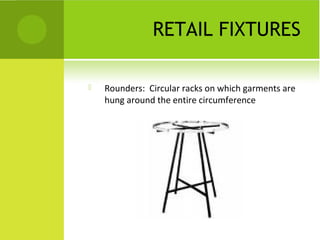
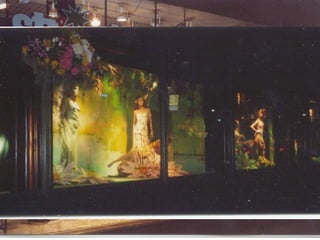
This document discusses visual merchandising and display techniques for retail stores. It covers store layouts like grid and maze formats. Fixtures include carousels, dump bins, racks and waterfalls for merchandise presentation. Displays should use lighting, props and signage to attract customers. Window displays are the first impression for those outside and come in various formats like enclosed, ramped or elevated windows. Interior displays are located at entrances, ends of aisles and near cash registers.
VISUAL MERCHANDISING
VisualMerchandising: The physical
display of goods in the most attractive
and appealing ways.
Store Layout: the interior arrangement of
retail facilities.
Selling areas: where merchandise is
displayed and customers interact with sales
personnel. (75-80% of the total space)
Sales support areas: devoted to customer
services, merchandise receiving and
distribution, management offices and staff
activities.
3.
VISUAL MERCHANDISING
FloorPlan: A drawing showing arrangement
of physical space, such as showing the
positioning of merchandise groups and
customer services for a retail store.
Grid Layout: A retail floor plan that has one
of ore primary (main) aisles running through
the store, with secondary (smaller) aisles
intersecting with them at right angles.
Maze Layout: A free-flowing retail floor plan
arrangement with informal balance.
Fixtures: Shelves, tables, rods, counters,
stands, easels, forms, and platforms on
which merchandise is stocked and displayed
for sale.
4.
MERCHANDISE
PRESENTATION
Merchandise presentationincludes the ways that
goods are hung, placed on shelves, or otherwise
made available for sale in retail stores.
Shoulder-out presentation: The way most
garments are hung in home closets with only one
side showing from shoulder to bottom.
Face-forward presentation (face-out
presentation): Hanging of clothing with the front
fully facing the viewer. This should always be
done at entrances and aisles.
RETAIL FIXTURES
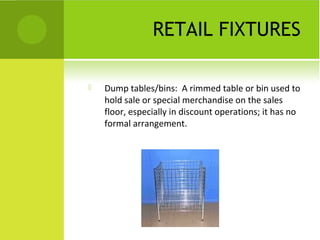
Dumptables/bins: A rimmed table or bin used to
hold sale or special merchandise on the sales
floor, especially in discount operations; it has no
formal arrangement.
7.
RETAIL FIXTURES
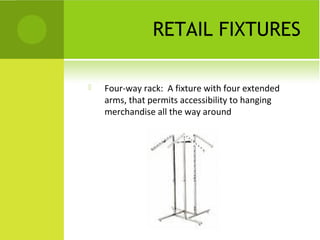
Four-wayrack: A fixture with four extended
arms, that permits accessibility to hanging
merchandise all the way around
RETAIL FIXTURES
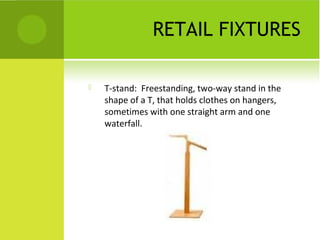
T-stand:Freestanding, two-way stand in the
shape of a T, that holds clothes on hangers,
sometimes with one straight arm and one
waterfall.
10.
RETAIL FIXTURES
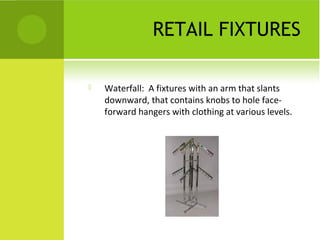
Waterfall:A fixtures with an arm that slants
downward, that contains knobs to hole face-
forward hangers with clothing at various levels.
11.
DISPLAYS
Displays: individualand notable physical presentation
of merchandise.
Displays are intended to:
Stimulate product interest
Provide information
Suggest merchandise coordination
Generate traffic flow
Remind customers of planned purchases
Create additional sales of impulse items
Enhance the store’s visual image
12.
INTERIOR DISPLAYS
Locationsfor interior displays:
Just in the entrance
Entrance to department
Near cash/wrap
Next to related items
Across from elevators and escalators
Ends of aisles
MERCHANDISE
More interestingif in odd numbers
Groups:
One-category, or line-of-goods
Related groupings: go together or reinforce each
other
Theme groupings: event, holiday, etc.
Variety or assortment groupings: collection of
unrelated items all sold at the same store.
15.
LIGHTING
Used todirect customer’s attention to the
display
Use more light for dark colors, less light for light
colors
Beamspread; the diameter of the circle of light
Beamspread techniques:
Floodlighting: recessed ceiling lights to direct light
over an entire wide display area
Spotlighting: focuses attention on specific areas or
targeted items of merchandise
Pinpointing: focuses a narrow beam of light on a
specific item
17.
PROPS
Objects addedthat support the theme of the
display.
Functional Props: used to physically support the
merchandise. (mannequins, stands, panels,
screens, etc)
Decorative Props: used to establish a mood or an
attractive setting for the merchandise being
featured (ex: mirrors, flowers, seashells,
surfboards, etc)
Structural Props: used to support functional and
decorative props and change the physical
makeup of displays. (boxes, rods, stands,
stairways, etc)
19.
SIGNAGE
Includes individualletters and complete
signs. Often on some kind of holder.
Can tell a story about the goods.
Should try to answer customers
questions.
Should be informative and concise.
Can include prices, sizes, department
location.
20.
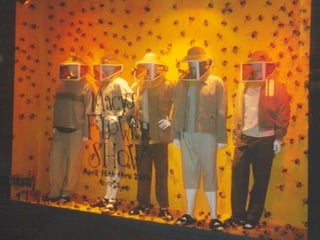
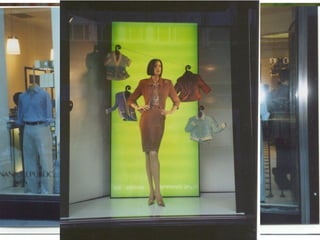
WINDOW DISPLAYS
Seenfrom outside of the store.
First contact with the customer.
Can have a series of windows.
Advantages of Window Displays:
Establish and maintain an image
Arouse curiosity
Disadvantages of Window Displays:
Expensive to design and maintain
Requires space
Merchandise can get ruined (sun ,etc)
Glare
21.
TYPES OF WINDOWDISPLAYS
Enclosed windows: have a full
background and sides that completely
separate the interior of the store from
the display window.
Ramped windows: floor is higher in back
than in front
Elevated windows: from 1 to 3 feet higher
than sidewalk
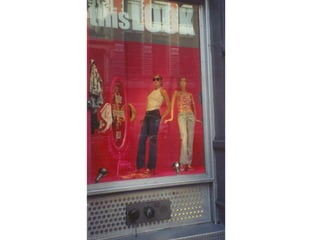
Shadowbox windows: small, boxlike display
windows
23.
TYPES OF WINDOWDISPLAYS
Semi-closed windows: have a partial
background that shuts out some of the
store interior from those viewing the
window
Open Windows: have no background
panel and the entire store is visible to
people walking by
Island windows: four-sided display
windows that stand alone, often in
lobbies.